
Test 9 of 25 · 20 questions · Free 2026
MA Permit Practice Test 9
Jump to the test ↓A fixed 20 question set from the Massachusetts bank with answers and plain English explanations. The real MA exam is 25 questions, 72 percent to pass; take the full length version on the main practice page.
Question 1 of 20 · 0 right so far
All 20 questions in test 9
Every question below comes from the Massachusetts question bank on this page. Open a question to see the correct answer and the explanation. Nothing here is hidden behind a signup.
1. According to the Massachusetts manual, what do roundabouts reduce the need for?
- Changing lanes
- Yielding to pedestrians
- Using turn signals
- Slowing down
Show answer
Changing lanes. Roundabouts are designed so you choose your lane before entering, based on the signs on the approach, and then stay in it until your exit. That is why the manual says they reduce the need to change lanes. Turn signals are still used to show your exit, pedestrians at the crossings still have the right of way, and you still slow on the approach. Pick the lane the sign gives for your exit, yield to circulating traffic, and hold that lane through the circle.
Study this in the handbook: Turns, right of way and rotaries
2. What does Massachusetts charge for the learner's permit exam and the road test?
- Both are free
- $30 for the permit exam and $35 for the road test
- $100 each
- $10 for both together
Show answer
$30 for the permit exam and $35 for the road test. The learner's permit exam fee is $30, covering application processing and the exam, and it is charged again if you fail or the permit expires. The road test fee is $35, a flat fee for any license application, and the Class D or Class M license issue or renewal fee is $50. A duplicate or amended license costs $25, and all fees are subject to change.
Study this in the handbook: The road test
3. Where does the Massachusetts manual tell drivers to be especially careful because children may be present?
- On limited access highways
- Near school zones, parks, bus stops, and playgrounds
- In tunnels
- At toll plazas
Show answer
Near school zones, parks, bus stops, and playgrounds. Children appear where children gather. Under the heading Be Extra Careful of Children, the manual says children are unpredictable and hard to see, and it names school zones, parks, bus stops and playgrounds as the places to be careful. Highways, tunnels and toll plazas have their own hazards, but the manual does not single them out for children. Slow down in these areas, scan the sidewalks and the spaces between parked cars, and be ready to stop, because a child may move into the road with little warning.
Study this in the handbook: Pedestrians, bicyclists, motorcycles and mopeds
4. How high can the fine for tailgating be in Massachusetts?
- There is no fine
- $25
- $500
- As high as $100
Show answer
As high as $100. The fine for tailgating can be as high as $100, and the manual calls tailgating illegal and the main cause of rear end crashes. The reason is stopping distance: at 50 mph you travel about 55 feet while reacting, and once you hit the brakes you may go another 160 feet or more, for a total of about 215 feet on dry, level pavement. Keep at least a three second following distance, and if a tailgater is behind you, move to another lane or pull to the side of the road to let the tailgater pass.
Study this in the handbook: Seat belts, child seats and safe following distance
5. Your car breaks down on a Massachusetts road. What color cloth should you tie to the antenna or door handle when it is snowing?
- Red
- White
- Orange
- Yellow
Show answer
Red. A cloth on the antenna or door handle signals to passing drivers that the vehicle is disabled. Massachusetts says to use a white cloth, but to switch to a red cloth when it is snowing, because a white cloth disappears against falling snow and a snowy background. Orange and yellow are not the colors the manual names. Along with the cloth, raise the hood, turn on your hazard lights, and put on a safety vest before you get out.
Study this in the handbook: Emergency vehicles, skids, brake failure and breakdowns
6. Besides being found at fault under the standards of fault, what payment makes a Massachusetts crash a surchargeable at-fault crash?
- Any payment at all
- The insurer pays more than $1000 for the damage or injury
- More than $100
- More than $5,000
Show answer
The insurer pays more than $1000 for the damage or injury. A driver is treated as more than 50 percent at fault when the insurance company finds fault under one of the standards of fault and has paid more than $1000 for collision, property damage, or bodily injury. Rear-end and wrong side of the road crashes are examples of those standards. Any payment, or $100, sets the bar too low, and $5,000 sets it too high. At-fault crashes count toward suspension like violations do.
Study this in the handbook: Citations, surchargeable events and suspensions
7. How close to a fire hydrant or fire lane may you park in Massachusetts?
- No closer than 5 feet
- No closer than 15 feet
- No closer than ten feet
- No closer than 20 feet
Show answer
No closer than ten feet. Massachusetts prohibits parking within ten feet of a fire hydrant or fire lane. Fifteen feet is a tempting guess, but it is not the Massachusetts hydrant distance. Twenty feet is the Massachusetts distance from an intersection, and five feet is too close. The same list bars parking in a crosswalk, in front of a driveway, and facing the wrong way.
Study this in the handbook: Parking rules and hills
8. An aggressive driver confronts you on a Massachusetts road. What does the manual advise?
- Make eye contact and gesture back
- Attempt to get out of their way and do not challenge that person
- Brake to block them
- Follow them to get their plate
Show answer
Attempt to get out of their way and do not challenge that person. The advice is to defuse, not compete: get out of the way, do not challenge the driver, avoid eye contact, ignore rude gestures and keep your safety belt on. Staring, gesturing or blocking escalates a confrontation with someone who has already shown poor judgment, and following them puts you in a chase. If it becomes an emergency, call the State Police at 911 and let them handle it. Control your own anger so the situation does not get worse.
Study this in the handbook: Passing, school buses and the move over law
9. How high can the reinstatement fee be for a Massachusetts suspension caused by a serious offense?
- As high as $1,200
- $25
- $100
- There is no fee
Show answer
As high as $1,200. You must pay a fee to reinstate a suspended or revoked license. Most fees are $100, but fees for suspensions caused by serious offenses may be as high as $1,200. For license suspensions of two years or more, you must also pass a learner's permit exam and road test to reinstate. A junior operator suspended for violating the passenger or night restriction pays $100 to reinstate, while a junior operator convicted of drag racing pays $500 for a first offense and $1,000 for a later one, along with a new permit exam and a Driver Attitudinal Retraining course. All fees are subject to change.
Study this in the handbook: Citations, surchargeable events and suspensions
10. A Massachusetts 19-year-old is caught carrying alcohol without a parent or guardian. What license suspension can follow?
- 90 days to one year
- No suspension, only a fine
- Exactly 30 days
- Five years
Show answer
90 days to one year. Anyone under 21 who buys alcohol, has someone buy it for them, or possesses, carries or transports it without a parent or guardian faces a license suspension of 90 days to one year, and there are also fines and other penalties. A fine alone understates the law, and 30 days and five years are not the stated range. Buying or trying to buy alcohol while under 21 carries its own 180 day suspension. The manual adds that drivers under 21 are twice as likely as other drivers to be involved in alcohol related crashes, one reason the laws are stronger for them.
Study this in the handbook: Operating under the influence and chemical tests
11. What is the one situation in which a Massachusetts driver may cross two solid yellow center lines?
- When passing a slow vehicle
- When the road is empty
- When turning left
- When driving a motorcycle
Show answer
When turning left. Double yellow lines forbid passing in both directions, but they do not seal off the driveways and side streets on the far side of the road. The manual's rule is that you do not cross a double yellow line unless you are turning left. Passing a slow vehicle, an empty road and the type of vehicle do not change the marking. Signal early, check for oncoming traffic, and cross at a right angle rather than driving along the wrong side.
Study this in the handbook: Pavement markings and special lanes
12. In Massachusetts, which drivers does the Junior Operator Law treat as Junior Operators?
- Anyone holding a learner's permit, regardless of age
- Drivers under 21 who have had a license for less than a year
- Motor vehicle operators and motorcyclists between the ages of 16 1/2 and 18
- Only motorcyclists under 18
Show answer
Motor vehicle operators and motorcyclists between the ages of 16 1/2 and 18. The Junior Operator Law draws a bright line by age: any car driver or motorcyclist from 16 and a half up to 18 is a Junior Operator, and the passenger, night and phone restrictions attach automatically. Permit holders over 18 are not covered, and a 20 year old with a new license is an adult under this law even though other rules still treat under 21 drivers specially. The law is not limited to motorcyclists. The RMV also adds the Junior Operator restriction, code letter I, to the license of every operator under age 18.
Study this in the handbook: The Junior Operator License (ages 16 1/2 to 18)
13. Unless posted otherwise, what is the Massachusetts statutory speed threshold on a divided highway outside a thickly settled or business district?
- 40 mph
- 50 mph
- 30 mph
- 65 mph
Show answer
50 mph. The Massachusetts statutory threshold is 50 mph on a divided highway outside a thickly settled or business district, measured over at least one-quarter mile. An undivided highway outside those districts has a 40 mph threshold instead. The distinction is the divided roadway, not simply whether a road is called a highway. Posted limits take precedence, and speed must still be reasonable for the actual traffic, weather, and road conditions.
Study this in the handbook: Speed limits and the dangers of speeding
14. Near schools, what does the Massachusetts manual tell drivers to look closely for?
- Signs listing the school's hours
- Signs allowing higher speeds during vacation
- Signs marking truck routes
- Signs saying you are approaching or entering a school zone
Show answer
Signs saying you are approaching or entering a school zone. Near schools the speed limit is 20 mph, and it can be posted in various ways: speed limit signs may have flashing yellow lights or be posted for certain hours of the day. The manual therefore tells drivers to look closely for signs announcing that they are approaching or entering a school zone. There are no vacation speed increases posted, truck route signs are unrelated, and the school's own hours are not what the manual tells you to look for. Slow at the first sign and watch for children, school safety patrols and crossing guards.
Study this in the handbook: Speed limits and the dangers of speeding
15. What does this NO LEFT TURN sign, a red circle with a diagonal slash over an arrow, mean in Massachusetts?
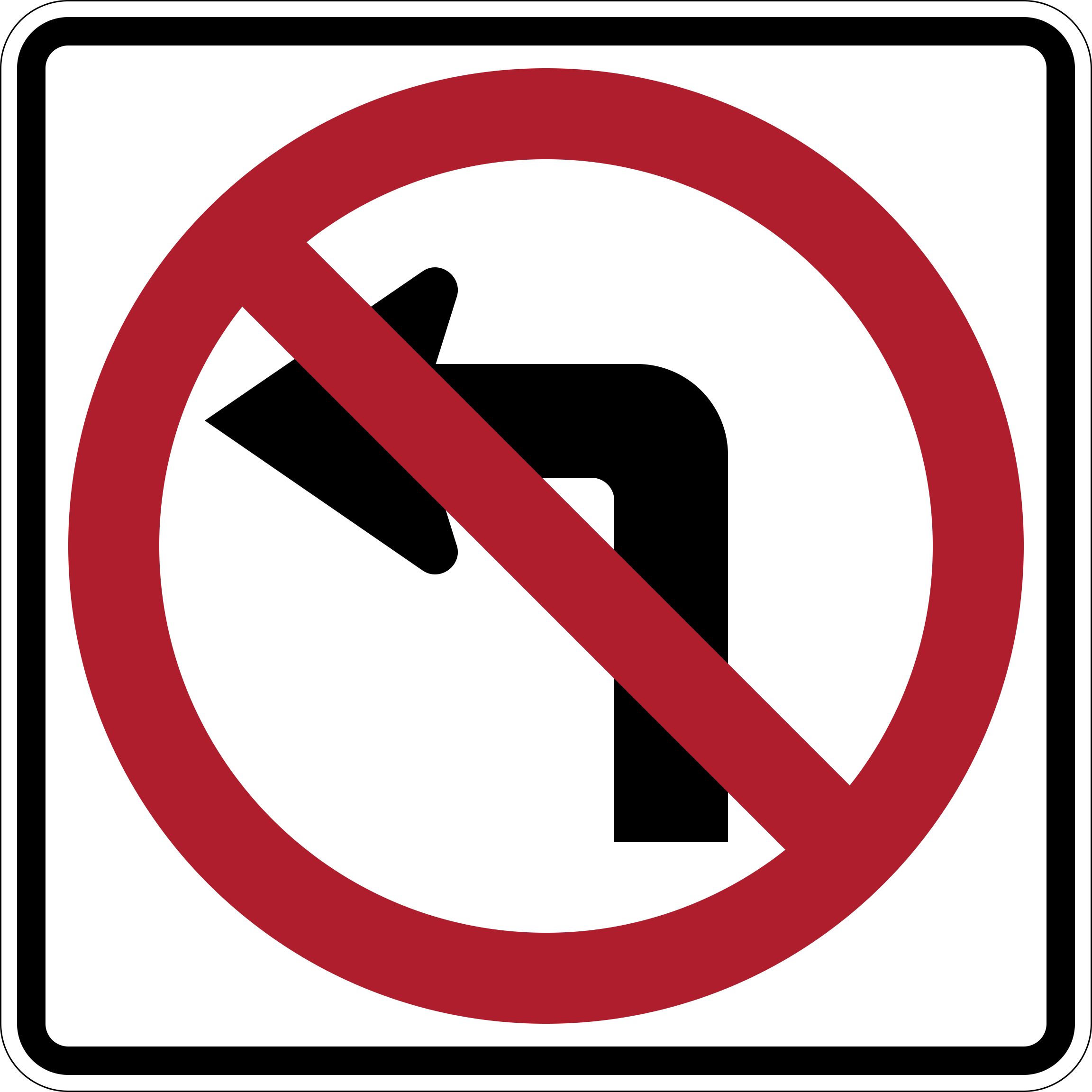
- A left turn is allowed only after stopping
- The left lane is closed
- Left turns are allowed for buses
- A left turn is prohibited here
Show answer
A left turn is prohibited here. Massachusetts reads the red circle with a diagonal slash as a universal prohibition: whatever is drawn inside is not allowed. Over a left arrow it forbids the left turn at that location, with no stop and go exception and no vehicle class exemption. It does not close a lane; it forbids a movement. The same symbol over a U shaped arrow bans U-turns and over a right arrow bans right turns, so read the arrow inside the circle before you commit to the lane.
Study this in the handbook: Traffic sign colors and types
16. This sign shows a red circle and slash over a right turn arrow. What does it prohibit in Massachusetts?
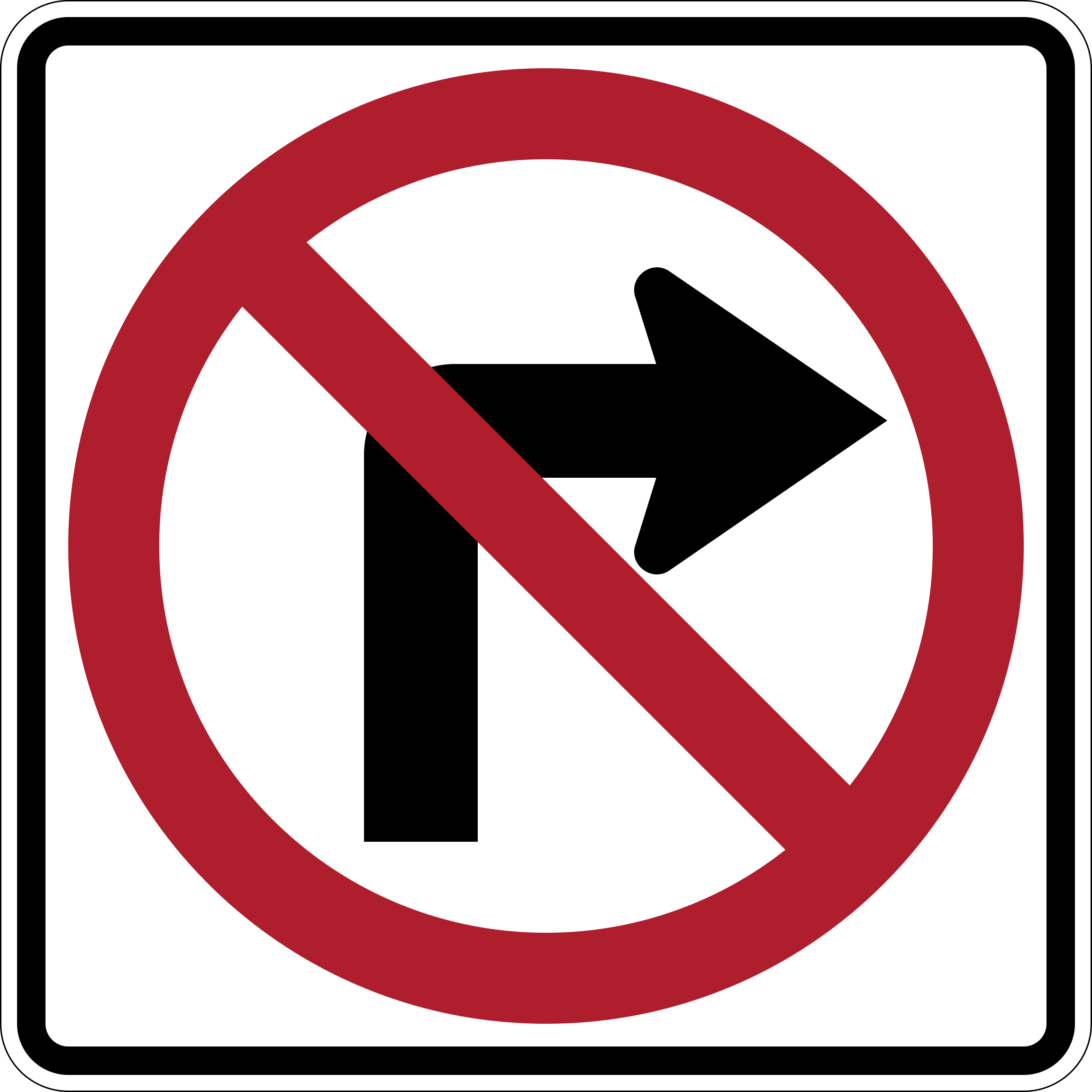
- Turning right unless the light is green
- Turning right for vehicles over 10,000 pounds
- Turning right at this location
- Turning right during posted hours only
Show answer
Turning right at this location. The manual says that signs using a red circle with a diagonal slash mean that something is prohibited, and the thing prohibited is the movement drawn inside the circle, here the right turn. A green light does not override the sign, the prohibition is not limited to heavy vehicles, and unless an added plaque limits it to certain hours it applies all day. These regulatory signs inform drivers of traffic laws, some using only images, so learn to read the symbol rather than wait for words. Continue straight and turn at the next legal opportunity.
Study this in the handbook: Traffic sign colors and types
17. Why does Massachusetts add a 180 day suspension for drivers ages 18 to 21 who refuse a chemical test when charged with OUI?
- To give the court time to schedule a trial
- Because refusal is treated as a guilty plea
- To allow the RMV to retest the driver's vision
- To get those youths to undergo alcohol education, regardless of the court outcome
Show answer
To get those youths to undergo alcohol education, regardless of the court outcome. The extra 180 days for an under 21 driver who refuses the test is not about the court case at all. The manual says it exists to make sure the young driver completes alcohol education, and it applies even if the OUI charge is later won. It is not a scheduling device and it is not a plea; refusal is a separate act with its own suspension. Vision testing has nothing to do with it. For drivers under 18 the same logic produces an additional year rather than 180 days.
Study this in the handbook: Operating under the influence and chemical tests
18. What total stopping distance does the Massachusetts manual give at 60 mph on dry, level road?
- About 100 feet
- About 292 feet, almost a whole football field
- About 30 feet
- About 1,000 feet
Show answer
About 292 feet, almost a whole football field. If your brakes and tires are working and the road is dry and level, at 60 mph it takes about 292 feet to react to a hazard, step on the brake and safely stop, almost a whole football field. At 50 mph the total is about 215 feet, 55 feet of reaction distance plus 160 feet of braking, and at just 30 mph it is about 104 feet. The manual adds that these numbers are for education only and that actual distances grow on wet, slippery or uneven pavement, going downhill, or in bigger, heavier vehicles.
Study this in the handbook: Stopping distance, headlights, night and bad weather
19. You see a stopped emergency vehicle on the shoulder ahead with flashing lights. What speed does Massachusetts expect as you pass?
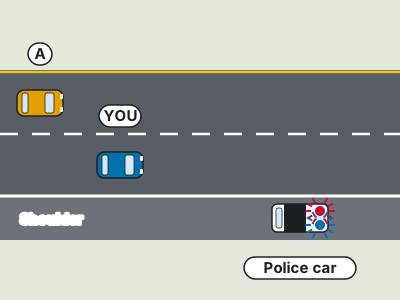
- A speed that is reasonable and safe for the road conditions, below the posted limit if needed
- At least 10 mph over to clear the scene quickly
- Exactly the posted limit
- Walking speed in every case
Show answer
A speed that is reasonable and safe for the road conditions, below the posted limit if needed. The law does not name a number; it requires a speed that is reasonable and safe for the conditions as you approach a stationary emergency vehicle with flashing lights, which in practice means well below the posted limit near people on foot. The posted limit is the maximum for open road, not for a crash scene, going faster is the violation, and walking speed is not always required on a wide highway with an empty adjacent lane. Slow, move over if you can, and proceed with caution.
Study this in the handbook: Passing, school buses and the move over law
20. Your rear tires begin to skid to the left on a Massachusetts road. What should you do with the steering wheel?
- Turn it to the right, away from the skid
- Hold it perfectly straight
- Turn it to the left, the direction of the skid
- Let go and brake
Show answer
Turn it to the left, the direction of the skid. Steer into the skid. If the rear is sliding left, turn the wheel left so the front tires point where the car is actually going, which lets them regain grip and straighten the car. Steering away sends the rear the other way in a fishtail, holding straight does nothing, and braking makes the skid worse. Ease off the gas, shift to neutral if you can, and make small corrections as the tires catch.
Study this in the handbook: Emergency vehicles, skids, brake failure and breakdowns
QualitySpace is expanding to Massachusetts
We are a California-based independent insurance brokerage working on licensing in more states. We cannot help with Massachusetts insurance yet. Leave your email and we will let you know when we can.
Every question is written from the official Massachusetts Driver's Manual. Need paper? Printable MA practice test with answer key.
Last verified 2026-10-05. How we check every question · Study all 500 as flashcards
Frequently asked questions
How many questions are on this Massachusetts practice test?
This fixed set has 20 questions. It is test 9 of 25 from the 500 question Massachusetts bank. The real MA exam asks 25 questions and you need 18 correct.
What is the passing score for the real Massachusetts test?
18 questions correct (out of 25) That figure comes from the official Massachusetts source cited on the DMV facts page.
How does this fixed test relate to the full Massachusetts bank?
Each numbered test is a fixed set of questions in a fixed order, so you can retake the same test later and compare. Every test mixes road signs and the other topics in about the same proportion as the full bank. Tests 1 to 25 together cover every question in the Massachusetts bank once. The full practice page mixes the whole bank at random.
Last verified 2026-10-05. See the Massachusetts DMV facts page for sourced state details.
Return to the full Massachusetts practice test · Study road signs