
Test 3 of 25 · 20 questions · Free 2026
MA Permit Practice Test 3
Jump to the test ↓A fixed 20 question set from the Massachusetts bank with answers and plain English explanations. The real MA exam is 25 questions, 72 percent to pass; take the full length version on the main practice page.
Question 1 of 20 · 0 right so far
All 20 questions in test 3
Every question below comes from the Massachusetts question bank on this page. Open a question to see the correct answer and the explanation. Nothing here is hidden behind a signup.
1. According to the Massachusetts manual, how do rain and wet roads affect driving?
- They only affect visibility, not traction
- They make it harder to start, stop, and turn
- They shorten stopping distance because tires grip better
- They have no effect below 30 mph
Show answer
They make it harder to start, stop, and turn. Water changes what the tires can do. The manual says rain and wet roads make it harder to start, stop and turn, which is a traction problem, not just a visibility one, though hard rain, fog and mist also make it harder to see. Wet pavement never shortens stopping distance, and the effect does not disappear at low speed; the first minutes of rain on an oily road are slippery at any pace. Slow down, leave more room, and avoid sudden inputs.
Study this in the handbook: Stopping distance, headlights, night and bad weather
2. You park facing uphill against a curb in Massachusetts. Which way should the front wheels point?
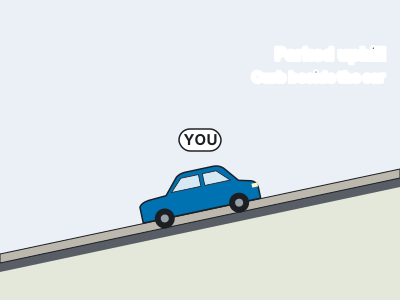
- Inward, toward the curb
- Outward, toward the travel lane
- Straight ahead
- Toward the sidewalk
Show answer
Outward, toward the travel lane. Uphill against a curb is the one case where the wheels turn outward. If the brake fails the car rolls backward, the back of the front tire meets the curb, and the curb stops it. Turning inward would let the car roll back into the street, straight wheels give no protection, and the sidewalk is the wrong direction for a backward roll. Downhill against a curb reverses the answer, with the wheels turned inward toward the curb, and with no curb the wheels always turn toward the road edge.
Study this in the handbook: Parking rules and hills
3. Unless posted otherwise, above what speed is driving not reasonable and proper in a Massachusetts school zone?
- 30 mph
- 15 mph
- 25 mph
- 20 mph
Show answer
20 mph. School zones sit at the bottom of the Massachusetts default list at 20 mph. Fifteen is lower than the state uses, twenty five is the optional posted limit some communities adopt for thickly settled areas, and thirty is the thickly settled default itself. School zone speed limit signs may carry flashing yellow lights or be posted for certain hours of the day, so look closely for signs saying you are approaching or entering a school zone, and watch for children crossing and for crossing guards.
Study this in the handbook: Speed limits and the dangers of speeding
4. Under Massachusetts law, what is the fine for tailgating, and why does the manual call it dangerous?
- Up to $500, and it damages the road
- Up to $25, and it wastes fuel
- Up to $100, and it is the main cause of rear-end crashes
- There is no fine
Show answer
Up to $100, and it is the main cause of rear-end crashes. Tailgating is illegal in Massachusetts and can cost up to $100, but the manual's real point is that following too closely is the main cause of rear end crashes. The $25 figure is the adult safety belt fine, and $500 is the fine for a third or later offense under the adult hands-free phone law, not for tailgating. There is certainly a fine. Use the three second rule so a sudden stop ahead leaves you room to react, keep more space at night and in rain, and leave at least four seconds behind a motorcycle.
Study this in the handbook: Seat belts, child seats and safe following distance
5. A Massachusetts Junior Operator is convicted of drag racing for the first time. How long is the license suspended?
- A 60-day suspension
- A 90-day suspension
- A three-year suspension
- A one-year suspension
Show answer
A one-year suspension. A first drag racing citation suspends a Junior Operator license for one year, and a later one brings a three year suspension. Ninety days is the first speeding penalty for a Junior Operator, and 60 days is the first passenger or night restriction penalty. Three years is the repeat drag racing term, not the first. The manual's chart of mandatory license suspensions for Junior Operators adds that every drag racing offense requires a new learner's permit exam, a Driver Attitudinal Retraining course, and a new road test, with a reinstatement fee of $500 for a first offense.
Study this in the handbook: Citations, surchargeable events and suspensions
6. The vehicle ahead of you on a Massachusetts road switches on its emergency lights while still in traffic. What does the manual say drivers use those lights to warn about?
- The driver is inviting you to pass
- The vehicle is turning left
- A hazard ahead that may require you to slow or stop
- Nothing, they are decorative
Show answer
A hazard ahead that may require you to slow or stop. The manual says to use emergency lights and signals when your vehicle breaks down so other drivers can see it, and that you can also use your emergency lights to warn drivers behind you about a traffic crash or hazard, giving them as much warning as possible. So when the vehicle ahead turns its flashers on, assume there is trouble ahead and be ready to slow or stop. Flashers are not a passing invitation, a left turn is shown with a turn signal, and the lights are not decorative. Increase your following distance.
Study this in the handbook: Stopping distance, headlights, night and bad weather
7. Which of these counts as a vulnerable road user under Massachusetts law?
- A driver of a pickup truck
- A passenger in a bus
- A roadside worker
- A motorcyclist on a highway
Show answer
A roadside worker. The Massachusetts definition lists pedestrians, roadside workers, bicyclists, people riding horses or horse drawn carriages, and people using wheelchairs, personal mobility devices, motorized bicycles, scooters, skateboards and roller skates. A roadside worker is on the list. A pickup driver and a bus passenger are inside motor vehicles, and motorcyclists are not named in the definition. Every listed user gets the four foot passing distance.
Study this in the handbook: Pedestrians, bicyclists, motorcycles and mopeds
8. This pennant-shaped NO PASSING ZONE sign marks the start of a no-passing stretch. Which pavement marking carries the same prohibition in Massachusetts?
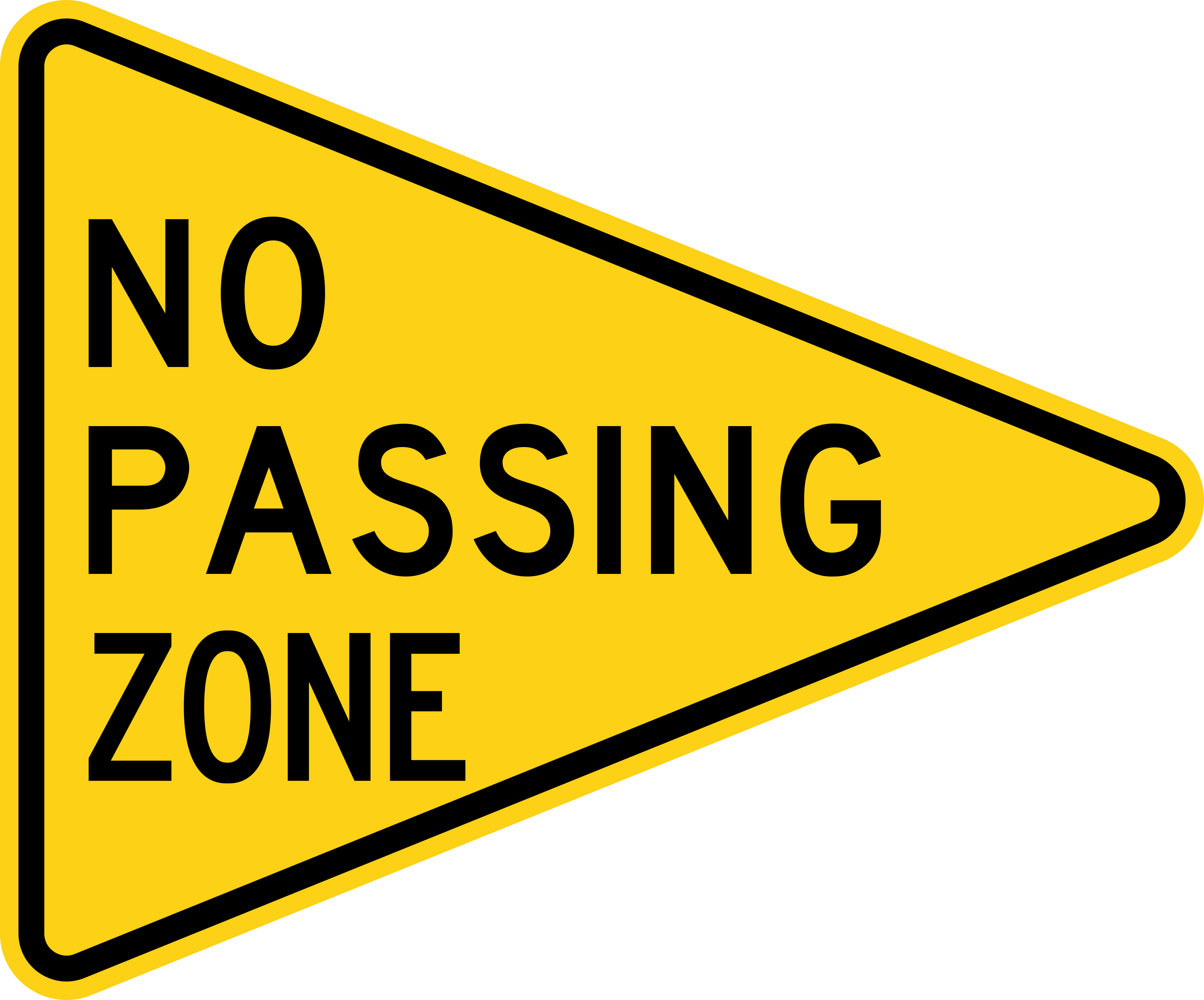
- Two solid yellow lines
- A broken yellow line
- Broken white lines
- A single solid white edge line
Show answer
Two solid yellow lines. A NO PASSING ZONE sign and a double solid yellow line on the pavement say the same thing: do not cross to pass. The manual says two solid yellow lines prohibit vehicles from crossing them to pass another vehicle, and you may cross them only to turn left when it is safe. A broken yellow line allows a pass when it is safe, broken white lines separate lanes going the same direction, and a single solid white line marks the right edge of the roadway. With one solid and one broken yellow line, only the driver beside the broken line may pass.
Study this in the handbook: Pavement markings and special lanes
9. Where does this white X-shaped crossbuck stand, and what does the small sign beneath it show when present?
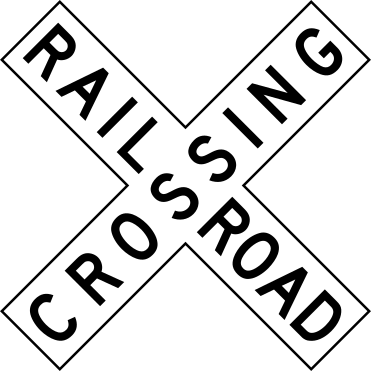
- One mile before the crossing; the train speed
- At the point where the tracks cross the road; the number of tracks
- On the train; the railroad's name
- At the station; the schedule
Show answer
At the point where the tracks cross the road; the number of tracks. The crossbuck is mounted at the crossing itself, marking the exact point where train tracks cross the road. When more than one track crosses, the number of tracks is posted below the crossbuck, so you know how many sets of rails you must clear. Advance warning comes from the round sign posted before the crossing, not from the crossbuck. The manual also says the toll free Emergency Notification System number is located in the middle of the crossbuck or on a metal box near the crossing, for use if a vehicle is stuck on the tracks.
Study this in the handbook: Railroad crossings and work zones
10. Beyond driver education, how many supervised driving hours must a Massachusetts JOL applicant normally complete if the applicant has not completed a qualifying driver skills development program?
- At least 40 hours
- At least 12 hours
- At least 6 hours
- At least 100 hours
Show answer
At least 40 hours. Driver education alone does not qualify a teen for a Massachusetts license. On top of the classroom and in car training, the applicant must log at least 40 hours of supervised driving, and a parent or guardian certifies those hours in a signed statement. Twelve hours is the in car training figure from the driver education program and six hours is the observation requirement, so both are easy to confuse with the practice total. One hundred hours is more than the state requires. The RMV accepts 30 supervised hours instead when the teen completes a driver skills development program.
Study this in the handbook: The Junior Operator License (ages 16 1/2 to 18)
11. A Massachusetts Junior Operator is convicted of reckless or negligent operation. What additional suspension applies for a first offense, beyond any other suspension required by law?
- 180 days
- 30 days
- One year
- No additional suspension
Show answer
180 days. Junior Operators carry an extra layer of consequences. For offenses such as operating under the influence, operating to endanger, leaving the scene of a crash, reckless or negligent operation, loaning a license or permit, or motor vehicle homicide, the RMV adds a 180 day suspension for a first offense and a full year for any later one, in addition to any other suspension required by law. Thirty days is too short to match the rule, and the idea of no extra suspension is exactly what the JOL law rejects. The add on does not apply when the teen already received an additional suspension for failing or refusing a breath test.
Study this in the handbook: Junior Operator suspensions
12. You are not sure whether the van ahead with flashing red lights is a school vehicle. How does the Massachusetts manual describe school pupil transport vehicles?
- They are always yellow buses
- They display orange triangles
- They have flashing red lights and SCHOOL BUS signs on top
- They use blue flashing lights
Show answer
They have flashing red lights and SCHOOL BUS signs on top. Not every school vehicle is a big yellow bus. The manual says school pupil transport vehicles, like vans, station wagons, or family sedans, have flashing red lights and SCHOOL BUS signs on top, and drivers use these warning signals when letting pupils on and off. If such a vehicle has its lights flashing and a stop sign extended, you must stop just as you would for a yellow bus. Orange warning signs on the back mark slow moving vehicles, and blue lights are not part of the description. When in doubt, stop.
Study this in the handbook: Passing, school buses and the move over law
13. This DIVIDED HIGHWAY sign announces a change ahead. How does the Massachusetts manual define a divided highway?

- A highway with separate roadways for traffic in opposite directions
- A road with a two-way center turn lane
- A highway with a posted limit above 55 mph
- Any road with more than two lanes
Show answer
A highway with separate roadways for traffic in opposite directions. A divided highway is defined by its layout, not its speed or lane count: separate roadways for each direction, split by a median or barrier. A four-lane road with only a painted center line is not divided, a center turn lane is a shared lane rather than a division, and the speed limit has nothing to do with the definition. The sign matters because on a divided highway you keep to the right roadway, and the yellow line will be on your left edge.
Study this in the handbook: Signaling, lane use and highway driving
14. A Massachusetts crosswalk signal has a countdown timer. Who has the right of way when the count reaches zero?
- Pedestrians who are already in the crosswalk
- Vehicles going straight on green
- Vehicles turning across the crosswalk
- No one, the crosswalk is closed
Show answer
Pedestrians who are already in the crosswalk. Some Massachusetts crosswalk signals include a numeric countdown timer, and the manual is clear about what happens at zero: pedestrians who are already in the crosswalk when the count reaches zero have the right of way and must be allowed to finish crossing. Turning and through vehicles must wait for them, and the crosswalk is not closed to someone who is already in it. As a driver you must yield to pedestrians using a crosswalk in your path and never let your vehicle block a crosswalk.
Study this in the handbook: Traffic signals and pedestrian signals
15. When must a Massachusetts driver lower high beam headlights to low beam?
- Within 1,000 feet of any vehicle
- Within 500 feet of an oncoming vehicle or within 200 feet of a vehicle ahead
- Only when the other driver flashes their lights
- Only in rain or fog
Show answer
Within 500 feet of an oncoming vehicle or within 200 feet of a vehicle ahead. The dimming distances are fixed in the manual: 500 feet for an oncoming vehicle and 200 feet when you are following another vehicle. A thousand feet is farther than the rule requires, waiting to be flashed means you have already blinded the other driver, and weather is not the trigger, though high beams are a poor choice in fog anyway because they reflect back at you. High beams reach about 350 feet, low beams about 100, so dim early and look to the right edge of the road.
Study this in the handbook: Stopping distance, headlights, night and bad weather
16. You are turning left on a steady green light in Massachusetts. What must you do?
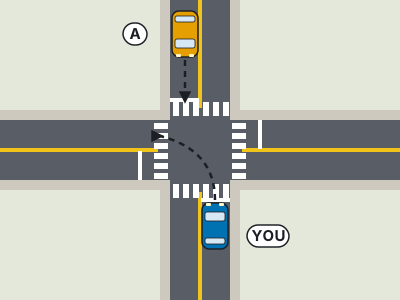
- Proceed, because green gives you the right of way over oncoming vehicles
- Sound the horn and turn
- Wait for a green arrow
- Yield to oncoming traffic
Show answer
Yield to oncoming traffic. A steady green circle means go, but first you must yield to other vehicles, bicycles, or pedestrians in the road, and a left turner on a steady green must yield to oncoming traffic. Green does not hand you priority over oncoming traffic, a green arrow is not required to turn left on a steady green, and the horn changes no one's right of way. The manual adds a warning to look out for drivers who do not obey traffic signals or race through intersections, so turn only when the gap is clearly large enough.
Study this in the handbook: Traffic signals and pedestrian signals
17. You are turning off a Massachusetts street into a parking lot and a pedestrian is crossing the entrance. Who has the right of way?
- The pedestrian; you must yield
- You, because you signaled the turn
- You, because there is no crosswalk
- Whoever reaches the entrance first
Show answer
The pedestrian; you must yield. The duty to yield to people on foot is not limited to marked crosswalks. Among the laws for drivers, Massachusetts says you must yield to pedestrians when turning into a driveway or parking lot. A turn signal announces your intent but gives you no priority, and the lack of painted crosswalk lines does not change the rule. It is not a race to the entrance either. Slow down as you turn, scan the sidewalk on both sides of the driveway, and let the walker finish crossing first.
Study this in the handbook: Traffic signals and pedestrian signals
18. In the Massachusetts sign color code, what does a brown sign point you to?
- A construction or maintenance zone
- Gas, food, and hotels
- A recreational, historic, or scenic site
- A school zone or pedestrian crossing
Show answer
A recreational, historic, or scenic site. The manual gives each sign color a job so you can sort a sign before you can read it. Brown marks a recreational, historic, or scenic site such as a park or landmark. Construction and maintenance warnings are orange, motorist services like gas, food, and hotels are blue, and school zone, bicycle, pedestrian, and curve warnings use fluorescent yellow green. Knowing that brown is a destination sign, not a warning, tells you there is nothing ahead that requires you to slow or stop.
Study this in the handbook: Traffic signals and pedestrian signals
19. Your car drives into water in Massachusetts. How does the manual tell you to get out?
- Open a door right away and swim out
- Stay buckled until the car reaches the bottom
- Wait for the car to fill with water before moving
- Unfasten your belt and escape through a window, not a door
Show answer
Unfasten your belt and escape through a window, not a door. Water against a door makes it hard to open, and if you force it, water rushes in and the vehicle could flip over. The manual says to unfasten your safety belt and escape through a window, and to open power windows quickly before the water stops them from working. If the car sinks before you are out, climb into the rear seat where an air pocket may form, then take a deep breath and go out through a window once the vehicle settles. Staying buckled or waiting wastes the time you have.
20. A Massachusetts driver under 21 tries to buy alcohol. How long is the license suspended?
- 30 days
- 180 days
- 60 days
- Two years
Show answer
180 days. If you are under 21 and buy or try to buy alcohol, your license is suspended for 180 days. The broader possession and purchase rule carries 90 days to one year, and this specific attempt carries 180 days. Thirty and sixty days are too short, and two years is too long. Using a false ID in the attempt adds separate penalties, including a one-year suspension on conviction.
Study this in the handbook: Operating under the influence and chemical tests
QualitySpace is expanding to Massachusetts
We are a California-based independent insurance brokerage working on licensing in more states. We cannot help with Massachusetts insurance yet. Leave your email and we will let you know when we can.
Every question is written from the official Massachusetts Driver's Manual. Need paper? Printable MA practice test with answer key.
Last verified 2026-10-05. How we check every question · Study all 500 as flashcards
Frequently asked questions
How many questions are on this Massachusetts practice test?
This fixed set has 20 questions. It is test 3 of 25 from the 500 question Massachusetts bank. The real MA exam asks 25 questions and you need 18 correct.
What is the passing score for the real Massachusetts test?
18 questions correct (out of 25) That figure comes from the official Massachusetts source cited on the DMV facts page.
How does this fixed test relate to the full Massachusetts bank?
Each numbered test is a fixed set of questions in a fixed order, so you can retake the same test later and compare. Every test mixes road signs and the other topics in about the same proportion as the full bank. Tests 1 to 25 together cover every question in the Massachusetts bank once. The full practice page mixes the whole bank at random.
Last verified 2026-10-05. See the Massachusetts DMV facts page for sourced state details.
Return to the full Massachusetts practice test · Study road signs