
Test 12 of 25 · 20 questions · Free 2026
MA Permit Practice Test 12
Jump to the test ↓A fixed 20 question set from the Massachusetts bank with answers and plain English explanations. The real MA exam is 25 questions, 72 percent to pass; take the full length version on the main practice page.
Question 1 of 20 · 0 right so far
All 20 questions in test 12
Every question below comes from the Massachusetts question bank on this page. Open a question to see the correct answer and the explanation. Nothing here is hidden behind a signup.
1. What does the ban on parking in a traffic lane next to a row of parked vehicles describe?
- Double parking in a live traffic lane
- Angle parking at a marked curb
- Parking overnight in a rest area
- Backing into a legal curb space
Show answer
Double parking in a live traffic lane. Parking in a traffic lane next to a row of parked vehicles is double parking. The manual lists it among prohibited parking locations. Angle parking uses a marked curb position rather than a live lane. Rest area overnight rules are not what this list item describes. A legal curb space keeps the vehicle out of the traffic lane. The cited passage states the point directly: In a traffic lane next to a row of parked vehicles (“double parked”)
Study this in the handbook: Parking rules and hills
2. What should you always wear when driving on bright, sunny days?
- A brimmed hat instead of eye protection
- No eyewear, to keep vision natural
- Tinted windows closed without sunglasses
- Sunglasses
Show answer
Sunglasses. On bright, sunny days, you should always wear sunglasses. The manual names sunglasses, rather than a hat or tinted windows, as the eyewear to use in these conditions. Tinted windows do not replace the sunglasses that should always be worn on bright, sunny days. The manual recommends sunglasses on bright, sunny days, not a hat as a substitute. The manual says you should always wear sunglasses on bright, sunny days.
Study this in the handbook: Seat belts, child seats and safe following distance
3. Which headlights should you use in fog in Massachusetts, and why?
- Low beam headlights, to reduce glare
- High beams, to see farther through fog
- Parking lights only
- No lights, to avoid reflection
Show answer
Low beam headlights, to reduce glare. In fog, use your low beam headlights to reduce glare. High beams are not the fog choice, because the stated purpose in fog is reducing glare rather than reaching farther. Parking lights only are not named for fog driving, and driving with no lights leaves the low beam instruction unmet. The adjustment is to select the low beams when fog appears, slow the vehicle, and let road edge markings guide progress when pavement or posts disappear from view. That pairing of low beam headlights with reduced speed matches the fog rule as stated for Massachusetts drivers.
Study this in the handbook: Stopping distance, headlights, night and bad weather
4. What happens to a speeding fine when the violation occurs in a posted work zone?
- Only the $5 public safety surcharge is added
- The fine stays flat but points double instead
- The speeding fine is doubled
- The fine drops by half for a first offense
Show answer
The speeding fine is doubled. If you are caught speeding in a posted work zone, the speeding fine is doubled. Civil fines under Chapters 89 or 90 have an added $5 public safety surcharge. Speeding fines include a $50 surcharge for the Head Injury Treatment Services Trust Fund. The stated rule doubles the speeding fine in a posted work zone; it does not provide a first-offense half-price fine. Massachusetts doubles the money owed for work zone speeding rather than doubling points while holding the fine flat.
Study this in the handbook: Citations, surchargeable events and suspensions
5. A road test applicant fails the test. What does the $35 road test fee mean for booking another attempt?
- The failed attempt is free, so booking again costs nothing
- The $35 fee still applies for the failed test and must be paid before a new test is booked
- Half the fee carries forward toward the next booking
- A waiver applies whenever a sponsor was present
Show answer
The $35 fee still applies for the failed test and must be paid before a new test is booked. The $35 road test fee still applies if you fail the test, do not appear, are rejected by the examiner, or cancel with less than 72 hours notice. It must be paid before a new test is booked. The fee covers processing the application and scheduling the test. For a Class D road test a sponsor is part of the test setup, but that creates no waiver of the fee after a failure.
Study this in the handbook: The learner's permit and permit exam
6. What blood alcohol level triggers penalties for a Massachusetts driver under 21?
- 0.08 or higher, same as older drivers in every respect
- Any measurable amount only after a crash occurs
- 0.05 or higher after two prior offenses
- 0.02 or higher under the zero tolerance approach
Show answer
0.02 or higher under the zero tolerance approach. Drivers younger than 21 face penalties at a blood alcohol content of 0.02 or beyond under zero tolerance wording. The 0.08 figure is the general legal limit, while drivers under 21 face penalties starting at 0.02. Young drivers also appear in alcohol related crashes at double the rate of others, context behind the stricter stance. Remember two hundredths as two fingers of space on a ruler; that tiny margin still ends a young license at the roadside stop.
Study this in the handbook: Operating under the influence and chemical tests
7. You are cited for speeding in a Massachusetts work area where road workers are nearby. What happens to the fine?
- The fine will be doubled
- The fine stays at the standard amount for that speed
- The fine is cut in half when warning signs were posted
- The fine is paid to the road crew at the scene
Show answer
The fine will be doubled. Follow road work signs carefully, stay alert for sudden changes in road direction or condition, and be prepared to stop. If you are cited for speeding in a work area, the fine is doubled. Posted warning signs do not halve the penalty; the fine increases instead. The standard amount does not apply; a work area speeding fine is doubled. Fines are not collected by the road crew at the scene.
8. A Massachusetts passenger vehicle has a spot light fitted. How high may its beam shine at a point 30 feet from the vehicle?
- No more than three feet above the roadway
- No more than two feet above the roadway
- Up to the height of the roof at 30 feet
- Any height, provided it is aimed at a sign
Show answer
No more than two feet above the roadway. A passenger vehicle spotlight may be used to read signs or as an emergency light if the headlights are not working. Its beam may shine only two feet above the roadway at a distance of 30 feet from the vehicle. The limit is measured above the roadway, not by the height of the vehicle roof. The manual specifies two feet above the roadway at 30 feet, not the height of the vehicle roof.
Study this in the handbook: Seat belts, child seats and safe following distance
9. What vision must you show for a full Massachusetts Class D or M license?
- At least 20/40 in the better eye, corrected, with at least 120 degrees of horizontal peripheral vision in both eyes together
- At least 20/70 in the better eye with 90 degrees of peripheral vision
- At least 20/20 in both eyes with no correction allowed
- At least 20/50 in either eye with 100 degrees of peripheral vision
Show answer
At least 20/40 in the better eye, corrected, with at least 120 degrees of horizontal peripheral vision in both eyes together. Full licensure pairs sharpness in the stronger eye with a wide side view. The standard is at least 20/40 visual acuity in the better eye, corrected, plus at least 120 degrees of horizontal peripheral vision with both eyes together. The 20/70 pairing understates acuity and narrows the field. Demanding uncorrected 20/20 in both eyes invents a stricter test that would exclude ordinary glasses wearers who pass. 20/50 acuity may qualify for a daylight-only license, but it does not meet the full-license acuity standard; 100 degrees also falls short of the required 120-degree field. Check both parts before assuming vision qualifies.
Study this in the handbook: The learner's permit and permit exam
10. Midway through an intersection turn you decide against it. What must you do?
- Stop in the turn and reverse direction
- Back out of the intersection
- Follow through; do not stop mid turn to change direction, and work back from the next intersection if needed
- Honk and cut across remaining lanes
Show answer
Follow through; do not stop mid turn to change direction, and work back from the next intersection if needed. Once you have started a turn through an intersection, you must follow through. Do not stop in mid-turn and change direction. If you decide you do not want to make the turn, drive to the next intersection and work your way back. Complete the turn and work your way back from the next intersection; backing out is not the instructed correction. You must follow through with the turn; honking and cutting across lanes is not the instructed correction.
Study this in the handbook: Turns, right of way and rotaries
11. When may children under 12 ride in the bed of a pickup truck in Massachusetts?
- Freely, at any speed, if they sit down
- Only within very limited exceptions, and never at speeds over five mph
- Never, without exception
- Whenever an adult rides in the bed with them
Show answer
Only within very limited exceptions, and never at speeds over five mph. Children under 12 are not allowed to ride in pickup truck beds, with very limited exceptions and never at speeds over five mph. The manual acknowledges exceptions but does not list them in this passage. Sitting down or having an adult present is not stated as a general permission to ride in the bed. The manual does not give adult accompaniment as a general exception; it states very limited exceptions and never allows speeds over five mph.
Study this in the handbook: Hands free law and distracted driving
12. What does Massachusetts charge as the out of state conversion fee for a Class D license?
- $140.00
- $50.00
- $30.00
- $115.00
Show answer
$115.00. Converting an out of state Class D license to Massachusetts costs $115.00. The $140.00 figure belongs to the commercial classes A, B, and C on the same conversion schedule, so it overcharges a passenger vehicle driver. Fifty dollars matches the Class D issue or renewal fee, a different transaction from converting an existing out of state credential. Thirty dollars matches permit related charges rather than a full license conversion. When a conversion price question names Class D, settle on the lower $115 figure instead of the commercial rate.
Study this in the handbook: The learner's permit and permit exam
13. How do NO U-TURN signs in Massachusetts convey their message?
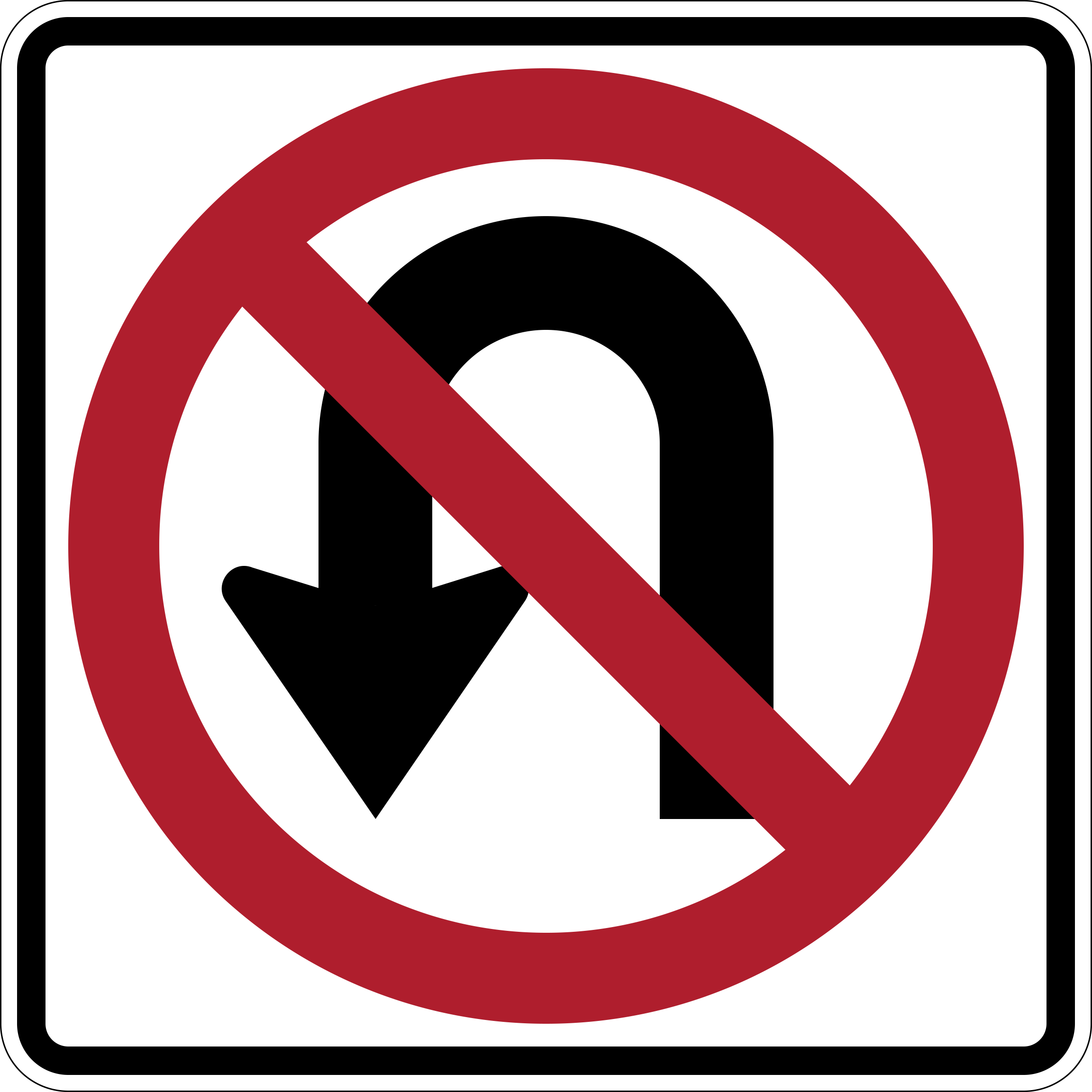
- With words only and no image
- With a red background and white words
- With words and images combined
- With images only and no words
Show answer
With images only and no words. Regulatory signs use different mixes of words and pictures. Others, such as NO U-TURN signs, use only images. Describing that sign as words and images combined blends it with a separate group of signs that mix both forms. A driver reads the U-turn arrow under the red slash without any wording. Look for the slashed arrow picture and obey it even though no words appear.
Study this in the handbook: Traffic sign colors and types
14. What fuel benefit can proper tire pressure provide on each tankful in Massachusetts driving?
- Up to 13% benefit per tankful of fuel
- Up to 3% benefit per year, not per tankful
- Up to 3% benefit per tankful of fuel
- No benefit unless the tires are overinflated
Show answer
Up to 3% benefit per tankful of fuel. Proper tire pressure in Massachusetts guidance is safer, extends tire life, and can provide up to 3% benefit per tankful of fuel. Inflating the figure to 13% promises savings far beyond the stated per tankful gain. Tying the gain to a year confuses it with the roughly $120 yearly saving linked to a tight fuel tank cap. Check the pressure regularly, since billions of gallons of fuel are wasted by driving on underinflated tires.
15. In Massachusetts, where must a back-facing child safety seat never be placed when that seating position has an air bag?
- On the rear bench behind the driver
- In the rear middle seating position
- Behind the front passenger seat
- On the front passenger seat
Show answer
On the front passenger seat. The manual says never to put a back-facing child safety seat in the front passenger seat if that seat has an air bag. It says the back seat is safest for children and the back middle seat is best. Infant seats must face the back of the vehicle. The manual identifies the back seat as the safest place for a child; the stated prohibition concerns the front passenger seat with an air bag.
Study this in the handbook: Seat belts, child seats and safe following distance
16. You stop on a divided highway in Massachusetts and set out warning triangles or LED flares. Where do they go?
- 100 feet in front of the vehicle and 10 feet beside the vehicle
- 10 feet in front of the vehicle and 100 feet in front of the vehicle
- 10 feet behind the vehicle and 100 feet behind the vehicle
- 200 feet behind the vehicle and 200 feet in front of the vehicle
Show answer
10 feet behind the vehicle and 100 feet behind the vehicle. On a divided highway, place warning triangles or LED flares 10 feet and 100 feet behind your vehicle. The separate instructions for witnessing a crash call for warning devices 200 feet or more in front of and behind the crash. Both front placements ignore approaching traffic behind the stopped vehicle on a divided highway. The divided-highway instructions place the devices 10 feet and 100 feet behind the vehicle.
Study this in the handbook: Emergency vehicles, skids, brake failure and breakdowns
17. If your electronic turn signals are not working while driving in Massachusetts, how should you give hand signals?
- Through the passenger window, and only for turns
- Through the driver side window, and knowing them is required to pass the road test
- By a passenger waving, with no test effect
- Hand signals are optional when electronics fail
Show answer
Through the driver side window, and knowing them is required to pass the road test. Signal failure never cancels the duty to communicate. Regardless of vehicle type, signals are required for lane changes, turns, pulling away from a curb, pulling over, and entering or exiting highways. If electronic signals are not working, the three hand signals must be used, made through the driver side window, and you must know these signals to pass the road test. Passenger window gestures put the signal on the wrong side. A waving passenger substitutes the wrong person. Optional signaling leaves following drivers guessing, which is exactly what check, signal, then move prevents.
Study this in the handbook: Signaling, lane use and highway driving
18. How is the Massachusetts Driver Retraining course scheduled, and what does completing it leave on your record?
- One two hour evening class, and offenses are erased
- Four separate full day sessions, and surcharges are removed
- An eight hour program held as two four hour sessions, with a single eight hour Saturday session possibly available; completing it does not remove offenses or surcharges
- A self paced online quiz with no set hours
Show answer
An eight hour program held as two four hour sessions, with a single eight hour Saturday session possibly available; completing it does not remove offenses or surcharges. The Driver Retraining course is an eight-hour program held as two four-hour sessions. A single eight-hour Saturday session may be available in your area. Completing it does not remove offenses or surcharges from your record or replace other requirements. For example, a drunk-driving conviction may also require alcohol treatment or education. The format is two four hour sessions or one Saturday session, and surcharges remain.
19. Traffic signals at an intersection are completely blacked out and not functioning. How should you proceed?
- Treat the green direction as open and drive through at normal speed
- Be cautious and proceed as though there is a stop sign in all directions, going when safe
- Follow the largest vehicle through without stopping
- Honk and continue, since no signal means no control
Show answer
Be cautious and proceed as though there is a stop sign in all directions, going when safe. Dark signals remove the usual color commands, so caution replaces them. Proceed as though a stop sign faces every direction and move only when safe. Assuming the last green direction stays open ignores drivers arriving from streets that also face darkness. Following a large vehicle through copies its timing instead of judging your own gaps. A horn blast creates noise, not control. Picture an octagon on every corner until crews restore the lights.
Study this in the handbook: Traffic signals and pedestrian signals
20. A blind pedestrian with a white cane or guide dog is crossing the street. What must you do?
- Come to a complete stop while the blind pedestrian is crossing
- Slow down and steer widely around the person
- Honk once so the person knows to hurry
- Wave the person across and keep rolling slowly
Show answer
Come to a complete stop while the blind pedestrian is crossing. Come to a complete stop for a blind pedestrian crossing the street and remain stopped until the person has safely crossed. Do not honk or wave the person on. Blind pedestrians may use a white cane or a guide dog. Do not wave the person on; stop completely and remain stopped until the person has safely crossed. Rolling around keeps the vehicle moving through space that must stay clear.
Study this in the handbook: Turns, right of way and rotaries
QualitySpace is expanding to Massachusetts
We are a California-based independent insurance brokerage working on licensing in more states. We cannot help with Massachusetts insurance yet. Leave your email and we will let you know when we can.
Every question is written from the official Massachusetts Driver's Manual. Need paper? Printable MA practice test with answer key.
Last verified 2026-10-05. How we check every question · Study all 500 as flashcards
Frequently asked questions
How many questions are on this Massachusetts practice test?
This fixed set has 20 questions. It is test 12 of 25 from the 500 question Massachusetts bank. The real MA exam asks 25 questions and you need 18 correct.
What is the passing score for the real Massachusetts test?
18 questions correct (out of 25) That figure comes from the official Massachusetts source cited on the DMV facts page.
How does this fixed test relate to the full Massachusetts bank?
Each numbered test is a fixed set of questions in a fixed order, so you can retake the same test later and compare. Every test mixes road signs and the other topics in about the same proportion as the full bank. Tests 1 to 25 together cover every question in the Massachusetts bank once. The full practice page mixes the whole bank at random.
Last verified 2026-10-05. See the Massachusetts DMV facts page for sourced state details.
Return to the full Massachusetts practice test · Study road signs