
Test 8 of 25 · 20 questions · Free 2026
MA Permit Practice Test 8
Jump to the test ↓A fixed 20 question set from the Massachusetts bank with answers and plain English explanations. The real MA exam is 25 questions, 72 percent to pass; take the full length version on the main practice page.
Question 1 of 20 · 0 right so far
All 20 questions in test 8
Every question below comes from the Massachusetts question bank on this page. Open a question to see the correct answer and the explanation. Nothing here is hidden behind a signup.
1. In which direction does traffic travel in a Massachusetts rotary?
- Counter-clockwise
- Clockwise
- Either direction, depending on the exit
- Straight through the center
Show answer
Counter-clockwise. Because Massachusetts drives on the right, every rotary is travelled counter-clockwise: you enter with a right turn, keep the island on your left, and leave with another right turn. Clockwise travel would send you head on into circulating cars, and there is never a choice of direction based on where you want to exit. Nothing crosses the center island. Signal your exit the same way you would at any intersection so the drivers waiting to enter can judge the gap.
Study this in the handbook: Turns, right of way and rotaries
2. Under Massachusetts's move-over law, what must you do when approaching a stationary emergency vehicle displaying its flashing lights?
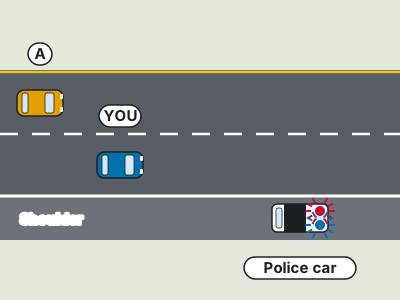
- Stop completely behind the vehicle
- Proceed with caution and reduce your speed to one that is reasonable and safe for the road conditions
- Maintain the posted limit so traffic keeps flowing
- Sound the horn to alert the responders
Show answer
Proceed with caution and reduce your speed to one that is reasonable and safe for the road conditions. Massachusetts framed its 2008 move-over law around caution and speed. When you approach a stationary emergency vehicle with its lights flashing you must proceed carefully and slow to a speed that is reasonable and safe for the conditions, moving to a farther lane when that can be done safely. Stopping in the travel lane creates a new hazard, holding the posted limit past people working on the shoulder is what the law forbids, and the horn helps no one. Slow early, give room, and watch for responders on foot.
Study this in the handbook: Passing, school buses and the move over law
3. A Massachusetts Junior Operator receives a first speeding citation. What license suspension does the manual list?
- No suspension until the third citation
- 30 days for each citation
- 90 days for a first citation and one year for any later citation
- One year for the first citation
Show answer
90 days for a first citation and one year for any later citation. Speeding is treated harshly for Junior Operators. The first citation costs a 90 day suspension and any later one costs a full year, and the manual's suspension chart adds that every such offense requires a new learner's permit exam. Adults, by contrast, face a 30 day suspension only after three speeding violations in a year. There is no free first or second offense for a JOL holder, and the first citation does not jump straight to a year. Losing the license also pauses the JOL passenger restriction clock, which then resumes after reinstatement.
Study this in the handbook: Junior Operator suspensions
4. How does the Massachusetts manual define a thickly settled district for speed limit purposes?
- Any area inside city limits
- Any street with a sidewalk on both sides
- An area with more than 1,000 residents per square mile
- An area where buildings are fewer than 200 feet apart for a distance of 1/4 mile or more
Show answer
An area where buildings are fewer than 200 feet apart for a distance of 1/4 mile or more. The thickly settled definition is about spacing, not population or municipal boundaries. If buildings sit less than 200 feet apart for at least a quarter mile, the road is thickly settled and the 30 mph default applies even with no sign in sight. City limits and population density are not part of the test, and sidewalks do not decide it either. The practical skill is to notice when houses and storefronts start crowding the road and to drop to 30 before a sign tells you.
Study this in the handbook: Speed limits and the dangers of speeding
5. What does a flashing red circle require of a Massachusetts driver?
- Slow down and proceed without stopping
- Wait for the light to turn green
- Yield only to vehicles on the right
- The same as a STOP sign
Show answer
The same as a STOP sign. A flashing red circle is a stop sign made of light. Come to a complete stop, yield to traffic and pedestrians, and go when it is safe. Slowing without stopping is the flashing yellow behavior, waiting for green is pointless because a flashing signal will not change, and yielding only to the right ignores the pedestrians and cross traffic the stop is meant to protect. If there is a white stop line or crosswalk line, make the stop before the line, just as you would at a STOP sign.
Study this in the handbook: Traffic signals and pedestrian signals
6. What does the round yellow warning sign with a black X and RR tell a Massachusetts driver?

- A hospital is ahead
- A rotary is ahead
- A railroad crossing is ahead
- The road curves sharply
Show answer
A railroad crossing is ahead. The round yellow sign with the crossed X and the letters RR is the advance warning for a railroad crossing. It is posted before the tracks so you can slow, look and listen; the crossing itself is marked with the white crossbuck, and a small sign under the crossbuck gives the number of tracks when there is more than one. Rotaries and hospitals use different shapes and colors, and sharp curves are shown with an arrow. Treat the round sign as the cue to be ready to stop.
Study this in the handbook: Railroad crossings and work zones
7. What is the only exception to the Massachusetts rule that you must stop for a school bus with flashing lights and an extended stop sign?
- The bus is on a road posted above 40 mph
- The bus has stopped on the other side of a divided highway with a barrier between travel directions
- No children are visible near the bus
- You are driving a commercial vehicle
Show answer
The bus has stopped on the other side of a divided highway with a barrier between travel directions. The exception is narrow and physical. When a divided highway has a barrier between the two directions, traffic on the opposite side does not stop for a bus loading on the far roadway, because children cannot cross the barrier to reach it. A high posted speed, the kind of vehicle you drive, and whether you happen to see children change nothing. A grass median without a barrier is not enough for the exception. If you are unsure whether a barrier exists, stop.
Study this in the handbook: Passing, school buses and the move over law
8. According to the Massachusetts manual, should a driver assume they automatically have the right of way?
- Yes, on any road with a posted speed limit
- Yes, when driving the larger vehicle
- No, the driver must always give the right of way to an animal being led, ridden, or driven, among others
- Yes, when traveling straight
Show answer
No, the driver must always give the right of way to an animal being led, ridden, or driven, among others. Right of way is something you give, not something you take, and the manual lists situations where you must yield even when you might expect priority. One example is any animal that someone is leading, riding or driving: you always give it the right of way. Posted limits, vehicle size and going straight do not confer priority. Slow near horses and livestock, do not honk, and pass only when the animal is calm and the road is clear.
9. Your headlights suddenly go out while you are driving at night in Massachusetts. What should you turn on first?
- Your interior dome light
- Your parking lights, emergency flashers, or turn signal
- Your high beams only
- Nothing; keep driving until you reach home
Show answer
Your parking lights, emergency flashers, or turn signal. Losing your headlights makes you hard to see as well as unable to see. The manual's first step is to turn on your parking lights, emergency flashers, or turn signal so other drivers can still spot you. Next, try the headlight switch a few times, and if the lights stay out, pull off the road as quickly as possible and leave your emergency flashers on. A dome light does not show other traffic where you are, high beams belong to the same headlights that just went dark, and driving on blind is dangerous.
Study this in the handbook: Emergency vehicles, skids, brake failure and breakdowns
10. A Massachusetts driver under 18 fails a chemical test in a first OUI case. How can the extra one-year suspension be shortened?
- To 180 days, by entering an approved alcohol education program
- It can be waived entirely by paying a fine
- To 30 days, by winning the court case
- It cannot be shortened at all
Show answer
To 180 days, by entering an approved alcohol education program. Drivers under 18 who fail a chemical test are suspended for 30 days plus one more year. In a first OUI case, that year can be reduced to 180 days upon entry into a Department of Public Health approved alcohol education program. Winning the court case does not change the requirement, because the extra suspension exists to get young drivers into alcohol education. A fine does not waive it, and saying it can never be shortened is wrong.
Study this in the handbook: Operating under the influence and chemical tests
11. You park on a hill in Massachusetts in a car with an automatic transmission. What must you do with the controls?
- Shift into neutral and leave the brake off
- Leave it in drive with the engine running
- Set the parking brake and shift into park
- Shift into park only; the parking brake is for manual transmissions
Show answer
Set the parking brake and shift into park. Parking on a hill asks two things of you. With an automatic transmission, set your parking brake and shift into park; with a manual transmission, set the parking brake and leave the vehicle in gear. Then turn the front wheels in the proper direction so the car will not roll into traffic if the brake fails. Neutral with no brake lets the car roll, leaving it in drive with the engine running is unsafe, and park alone skips the parking brake that the manual requires for both types.
Study this in the handbook: Parking rules and hills
12. Under Massachusetts law, how much can a driver who is not wearing a safety belt be fined, and when can that fine be issued?
- $100, at any time
- $500, and only after a crash
- There is no fine for adults
- $25, and only when the vehicle is stopped for a traffic violation
Show answer
$25, and only when the vehicle is stopped for a traffic violation. Massachusetts enforces the safety belt law as a secondary offense: the $25 fine is issued only when the vehicle has been stopped for some other traffic violation. The fine is not $100 or $500 and it does not depend on a crash. The manual's larger point is that belts cut the chance of death or serious injury in a crash by about half, so the fine is the least of the reasons to buckle up. The driver can also be fined for each unbelted passenger age 12 to 15.
Study this in the handbook: Seat belts, child seats and safe following distance
13. How long must a Massachusetts JOL applicant keep a clean driving record before the road test?
- At least 30 days
- At least three months
- At least one year
- At least six consecutive months
Show answer
At least six consecutive months. A Junior Operator applicant must hold a valid learner's permit for at least six consecutive months and keep a clean driving record for at least six consecutive months before the road test. Any suspension invalidates the permit, and the six months restart when it is lifted. Thirty days, three months and one year are not the stated periods. Driver education and 40 supervised hours are also required.
Study this in the handbook: The Junior Operator License (ages 16 1/2 to 18)
14. A Massachusetts driver over 21 fails a chemical test at 0.08 or higher. How long is the administrative license suspension?
- One year
- 30 days or until the court case ends, whichever is shorter
- 180 days
- Three years
Show answer
30 days or until the court case ends, whichever is shorter. For drivers over 21 who fail a chemical test, the license is suspended for 30 days or until the court case ends, whichever is shorter. If the court then finds the driver guilty, the court's sanctions follow. One year and 180 days are the added youth suspensions for drivers under 18 and 18 to 21, and three years is a refusal figure for drivers with a prior OUI. The suspension ends early if the case is concluded within the 30 days.
Study this in the handbook: Operating under the influence and chemical tests
15. This KEEP RIGHT sign tells you to pass an obstruction on the right. What general rule about road position does the Massachusetts manual give for drivers?
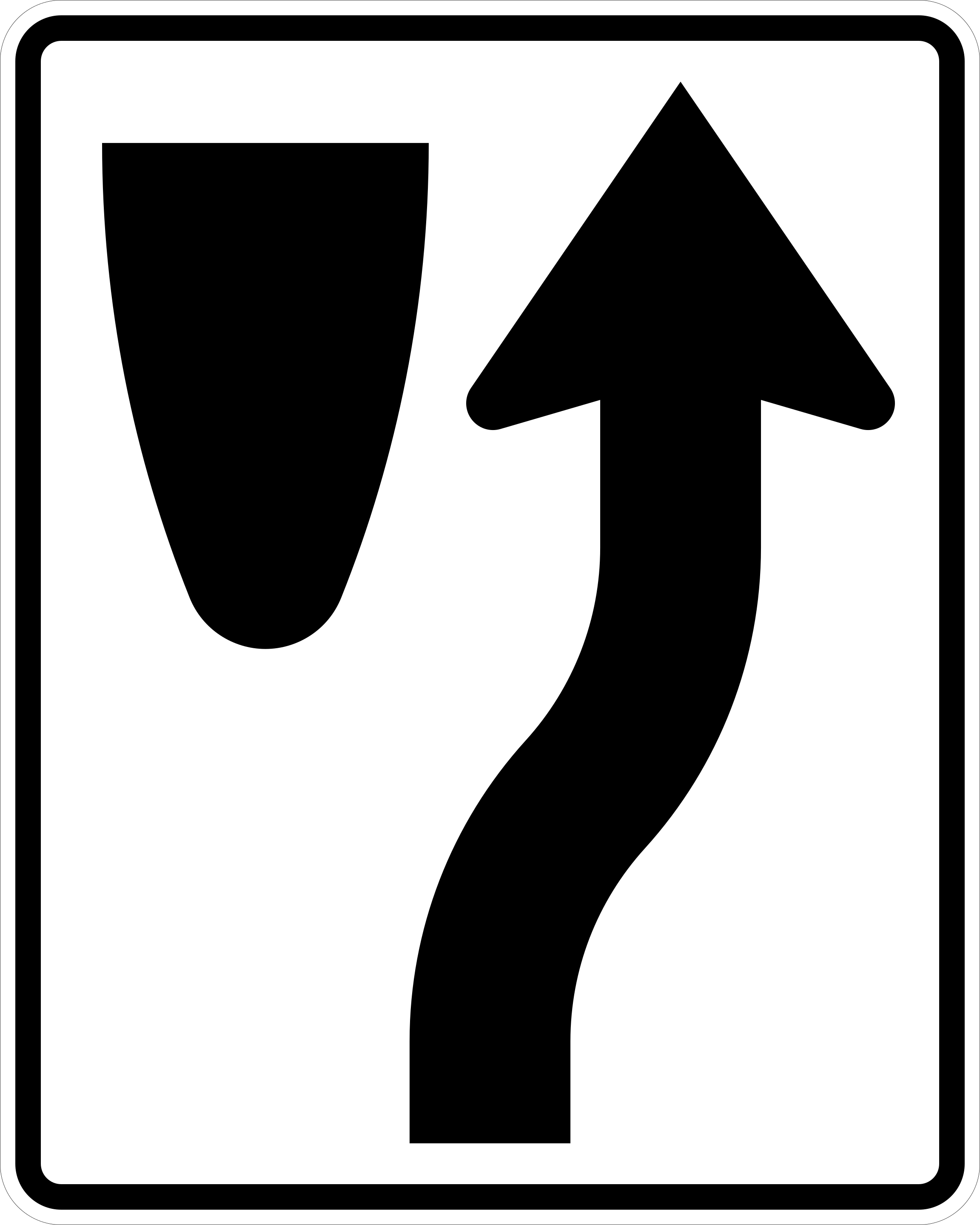
- Drive on the right side of the road, and pass on the left when passing is allowed
- Use the left side whenever it is empty
- Straddle the center line on narrow roads
- Drive in the center lane on any three-lane road
Show answer
Drive on the right side of the road, and pass on the left when passing is allowed. Keeping right is the default position in Massachusetts. The manual's rules for passing open with it: in general, the law requires you to drive on the right side of the road, and when passing is allowed you should pass on the left, with passing on the right allowed only in certain situations. The KEEP RIGHT sign applies that default at an obstruction by telling you which side to use. Using the left because it is empty puts you in the oncoming lane, straddling the center line leaves the right side, and a center lane may be a common left turn lane you may not travel in.
Study this in the handbook: Turns, right of way and rotaries
16. According to the Massachusetts manual, when should you pass a pedestrian, bicyclist, or motor vehicle?
- Whenever the vehicle ahead is below the speed limit
- Only when it is necessary and safe to do so
- Whenever you can see 200 feet ahead
- Only on a multi-lane road
Show answer
Only when it is necessary and safe to do so. Passing is not a right you exercise whenever someone ahead is slower; the manual limits it to when it is necessary and safe. A vehicle under the limit is not by itself a reason, a fixed sight distance is not the test, and passing is not restricted to multi-lane roads. The judgment covers oncoming traffic, sight distance, road markings and the room you can give the person you are overtaking. When the pass is not clearly needed and clearly safe, stay behind.
Study this in the handbook: Turns, right of way and rotaries
17. You see smoke coming from under the hood of your vehicle in Massachusetts. What does the manual tell you to do?
- Pull off the road, turn off the ignition, and move away from the vehicle
- Open the hood immediately to let the smoke out
- Keep driving to the nearest service station
- Pour water on the engine while it is running
Show answer
Pull off the road, turn off the ignition, and move away from the vehicle. Smoke from under the hood is treated as a fire, and the manual's sequence is to pull off the road, turn off the ignition, and move away from the vehicle, then call the fire department or emergency services. It adds that you should not try to fight the fire unless you have an extinguisher. Opening the hood, pouring water on a running engine and driving on to a service station all keep you at or in the burning vehicle instead of getting clear of it. Get everyone out and away first, and let firefighters handle the rest.
18. Where does the Massachusetts manual say you must not make a U-turn, even when no sign forbids it?
- Only on roads posted above 40 mph
- Only within 100 feet of a crosswalk
- Only after dark
- At the crest of a hill, near a curve, or anyplace where you or other drivers cannot see 500 feet away
Show answer
At the crest of a hill, near a curve, or anyplace where you or other drivers cannot see 500 feet away. The manual says you can make a U-turn if your path is clear and it is safe, but not at the crest of a hill, near a curve, or anyplace where you or other drivers cannot see 500 feet away. Hills and curves hide oncoming traffic, so a driver could appear while you are turning across the road. The rule is about sight distance, not a posted speed, a distance from a crosswalk, or the time of day. You also cannot make a U-turn where a NO U-TURN sign is posted, and you may only start one from the lane closest to the center line.
Study this in the handbook: Turns, right of way and rotaries
19. What corrected vision may qualify a Massachusetts driver for a daylight only license?
- 20/40 or better
- Worse than 20/100
- Between 20/50 and 20/70 in the better eye
- Any vision with glasses
Show answer
Between 20/50 and 20/70 in the better eye. If your corrected vision is between 20/50 and 20/70 in the better eye, you may be eligible for a daylight only license, while 20/40 is the standard for unrestricted driving. Medical Affairs handles other vision and physical qualifications and the voluntary reporting procedure for medical conditions. Have your eyesight checked every year or two, since vision loss is gradual and easy to miss.
Study this in the handbook: The learner's permit and permit exam
20. What shape is the standard advance warning sign for a railroad crossing in Massachusetts?
- Round
- Octagonal
- Pentagonal
- Rectangular
Show answer
Round. In Massachusetts there is usually a round warning sign before a railroad crossing. When you see it, slow down and prepare to stop, and if you see or hear a train coming, do not speed up and try to beat the train to the crossing. The point where the tracks cross the road is marked with a white crossbuck sign, and if more than one track crosses, the number of tracks is posted below the crossbuck. A crossing may also have red flashing lights and a bell. Octagonal, pentagonal, and rectangular are not the shape the manual gives for this advance warning sign.
Study this in the handbook: Railroad crossings and work zones
QualitySpace is expanding to Massachusetts
We are a California-based independent insurance brokerage working on licensing in more states. We cannot help with Massachusetts insurance yet. Leave your email and we will let you know when we can.
Every question is written from the official Massachusetts Driver's Manual. Need paper? Printable MA practice test with answer key.
Last verified 2026-10-05. How we check every question · Study all 500 as flashcards
Frequently asked questions
How many questions are on this Massachusetts practice test?
This fixed set has 20 questions. It is test 8 of 25 from the 500 question Massachusetts bank. The real MA exam asks 25 questions and you need 18 correct.
What is the passing score for the real Massachusetts test?
18 questions correct (out of 25) That figure comes from the official Massachusetts source cited on the DMV facts page.
How does this fixed test relate to the full Massachusetts bank?
Each numbered test is a fixed set of questions in a fixed order, so you can retake the same test later and compare. Every test mixes road signs and the other topics in about the same proportion as the full bank. Tests 1 to 25 together cover every question in the Massachusetts bank once. The full practice page mixes the whole bank at random.
Last verified 2026-10-05. See the Massachusetts DMV facts page for sourced state details.
Return to the full Massachusetts practice test · Study road signs