
Test 11 of 25 · 20 questions · Free 2026
MA Permit Practice Test 11
Jump to the test ↓A fixed 20 question set from the Massachusetts bank with answers and plain English explanations. The real MA exam is 25 questions, 72 percent to pass; take the full length version on the main practice page.
Question 1 of 20 · 0 right so far
All 20 questions in test 11
Every question below comes from the Massachusetts question bank on this page. Open a question to see the correct answer and the explanation. Nothing here is hidden behind a signup.
1. Who runs the Safe Driver Insurance Plan, and what drives the premium under it?
- The Merit Rating Board runs it, and premiums follow the driving record
- Each town clerk runs it, and premiums follow vehicle color
- The RMV runs it, and premiums follow annual mileage only
- Private agents run it jointly, and premiums ignore crashes
Show answer
The Merit Rating Board runs it, and premiums follow the driving record. The Merit Rating Board runs the Safe Driver Insurance Plan. Under SDIP, premiums are determined by the driving record. A safe driver’s rate may decrease; the rate increases for convictions of moving violations or being more than 50 percent at fault in a crash. The RMV is not the operator named for the plan, and mileage alone does not determine the premium. Town clerks do not run the plan, and vehicle color plays no role in merit based premium setting.
Study this in the handbook: Citations, surchargeable events and suspensions
2. You exit a highway where breakdown lanes serve as travel lanes. What check matters most?
- Check only the left mirror for faster traffic
- Look to your right and check your right hand blind spot before exiting
- Signal after leaving the travel lane
- Assume the breakdown lane is empty
Show answer
Look to your right and check your right hand blind spot before exiting. Take extra care when exiting a highway that uses breakdown lanes as travel lanes. Look to your right and check your right-hand blind spot before exiting. Signal when exiting a highway. Breakdown lanes in travel use may hold vehicles and cannot be assumed empty. Signals belong before the exit move, with the right blind spot verified. Left checks miss vehicles traveling in the right side breakdown lane.
Study this in the handbook: Signaling, lane use and highway driving
3. Which drivers and passengers are excused from the Massachusetts safety belt requirement because of vehicle age?
- All drivers of vehicles made before 1980
- Passengers only in vehicles without factory belts
- Drivers and passengers of vehicles made before July 1966
- No vehicle age exception exists
Show answer
Drivers and passengers of vehicles made before July 1966. Belt duties have a short exception list, and vehicle age supplies one entry. Drivers and passengers of vehicles made before July 1966 do not need to wear safety belts under this provision. Extending the cutoff to 1980 would excuse many newer vehicles that the rule still covers. Limiting the exception to passengers forgets that drivers of those early vehicles are included as well. Denying any age exception erases the listed category entirely. When checking an antique vehicle, look at its manufacture date first: before July 1966 is the dividing line written into the exception.
Study this in the handbook: Seat belts, child seats and safe following distance
4. What do crossing guards hold while walking into the street, and what should drivers expect?
- Orange cones for lane shifts
- Flashlights only after dark
- Speed limit paddles showing 20 mph
- Hand held stop paddles, warning drivers that children are crossing
Show answer
Hand held stop paddles, warning drivers that children are crossing. Crossing guards hold up stop paddles, which are hand-held stop signs, while walking into the street to warn drivers that children are crossing. Drivers should be prepared to stop and obey the guards’ signals. Crossing guards wear brightly colored, highly reflective clothing. The manual describes crossing guards holding stop paddles to warn of children crossing, not flashlight-only signals. Cones channel work zones; guards warn with hand held stop paddles.
Study this in the handbook: Pavement markings and special lanes
5. What can a first violation of the Massachusetts school bus stopping law bring?
- A verbal warning only
- A license suspension and a 250 dollar fine
- A 25 dollar parking ticket
- Community service with no fine
Show answer
A license suspension and a 250 dollar fine. A first violation of the school bus stopping law can cause a license suspension and a $250 fine. When the bus has its lights flashing and stop sign extended, stop and remain stopped until the lights stop flashing or the sign folds back. The exception is a bus on the other side of a divided highway with a barrier between travel directions.
Study this in the handbook: Passing, school buses and the move over law
6. Driving within a Massachusetts funeral procession, what speed rules apply?
- Up to 70 mph inside the procession
- Exactly the speed limit at all times, with no slower allowance
- No speed rules apply inside a procession
- Not faster than 55 MPH on a highway posted at 55 MPH or higher, and not more than 5 MPH slower than the limit on any other public way
Show answer
Not faster than 55 MPH on a highway posted at 55 MPH or higher, and not more than 5 MPH slower than the limit on any other public way. In a funeral procession, do not drive faster than 55 MPH on a highway posted at 55 MPH or higher, and do not go more than 5 MPH slower than the limit on any other public way. Drive carefully, keep headlights and taillights on, and use hazard lights if you are the first or last vehicle. Watch for pedestrians and other vehicles when entering intersections, and follow the lead vehicle only when safe.
7. The animal you are passing on a Massachusetts road looks scared. What must you do?
- Honk once to move it along
- Speed past before it reacts
- Pull your vehicle to the side and stop, proceeding only when it is safe
- Flash high beams at the rider
Show answer
Pull your vehicle to the side and stop, proceeding only when it is safe. If an animal you are passing looks scared, pull your vehicle to the side and stop. Proceed only when it is safe. Do not honk or make a loud noise, and stop if the rider or driver signals you to do so. If the animal looks scared, you must pull to the side and stop, then proceed only when safe. The required response is to pull to the side and stop, not flash high beams.
Study this in the handbook: Parking rules and hills
8. What are Shared Lane Markings, also called Sharrows, meant to help bicyclists do?
- Ride against traffic in a protected lane
- Stop and wait for drivers to wave them on
- Position themselves in the right location and right direction in a lane shared with motor vehicles
- Ride on the sidewalk at road speed
Show answer
Position themselves in the right location and right direction in a lane shared with motor vehicles. Shared Lane Markings, also known as Sharrows, guide riders inside ordinary travel lanes. They help bicyclists position themselves in the right location and in the right direction in a lane that is shared with motor vehicles, so riders can avoid the open door of a parked vehicle and avoid being squeezed beside a motor vehicle in a narrow lane. Riding against traffic contradicts the right direction purpose. Waiting for a wave invents a permission step. Sidewalk riding is a separate matter with walking pace duties. Drivers seeing a Sharrow should watch for bicyclists and leave passing space.
Study this in the handbook: Pavement markings and special lanes
9. On dry, level, clear pavement in Massachusetts, about what total distance does stopping from 50 mph require?
- About 215 feet
- About 104 feet
- About 292 feet
- About 55 feet
Show answer
About 215 feet. Stopping from 50 mph on dry, level, clear pavement takes about 215 feet in total, built from roughly 55 feet traveled while reacting plus another 160 feet or more after the brakes bite. Choosing 104 feet imports the total belonging to 30 mph and would leave a driver planning far too little room. The 292 foot figure belongs to 60 mph, where speed stretches every stage of the halt. Using 55 feet alone counts only the reaction slice and forgets the long braking roll that follows. Add reaction and braking together before judging any gap at this speed.
Study this in the handbook: Stopping distance, headlights, night and bad weather
10. In Massachusetts, what license suspension follows a drug trafficking conviction involving a substance other than Class D, even when no vehicle was operated?
- Thirty to one hundred eighty days
- One to five years
- Sixty days to one year
- One to three years
Show answer
One to five years. Massachusetts sets a license suspension of one to five years for any drug trafficking related conviction except a Class D substance, and operation of a vehicle is not required for that penalty to attach. Thirty to one hundred eighty days matches drag racing by drivers over eighteen, a driving offense with a shorter range. Sixty days to one year covers several vehicle related crimes such as operating to endanger. One to three years fits operating without the owner's authority, again a different offense. When trafficking appears without any driving, reach for the one to five year span.
11. A child is nine years old and meets the height mark for leaving a child restraint in Massachusetts. What belt rule and penalty apply?
- The child must wear a safety belt used correctly, and breaking that rule can bring a $25 fine
- No belt is required until age twelve, and no fine exists at any age
- A belt is optional when an adult sits beside the child in traffic
- The child must remain in a child restraint until age sixteen
Show answer
The child must wear a safety belt used correctly, and breaking that rule can bring a $25 fine. Children who are at least eight years old or at least 57 inches tall must wear safety belts correctly. The manual states that breaking this law can result in a $25 fine. The manual’s child-restraint requirement lasts until at least age eight or at least 57 inches tall; it does not require restraints until age sixteen. Belt use is already required from age eight or fifty-seven inches, with a fine attached.
Study this in the handbook: Seat belts, child seats and safe following distance
12. State law requires which steps when you leave your vehicle by itself?
- Leave the motor running for a quick return
- Set the brake only on hills
- Leave the key inside if doors are locked
- Stop the motor, set the parking brake, make sure the ignition is locked, remove your key, and lock the door
Show answer
Stop the motor, set the parking brake, make sure the ignition is locked, remove your key, and lock the door. When leaving your vehicle by itself, state law requires you to stop the motor, set the parking brake, make sure the ignition is locked, remove your key, and lock the door. These steps are not limited to parking on hills. The parking brake step applies whenever the vehicle is left, not only on hills. The manual requires removing your key as well as locking the ignition and door.
Study this in the handbook: Parking rules and hills
13. When may you pass a pedestrian, bicyclist, or motor vehicle, and what speed rule applies?
- Whenever the lane looks clear, exceeding the limit briefly
- Only when necessary and safe; you may not exceed the speed limit when passing, and if in doubt, do not pass
- Only on highways with three lanes
- Whenever the vehicle ahead is below the limit
Show answer
Only when necessary and safe; you may not exceed the speed limit when passing, and if in doubt, do not pass. Passing demands necessity, safety, and obedience at once. A pedestrian, bicyclist, or motor vehicle should be passed only when passing is necessary and safe. The speed limit still binds during the maneuver, so a brief excess remains a violation. Any doubt settles the choice against passing. Clear pavement alone ignores necessity and hidden hazards. Three lane highways are not the sole lawful setting, since two lane passing has its own sight rules. Slower traffic ahead invites evaluation, never automatic action. The discipline is restraint: gap, visibility, legality, and need must align before the steering wheel moves.
Study this in the handbook: Turns, right of way and rotaries
14. What happens when alcohol is combined with other drugs before driving?
- The effects cancel each other
- Combining alcohol with other drugs dramatically increases the negative effects
- Only the stronger drug matters
- Food removes the combined effect
Show answer
Combining alcohol with other drugs dramatically increases the negative effects. Combining alcohol with other drugs dramatically increases the negative effects. The manual warns not to mix alcohol, drugs, and driving. Eating does not change how quickly alcohol leaves your body. Eating does not change how quickly alcohol leaves your body, and the manual warns not to mix alcohol, drugs, and driving. The manual says combining alcohol with other drugs dramatically increases the negative effects.
Study this in the handbook: Zero tolerance and under 21 alcohol laws
15. You must use an Ignition Interlock Device and your car has the device, a center console brake, and a sponsor seat. How may you schedule a road test?
- Only by mail on a paper form
- Only in person at a police station
- Online at Mass.Gov/RMV
- Scheduling is barred while a device is installed
Show answer
Online at Mass.Gov/RMV. You can schedule the road test online at Mass.Gov/RMV if you can provide a vehicle with the required ignition interlock device, a center console brake, and a sponsor seat. If the vehicle has the device but lacks the center console brake or sponsor seat, call the RMV Contact Center and request a supervisor callback to schedule the test. For a vehicle meeting the listed equipment conditions, the manual permits online scheduling at Mass.Gov/RMV.
Study this in the handbook: Operating under the influence and chemical tests
16. How early may you renew a Massachusetts license or ID before it expires?
- Up to 30 days before expiration
- Up to 90 days before expiration
- Up to six months before expiration
- Up to one year before expiration
Show answer
Up to one year before expiration. You can renew your Massachusetts license or ID up to one year before its expiration date. The 30-day, 90-day, and six-month choices all give less advance time than the manual allows. Ninety days is a shorter advance-renewal window than the one year the manual allows. Six months gives only half the lead time; renewal may start a full year early. Thirty days is far narrower than the one year renewal window.
17. A Massachusetts driver requests a hearing on a civil citation and pays the filing fee. When is that fee refunded?
- Never, under any outcome
- When any single violation on the citation is dismissed
- When the court finds the driver NOT RESPONSIBLE for all violations on the civil citation
- Automatically after 20 days
Show answer
When the court finds the driver NOT RESPONSIBLE for all violations on the civil citation. Requesting a hearing on a civil motor vehicle citation requires a $25 filing fee to the RMV. You may send payment with the citation or pay online or by mail after receiving the RMV letter. The manual says the fee will be refunded if the court finds you NOT RESPONSIBLE for all violations on the civil citation. The manual states that the fee is refunded when the court finds you NOT RESPONSIBLE for all violations on the civil citation; dismissal of any one violation is not the condition it gives.
Study this in the handbook: Citations, surchargeable events and suspensions
18. What does Massachusetts law say about idling a stopped vehicle?
- Idling for more than five minutes is prohibited; switch the engine off when stopped
- Idling is allowed for ten minutes before any penalty
- Idling is banned only outside schools
- Idling in neutral is allowed without any time limit
Show answer
Idling for more than five minutes is prohibited; switch the engine off when stopped. Idling returns zero miles per gallon, and state law forbids idling beyond five minutes while stopped. Ten minutes doubles the legal allowance and burns fuel without moving a single wheel. Shifting into neutral during a necessary idle eases load against the brake, yet permission to idle indefinitely never follows from that tip. School zones carry no exclusive mention in this tip; the limit reads generally. Cue: watch a five minute timer beside the tachometer needle hovering above zero.
19. An emergency vehicle with siren or flashing lights approaches while you are inside an intersection in Massachusetts. What should you do?
- Drive through the intersection and pull over as soon as it is safe
- Stop inside the intersection and wait until the vehicle passes
- Slowly roll through the intersection without fully clearing it
- Pull to the left side of the intersection and stop there
Show answer
Drive through the intersection and pull over as soon as it is safe. Never stop in the middle of an intersection for an approaching emergency vehicle. Drive through the intersection and pull over as soon as it is safe. Pull as close as possible to the right side of the road and stop until the emergency vehicle has passed. You must drive through the intersection, then pull over safely and stop; slowly rolling is not acceptable. The manual says never to stop in the middle of an intersection; drive through and pull over when safe.
Study this in the handbook: Emergency vehicles, skids, brake failure and breakdowns
20. What does a Massachusetts sign with a red circle and a diagonal slash mean?
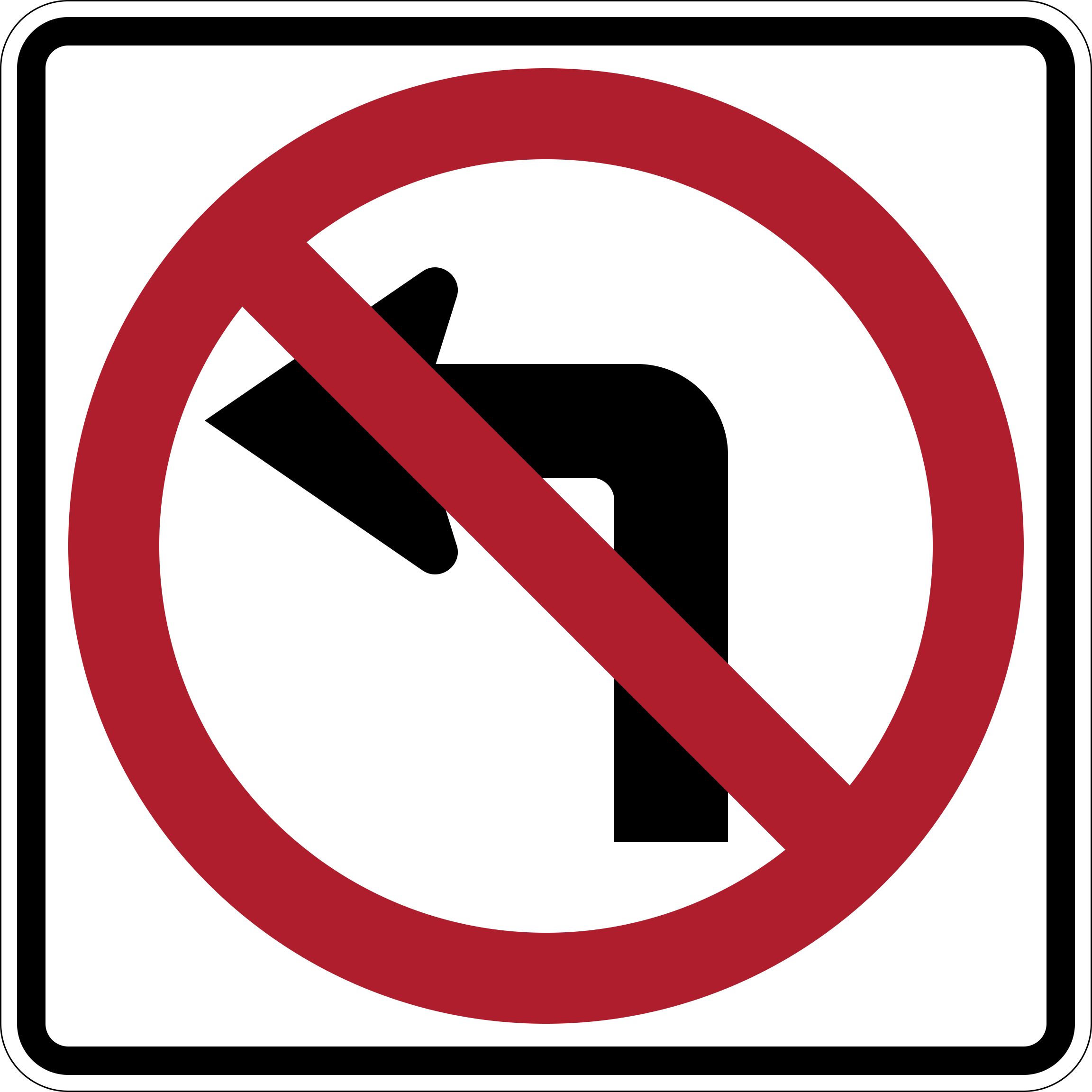
- Something is required
- A warning of a hazard
- A service is available
- Something is prohibited
Show answer
Something is prohibited. The red circle with a slash is the universal prohibition symbol, used on regulatory signs like no U-turn, no left turn and no trucks. It never means something is required, hazards are warned on yellow, and services appear on blue. When you see the slash, whatever is pictured inside the circle is not allowed at that location, so plan a different route or maneuver.
Study this in the handbook: Traffic sign colors and types
QualitySpace is expanding to Massachusetts
We are a California-based independent insurance brokerage working on licensing in more states. We cannot help with Massachusetts insurance yet. Leave your email and we will let you know when we can.
Every question is written from the official Massachusetts Driver's Manual. Need paper? Printable MA practice test with answer key.
Last verified 2026-10-05. How we check every question · Study all 500 as flashcards
Frequently asked questions
How many questions are on this Massachusetts practice test?
This fixed set has 20 questions. It is test 11 of 25 from the 500 question Massachusetts bank. The real MA exam asks 25 questions and you need 18 correct.
What is the passing score for the real Massachusetts test?
18 questions correct (out of 25) That figure comes from the official Massachusetts source cited on the DMV facts page.
How does this fixed test relate to the full Massachusetts bank?
Each numbered test is a fixed set of questions in a fixed order, so you can retake the same test later and compare. Every test mixes road signs and the other topics in about the same proportion as the full bank. Tests 1 to 25 together cover every question in the Massachusetts bank once. The full practice page mixes the whole bank at random.
Last verified 2026-10-05. See the Massachusetts DMV facts page for sourced state details.
Return to the full Massachusetts practice test · Study road signs