
Test 7 of 25 · 20 questions · Free 2026
MA Permit Practice Test 7
Jump to the test ↓A fixed 20 question set from the Massachusetts bank with answers and plain English explanations. The real MA exam is 25 questions, 72 percent to pass; take the full length version on the main practice page.
Question 1 of 20 · 0 right so far
All 20 questions in test 7
Every question below comes from the Massachusetts question bank on this page. Open a question to see the correct answer and the explanation. Nothing here is hidden behind a signup.
1. A vehicle is driving toward you head on in your lane. What does the Massachusetts manual tell you to do first?
- Steer left into the oncoming lane
- Flash your high beams and stay in your lane
- Slow down and pull to the right
- Stop in the middle of the road
Show answer
Slow down and pull to the right. When a car comes at you head on in your own lane, the manual's steps are to slow down, pull to the right, and sound your horn to alert the other driver. Slowing reduces how fast the gap closes and gives you more time to react, and pulling right moves you toward the edge of the road and away from the oncoming car. Flashing lights alone does not move you out of danger, steering left into the oncoming lane is not what the manual advises, and stopping in the middle of the road leaves you in the car's path. Move right first, then use the horn.
Study this in the handbook: Emergency vehicles, skids, brake failure and breakdowns
2. What is the fine for a first offense of parking in a Massachusetts space posted for disabled person or disabled veteran parking without plates or a placard?
- $300
- $25
- $100
- $1,000
Show answer
$300. Parking in a zone posted for HP-DV parking without the right plates or placard brings a $300 fine for a first offense. Wrongful use of a disabled person or veteran plate or placard costs at least $500. Twenty-five and one hundred dollars are far below the fine, and $1,000 is not the stated amount. Parking in the striped crosshatch area next to the space is also illegal, even with a placard.
Study this in the handbook: Parking rules and hills
3. Until what age or height must a Massachusetts child ride in a federally approved child passenger restraint?
- Until age 4 or 40 pounds
- Until at least eight years old or at least fifty-seven inches tall
- Until age 12 regardless of height
- Until age 6 or 50 inches
Show answer
Until at least eight years old or at least fifty-seven inches tall. Infants and children must ride in a federally approved child restraint until they are at least eight years old or at least fifty-seven inches tall. After that they must wear safety belts correctly. Age 4 and 40 pounds, age 6 and 50 inches, and age 12 are not the Massachusetts thresholds. A violation of the child restraint law can bring a $25 fine.
Study this in the handbook: Seat belts, child seats and safe following distance
4. What are the Massachusetts fines for seat belt violations?
- $25 for an unbelted driver and $25 for each unbelted passenger age 12 to 15
- A warning only
- $100 per person
- $500
Show answer
$25 for an unbelted driver and $25 for each unbelted passenger age 12 to 15. Massachusetts requires every person in a passenger vehicle, including vans and trucks under 18,000 pounds, to wear a safety belt or ride in a child restraint. A driver not wearing a belt can be fined $25, and the driver can also be fined $25 for each passenger age 12, 13, 14 or 15 who is unbelted. In 2023 nearly 11,000 unbelted people died in U.S. crashes.
Study this in the handbook: Seat belts, child seats and safe following distance
5. What does an orange sign mean in the Massachusetts sign color code?
- Stop or prohibition
- Construction or maintenance warning
- Motorist service
- Direction
Show answer
Construction or maintenance warning. In the manual's sign color code, orange means construction or maintenance warning. The manual adds that orange warning signs and work equipment usually mean people are on foot nearby, that you should follow road work signs and obey any police officer or civil flagger, and that speeding fines are doubled in posted work zones. Red is stop or prohibition, green is direction, and blue is motorist services. When orange appears, reduce your speed, stay alert for sudden changes in road direction or condition, and be prepared to stop.
Study this in the handbook: Traffic signals and pedestrian signals
6. What do Massachusetts regulatory signs, such as SPEED LIMIT signs, inform drivers of?
- Hazards ahead
- Distances to destinations
- Traffic laws or regulations
- Tourist attractions
Show answer
Traffic laws or regulations. Regulatory signs carry the rules: speed limits, turn restrictions, one-way streets, parking limits. They have a red or white background, and some use only words while others use only symbols. Hazards are the job of yellow warning signs, distances belong to green guide signs, and attractions are shown in brown. When a regulatory sign appears, treat it as a law you can be cited for breaking rather than a suggestion.
Study this in the handbook: Traffic sign colors and types
7. How far before a turn must a Massachusetts driver signal on an ordinary road, and on a highway?
- At least 50 feet everywhere
- At least 500 feet on a road and 100 feet on a highway
- Only when another vehicle is close enough to be affected
- At least 100 feet on a road and at least 500 feet on a highway
Show answer
At least 100 feet on a road and at least 500 feet on a highway. The signal has to reach other drivers early enough to matter, so the manual sets 100 feet on ordinary roads and 500 feet on a highway, where speeds are higher. Fifty feet is too late at any speed, and the road and highway numbers are not reversed. Signaling only when someone is nearby fails because the vehicle you did not see is the one that needed the warning. Signal before you brake so your intention is known first.
Study this in the handbook: Turns, right of way and rotaries
8. What speed limits are usual on Massachusetts highways, according to the manual?
- Between 25 and 35 mph
- 75 mph or more
- Between 45 and 65 mph
- Under 40 mph
Show answer
Between 45 and 65 mph. Highway speed limits are usually between 45 and 65 mph on expressways and freeways such as Routes 90, 495 and 128, which are entered and exited at interchanges. Yield to drivers already on the highway when merging, use the right lane for driving unless passing, and take extra care exiting where breakdown lanes serve as travel lanes during posted hours.
Study this in the handbook: Signaling, lane use and highway driving
9. Your car stalls on railroad tracks in Massachusetts and a train is coming. After everyone gets out, which way should you run?
- Straight down the tracks, away from the train
- Away from the tracks in the direction the train is heading
- Back to the car to try the engine one more time
- Away from the tracks at a 45 degree angle, in the direction the train is coming from
Show answer
Away from the tracks at a 45 degree angle, in the direction the train is coming from. When a train strikes a stalled car, the wreckage is carried forward along the train's path. That is why the manual tells you to get everyone out immediately, move as far from the tracks as you can, and run at a 45 degree angle away from the tracks toward the direction the train is coming from, then call 911. Running along the tracks or in the train's direction of travel puts you in the path of debris, and going back to the car wastes the seconds you need to get clear.
Study this in the handbook: Emergency vehicles, skids, brake failure and breakdowns
10. Unless posted otherwise, above what speed is a Massachusetts driver's speed not reasonable and proper in a thickly settled or business district?
- 30 mph, unless signs show a 25 mph limit
- 40 mph
- 50 mph
- 20 mph
Show answer
30 mph, unless signs show a 25 mph limit. Massachusetts speed law works from a list of unposted defaults, and a thickly settled or business district sits at 30 mph. Some communities have adopted a 25 mph limit and post signs saying so, which is why the choice mentions that exception. Twenty is the school zone figure, forty applies outside a thickly settled district, and fifty is for highways outside those districts. Exceeding the default is treated as speeding even without a sign, and driving at the default in rain or heavy traffic can still be ticketed as unreasonable.
Study this in the handbook: Speed limits and the dangers of speeding
11. Your Massachusetts vehicle has antilock brakes and they fail to respond even with the pedal fully pressed. What does the manual tell you to do?
- Pump the brake pedal rapidly
- Turn off the ignition to slow the engine
- Downshift to a lower gear, working down to the lowest gear if necessary
- Steer into oncoming traffic to get attention
Show answer
Downshift to a lower gear, working down to the lowest gear if necessary. The manual gives a specific sequence for antilock brakes that do not respond with the pedal fully pressed: downshift to a lower gear and work down to the lowest gear if necessary, then apply the parking brake gently while holding the release in case the vehicle starts to skid. It also says plainly not to pump antilock brakes; pumping is the step for vehicles without them. Turning off the ignition is not one of the steps, and steering toward oncoming traffic trades one emergency for a worse one. If you still cannot slow down, sound the horn and flash your lights to warn others.
Study this in the handbook: Emergency vehicles, skids, brake failure and breakdowns
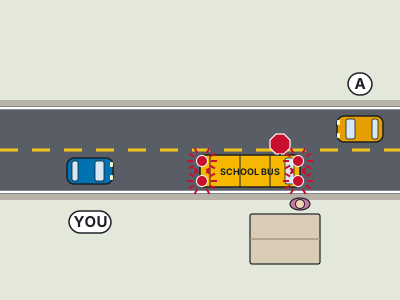
12. A school bus in Massachusetts has its lights flashing and its stop sign extended. What must you do?
- Slow to 10 mph and pass carefully
- Pass on the left if the road is clear
- Stop only if children are visible
- Stop
Show answer
Stop. When the red lights flash and the stop sign swings out, Massachusetts requires every driver approaching from either direction to stop. There is no slow and pass option, and you do not get to judge whether children are visible; the ones you cannot see are the reason for the rule. Passing on the left is the classic school bus violation. The single exception is a bus stopped on the far side of a divided highway with a barrier between the travel directions.
Study this in the handbook: Passing, school buses and the move over law
13. What does a flashing yellow arrow allow a Massachusetts driver to do?
- Turn without yielding because the turn is protected
- Turn in the direction of the arrow when oncoming traffic has a green light but there is a break in traffic
- Stop and wait for a green arrow
- Go straight only
Show answer
Turn in the direction of the arrow when oncoming traffic has a green light but there is a break in traffic. The flashing yellow arrow is a permissive turn signal. It allows you to turn left or right in the direction of the arrow while oncoming traffic has a green light, so you may turn only when there is a break in that traffic. The manual says you must carefully determine that there is an adequate gap in oncoming traffic and make sure no pedestrians are in your path. It is not a protected turn, it does not restrict you to going straight, and you do not have to wait for a green arrow. Turn only when the gap is clearly enough.
Study this in the handbook: Traffic signals and pedestrian signals
14. What must a Massachusetts driver do for a blind pedestrian crossing a street with a white cane or guide dog?
- Stop completely
- Slow down and go around
- Sound the horn to warn them
- Yield only if they are in a marked crosswalk
Show answer
Stop completely. The White Cane Law gives blind pedestrians a stronger protection than ordinary yielding: when a person with a white cane or a guide dog is crossing a street, you must stop completely. The manual adds that you should remain stopped until the person has safely crossed, should not honk or wave the person on, and should never pass another stopped vehicle. The rule is about the street crossing, not only a marked crosswalk. The white cane and the guide dog are the signals to look for, and once you see them, stop and wait.
Study this in the handbook: Pedestrians, bicyclists, motorcycles and mopeds
15. If a Massachusetts JOL applicant completes a driver skills development program, how many parent-supervised hours will the RMV accept?
- 12 hours
- 20 hours
- 50 hours
- 30 hours
Show answer
30 hours. The standard requirement is at least 40 hours of supervised driving certified by a parent or guardian. The RMV will accept 30 hours if the applicant completed a driver skills development program. Twelve hours is the behind-the-wheel training in driver education, and 20 and 50 are not Massachusetts figures for this rule. The 30 classroom hours of driver education are separate.
Study this in the handbook: The Junior Operator License (ages 16 1/2 to 18)
16. A Massachusetts learner's permit is suspended three months before the road test. What happens to the six-month permit period?
- It starts over when the suspension is lifted
- It keeps counting during the suspension
- It is waived
- It drops to 30 days
Show answer
It starts over when the suspension is lifted. An applicant needs a valid learner's permit for six consecutive months before the road test. Any suspension invalidates the permit, and the six months start running anew once the suspension is lifted. Time held before the suspension does not carry over, so the clock does not keep counting and is not waived or shortened. The same idea applies to the six-month passenger restriction, which pauses during a suspension.
Study this in the handbook: The Junior Operator License (ages 16 1/2 to 18)
17. In heavy rain or fog in Massachusetts, what does the manual say about visibility?
- Visibility is unaffected if headlights are on
- Hard rain, fog, and mist can make it more difficult to see
- Fog improves contrast at night
- Only snow reduces visibility
Show answer
Hard rain, fog, and mist can make it more difficult to see. The manual pairs traction and vision when it talks about bad weather: rain and wet roads make it harder to start, stop and turn, and hard rain, fog and mist make it harder to see. Headlights help others see you but do not restore your view, fog scatters light and worsens contrast, and snow is only one of several conditions that blind you. Slow to a speed that lets you stop within what you can see, and use low beams in fog.
Study this in the handbook: Stopping distance, headlights, night and bad weather
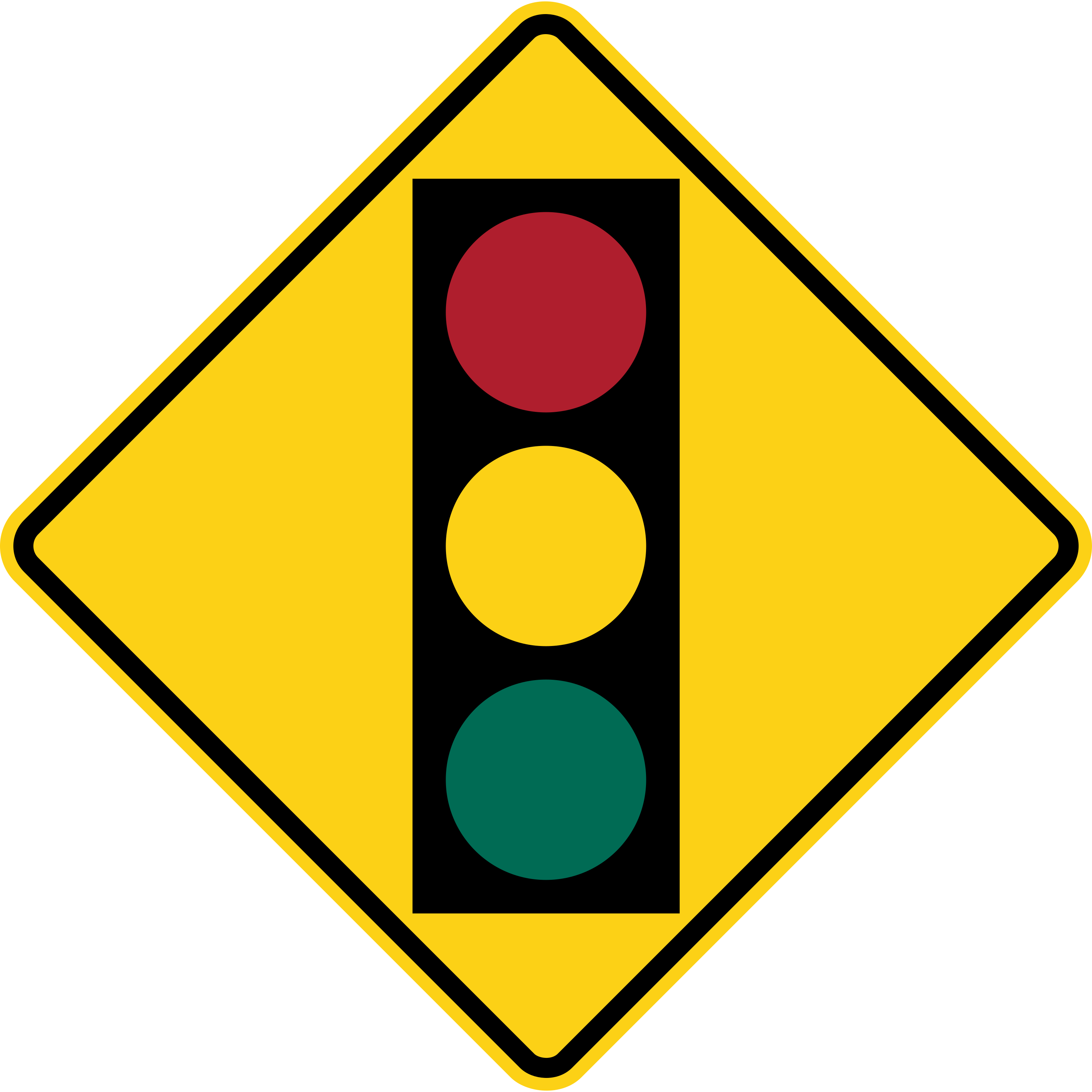
18. This SIGNAL AHEAD sign warns of a traffic light ahead. If that light shows a steady yellow circle as you approach, what does it mean?
- The signal is broken
- Speed up to clear the intersection
- Turns are prohibited
- The signal is changing from green to red
Show answer
The signal is changing from green to red. The advance sign tells you a signal is coming; the steady yellow circle tells you it is about to turn red. Yellow is not a malfunction and it is not an invitation to accelerate; it is the moment to stop if you can do so safely, and to clear the intersection only if you are already too close to stop. Turns are governed by arrows and posted signs, not by the yellow phase. Seeing the SIGNAL AHEAD sign, ease off so a yellow does not catch you at full speed.
Study this in the handbook: Traffic signals and pedestrian signals
19. A Massachusetts driver under 18 is charged with OUI and refuses a chemical test. What additional suspension does the manual describe, and does winning the court case remove the alcohol education requirement?
- An additional 30 days, waived if the case is won
- No additional suspension, only the education course
- An additional one year suspension, and the alcohol education requirement remains even if the case is won
- An additional 180 days, waived on acquittal
Show answer
An additional one year suspension, and the alcohol education requirement remains even if the case is won. For drivers under 18, refusing the chemical test adds a full year of suspension, and the manual is explicit that the outcome of the court case does not matter: even a driver who wins still must complete the alcohol education course. Thirty days is not a figure the rule uses, the education requirement is not the only consequence, and the 180 day version applies to drivers who are 18 to 20, not to those under 18. The extra year exists to get these youths into alcohol education, which is why acquittal does not cancel it.
Study this in the handbook: Operating under the influence and chemical tests
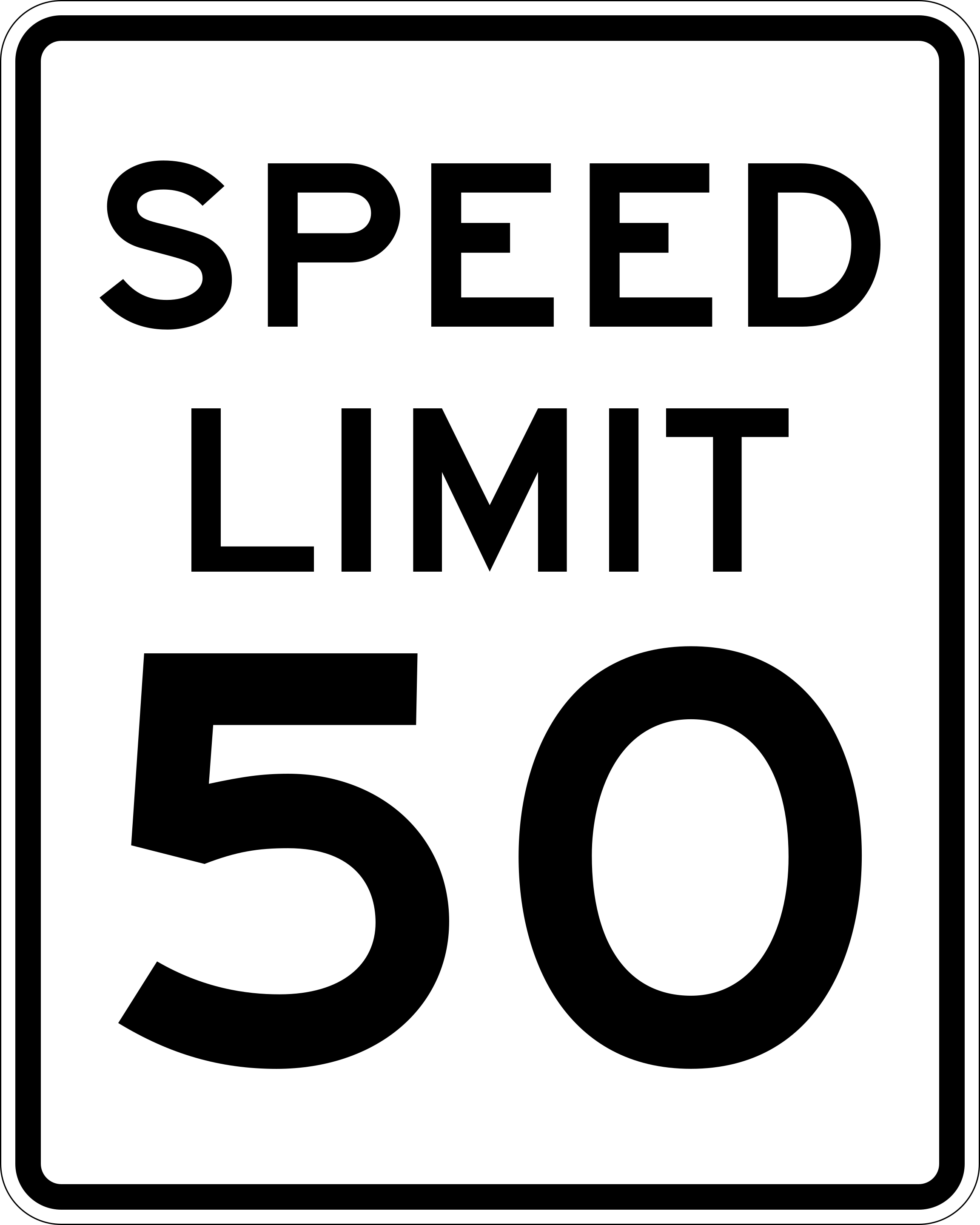
20. This white sign with black words states a speed limit. According to the Massachusetts manual, how do SPEED LIMIT signs convey their message?
- They always use an image of a speedometer
- They may include only words
- They use a red circle and slash
- They are always yellow
Show answer
They may include only words. Massachusetts sorts signs by how they speak. Some, like NO U-TURN, use only an image; some combine words and images; and some, like SPEED LIMIT signs, may include only words. There is no speedometer picture, the red slash is reserved for prohibitions, and yellow is the warning color rather than the regulatory white. Speed limit signs can also carry flashing yellow lights or apply only during posted hours, so read the whole sign, not just the number.
Study this in the handbook: Traffic sign colors and types
QualitySpace is expanding to Massachusetts
We are a California-based independent insurance brokerage working on licensing in more states. We cannot help with Massachusetts insurance yet. Leave your email and we will let you know when we can.
Every question is written from the official Massachusetts Driver's Manual. Need paper? Printable MA practice test with answer key.
Last verified 2026-10-05. How we check every question · Study all 500 as flashcards
Frequently asked questions
How many questions are on this Massachusetts practice test?
This fixed set has 20 questions. It is test 7 of 25 from the 500 question Massachusetts bank. The real MA exam asks 25 questions and you need 18 correct.
What is the passing score for the real Massachusetts test?
18 questions correct (out of 25) That figure comes from the official Massachusetts source cited on the DMV facts page.
How does this fixed test relate to the full Massachusetts bank?
Each numbered test is a fixed set of questions in a fixed order, so you can retake the same test later and compare. Every test mixes road signs and the other topics in about the same proportion as the full bank. Tests 1 to 25 together cover every question in the Massachusetts bank once. The full practice page mixes the whole bank at random.
Last verified 2026-10-05. See the Massachusetts DMV facts page for sourced state details.
Return to the full Massachusetts practice test · Study road signs