
Key points
Always leave at least a 12 foot wide clear roadway for traffic to pass.
Source: Handbook p. 109
“You must always make sure that you leave at least a 12-foot wide, clear roadway for traffic to pass.”
Massachusetts Driver's Manual, Handbook p. 109In a business or residential district, park no more than 12 inches from the curb.
Source: Handbook p. 109
“If you park in a business or residential district, your vehicle must be no more than 12 inches from the curb.”
Massachusetts Driver's Manual, Handbook p. 109When you leave your vehicle, stop the motor, set the parking brake, lock the ignition, take the key and lock the door.
Source: Handbook p. 109
“When you leave your vehicle by itself, state law requires you to stop the motor, set the parking brake, make sure the ignition is locked, remove your key, and lock the door.”
Massachusetts Driver's Manual, Handbook p. 109With no curb, turn your wheels inward, toward the edge of the road.
Source: Handbook p. 110
“Turn your wheels inward, toward the edge of the road.”
Massachusetts Driver's Manual, Handbook p. 110Uphill against a curb, turn your wheels outward, toward the travel lane.
Source: Handbook p. 110
“Turn your wheels outward, toward the travel lane.”
Massachusetts Driver's Manual, Handbook p. 110Downhill against a curb, turn your wheels inward, toward the curb.
Source: Handbook p. 110
“Turn your wheels inward, toward the curb.”
Massachusetts Driver's Manual, Handbook p. 110Do not park within 20 feet of an intersection.
Source: Handbook p. 110
“Within 20 feet of an intersection”
Massachusetts Driver's Manual, Handbook p. 110Parking in a posted bus stop brings a $100 penalty.
Source: Handbook p. 110
“In a bus stop (the penalty for parking in a posted bus stop is $100)”
Massachusetts Driver's Manual, Handbook p. 110Never park facing the wrong way against traffic.
Source: Handbook p. 111
“Facing the wrong way against traffic”
Massachusetts Driver's Manual, Handbook p. 111
Numbers to know
| Number | What it means | Manual |
|---|---|---|
| 12 feet | clear roadway you must leave | Handbook p. 109 |
| 12 inches | farthest from the curb in business or residential districts | Handbook p. 109 |
| 20 feet | no parking distance from an intersection | Handbook p. 110 |
| 10 feet | no parking distance from a fire hydrant or fire lane | Handbook p. 111 |
| $100 | fine for parking in a posted bus stop | Handbook p. 110 |
| $300 | first offense fine for parking in a disability space without plates or a placard | Handbook p. 110 |
Recognize these signs
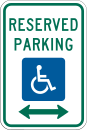
Disability parking 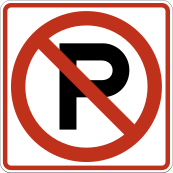
No parking
3 questions from the Massachusetts practice test
1. You park on a Massachusetts hill where there is no curb. Which way should you turn your front wheels?
- Inward, toward the edge of the road
- Straight ahead
- Outward, toward the travel lane
- It does not matter if the parking brake is set
Show answer
Inward, toward the edge of the road. With no curb there is nothing to catch a rolling wheel, so the goal is to send the car off the road rather than into traffic if the brake fails. Massachusetts says to turn the wheels inward, toward the edge of the road, whether you face uphill or downhill. Turning outward would aim a runaway car into the travel lane, straight wheels give it a free path, and the parking brake is a backup rather than a substitute for wheel position. Set the brake, shift to park or leave a manual in gear, then turn the wheels.
2. You park facing uphill against a curb in Massachusetts. Which way should the front wheels point?
- Inward, toward the curb
- Outward, toward the travel lane
- Straight ahead
- Toward the sidewalk
Show answer
Outward, toward the travel lane. Uphill against a curb is the one case where the wheels turn outward. If the brake fails the car rolls backward, the back of the front tire meets the curb, and the curb stops it. Turning inward would let the car roll back into the street, straight wheels give no protection, and the sidewalk is the wrong direction for a backward roll. Downhill against a curb reverses the answer, with the wheels turned inward toward the curb, and with no curb the wheels always turn toward the road edge.
3. You park facing downhill against a curb in Massachusetts. Which way should the front wheels point?
- Outward, toward the travel lane
- Straight ahead
- It does not matter on a downhill grade
- Inward, toward the curb
Show answer
Inward, toward the curb. Facing downhill, a rolling car moves forward, so the front wheels are turned inward toward the curb; if the brake lets go, the front tire rolls into the curb and stops. Outward is the uphill against a curb answer and would steer the car into the lane, straight wheels provide no backstop, and the grade is exactly why wheel position matters. The manual pairs this with setting the parking brake and shifting into park, or leaving a manual transmission in gear.
Practice this topic
Lock it in with parking questions from the free Massachusetts practice test. Every answer comes with a plain English explanation.
Source: the Massachusetts Driver's Manual, Chapter 4: Rules of the Road. This lesson is a plain English summary, not the law itself; where it differs, the manual and the statute govern. Last checked 2026-09-27.