
Key points
To pass across a broken yellow line, you must see clearly at least 400 feet ahead.
Source: Handbook p. 103
“If you are crossing a broken yellow line to pass, you must be able to see clearly at least 400 feet in front of you.”
Massachusetts Driver's Manual, Handbook p. 103Return to the right lane before any oncoming vehicle comes within 200 feet.
Source: Handbook p. 103
“You must return to the right lane before any oncoming vehicle comes within 200 feet of you.”
Massachusetts Driver's Manual, Handbook p. 103Never pass using a breakdown lane, shoulder or sidewalk.
Source: Handbook p. 102
“Never use a breakdown lane, the shoulder of a road, or a sidewalk for passing another vehicle.”
Massachusetts Driver's Manual, Handbook p. 102If you are being passed, slow down, stay right and do not speed up.
Source: Handbook p. 103
“If you are being passed by another vehicle, you must slow down and stay to the right. Allow the other driver to pass safely. Do not speed up.”
Massachusetts Driver's Manual, Handbook p. 103For a stopped emergency vehicle on a highway with at least 4 lanes, move over to a lane not next to it.
Source: Handbook p. 104
“If you are on a highway with at least four lanes (at least two of which allow travel in the same direction you are heading), yield the right-ofway by safely “moving over” to a lane that is not next to the lane”
Massachusetts Driver's Manual, Handbook p. 104If you cannot move over, still proceed with caution at a reasonable, safe speed.
Source: Handbook p. 104
“If “moving-over” is not possible, you must still proceed with caution and reduce your speed to that of a reasonable and safe speed for the road conditions.”
Massachusetts Driver's Manual, Handbook p. 104You must stop for a school bus with flashing lights and stop sign out, no matter which side of the road you are on.
Source: Handbook p. 105
“If a school bus or a school pupil transport vehicle has its lights flashing and a stop sign extended, you must stop. It is the law. It does not matter which side of the road you are traveling on.”
Massachusetts Driver's Manual, Handbook p. 105A first school bus violation can bring a license suspension and a $250 fine.
Source: Handbook p. 105
“A first violation of this law can cause a license suspension and a $250 fine.”
Massachusetts Driver's Manual, Handbook p. 105The only exception is a school bus on the other side of a divided highway with a barrier.
Source: Handbook p. 105
“The only exception to this law is if a school bus has stopped on the other side of a divided highway with a barrier between travel directions.”
Massachusetts Driver's Manual, Handbook p. 105Do not drive closer than 8 feet to a trolley's passenger step while riders get on or off.
Source: Handbook p. 107
“You must not drive closer than eight feet of a trolley passenger step when the trolley is letting passengers on or off.”
Massachusetts Driver's Manual, Handbook p. 107
Numbers to know
| Number | What it means | Manual |
|---|---|---|
| 400 feet | clear view needed to pass across a broken yellow line | Handbook p. 103 |
| 200 feet | distance from oncoming traffic by which you must finish passing | Handbook p. 103 |
| 4 lanes | highway size where the move over law requires a lane change | Handbook p. 104 |
| $250 | fine for a first school bus violation | Handbook p. 105 |
| 8 feet | closest you may drive to a trolley passenger step | Handbook p. 107 |
Recognize these signs
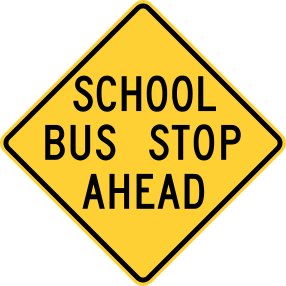
School bus stop ahead
3 questions from the Massachusetts practice test
1. Under Massachusetts's move-over law, what must you do when approaching a stationary emergency vehicle displaying its flashing lights?
- Stop completely behind the vehicle
- Proceed with caution and reduce your speed to one that is reasonable and safe for the road conditions
- Maintain the posted limit so traffic keeps flowing
- Sound the horn to alert the responders
Show answer
Proceed with caution and reduce your speed to one that is reasonable and safe for the road conditions. Massachusetts framed its 2008 move-over law around caution and speed. When you approach a stationary emergency vehicle with its lights flashing you must proceed carefully and slow to a speed that is reasonable and safe for the conditions, moving to a farther lane when that can be done safely. Stopping in the travel lane creates a new hazard, holding the posted limit past people working on the shoulder is what the law forbids, and the horn helps no one. Slow early, give room, and watch for responders on foot.
2. You see a stopped emergency vehicle on the shoulder ahead with flashing lights. What speed does Massachusetts expect as you pass?
- A speed that is reasonable and safe for the road conditions, below the posted limit if needed
- At least 10 mph over to clear the scene quickly
- Exactly the posted limit
- Walking speed in every case
Show answer
A speed that is reasonable and safe for the road conditions, below the posted limit if needed. The law does not name a number; it requires a speed that is reasonable and safe for the conditions as you approach a stationary emergency vehicle with flashing lights, which in practice means well below the posted limit near people on foot. The posted limit is the maximum for open road, not for a crash scene, going faster is the violation, and walking speed is not always required on a wide highway with an empty adjacent lane. Slow, move over if you can, and proceed with caution.
3. A school bus is stopped with red lights flashing on the opposite side of a Massachusetts road that has only a painted center line. What must you do?
- Slow to 20 mph and pass
- Continue, because the bus is on the other side
- Stop, because the exception applies only to a divided highway with a barrier
- Stop only if children are crossing
Show answer
Stop, because the exception applies only to a divided highway with a barrier. Traffic in both directions stops for a school bus unless a barrier physically separates the two roadways. A painted line, a turn lane or even a grass median without a barrier does not qualify, so on an ordinary two-way road you stop even when the bus faces the other way. Slowing to pass is the violation the law was written against, and children who have not started to cross yet are exactly the ones the stop protects.
Practice this topic
Lock it in with emergencies questions from the free Massachusetts practice test. Every answer comes with a plain English explanation.
Source: the Massachusetts Driver's Manual, Chapter 4: Rules of the Road. This lesson is a plain English summary, not the law itself; where it differs, the manual and the statute govern. Last checked 2026-09-27.