
Test 6 of 25 · 20 questions · Free 2026
MA Permit Practice Test 6
Jump to the test ↓A fixed 20 question set from the Massachusetts bank with answers and plain English explanations. The real MA exam is 25 questions, 72 percent to pass; take the full length version on the main practice page.
Question 1 of 20 · 0 right so far
All 20 questions in test 6
Every question below comes from the Massachusetts question bank on this page. Open a question to see the correct answer and the explanation. Nothing here is hidden behind a signup.
1. You break down on an undivided Massachusetts highway. Besides 10 feet and 100 feet behind your vehicle, where should a warning triangle or LED flare go?
- On the roof of your vehicle
- 500 feet behind your vehicle
- 100 feet in front of your vehicle
- Nowhere else; two devices are enough
Show answer
100 feet in front of your vehicle. On a road where traffic runs in both directions, a disabled car can be approached from the front as well as from behind. For a two lane road or an undivided highway, the manual places warning triangles or LED flares 10 feet behind the vehicle, 100 feet behind the vehicle, and 100 feet in front of it. On a divided highway, where traffic comes from only one direction, the two rear positions are enough. A roof or a spot 500 feet back is not part of the layout.
Study this in the handbook: Emergency vehicles, skids, brake failure and breakdowns
2. What penalty does the Massachusetts manual list for parking in a posted bus stop?
- A $25 penalty
- A $100 penalty
- A $300 penalty
- A $15 penalty
Show answer
A $100 penalty. A bus stop is on the Massachusetts list of places where you may not park, and it is one of the few entries on that list where the manual names the penalty itself: $100 for parking in a posted bus stop. Most other parking fines are set by city or town ordinance and vary. Three hundred dollars is the first offense fine for a disabled parking zone, and fifteen dollars is the bottom of the Turnpike range, so neither is the bus stop amount. Twenty five dollars is far too low.
Study this in the handbook: Parking rules and hills
3. A Massachusetts street has a marked bike lane. May a bicyclist ride in the full travel lane instead?
- Yes, a bicyclist may use the full lane even when there is a bike lane
- No, a bicyclist must stay in the bike lane whenever one exists
- Only on weekends and holidays
- Only if the bicyclist rides faster than 20 mph
Show answer
Yes, a bicyclist may use the full lane even when there is a bike lane. Massachusetts law lets bicyclists use the full lane anywhere, anytime, and on any street, even if there is a bike lane. The only exception is limited access or express state highways posted with signs prohibiting bicycles. Drivers should not expect a rider to move into the bike lane to clear the way, and should pass only when it is safe, leaving at least four feet. No weekend rule or minimum riding speed limits the right, and a bicyclist on a public way must obey the same basic traffic laws as drivers.
4. What do broken white lines on a Massachusetts road separate?
- Traffic traveling in opposite directions
- Lanes of traffic traveling in the same direction
- The road from the shoulder
- Lanes where crossing is never allowed
Show answer
Lanes of traffic traveling in the same direction. White lines separate traffic moving the same way, and the broken pattern tells you that once you have signaled and it is safe, you may cross the line when changing lanes. Opposing traffic is separated by yellow lines, and the right edge of the pavement is marked by a single white line. The marking you may not cross is the double solid white line, which also separates two lanes going the same direction. A solid white line may be crossed only when you need to avoid danger, so the broken line is the one that invites a planned lane change.
Study this in the handbook: Pavement markings and special lanes
5. In the Massachusetts sign color code, what do purple signs indicate?
- Evacuation routes
- Incident management
- Regulations such as speed limits
- Electronic toll collection
Show answer
Electronic toll collection. Purple has one narrow use in the manual's color list: electronic toll collection signs. Evacuation routes share blue with motorist services such as gas, food, and hotels, incident management signs are fluorescent pink, and regulations such as speed limits are black and white. Because the shapes and colors of traffic signs carry meaning, spotting purple from a distance tells you the sign concerns tolling, which gives you more time to read it and choose your lane calmly.
Study this in the handbook: Traffic signals and pedestrian signals
6. According to the Massachusetts manual, what share of crashes happen at speeds of 40 mph or less?
- Two out of ten
- Half
- Eight out of ten
- One out of ten
Show answer
Eight out of ten. Speed feels like a highway problem, but the manual points out that eight out of ten crashes happen at 40 mph or less. It also notes that most motor vehicle crashes happen less than 25 miles from home, on the short, familiar trips drivers take every day. Two in ten and one in ten invert the statistic, and half understates it. The lesson is that a windshield strike at 30 mph is like a three story fall, so belts and attention matter on the slow trips as much as on the interstate.
Study this in the handbook: Seat belts, child seats and safe following distance
7. This pedestrian crossing sign warns of a crosswalk ahead. What does Massachusetts law require when a pedestrian is entering or using a crosswalk in your path?

- You may proceed if you sound the horn
- You must yield only at signalized crossings
- You must stop only if the crosswalk is marked
- You must yield to the pedestrian
Show answer
You must yield to the pedestrian. The sign gives advance notice; the law behind it is simple. A driver must yield to any pedestrian entering or using a crosswalk in the travel path, must never let the vehicle block a crosswalk, and must never pass a vehicle that is stopped or slowing for a pedestrian. The horn does not transfer the right of way. The manual also singles out blind pedestrians with a white cane or guide dog, for whom you must stop completely. Slow when you see the sign and scan both curbs.
Study this in the handbook: Traffic signals and pedestrian signals
8. What is the first offense fine for violating Massachusetts' law on driving with an out of country license?
- $25
- $500, as a criminal violation of Chapter 90, Section 10
- $5,000
- No fine, only a warning
Show answer
$500, as a criminal violation of Chapter 90, Section 10. Chapter 90, Section 10 allows certain validly licensed drivers from other countries to operate validly registered vehicles in Massachusetts, but driving outside those terms is a criminal violation and a first offense carries a fine of $500. A visitor must carry the valid foreign license while driving, along with an English translation when the license lacks one. Anyone who becomes a Massachusetts resident must obtain a Massachusetts license to keep driving, and there is no grace period.
Study this in the handbook: The learner's permit and permit exam
9. A Massachusetts road has a single broken yellow center line. Where must you normally drive, and when may you cross it?
- Drive on either side freely
- Cross it only to park
- Stay left of the line
- Stay to the right of the line, crossing only temporarily to pass when it is safe
Show answer
Stay to the right of the line, crossing only temporarily to pass when it is safe. A broken yellow line separates lanes of traffic moving in opposite directions, so your lane is to the right of it. The manual says to stay to the right of the line unless you are passing a vehicle in front of you, and to cross it only temporarily when it is safe. Driving on either side freely or staying left puts you in the oncoming lane, and the line has nothing to do with parking. When you do pass, you must be able to see clearly at least 400 feet ahead and return to the right lane before any oncoming vehicle comes within 200 feet.
Study this in the handbook: Pavement markings and special lanes
10. How many people died from distracted driving in 2023, according to the Massachusetts manual?
- About 50,000
- About 100
- 3,275
- About 800
Show answer
3,275. In 2023 distracted driving resulted in 3,275 deaths. Massachusetts prohibits hand held mobile electronic device use while driving under Chapter 90, Section 13B, and drivers under 18 cannot use any mobile electronic device for any reason while driving. Adults may use hands free mode only, and fines and other penalties apply to violators of the hands free law, with escalating fines for repeat offenses.
Study this in the handbook: Hands free law and distracted driving
11. A Massachusetts traffic signal is not working. According to the manual, how will it usually appear?
- It will simply flash either red or yellow lights
- It will show all three colors at once
- It will show a steady green in every direction
- It will be dark and should be ignored
Show answer
It will simply flash either red or yellow lights. When a signal is not working in Massachusetts it will usually flash either red or yellow lights, and you then follow the rules for flashing lights. Flashing red works as a stop sign and flashing yellow as a warning, so the intersection still has rules. A failed signal will not show all colors or give everyone green. If the signals are blacked out and not functioning, the manual says to be cautious and proceed as though there is a stop sign in all directions, going only when it is safe.
Study this in the handbook: Traffic signals and pedestrian signals
12. What are Massachusetts' minimum insurance limits?
- $15,000, $30,000 and $5,000
- $25,000 per person and $50,000 per crash for bodily injury, and $30,000 for property damage
- $50,000, $100,000 and $25,000
- $10,000 combined
Show answer
$25,000 per person and $50,000 per crash for bodily injury, and $30,000 for property damage. Massachusetts minimum limits are $25,000 per person and $50,000 per crash for bodily injury and $30,000 for property damage, and a road test vehicle registered out of state must show the examiner proof of coverage equal to those limits. A policy or a certificate that lists the coverage limits serves as that proof. If the road test vehicle is rented, the driver must also show the rental agreement and a letter from the rental company authorizing its use for the test.
Study this in the handbook: The road test
13. When entering a Massachusetts rotary, to whom must you yield unless signs or a police officer direct otherwise?
- Vehicles already in the rotary and pedestrians
- Nobody, because entering traffic has priority
- Only trucks and buses
- Vehicles entering from your right
Show answer
Vehicles already in the rotary and pedestrians. Rotaries are a Massachusetts specialty, and the rule inside them is simple: traffic already circulating has the right of way, and so do pedestrians at the crossings. Entering vehicles wait for a gap, no matter which direction they come from, so the idea of yielding only to the right or of entering traffic having priority is backwards. Vehicle size plays no part. Signs or an officer can change the pattern at a particular rotary, which is why the rule carries that exception.
Study this in the handbook: Turns, right of way and rotaries
14. How many questions are on each Massachusetts learner's permit exam?
- 18 multiple-choice questions
- 40 true or false questions
- 50 multiple-choice questions
- 25 multiple-choice questions
Show answer
25 multiple-choice questions. Each learner's permit exam contains 25 multiple choice questions covering alcohol misuse, suspensions, JOL violations, rules of the road and road signs. Eighteen is the number you must get right, not the number asked, and fifty or forty questions overstate the exam. The test allows about a minute per question, for a 25 minute limit, and is offered on automated testing kiosks and online in several languages for Class D and M permits.
Study this in the handbook: The learner's permit and permit exam
15. When passing a bicycle or moped in Massachusetts, what does the manual list first?
- Pass as closely as possible to save time
- Sound the horn repeatedly
- Lower your speed
- Speed up to shorten the pass
Show answer
Lower your speed. The manual's checklist for passing a bicycle or moped begins with lowering your speed. A slower pass gives you time to judge the space, gives the rider less wind blast, and lets you stop if the bike swerves around a pothole. Repeated horn use startles riders, passing close is the crash the rule prevents, and speeding up removes your margin. After lowering speed, give the rider room and do not cut back to the right until you are safely past.
Study this in the handbook: Pedestrians, bicyclists, motorcycles and mopeds
16. This WRONG WAY sign faces you. In the Massachusetts parking rules, may you park a vehicle facing the wrong way against traffic?
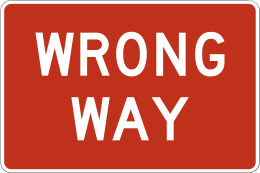
- No, parking facing the wrong way against traffic is prohibited
- Yes, if the hazard lights are on
- Yes, on any residential street
- Yes, for less than five minutes
Show answer
No, parking facing the wrong way against traffic is prohibited. Facing the wrong way is not only a driving error; the Massachusetts list of places where you may not park includes leaving a vehicle facing the wrong way against traffic, alongside parking on a sidewalk, in a crosswalk, double parked, or during a weather or roadway emergency. The list gives no residential street exception, hazard lights do not legalize it, and there is no short duration allowance. The manual adds that fines for most of these violations are set by city or town ordinance, and unpaid parking tickets can stop you from renewing your license or registration.
Study this in the handbook: Parking rules and hills
17. A Massachusetts driver who is 19 fails a chemical test. What suspension applies?
- 30 days only
- 30 days plus an additional one year
- 30 days plus an additional 180 days
- Three years
Show answer
30 days plus an additional 180 days. Drivers age 18 to 21 who fail a chemical test lose the license for 30 days plus an extra 180 days under MGL chapter 90, section 24P. If this is the first OUI case, the 180 days can be waived by entering a Department of Public Health approved alcohol education program. Thirty days alone applies to drivers over 21. The extra full year applies to drivers under 18, and three years is a refusal period.
Study this in the handbook: Zero tolerance and under 21 alcohol laws
18. A Massachusetts traffic signal shows a steady yellow light as you approach. What should you do?
- Speed up to beat the red
- Stop only if there is a pedestrian
- Turn left without yielding
- Stop if you can do so safely, because the signal is changing from green to red
Show answer
Stop if you can do so safely, because the signal is changing from green to red. Yellow is the start of the stop, not a sprint signal. The steady yellow means the light is changing from green to red, so you stop if you can do so safely, and if you are already stopped at the intersection or the stop line you may not proceed. Accelerating on yellow is what lands cars in the intersection when cross traffic gets green. Pedestrians are not the only trigger for stopping, and no turn is free of yielding on a yellow.
Study this in the handbook: Traffic signals and pedestrian signals
19. If your vehicle stalls on railroad tracks in Massachusetts, no train is coming, and you cannot move the vehicle off the tracks, what does the manual say to do?
- Wait in the vehicle for the train to stop
- Call the toll free Emergency Notification System number on the crossbuck or the metal box near the crossing
- Flash the headlights at the train
- Push the vehicle along the tracks
Show answer
Call the toll free Emergency Notification System number on the crossbuck or the metal box near the crossing. When a stalled vehicle cannot be moved off the tracks and no train is coming, the manual says to call the toll free Emergency Notification System number located in the middle of the crossbuck or on the metal box near the grade crossing. Give the railroad dispatcher the DOT grade crossing locator number that is also on the sign, say that a vehicle is on the tracks, and follow the dispatcher's instructions. Before that, listen for a train, try to restart the engine, and try to push the vehicle off the tracks in neutral. If a train is coming, get everyone out and away immediately.
Study this in the handbook: Emergency vehicles, skids, brake failure and breakdowns
20. What maximum penalty does Massachusetts law set for leaving the scene of a crash that damaged another vehicle or property without identifying yourself?
- Up to $200 or up to two years in prison, or both
- A written warning only
- Up to $5,000 or up to 10 years in state prison
- A $35 civil fine
Show answer
Up to $200 or up to two years in prison, or both. Leaving the scene without stopping and identifying yourself is a crime, even when only property is damaged. For a crash that damages another vehicle or other property, the maximum penalty is up to $200 or up to two years imprisonment, or both. Penalties climb when someone is hurt: up to $1,000 and two years for an injury, and up to $5,000 with up to 2 1/2 years in jail or 10 years in state prison when the crash causes a death. A conviction can also bring insurance surcharges and a license suspension.
QualitySpace is expanding to Massachusetts
We are a California-based independent insurance brokerage working on licensing in more states. We cannot help with Massachusetts insurance yet. Leave your email and we will let you know when we can.
Every question is written from the official Massachusetts Driver's Manual. Need paper? Printable MA practice test with answer key.
Last verified 2026-10-05. How we check every question · Study all 500 as flashcards
Frequently asked questions
How many questions are on this Massachusetts practice test?
This fixed set has 20 questions. It is test 6 of 25 from the 500 question Massachusetts bank. The real MA exam asks 25 questions and you need 18 correct.
What is the passing score for the real Massachusetts test?
18 questions correct (out of 25) That figure comes from the official Massachusetts source cited on the DMV facts page.
How does this fixed test relate to the full Massachusetts bank?
Each numbered test is a fixed set of questions in a fixed order, so you can retake the same test later and compare. Every test mixes road signs and the other topics in about the same proportion as the full bank. Tests 1 to 25 together cover every question in the Massachusetts bank once. The full practice page mixes the whole bank at random.
Last verified 2026-10-05. See the Massachusetts DMV facts page for sourced state details.
Return to the full Massachusetts practice test · Study road signs