
Test 5 of 25 · 20 questions · Free 2026
MA Permit Practice Test 5
Jump to the test ↓A fixed 20 question set from the Massachusetts bank with answers and plain English explanations. The real MA exam is 25 questions, 72 percent to pass; take the full length version on the main practice page.
Question 1 of 20 · 0 right so far
All 20 questions in test 5
Every question below comes from the Massachusetts question bank on this page. Open a question to see the correct answer and the explanation. Nothing here is hidden behind a signup.
1. How much instruction on the driver education curriculum must a parent or guardian of a Massachusetts JOL applicant take?
- Thirty minutes
- Six hours
- Two hours
- Twelve hours
Show answer
Two hours. A parent or guardian must take part in two hours of instruction on the driver education curriculum, unless they did so within the past five years. Six and twelve hours are student figures, the six hours of observing other drivers and the twelve hours behind the wheel. Thirty minutes is short of the rule. The parent also certifies the 40 hours of supervised driving.
Study this in the handbook: The Junior Operator License (ages 16 1/2 to 18)
2. What is the Massachusetts fine for a first offense of failing to produce your license or registration when an officer asks?
- $5
- $35
- $100
- $500
Show answer
$35. Chapter 90, section 11 requires drivers to keep their license and registration handy, and failing to produce either brings a $35 fine for a first offense. Five dollars is the separate public safety surcharge on civil fines. One hundred dollars is the fine for refusing to give a name and address or giving a false one, a separate offense that can also lead to arrest. Five hundred dollars is not a figure in this rule.
Study this in the handbook: Emergency vehicles, skids, brake failure and breakdowns
3. What surcharge is added to every Massachusetts civil motor vehicle infraction fine under Chapters 89 or 90?
- Nothing
- A $50 court fee
- A $5 public safety surcharge
- A $100 surcharge
Show answer
A $5 public safety surcharge. Every fine for a civil motor vehicle infraction that comes from Chapter 89 or 90 of the General Laws carries an added $5 public safety surcharge. The RMV records all moving violations on your driving record, and an attested copy of that record costs $20. Criminal motor vehicle offenses such as OUI and leaving the scene are handled separately in criminal court and can bring license suspension and jail.
Study this in the handbook: Citations, surchargeable events and suspensions
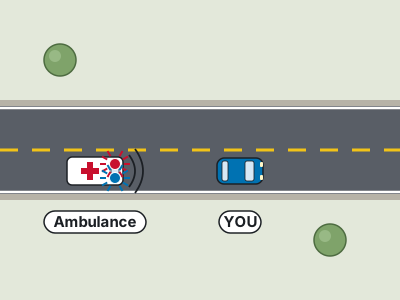
4. An emergency vehicle is approaching you from behind with lights and siren. According to the Massachusetts manual, what should you do?
- Stop immediately where you are, even in the travel lane
- Speed up to stay ahead of it
- Move to the left lane to leave the right lane open
- Check your mirrors and find a safe place to pull over to the right
Show answer
Check your mirrors and find a safe place to pull over to the right. The manual's instruction is to check your mirrors and find a safe place to pull over to the right, then stop until the emergency vehicle has passed. Stopping suddenly in the travel lane is exactly what the manual warns against, speeding up keeps you in the vehicle's path, and the manual specifically says not to pull your vehicle to the left. Use your right turn signal, and never stop in the middle of an intersection. Before pulling back out, be sure another emergency vehicle is not following the first.
Study this in the handbook: Emergency vehicles, skids, brake failure and breakdowns
5. You damage a parked vehicle in Massachusetts and the owner is not present. What must you do?
- Try to locate the owner to report the crash, or notify the local police
- Leave the scene if the damage looks minor
- Wait ten minutes, then drive away
- Report it only if the damage exceeds $5,000
Show answer
Try to locate the owner to report the crash, or notify the local police. Hitting an unattended vehicle or other property does not end when you drive away. The manual requires you to try to find the owner and report the crash, and if you cannot, to notify the local police. Leaving because the damage seems small is the definition of leaving the scene, waiting a fixed time is not a substitute for reporting, and there is no dollar threshold below which the duty disappears. Even after a small crash you must stop, and leaving the scene can bring a hit and run charge.
6. What is the penalty for a Massachusetts driver under 18 convicted of a first offense of using a mobile electronic device while driving?
- A $100 fine, a 60-day license or permit suspension, and an attitude-change course before reinstatement
- A written warning only, since first offenses carry no fine
- A $250 fine and a 180-day suspension
- A $35 fine with no suspension
Show answer
A $100 fine, a 60-day license or permit suspension, and an attitude-change course before reinstatement. A junior operator's first conviction for using a mobile electronic device brings a $100 fine and a 60-day suspension of the license or permit, and the license is not reinstated until the driver completes a program that encourages attitudinal changes in young drivers. The $250 fine with a 180-day suspension is the penalty for a second offense, so picking it confuses the tiers. There is no warning-only first offense. Remember the ladder: 100 dollars and 60 days first, then it climbs.
7. When may a Massachusetts driver turn left on a red light?
- At any intersection after a complete stop
- When driving on a one-way street and turning left onto another one-way street, after stopping and yielding
- Never
- Only when a green arrow appears
Show answer
When driving on a one-way street and turning left onto another one-way street, after stopping and yielding. Massachusetts allows a left on red in one narrow case: you are on a one-way street and you are turning left onto another one-way street. Even then you stop first and yield to pedestrians and other vehicles. The right on red rule does not extend to left turns at ordinary intersections, a green arrow is a protected turn rather than a red light exception, and never is wrong because the one-way case exists. A NO TURN ON RED sign removes the option.
Study this in the handbook: Traffic signals and pedestrian signals
8. You are driving through a posted Massachusetts work zone and are caught speeding. What happens to the fine?
- It is waived if no workers were present
- It is doubled
- It is reduced because the limit is temporary
- It is the same as anywhere else
Show answer
It is doubled. Massachusetts doubles the speeding fine in a posted work zone. The manual states the rule without exceptions, so it gives no waiver when no workers happen to be visible, the temporary nature of a work zone limit does not soften the fine, and the fine is not the ordinary amount. The manual explains elsewhere that orange warning signs and work equipment usually mean people are on foot nearby. When approaching a work zone, reduce your speed, watch for sudden changes in road direction or condition, and be prepared to stop.
Study this in the handbook: Citations, surchargeable events and suspensions
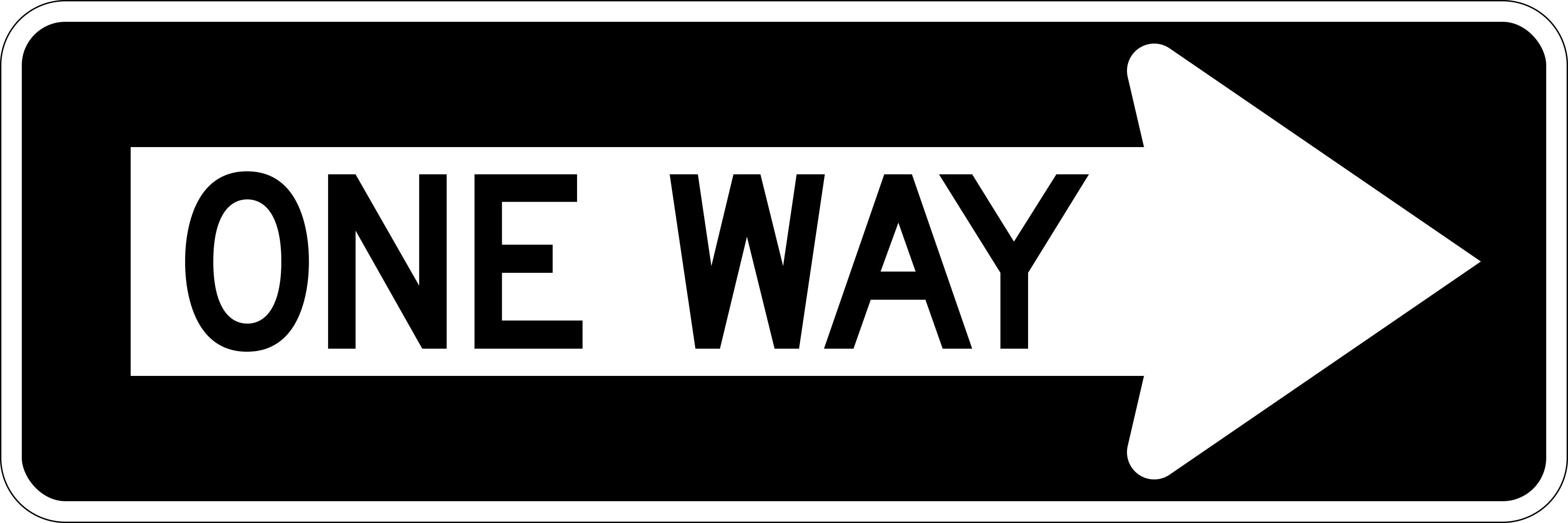
9. This ONE WAY sign marks a one-way street. In Massachusetts, what may a single yellow line mark on a one-way street?
- The center of the street
- A parking lane
- A bicycle lane
- The left edge of the pavement
Show answer
The left edge of the pavement. On a one-way street there is no opposing traffic, so a center yellow line would make no sense. Massachusetts instead uses a single yellow line to mark the left edge of the pavement on one-way streets and divided highways, telling you where the road ends on the side that would normally face oncoming cars. Bicycle lanes and parking areas are marked in white. The rule pairs with the ONE WAY sign: yellow on the far left edge confirms you are traveling with the flow.
Study this in the handbook: Pavement markings and special lanes
10. This merge sign warns that traffic will join your roadway. In a work zone, what does the Massachusetts manual say to do when you see channeling devices in the roadway?

- Stop and wait for a flagger
- Drive between the devices to hold your lane
- Carefully merge into the adjacent travel lane
- Speed up to get ahead of merging traffic
Show answer
Carefully merge into the adjacent travel lane. Merging works when everyone moves early and predictably. In a work zone the cones, barrels and arrow panels are placed before the closure so you have notice to merge into the adjacent open lane while there is still room. Stopping in a live lane invites a rear end crash, threading between the devices puts you in the closed lane, and racing ahead of the merge forces a late, dangerous squeeze. Signal, check your mirror and shoulder, and blend in.
Study this in the handbook: Railroad crossings and work zones
11. How many questions must a Massachusetts applicant answer correctly to pass the learner's permit exam, and in how much time?
- 20 questions within 30 minutes
- 25 questions within 60 minutes
- 15 questions within 20 minutes
- 18 questions within 25 minutes
Show answer
18 questions within 25 minutes. The permit exam has a clock as well as a score. Massachusetts requires 18 correct answers within 25 minutes, and the audio version of the exam carries the same 25 minute limit. The other combinations either overstate the number needed or invent a longer time window. Cheating carries a separate penalty: anyone found responsible cannot hold any license or permit for 60 days. Using a driver's manual, other reference material or an electronic device during the exam counts as cheating.
Study this in the handbook: The learner's permit and permit exam
12. On a designated throughway in Massachusetts, what must you do before you turn?
- Yield the right of way to traffic on the throughway
- Stop for at least three seconds
- Sound your horn
- Flash your headlights
Show answer
Yield the right of way to traffic on the throughway. A throughway is the road given priority, and the rule is that you yield to its traffic before turning onto or across it. There is no fixed stop time, and horns and headlights never substitute for yielding. Check both directions, judge the gap against your acceleration, and turn only when you can complete the move without making throughway traffic brake. The same logic applies at any intersection where one road is signed as the through road.
Study this in the handbook: Turns, right of way and rotaries
13. Under the Massachusetts rules for pedestrians, where should a person walk when no sidewalk is available?
- On the shoulder, with their back to traffic
- In the center of the travel lane
- Along the nearest expressway shoulder
- On the shoulder, facing traffic
Show answer
On the shoulder, facing traffic. Pedestrians must use a sidewalk when one is available. When there is none, the manual says to walk on the shoulder facing traffic, so the walker can see approaching vehicles and step aside. Walking with traffic at your back hides the danger, the travel lane is not a walking space, and pedestrians must never walk along or across expressways, interstate highways, or turnpikes. Drivers should expect walkers on shoulders of roads without sidewalks, especially at night, when the manual urges bright or reflective clothing.
14. What do yellow and fluorescent yellow-green warning signs tell a Massachusetts driver?
- That there are hazards or changes in conditions ahead
- The distance to the next exit
- That the road is closed
- That a law is being stated that you must obey
Show answer
That there are hazards or changes in conditions ahead. Yellow, including the bright fluorescent yellow green version, is the warning color. These signs announce a hazard or a change in conditions ahead: the road layout may be changing, a school zone may be coming, or there may be a special situation ahead, and the manual says to slow down and obey the sign. Regulatory signs, which state laws, have a red or white background, and green guide signs give highway directions, distances and destinations. Nothing about a yellow warning sign means the road is closed. Read yellow as a prompt to slow and look.
Study this in the handbook: Traffic sign colors and types
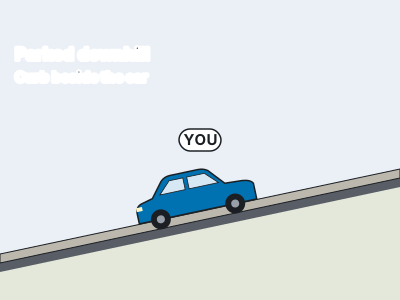
15. You park facing downhill against a curb in Massachusetts. Which way should the front wheels point?
- Outward, toward the travel lane
- Straight ahead
- It does not matter on a downhill grade
- Inward, toward the curb
Show answer
Inward, toward the curb. Facing downhill, a rolling car moves forward, so the front wheels are turned inward toward the curb; if the brake lets go, the front tire rolls into the curb and stops. Outward is the uphill against a curb answer and would steer the car into the lane, straight wheels provide no backstop, and the grade is exactly why wheel position matters. The manual pairs this with setting the parking brake and shifting into park, or leaving a manual transmission in gear.
Study this in the handbook: Parking rules and hills
16. A Massachusetts road has a double yellow center line with one solid and one broken line, and the solid line is closer to you. What does that mean?
- You may pass when it is safe
- You cannot cross the lines
- The lines mark the shoulder
- Only vehicles from the other direction may not cross
Show answer
You cannot cross the lines. Read the line nearest your lane. With one solid and one broken yellow line, the solid line on your side means you cannot cross, while drivers on the broken line side may pass when it is safe. The rule is about which side the solid line is on, not about the other direction being free to cross, and yellow lines separate opposing traffic rather than marking a shoulder. Solid means stay, broken means you may pass with care.
Study this in the handbook: Pavement markings and special lanes
17. What fine does Massachusetts set for having an open alcoholic drink inside a vehicle?
- $25 to $50
- $1,000 to $2,000
- $100 to $500
- No fine if a passenger holds it
Show answer
$100 to $500. You may not drink while driving or have an open alcoholic drink in the vehicle, even if someone else is holding it. A conviction brings a fine of $100 to $500. Anyone under 21 is also arrested, fined and suspended. The idea that a passenger holding the drink avoids the fine is exactly what the law rules out. Twenty-five to fifty dollars is too low, and $1,000 to $2,000 is too high.
Study this in the handbook: Operating under the influence and chemical tests
18. A yellow school bus ahead has stopped with its red lights flashing and stop sign extended on a Massachusetts road. Where does the stop sign fold out from?
- The rear bumper
- The roof
- The driver's side of the bus
- The passenger door
Show answer
The driver's side of the bus. The manual describes the equipment so you recognize it: yellow school buses have flashing red lights and stop signs that fold out from the driver's side. The rear bumper, roof and passenger door are not where the manual places the sign. When the lights flash and the sign is out, you must stop, whichever side of the road you are on, and remain stopped until the lights stop flashing or the stop sign folds back. Vans, station wagons and family sedans used as school pupil transport vehicles show flashing red lights with SCHOOL BUS signs on top instead.
Study this in the handbook: Passing, school buses and the move over law
19. In the Massachusetts sign color code, what does yellow indicate?
- General warning
- Motorist services
- Recreation
- Direction, showing where you can go
Show answer
General warning. The color code lets you sort a sign before you can read it. In the manual's list, yellow is general warning, green is direction, blue is motorist services such as gas, food and hotels, and brown is a recreational, historic or scenic site. A yellow sign means a hazard or change ahead, so ease off and look for the specific condition it names. Fluorescent yellow green is used for school zone, bicycle, pedestrian and curve warnings, and orange for construction or maintenance warnings.
Study this in the handbook: Traffic signals and pedestrian signals
20. What should a pedestrian in Massachusetts do when the DON'T WALK signal is showing?
- Cross quickly before the light changes
- Not begin to cross
- Cross only if no cars are coming
- Wait for a police officer
Show answer
Not begin to cross. Pedestrians must obey the WALK and DON'T WALK signals just as drivers obey the lights. DON'T WALK means do not begin to cross; someone already in the crosswalk should finish crossing. Dashing across ahead of the change or crossing because the street looks empty ignores the turning traffic the manual warns pedestrians to watch for. A police officer is not required to cross legally; push the button where there is one and wait for the WALK signal, then look left and right before stepping off the curb.
Study this in the handbook: Traffic signals and pedestrian signals
QualitySpace is expanding to Massachusetts
We are a California-based independent insurance brokerage working on licensing in more states. We cannot help with Massachusetts insurance yet. Leave your email and we will let you know when we can.
Every question is written from the official Massachusetts Driver's Manual. Need paper? Printable MA practice test with answer key.
Last verified 2026-10-05. How we check every question · Study all 500 as flashcards
Frequently asked questions
How many questions are on this Massachusetts practice test?
This fixed set has 20 questions. It is test 5 of 25 from the 500 question Massachusetts bank. The real MA exam asks 25 questions and you need 18 correct.
What is the passing score for the real Massachusetts test?
18 questions correct (out of 25) That figure comes from the official Massachusetts source cited on the DMV facts page.
How does this fixed test relate to the full Massachusetts bank?
Each numbered test is a fixed set of questions in a fixed order, so you can retake the same test later and compare. Every test mixes road signs and the other topics in about the same proportion as the full bank. Tests 1 to 25 together cover every question in the Massachusetts bank once. The full practice page mixes the whole bank at random.
Last verified 2026-10-05. See the Massachusetts DMV facts page for sourced state details.
Return to the full Massachusetts practice test · Study road signs