
Test 4 of 25 · 20 questions · Free 2026
MA Permit Practice Test 4
Jump to the test ↓A fixed 20 question set from the Massachusetts bank with answers and plain English explanations. The real MA exam is 25 questions, 72 percent to pass; take the full length version on the main practice page.
Question 1 of 20 · 0 right so far
All 20 questions in test 4
Every question below comes from the Massachusetts question bank on this page. Open a question to see the correct answer and the explanation. Nothing here is hidden behind a signup.
1. In the Massachusetts sign color code, what are fluorescent pink signs used for?
- Electronic toll collection
- Incident management
- School zones
- Scenic routes
Show answer
Incident management. The manual's color list gives fluorescent pink a single job: incident management signs. When you see that color, the sign is about managing an incident on the road rather than a permanent rule or a service. Purple is the color for electronic toll collection signs, school zone, bicycle, pedestrian, and curve warnings use fluorescent yellow green, and recreational, historic, or scenic sites are brown. Learning the full color list lets you sort a sign by color long before you can read its words.
Study this in the handbook: Traffic signals and pedestrian signals
2. Unless posted otherwise, what is the Massachusetts statutory speed threshold on an undivided highway outside a thickly settled or business district?
- 30 mph
- 50 mph
- 40 mph
- 55 mph
Show answer
40 mph. An unposted, undivided highway outside a thickly settled or business district has a 40 mph statutory threshold in Massachusetts, measured over at least one-quarter mile. The corresponding divided-highway threshold is 50 mph. Open country alone does not make an undivided road a 50 mph road. A posted speed limit controls where signs establish one, and drivers must slow further when rain, limited sight distance, or other conditions require it.
Study this in the handbook: Speed limits and the dangers of speeding
3. On a two-way Massachusetts road with a broken yellow center line, when may you cross into the oncoming lane?
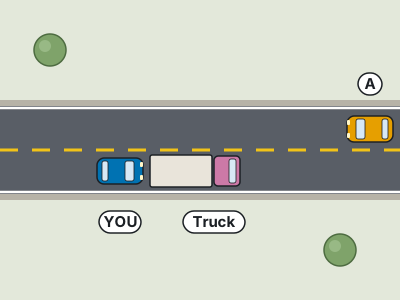
- Any time the lane looks empty
- Temporarily, to pass a vehicle, if it is safe to do so
- Never
- Only to turn left into a driveway
Show answer
Temporarily, to pass a vehicle, if it is safe to do so. The broken yellow line is a conditional permission. You may cross it temporarily to pass a vehicle when it is safe, and the manual sets the conditions: you must be able to see clearly at least 400 feet in front of you, and you must return to the right lane before any oncoming vehicle comes within 200 feet of you. An empty looking lane is not enough on its own, the line is not limited to driveway turns, and never describes the double solid line, not the broken one. Signal, pass, and move back to the right once you can see the passed vehicle's headlights in your mirror.
Study this in the handbook: Passing, school buses and the move over law
4. What does the Massachusetts manual tell drivers to do near a curve or any place where they cannot see clearly ahead?
- Always slow down
- Move to the center of the road for a better view
- Flash the high beams to warn oncoming drivers
- Maintain speed to keep momentum through the curve
Show answer
Always slow down. Curves and blind spots share the same rule: slow down before you get there. A vehicle is more likely to leave the road at a curve, and anything hidden beyond a crest or bend leaves you no time if you arrive fast. Holding speed for momentum is a racing idea, not a driving manual one. Moving toward the center puts you in the path of oncoming traffic, and flashing high beams does not reveal the road ahead. Keep to the right and ease off before the curve, not in it.
Study this in the handbook: Signaling, lane use and highway driving
5. What does a flashing yellow circle mean at a Massachusetts intersection?
- It means the same as a stop sign
- It means the signal is broken
- It is a warning
- It means a left turn is protected
Show answer
It is a warning. A flashing yellow circle is a warning: the manual says to proceed with caution, stay alert, and look both ways when crossing the intersection. It does not require a stop. The flashing red circle is the one that means the same as a stop sign. A flashing signal is a normal mode, not a broken one, and a protected left turn is shown by a green arrow, not a flashing yellow circle. Treat the flashing yellow as permission to continue only after you have slowed enough to react to anyone crossing your path.
Study this in the handbook: Traffic signals and pedestrian signals
6. You park on a Massachusetts hill where there is no curb. Which way should you turn your front wheels?
- Inward, toward the edge of the road
- Straight ahead
- Outward, toward the travel lane
- It does not matter if the parking brake is set
Show answer
Inward, toward the edge of the road. With no curb there is nothing to catch a rolling wheel, so the goal is to send the car off the road rather than into traffic if the brake fails. Massachusetts says to turn the wheels inward, toward the edge of the road, whether you face uphill or downhill. Turning outward would aim a runaway car into the travel lane, straight wheels give it a free path, and the parking brake is a backup rather than a substitute for wheel position. Set the brake, shift to park or leave a manual in gear, then turn the wheels.
Study this in the handbook: Parking rules and hills
7. No one is hurt in a minor Massachusetts crash and your cars can still be driven. What does the Driver Removal Law require?
- Move the vehicles out of the travel lanes to a safe location
- Leave the vehicles exactly where they stopped until police arrive
- Move the vehicles only after an insurance adjuster photographs them
- Drive home and report the crash by phone the next day
Show answer
Move the vehicles out of the travel lanes to a safe location. When a crash causes property damage only, Massachusetts does not want wrecked cars sitting in live traffic. The Driver Removal Law requires that, if there are no injuries, the vehicles be moved out of the travel lanes to a safe location. After that you still exchange name, address, license, registration and insurance information with the other drivers. Waiting in the lane for police or an adjuster keeps everyone exposed to a second collision, and driving home is leaving the scene, which is against the law.
8. How much space does the Massachusetts manual tell you to keep behind a motorcycle compared with another vehicle?
- Two seconds
- The same three seconds
- At least four seconds
- One second, because motorcycles stop quickly
Show answer
At least four seconds. The manual asks for more space behind a motorcycle than behind another vehicle: at least four seconds instead of the usual three second minimum. It also notes that motorcyclists need to move within a lane to avoid road debris, potholes, or surface oil, and that you must never move into the same lane space as a motorcycle. Two seconds or one second is below even the three second minimum for a car, and the same three seconds ignores the extra space the manual asks for. Watch for motorcycles in your blind spots and signal early before changing lanes.
Study this in the handbook: Pedestrians, bicyclists, motorcycles and mopeds
9. If your vehicle breaks down on a Massachusetts highway, where should you move it?
- To the left lane, where traffic is fastest and will see you
- Leave it in the travel lane with the doors open
- To the center median
- To the breakdown lane or shoulder, as far from the travel lane as you can
Show answer
To the breakdown lane or shoulder, as far from the travel lane as you can. A stalled car in a travel lane is a serious hazard, so the manual's instruction is to move it to the breakdown lane or shoulder and as far from the travel lane as you can. The left lane is the worst place to stop, leaving it in a travel lane invites a crash, and the manual does not name the median as a place to go. Once you are off the road, the manual says to stay in your vehicle and not to stand near the travel lane or in the breakdown lane, because many people have been killed standing near or working on a vehicle.
Study this in the handbook: Signaling, lane use and highway driving
10. A Massachusetts driver has a green arrow for a turn. What should be true of pedestrians and oncoming vehicles at that moment?
- They have the right of way and you must wait
- They should be stopped for red lights
- Only pedestrians may cross
- They may proceed at the same time
Show answer
They should be stopped for red lights. A green arrow is the protected turn. While it shows, the signal holds pedestrians and oncoming vehicles on red so the turn can be made without crossing anyone's path. That is different from a circular green, where oncoming traffic also has green and you must yield. Still look before you turn, because a red light runner or a pedestrian who ignores the signal can be in the crosswalk, and the arrow protects you only from those who obey it.
Study this in the handbook: Traffic signals and pedestrian signals
11. A Massachusetts driver under 18 commits a driving offense in which alcohol or drugs were involved. What license suspension applies in addition to any court penalty?
- 60 days
- 180 days
- 30 days
- One year
Show answer
One year. For the youngest drivers Massachusetts adds a full year of suspension when alcohol or drugs are part of certain driving offenses. The 180 day figure belongs to drivers who are 18 to 21 in the same situation. Thirty and sixty day suspensions exist in the manual for other reasons, such as three speeding violations in a year or a first Junior Operator passenger or night violation, but not for this one. The manual says this suspension comes in addition to any penalty assessed by a court or other law, so it stacks on top of the criminal case rather than replacing it.
Study this in the handbook: The Junior Operator License (ages 16 1/2 to 18)
12. What defines a Low Speed Vehicle in Massachusetts?
- A motorcycle under 50cc
- Any golf cart
- A vehicle under 10,000 pounds
- A four wheel vehicle that goes only 20 to 25 mph with a gross weight rating under 3,000 pounds
Show answer
A four wheel vehicle that goes only 20 to 25 mph with a gross weight rating under 3,000 pounds. A Low Speed Vehicle has four wheels, can only travel between 20 and 25 mph, and must have a gross weight rating lower than 3,000 pounds. Driving one requires a valid Class D license or learner's permit, and it may not be driven on a limited access or express state highway or on any road with a speed limit faster than 30 mph. Drivers around LSVs should expect them to move slowly and give them room, since they cannot keep pace with faster traffic.
Study this in the handbook: Pedestrians, bicyclists, motorcycles and mopeds
13. This curved-arrow sign warns of a curve ahead. What does the Massachusetts manual tell you to do at a curve where you cannot see ahead?

- Maintain speed to hold traction
- Move toward the center for a wider view
- Keep to the right and slow down
- Flash your high beams around the curve
Show answer
Keep to the right and slow down. A blind curve hides whatever is beyond it, so the manual's instruction is to keep to the right and slow down before you enter. Moving toward the center puts you in the oncoming lane at the worst possible moment, holding speed leaves no margin if something is stopped ahead, and high beams do not see around a bend. Brake before the curve, steer smoothly through it, and accelerate gently once you can see the exit.
Study this in the handbook: Signaling, lane use and highway driving
14. What does this NO U-TURN sign mean in Massachusetts?
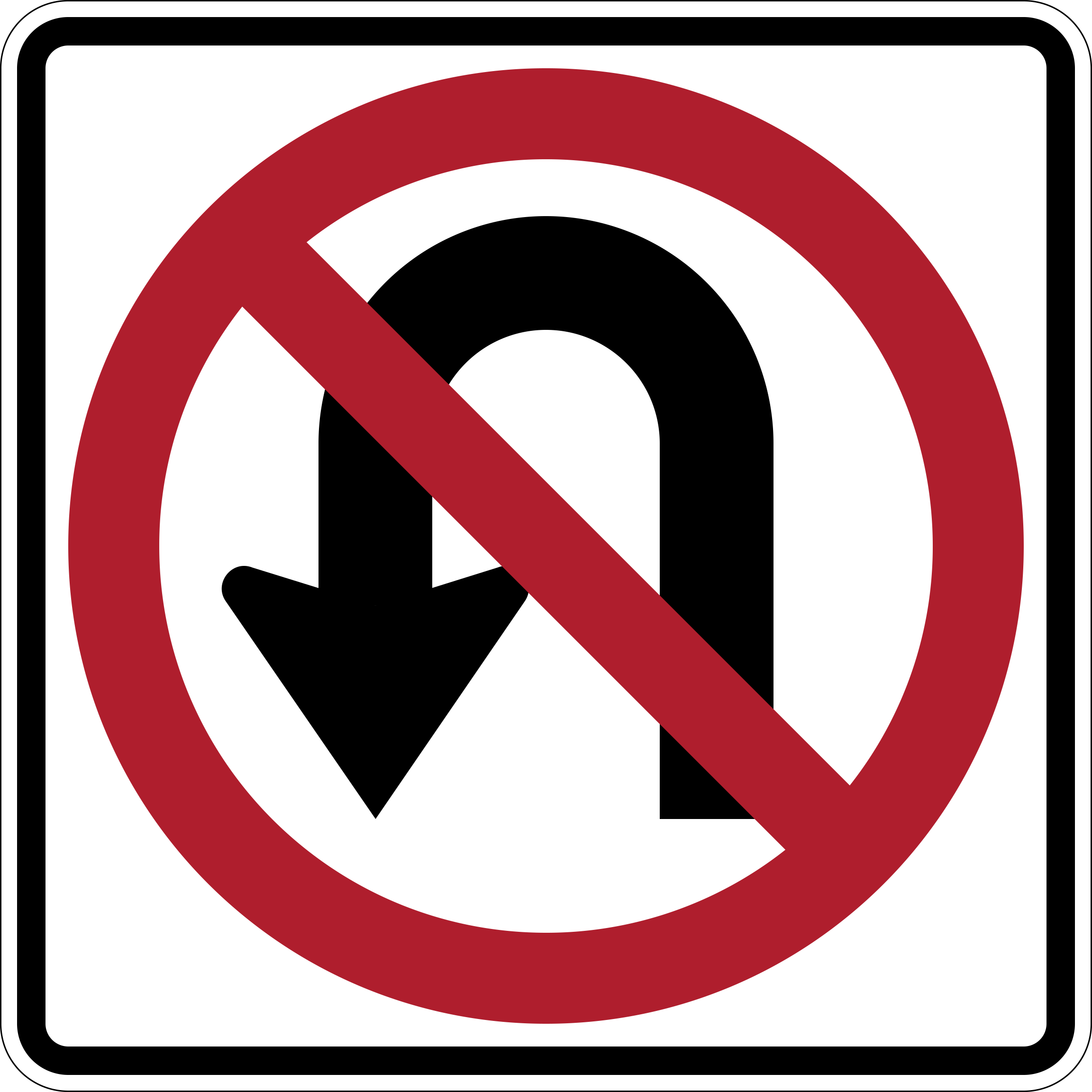
- You cannot make a U-turn where the sign is posted
- Only trucks may not make a U-turn
- U-turns are allowed when no traffic is visible
- U-turns are allowed after a complete stop
Show answer
You cannot make a U-turn where the sign is posted. The sign is absolute where it is posted: you cannot make a U-turn there, for any vehicle, regardless of a stop or an empty road. The manual notes that NO U-TURN is one of the regulatory signs that uses only an image. Where no sign forbids it, a U-turn is allowed only if your path is clear and it is safe, and only from the lane closest to the center line. Even without a sign, never make a U-turn at the crest of a hill, near a curve, or anyplace where you or other drivers cannot see 500 feet away.
Study this in the handbook: Turns, right of way and rotaries
15. After a Massachusetts license suspension of two years or more, what must the driver do besides paying the reinstatement fee?
- Only renew the license online
- Only take a vision test
- Pass a learner's permit exam and a road test
- Nothing else
Show answer
Pass a learner's permit exam and a road test. For suspensions of two years or more, the driver must pass a learner's permit exam and a road test to get the license back, and bring identification documents for those tests. Online renewal or a vision test alone is not enough, and doing nothing else is wrong. Most reinstatement fees are $100, but suspensions for serious offenses can cost as much as $1,200.
Study this in the handbook: Citations, surchargeable events and suspensions
16. What do green signs do on Massachusetts highways?
- Warn of hazards ahead
- Give highway directions and guide you through highway interchanges
- List motorist services
- Mark work zones
Show answer
Give highway directions and guide you through highway interchanges. Green is the direction color: route markers, distance and destination signs, and the overhead signs that guide you through interchanges. Hazards are yellow, motorist services are blue, and work zones are orange. Reading green signs early lets you choose your lane well before the exit, which is safer than a last second change across traffic. In Massachusetts, numbered state highway routes are posted on white rectangular signs with black letters and borders, while interstate highway signs are blue, red and white shields.
Study this in the handbook: Traffic sign colors and types
17. What share of pedestrians are seriously injured or killed when hit at 20 mph, according to the Massachusetts manual?
- 1 percent
- 50 percent
- 90 percent
- 13 percent
Show answer
13 percent. At a speed of 20 mph, 13 percent of pedestrians hit are seriously injured or killed, and the manual shows how fast that share climbs: 40 percent at 30 mph and 73 percent at 40 mph. It calls the speed of vehicles the leading threat to pedestrian safety. About one third of all motor vehicle fatalities involve speeding, and drivers must yield to pedestrians entering or using a crosswalk in their travel path. Slow down wherever people walk, and stop for anyone in a crosswalk.
Study this in the handbook: Speed limits and the dangers of speeding
18. At a Massachusetts four-way stop, you and a vehicle directly to your right stop at the same time. Who goes first?
- The vehicle on your right
- The larger vehicle
- You, because you are on the left
- Whoever accelerates first
Show answer
The vehicle on your right. The four-way stop rule has two parts: a vehicle that stopped before you goes first, and when you stop at the same moment, the vehicle to your right has the right of way. Being on the left gives you nothing, vehicle size never decides priority, and racing off the line is how these intersections produce crashes. Make eye contact with the other driver to confirm who is going, then proceed only when your turn is clear.
Study this in the handbook: Turns, right of way and rotaries
19. How close to a fire may a Massachusetts driver drive by or park?
- No closer than 100 feet
- No closer than 800 feet
- No closer than 300 feet
- No closer than 500 feet
Show answer
No closer than 800 feet. Massachusetts makes it illegal to drive by or park within 800 feet of a fire. Three hundred feet is the rule for following an emergency vehicle responding to an alarm. One hundred and five hundred feet are not the fire distance. Drivers also may not run over an unprotected fire hose unless a firefighter or public safety official directs it.
Study this in the handbook: Emergency vehicles, skids, brake failure and breakdowns
20. During which parts of the Massachusetts JOL night restriction is enforcement secondary, meaning police must first stop the driver for another reason?
- The whole period from 12:30 to 5:00 a.m.
- 12:30 to 1:00 a.m. and 4:00 to 5:00 a.m.
- Midnight to 1:00 a.m. only
- There is no secondary enforcement
Show answer
12:30 to 1:00 a.m. and 4:00 to 5:00 a.m.. Junior Operators may not drive from 12:30 a.m. to 5:00 a.m. without a parent or guardian. Between 12:30 and 1:00 a.m. and between 4:00 and 5:00 a.m., police enforce the rule only after lawfully stopping the driver for some other violation. Driving then is still illegal. The law names only those two windows for secondary enforcement, so the whole period is not secondary. Midnight is not part of the restriction.
Study this in the handbook: The Junior Operator License (ages 16 1/2 to 18)
QualitySpace is expanding to Massachusetts
We are a California-based independent insurance brokerage working on licensing in more states. We cannot help with Massachusetts insurance yet. Leave your email and we will let you know when we can.
Every question is written from the official Massachusetts Driver's Manual. Need paper? Printable MA practice test with answer key.
Last verified 2026-10-05. How we check every question · Study all 500 as flashcards
Frequently asked questions
How many questions are on this Massachusetts practice test?
This fixed set has 20 questions. It is test 4 of 25 from the 500 question Massachusetts bank. The real MA exam asks 25 questions and you need 18 correct.
What is the passing score for the real Massachusetts test?
18 questions correct (out of 25) That figure comes from the official Massachusetts source cited on the DMV facts page.
How does this fixed test relate to the full Massachusetts bank?
Each numbered test is a fixed set of questions in a fixed order, so you can retake the same test later and compare. Every test mixes road signs and the other topics in about the same proportion as the full bank. Tests 1 to 25 together cover every question in the Massachusetts bank once. The full practice page mixes the whole bank at random.
Last verified 2026-10-05. See the Massachusetts DMV facts page for sourced state details.
Return to the full Massachusetts practice test · Study road signs