
Test 2 of 25 · 20 questions · Free 2026
MA Permit Practice Test 2
Jump to the test ↓A fixed 20 question set from the Massachusetts bank with answers and plain English explanations. The real MA exam is 25 questions, 72 percent to pass; take the full length version on the main practice page.
Question 1 of 20 · 0 right so far
All 20 questions in test 2
Every question below comes from the Massachusetts question bank on this page. Open a question to see the correct answer and the explanation. Nothing here is hidden behind a signup.
1. How close may a Massachusetts driver follow an emergency vehicle responding to an alarm?
- No closer than 100 feet
- No closer than 500 feet
- No closer than 800 feet
- No closer than 300 feet
Show answer
No closer than 300 feet. It is illegal to follow closer than 300 feet behind an emergency vehicle responding to an alarm. Five hundred feet is not the Massachusetts figure. Eight hundred feet is the distance you must keep when driving by or parking near a fire, a different rule. One hundred feet is too close. After the vehicle passes, signal and check for more emergency vehicles before merging back.
Study this in the handbook: Emergency vehicles, skids, brake failure and breakdowns
2. What does the Massachusetts manual say to do before changing lanes?
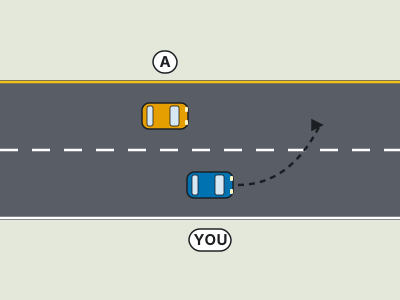
- Change lanes first, then signal
- Sound the horn and move over
- Signal early and check twice
- Slow down sharply before moving
Show answer
Signal early and check twice. A lane change goes wrong in the blind spot, so the manual's advice is short: signal early, then check twice, once in the mirrors and once over your shoulder, before you move. Signaling after the move defeats the purpose, the horn is not a lane change tool, and braking hard before moving invites a rear end collision. On highways the manual asks for extra attention during lane changes and merges because closing speeds are higher.
Study this in the handbook: Signaling, lane use and highway driving
3. What should a Massachusetts driver do on seeing a YIELD sign?
- Slow down and be prepared to stop
- Speed up to merge ahead of traffic
- Come to a complete halt every time
- Stop only if a police officer is present
Show answer
Slow down and be prepared to stop. The yield sign asks for judgment rather than an automatic stop. Slow down and be prepared to stop, let vehicles, bicyclists and pedestrians go before you proceed, and come to a complete stop if traffic conditions require it. A full stop every time is the stop sign rule, speeding up to beat traffic is the crash the sign exists to prevent, and police presence has nothing to do with it. The yield sign hands you the decision, so look well ahead as you approach and give yourself room to stop if someone has the right of way.
Study this in the handbook: Traffic sign colors and types
4. A Massachusetts police officer stops a driver whose BAC is above the legal limit, or who refuses a breathalyzer or blood test. What must the officer do with the license?
- Take the license away
- Hold it for 24 hours only
- Issue a warning and return it
- Mail it to the RMV for review
Show answer
Take the license away. Massachusetts pairs the breath test with an immediate consequence. When the result is above the legal limit, or when the driver refuses a breathalyzer or blood test, the police officer must take away the license, and the driver is given a notice of suspension that is effective immediately. The law does not let the officer issue a warning and hand the card back, hold it for only 24 hours, or mail it to the RMV for a later decision. How long the suspension lasts is set by the manual's charts, which depend on age and prior offenses.
Study this in the handbook: Operating under the influence and chemical tests
5. What do two solid yellow lines in the center of a Massachusetts road prohibit?
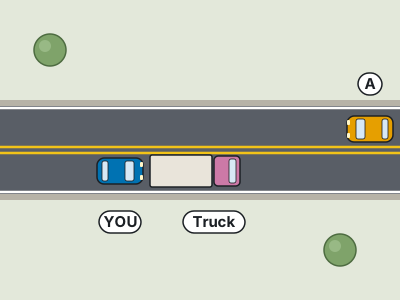
- Turning left into a driveway
- Driving faster than 30 mph
- Crossing them to pass another vehicle
- Stopping for a school bus
Show answer
Crossing them to pass another vehicle. Double solid yellow means no passing in either direction. The manual says two solid yellow lines prohibit vehicles from crossing them to pass another vehicle, and that you may not cross them unless turning left when it is safe to do so. That is why a left turn into a driveway is not what the lines forbid. They set no speed, and they have nothing to do with school buses. If the vehicle ahead is slow, wait until a broken yellow line appears on your side and the way is clear rather than crossing the double line.
Study this in the handbook: Pavement markings and special lanes
6. What does it cost to convert an out of state Class D license to Massachusetts?
- Nothing
- $50
- $140
- $115, plus $3 per year to add motorcycle privileges
Show answer
$115, plus $3 per year to add motorcycle privileges. Out of state conversion fees are $140 for Class A, B or C and $115 for Class D or Class M only, with an additional $3 per year to add Class M motorcycle privileges to another class; converting a Class D or M permit costs $30. All fees are subject to change. A regular Class D license issue or renewal is $50.
Study this in the handbook: The learner's permit and permit exam
7. A driver is tailgating you on a Massachusetts road. What does the manual tell you to do?
- Brake hard to warn them
- Move to another lane or pull to the side of the road to let the tailgater pass
- Speed up to open a gap
- Stop in the lane until they back off
Show answer
Move to another lane or pull to the side of the road to let the tailgater pass. The safest response to a tailgater is to get out of the way: change lanes or pull over and let them pass. Brake checking invites the rear end crash you are trying to avoid, speeding up only moves the problem faster, and stopping in a travel lane is dangerous. If you cannot move over, keep your own following distance long so you never have to brake suddenly with someone on your bumper.
Study this in the handbook: Seat belts, child seats and safe following distance
8. In a Massachusetts work zone, what do orange warning signs and work equipment usually tell you?
- The road is closed to all traffic
- The speed limit no longer applies
- People are on foot nearby
- Only trucks may use the lane
Show answer
People are on foot nearby. Orange is the work zone color, and the manual's point is human rather than mechanical: orange warning signs and work equipment usually mean that people are on foot nearby. The signs do not mean the road is closed to all traffic, the speed limit still applies and a speeding fine in a work area is doubled, and lane restrictions come from separate signs. The manual says to follow road work signs carefully, stay alert, look for sudden changes in road direction or condition, and be prepared to stop.
9. This LANE ENDS sign tells you a lane will close ahead. On multiple lane roadways, why are portable arrow boards placed before a work area within the closed lane?

- To show where the speed limit returns to normal
- To mark a parking area for work vehicles
- To give you notice to merge when it is safe
- To separate bicycles from cars
Show answer
To give you notice to merge when it is safe. The manual says portable arrow boards on multiple lane roadways show that the shoulder or a lane is closed and which lane is open for travel. They sit before the work area, inside the closed lane, so drivers in that lane get notice to merge while it is still safe. They are not a parking zone, they do not restore the speed limit, and they do not create a bicycle lane. Drums, cones and tubular markers lined up at an angle do a similar job, and when you see them you should carefully merge into the adjacent travel lane.
Study this in the handbook: Railroad crossings and work zones
10. Unlike a gentle curve sign, this right-angle arrow warns of a sharp turn. According to the Massachusetts manual, where is a vehicle more likely to leave the road?

- On a straight highway
- At a curve
- In a parking lot
- At a railroad crossing
Show answer
At a curve. The manual states the risk plainly: your vehicle is more likely to leave the road at a curve. It pairs that warning with the rule to always slow down near a curve or an area where you cannot see clearly ahead, and with the braking tip to brake early and gently when preparing to stop or turn. Straight highways, parking lots and railroad crossings each have their own hazards, but the manual names curves as the place a vehicle tends to run off. The right angle arrow is your cue that the turn ahead is tight. Slow first, then steer.
Study this in the handbook: Stopping distance, headlights, night and bad weather
11. Under the Massachusetts Vulnerable Road Users Law, how much space must you leave when passing a bicyclist or pedestrian?
- At least two feet
- At least four feet
- At least three feet
- At least six feet
Show answer
At least four feet. Massachusetts requires a safe passing distance of at least four feet between your vehicle and a vulnerable road user. Three feet is a tempting wrong answer, but Massachusetts sets four. Two feet is far too close, and six feet is more than the law requires. If it is safe, you may use part of the next lane or cross the center line to give that room, but you must still obey the speed limit.
Study this in the handbook: Pedestrians, bicyclists, motorcycles and mopeds
12. A Massachusetts driver is convicted a third time of using a hand-held mobile device while driving. What is the penalty?
- A $250 fine only
- A $100 fine and a warning
- A $1,000 fine and one year in jail
- A $500 fine, an insurance surcharge and a distracted driving program
Show answer
A $500 fine, an insurance surcharge and a distracted driving program. Third and later offenses bring a $500 fine plus an insurance surcharge and mandatory completion of a distracted driving program. The $250 fine belongs to the second offense, and $100 to the first. Jail and a $1,000 fine are not part of the hand-held device schedule. A crash that injures someone because of phone use can bring separate criminal charges for negligent operation.
Study this in the handbook: Hands free law and distracted driving
13. Under the Massachusetts hands-free law, when may a driver 18 or older use a mobile telephone or other electronic device while driving?
- Whenever the vehicle is moving slower than 25 mph
- Only when the device is used in hands-free mode
- At any time, as long as the phone is not held to the ear
- Only for calls shorter than one minute
Show answer
Only when the device is used in hands-free mode. The law is written around the device, not the conversation. An adult driver may use a phone or other electronic device only in hands-free mode; holding it to text, dial or watch is prohibited regardless of speed or the length of the call. The low speed and short call answers describe habits the law was written to end, and the answer allowing use whenever the phone is not held to the ear misstates the rule, since holding the device at all is the violation. Teen drivers face a stricter rule and may not use devices even hands-free.
Study this in the handbook: Hands free law and distracted driving
14. What is the minimum age to apply for a Class D or Class M learner's permit in Massachusetts?
- 17
- 15
- 16 1/2
- 16
Show answer
16. The Massachusetts ladder starts at 16 with the learner's permit for a car or motorcycle. Fifteen is too young, sixteen and a half is the earliest age for the Junior Operator license itself, and seventeen is not the permit age. The permit lets the holder practice with a licensed operator who is at least 21 in the passenger seat, and it is valid for up to two years. Applicants under 18 must also hold the permit for six months and complete driver education before the road test.
Study this in the handbook: The learner's permit and permit exam
15. What is the lowest BAC threshold for Massachusetts's under-21 alcohol driving rule?
- 0.08 or higher
- 0.05 or higher
- 0.02 or higher
- Any BAC above 0.00
Show answer
0.02 or higher. Massachusetts sets the adult per se limit at 0.08 but has a zero tolerance law for anyone under 21: a BAC of 0.02 or higher brings penalties. Point zero five is not a Massachusetts threshold, and while the zero tolerance label suggests young drivers should not drink at all, the number written in the manual is 0.02 rather than any trace above zero. The manual adds that an under 21 driver caught with a BAC as low as 0.02 while driving will lose the license, and that drivers under 21 are twice as likely to be in alcohol related crashes.
Study this in the handbook: Zero tolerance and under 21 alcohol laws
16. A car in the next lane is slowing for a pedestrian at a Massachusetts crosswalk. What does the law say about passing it?
- You may pass if you sound your horn first
- Never pass a vehicle that is stopped or slowing for a pedestrian
- You may pass if you stay under the speed limit
- You may pass if the other car is in the left lane
Show answer
Never pass a vehicle that is stopped or slowing for a pedestrian. A car that slows or stops at a crosswalk often hides the person it is stopping for. Massachusetts lists it among the laws for drivers: never pass a vehicle that is stopped or slowing for a pedestrian. A horn, a legal speed, or which lane the other car occupies does not change the danger, because you still cannot see whether someone is stepping out in front of it. The same list requires you to yield to pedestrians entering or using a crosswalk in your path and never to block one.
Study this in the handbook: Traffic signals and pedestrian signals
17. This yield sign is posted with a painted yield line before a crosswalk. If a pedestrian is in the crosswalk, where must you stop?
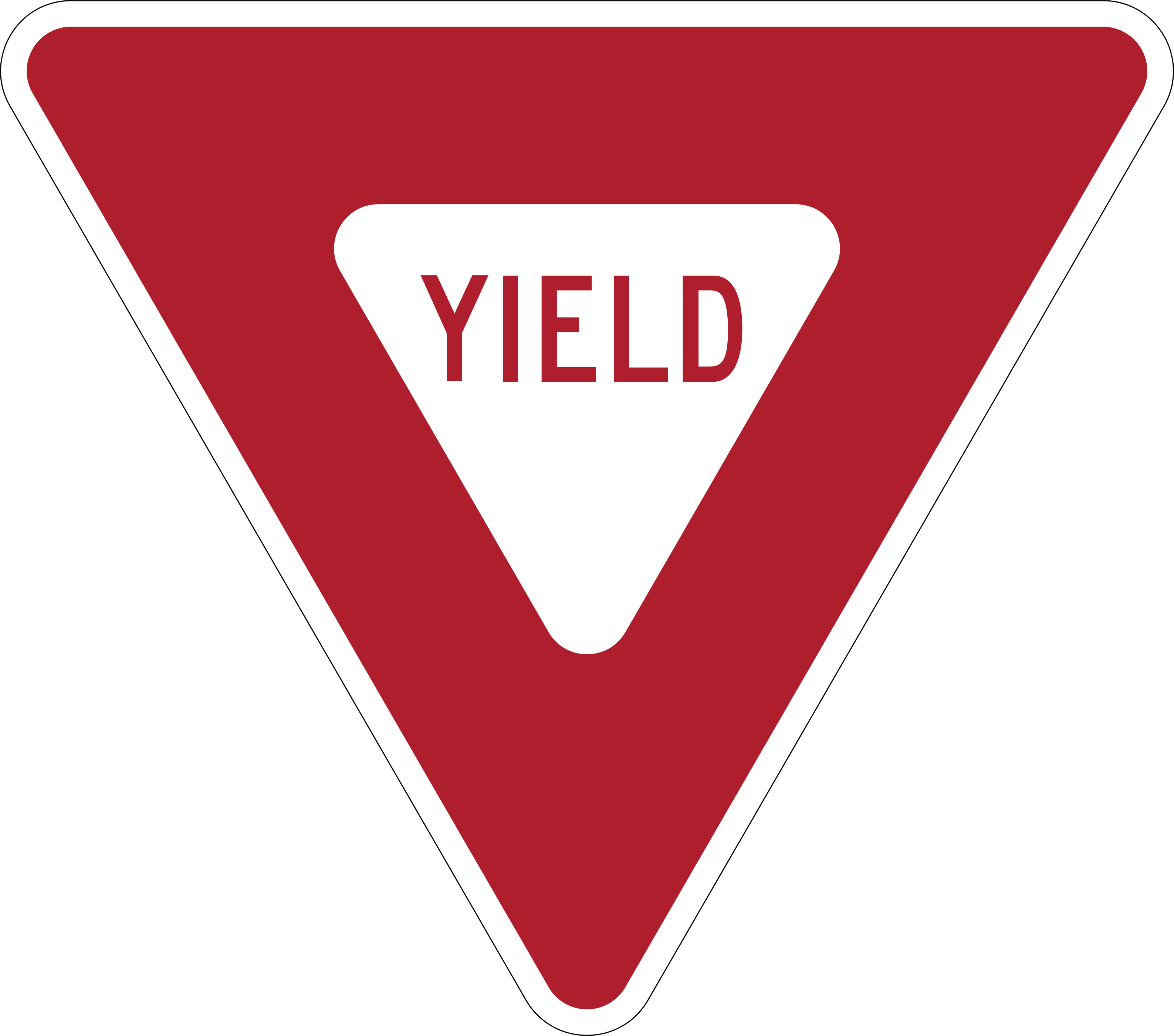
- Behind the yield line and crosswalk lines
- Past the crosswalk, out of the pedestrian's way
- In the crosswalk, so the pedestrian can see you
- You do not need to stop at a yield sign
Show answer
Behind the yield line and crosswalk lines. Yield lines and crosswalk lines are stop points when a pedestrian is using the crossing. The manual requires you to stop behind the stop lines, yield lines and crosswalk lines whenever a stop or yield sign, a traffic signal or a pedestrian in the crosswalk calls for it. Stopping inside the crosswalk blocks the very space the pedestrian needs, and stopping beyond it means you drove through the crossing. A yield sign does require a stop whenever a stop is needed to yield.
Study this in the handbook: Pavement markings and special lanes
18. How much does the Massachusetts manual say the fine would be for driving 73 mph on a highway posted at 55 mph?
- $185
- $100
- $500
- $50
Show answer
$185. The manual works the arithmetic for you: 73 mph on a 55 mph highway comes to a $185 fine. That total combines the base fine with a per mile charge for every mile over the limit, which is why a modest looking overage produces a three figure ticket. Fifty and one hundred dollars understate it, and five hundred is far more than this example produces; in a posted work zone the whole speeding fine would instead be doubled. The fine is only the start, since the violation also counts toward the three in twelve months suspension and raises insurance surcharges.
Study this in the handbook: Citations, surchargeable events and suspensions
19. What rule does the Massachusetts manual give for keeping a safe distance behind the vehicle in front of you?
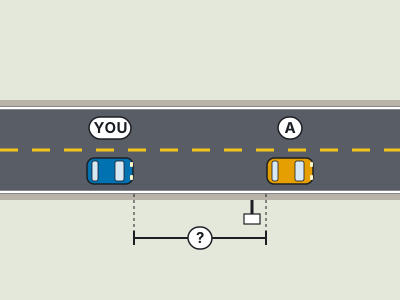
- The one-second rule
- The one car length per 10 mph rule
- The three-second rule
- The fifty foot rule
Show answer
The three-second rule. Massachusetts measures following distance in time. Pick an object ahead, like a sign post or a tree, and when the vehicle in front reaches it count one one thousand, two one thousand, three one thousand; if you reach the object before you finish, you are too close. The manual calls three seconds a minimum for good road conditions and moderate traffic, asks you to count more for added safety, and wants at least four seconds behind a motorcycle and ten behind heavy equipment. Car lengths, a fixed footage and a single second are not the rule the manual gives.
Study this in the handbook: Seat belts, child seats and safe following distance
20. What does a broken yellow center line separate on a Massachusetts road?
- Lanes of traffic moving in opposite directions
- The road from the shoulder
- Lanes of traffic moving in the same direction
- A bicycle lane from a travel lane
Show answer
Lanes of traffic moving in opposite directions. Yellow lane lines separate lanes of traffic moving in opposite directions, so a yellow center line tells you the traffic beyond it is coming toward you. A broken yellow line separates opposite directions and, because it is broken, lets you cross temporarily to pass when it is safe; otherwise stay to the right of it. Same direction lanes are divided by white lines, a solid white line marks the right edge of the roadway, and bicycle lanes are marked with solid white lines as well. Reading the color first tells you what you would meet if you crossed the line.
Study this in the handbook: Pavement markings and special lanes
QualitySpace is expanding to Massachusetts
We are a California-based independent insurance brokerage working on licensing in more states. We cannot help with Massachusetts insurance yet. Leave your email and we will let you know when we can.
Every question is written from the official Massachusetts Driver's Manual. Need paper? Printable MA practice test with answer key.
Last verified 2026-10-05. How we check every question · Study all 500 as flashcards
Frequently asked questions
How many questions are on this Massachusetts practice test?
This fixed set has 20 questions. It is test 2 of 25 from the 500 question Massachusetts bank. The real MA exam asks 25 questions and you need 18 correct.
What is the passing score for the real Massachusetts test?
18 questions correct (out of 25) That figure comes from the official Massachusetts source cited on the DMV facts page.
How does this fixed test relate to the full Massachusetts bank?
Each numbered test is a fixed set of questions in a fixed order, so you can retake the same test later and compare. Every test mixes road signs and the other topics in about the same proportion as the full bank. Tests 1 to 25 together cover every question in the Massachusetts bank once. The full practice page mixes the whole bank at random.
Last verified 2026-10-05. See the Massachusetts DMV facts page for sourced state details.
Return to the full Massachusetts practice test · Study road signs