
Test 1 of 25 · 20 questions · Free 2026
MA Permit Practice Test 1
Jump to the test ↓A fixed 20 question set from the Massachusetts bank with answers and plain English explanations. The real MA exam is 25 questions, 72 percent to pass; take the full length version on the main practice page.
Question 1 of 20 · 0 right so far
All 20 questions in test 1
Every question below comes from the Massachusetts question bank on this page. Open a question to see the correct answer and the explanation. Nothing here is hidden behind a signup.
1. What does a solid green turn arrow mean for a Massachusetts driver?
- You may go straight only
- You must stop and wait for a circular green
- Turns are prohibited
- You can make a protected turn in the direction of the arrow
Show answer
You can make a protected turn in the direction of the arrow. The green arrow is the protected phase. It tells you that you can turn in the arrow's direction and that the signal is holding pedestrians and oncoming traffic on red while you do. It does not restrict you to going straight, you do not wait for a circular green, and it is the opposite of a prohibition. Still glance across the intersection before turning, because the protection depends on everyone else obeying their red.
Study this in the handbook: Traffic signals and pedestrian signals
2. At a Massachusetts four-way stop, several vehicles arrive at slightly different times. Who has the right of way?
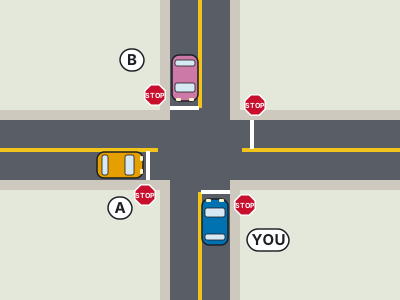
- The vehicle on the left
- The first vehicle in the intersection or at the four-way stop
- The vehicle going straight, regardless of arrival order
- The largest vehicle
Show answer
The first vehicle in the intersection or at the four-way stop. Arrival order settles most four-way stops: the first vehicle to reach the intersection has the right of way once it has stopped, and the others follow in turn. The vehicle on the left yields to the right only when two vehicles arrive at the same moment, size never confers priority, and going straight does not override an earlier arrival. Make eye contact, take your turn deliberately, and do not wave others through out of turn.
Study this in the handbook: Traffic sign colors and types
3. A school bus is stopped with red lights flashing on the opposite side of a Massachusetts road that has only a painted center line. What must you do?
- Slow to 20 mph and pass
- Continue, because the bus is on the other side
- Stop, because the exception applies only to a divided highway with a barrier
- Stop only if children are crossing
Show answer
Stop, because the exception applies only to a divided highway with a barrier. Traffic in both directions stops for a school bus unless a barrier physically separates the two roadways. A painted line, a turn lane or even a grass median without a barrier does not qualify, so on an ordinary two-way road you stop even when the bus faces the other way. Slowing to pass is the violation the law was written against, and children who have not started to cross yet are exactly the ones the stop protects.
Study this in the handbook: Passing, school buses and the move over law
4. How many surchargeable events within three years lead to an automatic 60-day suspension in Massachusetts?
- Three
- Five
- Twelve
- Seven
Show answer
Seven. Seven surchargeable events within a three-year period bring an automatic 60-day suspension. Three events within two years trigger the Driver Retraining course instead. Five is not a threshold. Twelve major or minor violations within five years is the habitual traffic offender level, a far more serious status. Surchargeable events also raise insurance premiums under the Safe Driver Insurance Plan, run by the Merit Rating Board.
Study this in the handbook: Citations, surchargeable events and suspensions
5. Railroad crossing lights in Massachusetts begin to flash. Where must you stop?
- At least 15 feet before the light post or gate
- Right at the gate arm
- At least 5 feet before the tracks
- At least 50 feet before the gate
Show answer
At least 15 feet before the light post or gate. When the lights begin to flash, you must stop at least 15 feet before the light post or gate and stay stopped until the gate rises and the lights stop. Stopping right at the gate or five feet from the tracks leaves too little room. Fifty feet is not the stated rule. Failure to stop is a violation with a heavy fine, and drivers must never go around a lowered gate even if no train is visible.
Study this in the handbook: Railroad crossings and work zones
6. Massachusetts adds a surcharge to every speeding fine that goes entirely to the Head Injury Treatment Services Trust Fund. How much is it?
- $50
- $5
- $25
- $100
Show answer
$50. By law, all Massachusetts speeding fines include a $50 surcharge, and the entire surcharge goes to the Head Injury Treatment Services Trust Fund, because speeding often plays a part in crashes that cause serious head injuries. The $5 figure is a separate public safety surcharge, not the trust fund surcharge. Twenty-five and one hundred dollars are not the stated amounts. The speeding fine itself is $105 for the first 10 mph over plus $10 for each additional mph.
Study this in the handbook: Citations, surchargeable events and suspensions
7. After a Massachusetts crash that caused $1,000 or more in property damage, how soon must you file a crash report, and with whom?
- Within 30 days, with your insurance company only
- Within 24 hours, with the State Police only
- Within five days, with both the RMV and the local police department
- Only if a police officer did not come to the scene
Show answer
Within five days, with both the RMV and the local police department. Massachusetts sets both a deadline and two recipients for a crash report. Any crash with $1,000 or more of property damage, or one that injures or kills someone, must be reported within five days, and the report goes to the RMV and to the local police department. You should also notify your insurance company, but telling the insurer does not replace the report. A one day deadline and a State Police only filing are not the rule, and an officer showing up at the scene does not excuse you from filing.
8. This TWO-WAY TRAFFIC sign warns that opposing traffic shares the roadway ahead. Which pavement marking separates opposite lanes of traffic in Massachusetts?
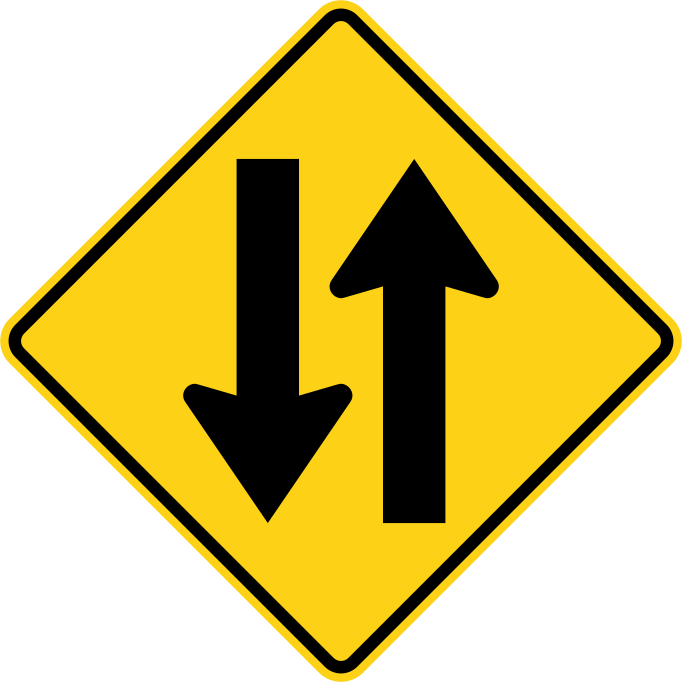
- Broken white lines
- Yellow lines, such as one solid and one broken yellow line
- A double solid white line
- A white diamond symbol
Show answer
Yellow lines, such as one solid and one broken yellow line. Yellow is the color that says oncoming. On a two-way road the center is marked in yellow, and a double line with one solid and one broken side tells each direction whether passing is allowed. Broken white lines separate lanes going the same way, a double solid white line separates same direction lanes you may not cross, and the white diamond marks an HOV restriction. When the TWO-WAY TRAFFIC sign appears after a one-way stretch, look for the yellow center line and keep right of it.
Study this in the handbook: Pavement markings and special lanes
9. This STOP AHEAD sign warns of a stop sign you cannot yet see. Once you reach that stop sign, when may you enter the intersection?

- Only after coming to a complete stop
- After slowing to walking speed
- Immediately if no traffic is visible
- After flashing your headlights
Show answer
Only after coming to a complete stop. The warning sign buys you braking distance; the stop sign itself still demands a complete halt before you go on. The manual says to stop before any crosswalk or stop line, come to a complete stop, yield to pedestrians or other vehicles, and go carefully, and it adds that just slowing down is not enough. Seeing no traffic does not excuse the stop, since the sign applies to each vehicle that comes to it. Flashing headlights is not a substitute for stopping. Begin slowing at the STOP AHEAD sign so the stop is smooth.
Study this in the handbook: Traffic sign colors and types
10. You approach a STOP sign where a white stop line is painted on the road. Where must a Massachusetts driver stop?
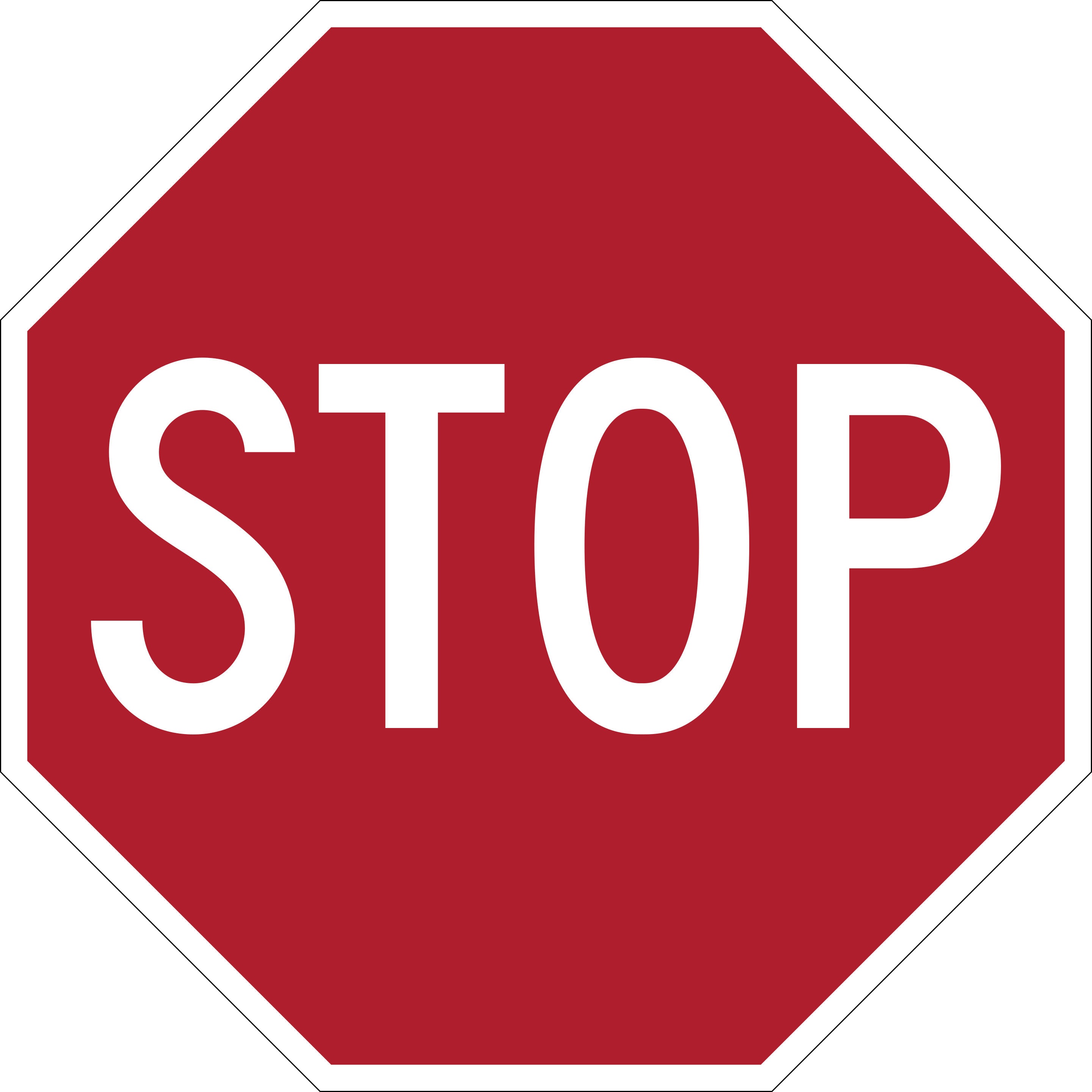
- With the front bumper over the line for a better view
- Before the line
- Anywhere within 20 feet of the sign
- Only if traffic is coming
Show answer
Before the line. A painted stop line tells you exactly where the stop belongs: before the line, not on it or past it. The manual says that when approaching a STOP sign you must stop before any crosswalk or stop line painted on the pavement, come to a complete stop, yield to pedestrians or other vehicles, and go carefully. Just slowing down is not enough. Pulling the front bumper over the line is not a stopping point, there is no 20 foot zone, and the stop is required whether or not traffic is visible, because the sign applies to each vehicle that comes to it.
Study this in the handbook: Traffic sign colors and types
11. When a Massachusetts officer takes a driver's license for a BAC above the limit or a test refusal, when does the notice of suspension take effect?
- After a hearing is held
- 30 days after the arrest
- Only after a court conviction
- Immediately
Show answer
Immediately. The suspension paperwork handed over at the roadside is not a warning of something to come; the notice of suspension is effective immediately. The driver cannot legally drive away from the stop. No hearing precedes it, there is no 30 day grace period, and it does not wait for a conviction. The suspension periods themselves are set out in charts in the manual and depend on age, prior offenses and whether the driver failed or refused the test.
Study this in the handbook: Operating under the influence and chemical tests
12. After an emergency vehicle passes you on a Massachusetts road, what should you check before pulling back into traffic?
- That no other emergency vehicles are approaching
- That your headlights are on
- That you signaled for at least five seconds
- That the vehicle behind you has also pulled over
Show answer
That no other emergency vehicles are approaching. After an emergency vehicle has passed, the manual says to use your left turn signal, make sure the lane is clear, and be sure there are no other emergency vehicles approaching before you merge back into traffic. Headlights and signal timing are not the issue, and the car behind you is responsible for itself. The manual also makes it illegal to follow closer than 300 feet behind an emergency vehicle responding to an alarm, so once you merge back, keep well back from the one that just passed.
Study this in the handbook: Emergency vehicles, skids, brake failure and breakdowns
13. Who must use an Ignition Interlock Device to get a hardship license or reinstatement in Massachusetts?
- Any driver with one speeding ticket
- Every driver under 21
- Only commercial drivers
- A driver with two or more OUI offenses
Show answer
A driver with two or more OUI offenses. A driver who has had two or more operating under the influence offenses and qualifies for a hardship license or reinstatement must have an Ignition Interlock Device installed at the driver's own expense. A speeding ticket does not trigger it, and it is not required of every driver under 21 or only of commercial drivers. The device stays in use during the hardship license and for two more years after reinstatement.
Study this in the handbook: Operating under the influence and chemical tests
14. During the first six months after receiving a Massachusetts JOL, when may the holder drive with a passenger under 18 who is not an immediate family member?
- Only when accompanied by a person at least 21 with at least one year of driving experience and a valid license, seated beside the driver
- At any time, as long as only one passenger is under 18
- Only during daylight hours
- Never, under any circumstances
Show answer
Only when accompanied by a person at least 21 with at least one year of driving experience and a valid license, seated beside the driver. The passenger restriction is the heart of the Junior Operator law. For six months a new JOL holder may not carry any passenger under 18 who is not immediate family, unless a qualifying adult is in the seat beside the driver: at least 21 years old, licensed in Massachusetts or another state, with at least one year of driving experience. There is no one passenger allowance and no daylight exception, but the rule is not absolute, because the supervising adult lifts it. The clock stops during any suspension and resumes afterward.
Study this in the handbook: The Junior Operator License (ages 16 1/2 to 18)
15. A Massachusetts Junior Operator violates the passenger restriction or the night restriction. What suspension applies for a first offense?
- 180 days
- 60 days
- One year
- 14 days
Show answer
60 days. The JOL restrictions come with an escalating ladder of suspensions. A first violation of either the passenger rule or the night driving rule brings a 60 day suspension, a second brings 180 days, and any further violation costs a full year. Fourteen days is the wait after a failed road test, not a suspension. The manual also notes that the six month passenger restriction clock stops during any suspension, so a teen who loses the license early ends up restricted for longer overall.
Study this in the handbook: Junior Operator suspensions
16. During which hours may a Massachusetts JOL holder not drive unless accompanied by a parent or legal guardian?
- Between 10:00 p.m. and 6:00 a.m.
- Between midnight and 7:00 a.m.
- Between 12:30 a.m. and 5:00 a.m.
- Between sunset and sunrise
Show answer
Between 12:30 a.m. and 5:00 a.m.. The Junior Operator night restriction runs from 12:30 a.m. to 5:00 a.m. During those hours a JOL holder may drive only with a parent or legal guardian in the car, and a holder found driving in violation may be charged with operating without being licensed, which is a criminal violation. Ten p.m., midnight and sunset are not the starting points the manual gives. It adds that in the half hours at each end of the window, police enforce the restriction only after a lawful stop for another reason, but the restriction itself still applies.
Study this in the handbook: The Junior Operator License (ages 16 1/2 to 18)
17. What do blue signs list on Massachusetts roads?
- Highway directions
- Public recreational areas
- Motorist services like gas, food, and lodging
- Traffic regulations
Show answer
Motorist services like gas, food, and lodging. Blue guide signs list motorist services: gas, food, lodging and evacuation routes. Highway directions and interchange guidance are on green, public recreation areas, parks and scenic sites on brown, and regulations on white or red. Blue signs help you plan a stop without pulling off to search, which keeps you from making sudden exit decisions on the highway. The manual groups them with green direction signs and brown recreation signs under the guide sign category.
Study this in the handbook: Traffic sign colors and types
18. A center lane on a two-way Massachusetts road is marked as a common left-turn lane. What may you not do in it?
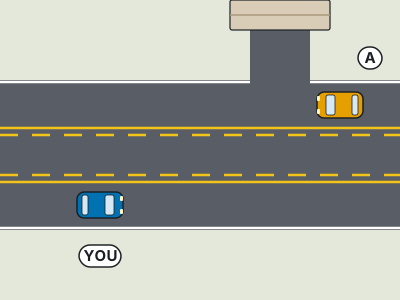
- Turn left from it
- Travel in the center turning lane
- Enter it from either direction
- Use it to begin a left turn
Show answer
Travel in the center turning lane. A two-way left-turn lane is shared by both directions for one purpose: setting up left turns. Drivers from either side may enter it to turn left, so those are permitted uses. What the manual forbids is traveling along it as if it were a through lane, which puts you head on with someone entering from the other direction. Enter close to your turn, signal, and wait there for a gap.
Study this in the handbook: Turns, right of way and rotaries
19. A funeral procession is moving through an intersection in Massachusetts. Which vehicles must it yield to?
- Any vehicle already stopped at the intersection
- Vehicles on the right
- Emergency vehicles with flashing lights or sirens, or as directed by law enforcement
- Trucks and buses
Show answer
Emergency vehicles with flashing lights or sirens, or as directed by law enforcement. A funeral procession keeps the right of way at intersections so it can stay together, and other drivers may not cut between its vehicles. The one exception is emergency traffic: the procession must yield to vehicles with flashing lights or sirens and to law enforcement directions. Stopped cars, vehicles on the right and large vehicles all wait for the procession. If the lead vehicle legally enters an intersection, the rest may follow even if the light changes.
Study this in the handbook: Turns, right of way and rotaries
20. Massachusetts asks you to allow extra following space in which of these situations?
- Only on sunny days
- Only on one-way streets
- Only when you are late
- Rain, snow, ice, or other poor weather or road conditions
Show answer
Rain, snow, ice, or other poor weather or road conditions. The three second rule is the minimum for good road conditions and moderate traffic, and the manual lists situations that call for more: bad drivers, rain, snow, ice or other poor weather or road conditions, blind or obstructed driveways and roads, drivers backing out of parking spaces or driveways, and children playing in yards or near the road. It also asks for at least four seconds behind a motorcycle and ten behind heavy equipment. Sunny days are the baseline, being late is a reason to leave earlier, and one way streets are not on the list. When traction drops, the extra space is what lets you stop safely.
Study this in the handbook: Seat belts, child seats and safe following distance
QualitySpace is expanding to Massachusetts
We are a California-based independent insurance brokerage working on licensing in more states. We cannot help with Massachusetts insurance yet. Leave your email and we will let you know when we can.
Every question is written from the official Massachusetts Driver's Manual. Need paper? Printable MA practice test with answer key.
Last verified 2026-10-05. How we check every question · Study all 500 as flashcards
Frequently asked questions
How many questions are on this Massachusetts practice test?
This fixed set has 20 questions. It is test 1 of 25 from the 500 question Massachusetts bank. The real MA exam asks 25 questions and you need 18 correct.
What is the passing score for the real Massachusetts test?
18 questions correct (out of 25) That figure comes from the official Massachusetts source cited on the DMV facts page.
How does this fixed test relate to the full Massachusetts bank?
Each numbered test is a fixed set of questions in a fixed order, so you can retake the same test later and compare. Every test mixes road signs and the other topics in about the same proportion as the full bank. Tests 1 to 25 together cover every question in the Massachusetts bank once. The full practice page mixes the whole bank at random.
Last verified 2026-10-05. See the Massachusetts DMV facts page for sourced state details.
Return to the full Massachusetts practice test · Study road signs