
Test 9 of 10 · 20 questions · Free 2026
CO Permit Practice Test 9
Jump to the test ↓A fixed 20 question set from the Colorado bank with answers and plain English explanations.
Question 1 of 20 · 0 right so far
All 20 questions in test 9
Every question below comes from the Colorado question bank on this page. Open a question to see the correct answer and the explanation. Nothing here is hidden behind a signup.
1. The adult who signed a Colorado minor's Affidavit of Liability withdraws the signature. What happens?
- The minor's permit or license is canceled
- Nothing, because the license was already issued
- The minor must retake the written test
- The minor gets a 30 day grace period to find a new signer
Show answer
The minor's permit or license is canceled. Whoever signs the affidavit takes legal responsibility for the minor's driving. If that person decides to stop accepting responsibility, the signature may be withdrawn, and the minor's permit or license will be canceled. An issued license is not protected. The handbook does not call for a new written test or a grace period. Minors in foster care may be exempt from the affidavit requirement when certain conditions are met.
Study this in the handbook: Getting a license, instruction permits and the drive test
2. How is a second or third DUI or DWAI conviction described for a driver younger than 21?
- A vehicle registration suspension only
- A warning with no licensing consequence
- A license renewal without restrictions
- A mandatory revocation of the driver license
Show answer
A mandatory revocation of the driver license. For a driver younger than 21, the handbook says a second or third DUI or DWAI conviction requires mandatory revocation of the license. That is stronger than a warning and concerns the driving privilege rather than vehicle registration. The handbook does not promise an unrestricted renewal after those convictions. The age-specific rule is easy to miss beside the first-conviction condition, so count prior convictions carefully and treat the revocation consequence as automatic for the second or third conviction.
Study this in the handbook: Drugs, penalties and express consent
3. What must a driver do at a Colorado STOP sign?

- Slow down without stopping
- Continue if no vehicle is visible
- Stop only if a train is approaching
- Come to a complete stop
Show answer
Come to a complete stop. A Colorado STOP sign requires a complete stop. The driver must stop at the marked stop line, or, if no line exists, before entering the near-side crosswalk. If neither is present, stop at the point nearest the intersecting roadway where approaching traffic can be seen. Merely slowing down is not enough, even when the intersection looks empty. The train-only choice confuses railroad controls with an ordinary stop requirement. After stopping, check for pedestrians and other traffic before proceeding.
Study this in the handbook: Fitness to drive, distractions and basic control
4. Which serving is defined as one standard drink under Colorado's handbook guidance?
- 16 ounces of beer, 6 ounces of wine, or 2 ounces of distilled spirits
- 8 ounces of beer, 4 ounces of wine, or 1 ounce of distilled spirits
- 12 ounces of beer, 5 ounces of wine, or 1.5 ounces of distilled spirits
- A mixed drink is always one standard drink regardless of its ingredients
Show answer
12 ounces of beer, 5 ounces of wine, or 1.5 ounces of distilled spirits. Colorado treats several differently sized servings as comparable alcohol amounts: 12 ounces of beer, 5 ounces of wine, or 1.5 ounces of distilled spirits. The smaller measurements of 8 ounces of beer, 4 ounces of wine, or 1 ounce of spirits understate the handbook's definition, while 16 ounces of beer, 6 ounces of wine, or 2 ounces of spirits overstate it. The handbook defines a standard drink by these measured amounts, not by calling every mixed drink one serving. When estimating alcohol exposure, identify the beverage type and measure rather than relying on the glass's appearance.
Study this in the handbook: DUI, DWAI and how alcohol works
5. When is driving below a posted minimum speed limit allowed?
- When road or weather conditions require it
- Whenever traffic is light
- Only when a passenger requests it
- Any time the driver is behind schedule
Show answer
When road or weather conditions require it. The handbook says driving slower than a minimum speed limit is a traffic violation unless road or weather conditions require the slower pace. This exception recognizes hazards such as poor weather or unsafe roadway conditions, not personal preference or schedule. Light traffic does not automatically authorize driving below the minimum, and a passenger request has no legal effect. Watch the roadway and weather ahead, maintain a safe pace, and slow only as much as the conditions require while avoiding unnecessary disruption to traffic.
Study this in the handbook: Speed limits and stopping distance
6. If your vehicle is hydroplaning, when should you try to stop or turn?
- Before lifting off the accelerator
- Immediately, by braking hard and steering sharply
- Only after the tires are gripping the road again
- After shifting to park in the travel lane
Show answer
Only after the tires are gripping the road again. Hydroplaning means the tires are riding on the water on top of the pavement, which can cause complete loss of traction and steering control. Colorado's guidance is to take your foot off the gas so the vehicle slows, then slowly steer in the direction you are hydroplaning until you have control. Steering must be slow, because jerking the wheel can cause an overcorrection. Do not try to stop or turn until your tires are gripping the road again, so hard braking, sharp steering, or shifting to park in the lane are not the steps given.
Study this in the handbook: Freeways, lane changes and passing
7. If power steering fails, what should a driver remember about the brakes?
- They should be pumped before touching the steering wheel
- They stop working as soon as steering becomes difficult
- They work only after the engine is turned off
- They still work, but the pedal may require very hard pressure
Show answer
They still work, but the pedal may require very hard pressure. Power failure can make steering heavy, but the handbook notes that braking remains available. The pedal may need much more force, so keep a strong grip, guide the vehicle off the roadway, and press firmly as needed. Assuming the brakes are gone can lead to panic or unnecessary use of the parking brake. The cue is steering that suddenly becomes difficult.
Study this in the handbook: Avoiding collisions, animals and vehicle failures
8. During the first six months after a Colorado minor's license is issued, which passenger is generally prohibited?
- A passenger younger than 21, unless a parent or licensed adult driver is present
- A sibling younger than 21 under every circumstance
- One passenger younger than 21, even with a parent present
- All passengers, regardless of age
Show answer
A passenger younger than 21, unless a parent or licensed adult driver is present. For the first six months of a minor's license, Colorado restricts passengers under 21. Such a passenger is not allowed unless a parent or another licensed adult driver is in the vehicle. That means a sibling under 21 is not banned in every circumstance, because a parent or licensed adult in the car changes the situation. The restriction also does not eliminate every passenger. Think of the first six months as a supervised transition period with a specific age limit for young passengers.
Study this in the handbook: Passenger limits and curfew for young drivers
9. Before entering a Colorado roundabout, whom must a driver yield to when large vehicles are present?
- No one if the driver has reached the entry line first
- Only a passenger car approaching from the right
- Only a bicyclist already on the shoulder
- A truck, bus, emergency vehicle, or recreational vehicle
Show answer
A truck, bus, emergency vehicle, or recreational vehicle. Colorado gives a large truck, bus, emergency vehicle, or recreational vehicle priority when entering, exiting, or driving in a roundabout. That rule applies before entry, so reaching the line first does not erase the yield. A passenger car on the right is not the handbook's special large-vehicle rule, and shoulder position alone does not describe the entering traffic requirement. Approach slowly, read the signs, check for pedestrians, and merge only after the needed gap is available.
Study this in the handbook: Lines, crosswalks and special lanes
10. After stopping at a steady red light, when may a driver turn right?
- Only when a police officer waves the driver through
- Whenever the driver has waited five seconds
- After yielding to pedestrians and traffic, unless a sign prohibits it
- Without stopping when the intersection appears empty
Show answer
After yielding to pedestrians and traffic, unless a sign prohibits it. Colorado permits a right turn on steady red after the driver stops, yields to pedestrians and other traffic, and confirms that no sign prohibits the movement. The rule is based on a complete stop and a clear, yielded path, not on waiting a fixed number of seconds. A police officer does not have to authorize every lawful turn, although an officer's direction would control if present. Check the crosswalk, the intersection, and approaching traffic before moving into the turn.
Study this in the handbook: Fitness to drive, distractions and basic control
11. According to the handbook, how quickly does BAC drop on average after alcohol is in the bloodstream?
- 0.005% every ten minutes
- 0.015% per hour
- 0.15% per hour
- It drops immediately after coffee is consumed
Show answer
0.015% per hour. The handbook gives an average decline of 0.015% per hour after alcohol enters the bloodstream. That is a slow, time-based process, not something accelerated by coffee, food, a cold shower, or fresh air. A rate of 0.15% per hour is ten times the handbook figure, and 0.005% every ten minutes works out to twice the stated average. A person who feels more alert may still have alcohol in the body. Arrange a sober ride and allow time rather than trying to counteract intoxication with a quick remedy.
Study this in the handbook: Losing your license, seat belts and child restraints
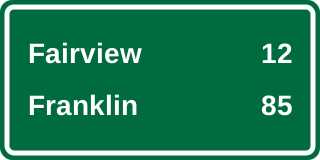
12. What information do Colorado guide signs provide?
- Laws that apply at a specific location
- Warnings about slippery pavement
- Directional and mileage information to specific destinations
- Directions to service facilities only
Show answer
Directional and mileage information to specific destinations. Guide signs provide directional and mileage information to specific destinations. They help a driver follow a route, identify where a road leads, or estimate distance. Warning signs address hazards such as curves or merging traffic, regulatory signs state laws, and blue service signs point toward facilities. Use the guide sign to confirm route direction and destination information, while continuing to obey any separate speed, lane, or traffic control signs along the roadway.
Study this in the handbook: Regulatory signs: stop, yield and speed
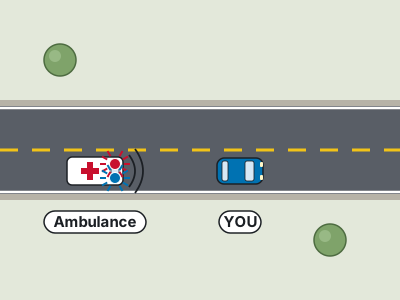
13. What must a driver do for an emergency vehicle using a siren or flashing warning lights?
- Speed up to clear the route
- Yield, pull right when possible, and stop
- Stop only if the vehicle is a police car
- Remain in place until the signal changes
Show answer
Yield, pull right when possible, and stop. A driver must yield to an emergency vehicle using a siren, air horn, or qualifying flashing lights. When possible, move to the right edge and stop. If already in an intersection, clear it first and then pull over. The duty is not limited to police cars, and speeding away can place both vehicles in conflict. Hear or see the warning, check the safest path, and give the emergency vehicle room to pass.
Study this in the handbook: Right of way at intersections, roundabouts and mountain roads
14. Which listening device may a Colorado driver legally wear while driving?
- Headphones covering both ears at low volume
- A device covering part of only one ear that is connected to a wireless device
- Earbuds in both ears
- A headset covering both ears for navigation only
Show answer
A device covering part of only one ear that is connected to a wireless device. You may not drive while wearing earphones, and Colorado defines earphones as any device or headset that covers all or part of both ears. The definition excludes hearing aids, cochlear implants, assistive listening devices, speakers built into protective headgear, and a device that covers only one ear and is connected to a wireless device. Low volume or a navigation purpose does not change the two-ear rule, so every both-ear choice is illegal.
Study this in the handbook: Drugs, penalties and express consent
15. What should a driver do when a steady yellow traffic light appears?
- Stop unless already in the intersection
- Accelerate to enter before the red light appears
- Reverse immediately, even if traffic is behind
- Turn left without checking the crosswalk
Show answer
Stop unless already in the intersection. A steady yellow light warns that a red light is about to appear. The driver should stop, unless the vehicle is already in the intersection. Accelerating to beat the signal increases the chance of entering after red, and reversing creates a separate hazard for traffic behind. A left turn still requires attention to pedestrians and other traffic. As the display changes from green to yellow, judge whether a controlled stop is possible and halt before the intersection when it is.
Study this in the handbook: Fitness to drive, distractions and basic control
16. Which color and symbol combination identifies Colorado warning signs?
- Blue with white service symbols
- Green with white mileage numbers
- Yellow or fluorescent green with black symbols
- Brown with white recreation symbols
Show answer
Yellow or fluorescent green with black symbols. Warning signs use yellow or fluorescent green with black symbols to call attention to roadway conditions. The handbook lists examples such as school zones, curves, slippery surfaces, merging traffic, and pedestrian-dense areas. Green guide signs give directions and mileage, blue signs identify service facilities, and brown signs point toward recreation or cultural locations. Treat the warning color as a cue to scan farther ahead and prepare for the pictured condition. It does not tell you to stop at every sign, but it does require earlier attention and an appropriate speed.
Study this in the handbook: Warning, guide, work zone and special signs
17. According to the Colorado handbook, where should your right foot be before starting the engine?
- On the brake
- On the accelerator
- On the floor beside the pedals
- On the parking brake handle
Show answer
On the brake. Colorado's starting procedure places the right foot on the brake before the vehicle is started. This gives the driver immediate control over unintended movement while checking the vehicle's indicator lights and gauges. The accelerator is not the starting position, and placing the foot away from the pedals removes a useful control. The parking brake handle is not a substitute for the brake pedal. Build the habit by checking the surroundings, pressing the brake, then starting and checking the vehicle information displays.
Study this in the handbook: Fitness to drive, distractions and basic control
18. What do brown backgrounds on service and recreation signs indicate?
- A mandatory reduced-speed zone
- Recreational, historic, or cultural areas
- A railroad crossing emergency phone
- A route reserved only for trucks
Show answer
Recreational, historic, or cultural areas. Brown service and recreation signs guide drivers to recreational, historic, or cultural places. They are not regulatory speed signs and they do not carry railroad emergency contact numbers. Blue signs in the same family point to service facilities, so color is the cue. When the background is brown, expect destination information for parks, historic sites, or similar attractions. The color helps separate destinations from enforceable commands.
Study this in the handbook: Regulatory signs: stop, yield and speed
19. How are reversible lanes separated when their direction changes at different times?
- By a row of parking meters
- By one solid white line only
- By a painted blue shoulder stripe
- By double-broken yellow lines or a barrier
Show answer
By double-broken yellow lines or a barrier. A reversible lane can carry traffic one way at one time and the opposite way later, so its separation must make the changing arrangement clear. The handbook identifies a barrier or double-broken yellow lines as the ways these lanes are separated, with signs or special lights sometimes adding information. A single solid white stripe marks same-direction lane boundaries, while a blue shoulder stripe and parking meters are unrelated to reversible operation. Before entering, check overhead or roadside signs and any lane-control lights for the direction currently permitted.
Study this in the handbook: Lines, crosswalks and special lanes
20. With a steady green light and no turn arrow, how should you make a left turn?
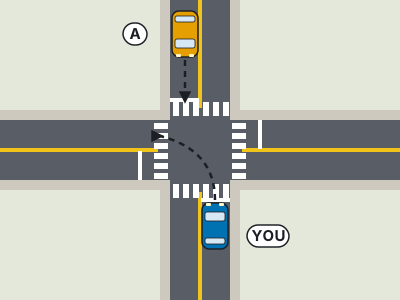
- Enter only after yielding to traffic and pedestrians in the intersection
- Turn immediately without checking the opposing lane
- Wait for a red light even when the intersection is clear
- Use the green light to force pedestrians to stop
Show answer
Enter only after yielding to traffic and pedestrians in the intersection. A steady green light permits movement, but it does not erase the duty to yield to vehicles or pedestrians already in the intersection or adjacent crosswalk. For a left turn without an arrow, enter carefully, wait for an acceptable gap in opposing traffic, and complete the turn without forcing anyone to brake or stop. Turning immediately can put you across an oncoming vehicle's path. Waiting for red is unnecessary when a lawful gap exists, and a signal never gives permission to threaten pedestrians.
Study this in the handbook: Fitness to drive, distractions and basic control
QualitySpace is expanding to Colorado
We are a California-based independent insurance brokerage working on licensing in more states. We cannot help with Colorado insurance yet. Leave your email and we will let you know when we can.
Every question is written from the official Colorado Driver Handbook. Need paper? Printable CO practice test with answer key.
Last verified 2026-10-05. How we check every question · Study all 213 as flashcards
Frequently asked questions
How many questions are on this Colorado practice test?
This fixed set has 20 questions. It is test 9 of 10 from the 213 question Colorado bank.
How does this fixed test relate to the full Colorado bank?
Each numbered test is a fixed set of questions in a fixed order, so you can retake the same test later and compare. Every test mixes road signs and the other topics in about the same proportion as the full bank. Tests 1 to 10 together cover 200 of the 213 questions in the Colorado bank, each once. The full practice page mixes the whole bank at random.
Last verified 2026-10-05. See the Colorado DMV facts page for sourced state details.
Return to the full Colorado practice test · Study road signs