
Test 14 of 25 · 20 questions · Free 2026
CO Permit Practice Test 14
Jump to the test ↓A fixed 20 question set from the Colorado bank with answers and plain English explanations.
Question 1 of 20 · 0 right so far
All 20 questions in test 14
Every question below comes from the Colorado question bank on this page. Open a question to see the correct answer and the explanation. Nothing here is hidden behind a signup.
1. A broken yellow line runs on your side beside a solid yellow line. When may you pass?
- When the broken line is on your side and it is safe
- Whenever the solid line looks faded or worn out
- Only when you are following behind a slow truck
- Never, since paired lines forbid all passing at all times
Show answer
When the broken line is on your side and it is safe. The handbook says that if the broken yellow line is on your side, you may pass if it is safe to do so. You must return to your lane before the broken lines turn solid. Check the lines before and during the pass. If the markings change to solid on your side, you have to be back in your lane before they do.
Study this in the handbook: Warning, guide, work zone and special signs
2. Freeway traffic merges from a ramp as you cruise in the right lane with room to your left. What courtesy does Colorado suggest when safe?
- Move over to make room for vehicles entering
- Hold your lane and your speed regardless of the ramp
- Slow sharply so that the ramp traffic enters first
- Flash your headlights to wave them in early
Show answer
Move over to make room for vehicles entering. The handbook says to move over, if it is safe to do so, when approaching a merge area, to make room for vehicles entering the freeway. If another lane is open and it is safe, moving over helps vehicles merge smoothly and reduces conflicts at the merge point. Doing so reduces the chance of two vehicles trying to occupy the same space at the merge point, and it keeps traffic flowing smoothly. If you cannot move over safely, then maintain your lane and leave room for the vehicle entering.
Study this in the handbook: Signaling, turns, U turns and parking
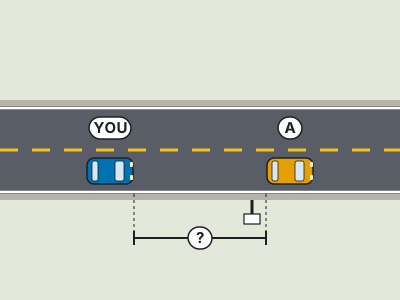
3. How should a driver test a three second following gap?
- Use the brake lights ahead as the only distance measure
- Measure one car length for every ten miles per hour
- Wait exactly one second regardless of speed
- Count after the vehicle ahead passes a fixed point and compare your arrival
Show answer
Count after the vehicle ahead passes a fixed point and compare your arrival. To check a following gap, choose a fixed reference such as a mile marker, sign, or telephone pole. Begin counting after the vehicle ahead passes it, counting one thousand one through one thousand three, and compare when your vehicle reaches the same point. Arriving before the count ends means you are too close. A fixed car-length formula, a one-second rule, or brake-light watching does not account for changing speed and road conditions. Add still more space in rain, darkness, or heavy traffic.
Study this in the handbook: Scanning, following distance, phones and traffic stops
4. A DO NOT ENTER sign faces you at the top of a freeway off-ramp. What should you do?
- Do not go past the sign, and find a permitted route
- Proceed slowly, since the exiting traffic must stop for you
- Continue on if no other vehicles are visible right now
- Turn around on the ramp right away and go back
Show answer
Do not go past the sign, and find a permitted route. The handbook says Do Not Enter signs warn and redirect drivers who are heading the wrong way on streets or freeway ramps. Do not proceed past one of these signs. If you find that you have entered the wrong way, stop safely and get back to a legal route. Continuing is dangerous because oncoming vehicles are driving toward you. Back out only if it is safe to do so.
Study this in the handbook: Regulatory signs: stop, yield and speed
5. What type of information does a lane control sign provide?
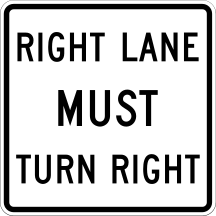
- Direction and information about where a driver can turn
- The minimum distance required behind another vehicle
- The color of pavement used for bicycle lanes
- The location of the nearest fuel station
Show answer
Direction and information about where a driver can turn. Lane control signs use directions and arrow symbols to show how a lane may be used, including where a turn is permitted. They can appear beside the roadway or above it, and a matching arrow may also be painted on the pavement. The fuel station choice describes a service sign, not lane use. Check the overhead or roadside arrow before selecting a lane so the vehicle is positioned for a legal movement.
Study this in the handbook: Regulatory signs: stop, yield and speed
6. A driver may not pass when the vehicle cannot return to the right side before what point?
- Coming within 50 feet of an oncoming vehicle ahead
- Reaching the next mile marker posted on the road
- Coming within 200 feet of an oncoming vehicle or bicyclist
- Passing through the center of the next intersection ahead
Show answer
Coming within 200 feet of an oncoming vehicle or bicyclist. The handbook says not to pass if you cannot safely return to the right-hand side before coming within 200 feet of an oncoming vehicle, including a bicyclist in the oncoming lane or shoulder. A bicyclist counts as an oncoming vehicle for this rule, so a rider on the shoulder or in the oncoming lane can also make a pass unsafe.
Study this in the handbook: Freeways, lane changes and passing
7. A truck or bus is preparing to back up. What should you do?
- Pass quickly on either side before the truck begins backing
- Stay clear and do not pass or stop close to it
- Stop close behind it to block the traffic that is coming
- Honk once and then pass on whichever side looks open
Show answer
Stay clear and do not pass or stop close to it. The handbook says not to pass or stop close to a truck or bus that is preparing to back up or is backing up, because the trailer will obstruct objects in the No Zone behind it. Stay well back and let the maneuver finish. A truck or bus that is backing has large areas behind it that the driver cannot see, so the safest place for your car is well away from it.
Study this in the handbook: Bicyclists, motorcycles, trucks and pedestrians
8. Your headlights die on a dark rural road. What is the first response?
- Continue slowly using parking lights
- Pull off the road, then try the headlight switch a few times
- Drive on to the next town in the dark
- Follow another car's taillights closely for a few miles
Show answer
Pull off the road, then try the headlight switch a few times. For headlight failure, the handbook says to pull off the road as soon as possible and try the headlight switch a few times. That is the first thing to do, before anything else. After pulling off the road safely, check the headlight switch a few times. If the lights still do not come on, the handbook gives other steps, such as using emergency flashers, turn signals or fog lights.
Study this in the handbook: Avoiding collisions, animals and vehicle failures
9. You see a flooded roadway ahead. What should you do?
- Drive through it slowly down the center of the road
- Follow another vehicle through the water to be safe
- Speed through it before the water gets any deeper
- Find another route to your destination
Show answer
Find another route to your destination. The handbook says not to drive through large bodies of standing water on the road. If you see a flooded roadway, find another route to get to your destination. Because you cannot tell how deep the water is, turning back and finding another route is the safe choice. Even a shallow looking road can hide a hazard, so avoid it altogether.
Study this in the handbook: Freeways, lane changes and passing
10. Approaching a hill or curve that hides the road ahead, what should a driver be ready to do?
- Be ready to stop at any moment
- Speed up to clear the blind area as fast as possible
- Move to the center of the road for a better view
- Turn on the high beams at midday as a warning
Show answer
Be ready to stop at any moment. The handbook says hills and curves can hide obstructions in the road, even on familiar roads. Be prepared to stop when approaching a curve or hill that obscures your view of the road. Familiar roads can also hide stopped vehicles or debris beyond a rise, so slow enough that you could stop within the distance you can see. Good judgment here is a habit you can practice on every trip.
Study this in the handbook: Freeways, lane changes and passing
11. Red and blue lights flash behind you with a siren sounding. What are your first moves?
- Slow down and let the vehicle pass you on the left
- Yield, pull to the right edge if possible, and stop
- Stop right away in whichever lane you are in
- Speed up so that you can reach the next side street
Show answer
Yield, pull to the right edge if possible, and stop. The handbook says you must yield the right-of-way to all emergency vehicles using a siren, air horn and/or flashing red, blue, white or yellow lights. Pull over to the right edge of the road where possible and stop until the emergency vehicle has passed. Stay stopped until the emergency vehicle has gone by, then check carefully before you merge back into traffic.
Study this in the handbook: Right of way at intersections, roundabouts and mountain roads
12. Gates are down and lights flash at a crossing as a train passes. When may you cross?
- As soon as the train has cleared your own lane
- When the gates have started rising and are about halfway up
- After you have waited ten seconds past the train
- After the gates are raised and the lights stop flashing
Show answer
After the gates are raised and the lights stop flashing. The handbook says gates are used with flashing light signals at certain crossings. Do not cross until the gates are raised and the lights have stopped flashing. Pay attention to the gates and the lights together. Another train may be approaching on a second track, so wait until both the gates are fully up and the lights have stopped flashing before moving.
Study this in the handbook: Railroad crossings and light rail
13. How does fatigue change a driver's ability?
- Reaction time actually improves with more practice
- Only steering suffers, while judgment is never affected
- It matters only for drivers who are on the road after midnight
- Reactions and decision-making skills are greatly reduced
Show answer
Reactions and decision-making skills are greatly reduced. Describing the effect of fatigue, the handbook says your reactions and decision making skills are greatly reduced. A tired driver is slower to see and respond to hazards. Rest before a long drive, and pull over to rest if you feel drowsy, since being tired reduces your ability to drive safely. Fatigue does not just make you sleepy. It slows your response to hazards, hurts your judgment about gaps and speed, and can make a short lapse in attention cause a crash. Stop to rest rather than push on.
Study this in the handbook: Drugs, penalties and express consent
14. A permit holder drives with her 20-year-old licensed brother beside her in Colorado. What is wrong with that setup?
- Nothing is wrong, since any sibling can supervise a permit driver at all
- The brother is required to sit in the back seat
- The front passenger must be 21 or older with a valid Colorado license
- Permit driving allows any adult at all to ride along
Show answer
The front passenger must be 21 or older with a valid Colorado license. The handbook says that when driving with an instruction permit, you must have a person who is 21 years or older with a valid Colorado license in the front passenger seat. A 20-year-old brother does not meet that age requirement. The supervising person must also hold a valid Colorado license, so a family member who is too young cannot ride along even if licensed. Plan permit practice with an eligible adult.
Study this in the handbook: Getting a license, instruction permits and the drive test
15. A law enforcement officer signals you to stop while your traffic light is green. Which instruction controls?
- Follow the signal only if the officer is in uniform
- Continue because the green light always controls
- Proceed slowly until the officer repeats the signal
- Stop as directed by the officer
Show answer
Stop as directed by the officer. Colorado treats traffic control by authorized people as part of the roadway control system, and drivers must obey their directions. That means an officer's stop signal controls even when the traffic light displays green. Continuing because the light is green places the driver in conflict with the person managing the scene. Waiting for repetition is also unnecessary when the direction is already clear. Look toward the officer, follow the hand signal, and proceed only when the officer or the applicable control permits movement.
Study this in the handbook: Fitness to drive, distractions and basic control
16. Your power steering fails while you are driving. What should you do?
- Let go of the wheel and rely only on the brake
- Keep a strong grip on the wheel and expect it to be heavy
- Loosen your hands so that the wheel is able to move freely
- Turn the engine off right away while you are moving
Show answer
Keep a strong grip on the wheel and expect it to be heavy. For a power failure, the handbook says to keep a strong grip on the steering wheel and to be aware that the steering may be difficult to turn. Expect heavier steering, hold on tightly and slow down. Never turn the engine off while moving, and do not take your hands off the wheel. Pull off the road safely once you have slowed down.
Study this in the handbook: Avoiding collisions, animals and vehicle failures
17. Why must drivers avoid assuming pedestrians heard or saw the vehicle?
- Pedestrians are always wearing earphones while they walk on the street
- Crossing signals are meant to work only for drivers
- Some pedestrians may be deaf, hard of hearing, or blind
- Most pedestrians walk while facing away from traffic
Show answer
Some pedestrians may be deaf, hard of hearing, or blind. The handbook says not to assume that pedestrians can hear or see your vehicle or any visual or audible crossing signals, as some pedestrians may be deaf, hard of hearing, deaf-blind, or blind. A pedestrian who cannot hear an engine or see a signal may step off the curb without warning, so slow down, be ready to stop, and let the pedestrian cross.
Study this in the handbook: Bicyclists, motorcycles, trucks and pedestrians
18. Parked facing downhill, which way should the front wheels point?
- Away from the curb and toward the traffic lane
- Toward the curb, with the tire resting against it
- Straight ahead on every downhill slope you park on
- To the right only when there is no curb present
Show answer
Toward the curb, with the tire resting against it. The handbook says that when you stop headed downhill, you turn your front wheels toward the curb. If the vehicle begins to roll, the tire meets the curb, which keeps the vehicle from rolling into the street. The same idea works in reverse uphill, where the wheels point away from the curb so that the curb catches a rolling vehicle.
Study this in the handbook: Signaling, turns, U turns and parking
19. A 19-year-old Colorado driver tests at 0.03 percent after drinking. Which revocation level has the driver crossed?
- The 0.08 percent level that applies to adult drivers
- The 0.04 percent level meant for commercial drivers only
- The 0.02 percent level for drivers younger than 21
- No level at all, since the driver is a minor
Show answer
The 0.02 percent level for drivers younger than 21. The handbook says a license may be revoked based on a BAC over 0.08, or over 0.02 if the driver is under 21, or over 0.04 for a commercial license holder. A 19-year-old at 0.03 is over the under-21 level. The lower limit for drivers younger than 21 means that even a small amount of alcohol can cost a young driver the license.
Study this in the handbook: Losing your license, seat belts and child restraints
20. Rain begins falling hard on a Colorado highway posted at 65 mph, and spray cuts your view. What does the limit require now?
- Hold 65 mph, because the posted sign allows it
- Slow down only after the traffic around you begins to slow
- Slow below the maximum, because conditions require it
- Add speed so that you clear the rainy stretch quickly
Show answer
Slow below the maximum, because conditions require it. The handbook says you must reduce your speed when conditions require it. A posted limit is a maximum for good conditions, and heavy rain with spray is a condition that calls for slowing down. Heavy rain reduces both traction and visibility, so you should slow down enough to stop within the distance you can see. A speed that would be fine on a dry day can be too fast when visibility drops and the road is wet, so the safe speed depends on the conditions you actually face.
Study this in the handbook: Fitness to drive, distractions and basic control
Every question is written from the official Colorado Driver Handbook. Need paper? Printable CO practice test with answer key.
Last verified 2026-10-05. How we check every question · Study all 500 as flashcards
Frequently asked questions
How many questions are on this Colorado practice test?
This fixed set has 20 questions. It is test 14 of 25 from the 500 question Colorado bank.
How does this fixed test relate to the full Colorado bank?
Each numbered test is a fixed set of questions in a fixed order, so you can retake the same test later and compare. Every test mixes road signs and the other topics in about the same proportion as the full bank. Tests 1 to 25 together cover every question in the Colorado bank once. The full practice page mixes the whole bank at random.
Last verified 2026-10-05. See the Colorado DMV facts page for sourced state details.
Return to the full Colorado practice test · Study road signs