
Test 11 of 25 · 20 questions · Free 2026
CO Permit Practice Test 11
Jump to the test ↓A fixed 20 question set from the Colorado bank with answers and plain English explanations.
Question 1 of 20 · 0 right so far
All 20 questions in test 11
Every question below comes from the Colorado question bank on this page. Open a question to see the correct answer and the explanation. Nothing here is hidden behind a signup.
1. A marked animal crossing sign appears on a mountain road. What is the first precaution?
- Sound the horn to scatter the wildlife nearby
- Slow down and look carefully for animals
- Speed up to get through the crossing zone quickly
- Turn on the high beams even though it is midday
Show answer
Slow down and look carefully for animals. The handbook says that upon entering a designated animal crossing, the first precaution should be to slow down and look for animals. Slowing gives you time to stop if one steps out. A designated animal crossing sign shows where animals are known to cross, so reduce speed as soon as you see it and keep scanning both sides of the road.
Study this in the handbook: Avoiding collisions, animals and vehicle failures
2. A farm vehicle ahead carries a reflective orange triangle on its rear. What speed was it designed for?
- Exactly 25 mph at all times of the day
- Slower than 25 mph
- Up to 35 mph when on rural roads
- Slower than 45 mph, by its design
Show answer
Slower than 25 mph. The handbook says a reflective orange triangle on the rear of a vehicle means it is designed to travel at speeds slower than 25 miles per hour. Slow down early and be careful passing. Because the vehicle travels more slowly than normal traffic, you may close on it quickly. Reduce speed and pass only when the road ahead is clear and passing is legal.
Study this in the handbook: Warning, guide, work zone and special signs
3. The blue sign shown carries a white H symbol. What does its blue background announce?
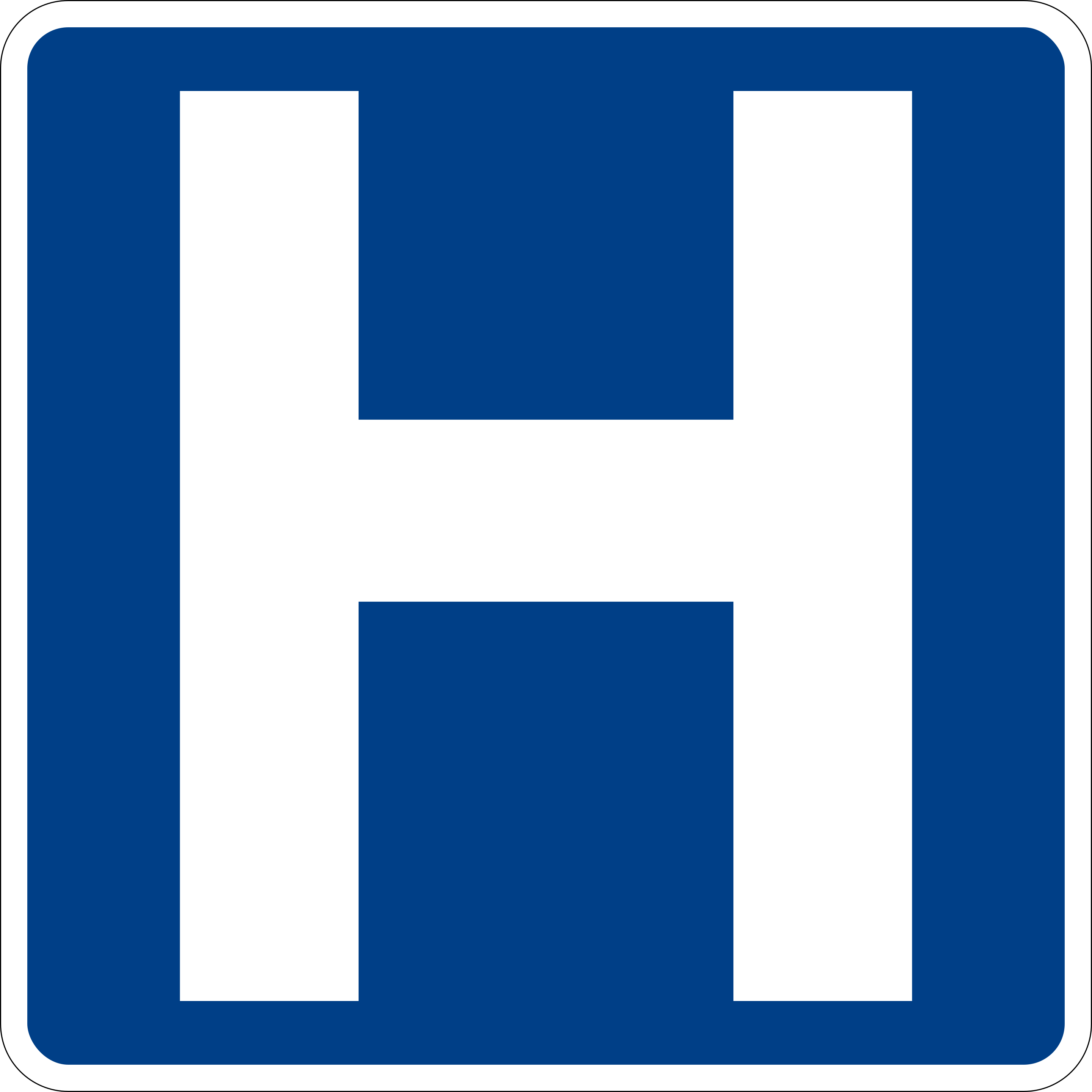
- A hazard that requires you to slow down
- A law that applies to drivers at this location
- Directions to service facilities
- Recreation areas and historic sites nearby
Show answer
Directions to service facilities. The handbook says signs with blue backgrounds provide directions to service facilities, such as a hospital. Blue signs mark services that drivers may need, such as gas, food, lodging or hospitals, so a blue sign with an H points toward a hospital. Blue signs mark places where you can get help or supplies and have nothing to do with hazards or rules, so a sign with a white H on blue directs you toward a hospital or other medical services.
Study this in the handbook: Regulatory signs: stop, yield and speed
4. A green arrow lights above your turn lane while the circular light stays red. When may you turn?
- Only after the circular light turns green again
- After stopping and then treating the lit arrow as a yield sign
- While the arrow is lit, in the direction it points
- Never, since a red circle cancels out the arrow
Show answer
While the arrow is lit, in the direction it points. The handbook says a lighted green arrow, by itself or along with a red, green or yellow light, means you may turn in the direction shown by the arrow. The green arrow gives you a protected turn in the direction shown, so you can go while it is lit, even if a red light is showing on the circular signal beside it.
Study this in the handbook: Fitness to drive, distractions and basic control
5. Your on-ramp is short and freeway traffic moves at 65 mph. What should you do on the ramp?
- Enter at 40 mph and let freeway drivers adjust around your car
- Stop at the end of the ramp and wait for a very large gap
- Merge early across the solid white line to gain extra room
- Use the ramp to build speed and merge at the speed of traffic
Show answer
Use the ramp to build speed and merge at the speed of traffic. The handbook says high-speed roadways generally have acceleration ramps so you can build up speed, and that when entering a freeway from an on-ramp you should try to increase your speed to match freeway traffic. Use the whole length of the ramp to reach the speed of traffic, then merge into a gap, because slowing or stopping on the ramp forces freeway drivers to react.
Study this in the handbook: Signaling, turns, U turns and parking
6. A tire blows out at highway speed. What sequence keeps the vehicle under control?
- Brake hard and steer toward the shoulder of the road at once
- Hold the wheel tightly, go straight, and slow down gradually
- Speed up first so that the vehicle stays stable
- Turn sharply away from the side with the blown tire
Show answer
Hold the wheel tightly, go straight, and slow down gradually. After a tire blowout, the handbook says to hold the steering wheel tightly and keep the vehicle going straight as you slow down gradually. Sudden braking or steering can make control worse. Gradually easing off the gas lets the vehicle slow without upsetting its balance. Once the vehicle is slow and stable, you can pull off the road to a safe place.
Study this in the handbook: Avoiding collisions, animals and vehicle failures
7. A large recreational vehicle is circulating as you reach a roundabout entry. How does Colorado treat your entry?
- Yield to the large vehicle as it drives in the roundabout
- Enter first, since smaller cars are able to merge faster than large ones
- Yield only if that vehicle shows a turn signal
- Stop fully and wait until the whole circle is empty
Show answer
Yield to the large vehicle as it drives in the roundabout. The handbook says that before entering a roundabout, Colorado law requires drivers to yield the right-of-way to the driver of a truck, bus, emergency vehicle or recreational vehicle, which it calls a large vehicle. Large vehicles need room to swing wide. Slow down, look for a large vehicle in the circle, and let it finish its path before you enter. A truck or bus needs extra room and cannot easily stop for a car that cuts in front of it.
Study this in the handbook: Lines, crosswalks and special lanes
8. An emergency vehicle sits stopped ahead, and your side of the road has only one lane. How should you pass it?
- Slow to a safe speed and pass with care and caution
- Change lanes quickly onto the shoulder so that you can pass it
- Keep your speed and give the vehicle a wide honk
- Stop and wait until the emergency vehicle leaves
Show answer
Slow to a safe speed and pass with care and caution. The handbook says that if the road only has one lane on your side or you cannot change lanes, you should slow down to a safe speed and use care and caution as you pass a stopped emergency vehicle. Slowing down gives you time to react if someone steps out from behind the stopped vehicle, and using care means keeping as much room as you can from the emergency workers.
Study this in the handbook: Right of way at intersections, roundabouts and mountain roads
9. Which locations share a parking ban in Colorado?
- A marked space in a shopping center parking lot during store hours
- Beside a curb on a quiet residential street with no signs posted
- A crosswalk, sidewalk, bridge, tracks, or controlled access highway
- A driveway where the property owner has given permission to park
Show answer
A crosswalk, sidewalk, bridge, tracks, or controlled access highway. The handbook lists several places where you cannot park a vehicle. They include a crosswalk, sidewalk, bridge, elevated structure, railroad tracks, or any controlled access highway. Parking there blocks people or traffic or creates a serious hazard. Each of these places is a spot where a parked vehicle could block people on foot, interfere with trains, or endanger traffic on a high speed road.
Study this in the handbook: Signaling, turns, U turns and parking
10. You are merging onto a highway where traffic streams past at full speed. Who holds the right of way?
- All of the vehicles on the road you are merging with
- You, as soon as your turn signal begins to flash
- Whoever is driving the faster of the vehicles involved
- Nobody, since merging is first come, first served
Show answer
All of the vehicles on the road you are merging with. The handbook says that when merging, you must yield to all vehicles on the roadway you are merging with. Adjust your speed to match the flow and find a gap before you move in. Use the acceleration lane to reach the speed of the traffic you are joining, check for a gap, signal, and merge when it is safe, since the vehicles already on the road do not have to move over for you.
Study this in the handbook: Right of way at intersections, roundabouts and mountain roads
11. After completing a lane change, how quickly should the turn signal turn off?
- After traveling another full block in the new lane
- Within 3 seconds of completing the lane change
- Only once you begin your next turn somewhere ahead
- Within 30 seconds of changing lanes on a freeway
Show answer
Within 3 seconds of completing the lane change. The handbook says to deactivate your turn signal within 3 seconds of completing the lane change. Leaving it blinking longer could suggest that you are about to move again. A signal that stays on after the move can mislead other drivers, which is why the handbook sets such a short time limit. Turn the signal off promptly, and double check that it is not still blinking after you finish. A signal that stays on can confuse drivers behind you and lead to a crash. Make it a habit.
Study this in the handbook: Freeways, lane changes and passing
12. What is the correct sequence for a normal stop in traffic?
- Look down at the pedals, then press the brake in short pumps
- Check mirrors behind, move to the brake, and press steadily
- Turn the wheel toward the curb while braking to a full stop
- Release the accelerator and coast until the vehicle stops itself
Show answer
Check mirrors behind, move to the brake, and press steadily. The handbook's stopping steps are to check your mirrors for traffic to the rear, move your foot from the accelerator to the brake pedal, and, with steady pressure, press until the vehicle comes to a stop. Steady pressure on the pedal gives a smooth stop, and checking the mirror first tells you whether the driver behind you can stop in time.
Study this in the handbook: Fitness to drive, distractions and basic control
13. Your green arrow ends while the circular green stays lit, and no sign or red arrow blocks your turn. What changes?
- The turn becomes forbidden as soon as the arrow ends
- You must stop and wait until the arrow returns
- You may still turn after yielding to through vehicles and pedestrians
- Oncoming traffic must now yield to you instead
Show answer
You may still turn after yielding to through vehicles and pedestrians. The handbook says that if the green arrow goes off but the circular green is on, you may still turn after yielding to through vehicles and pedestrians. The circular green still lets you proceed, but you must give way to through traffic and to pedestrians first, because no arrow now protects your turn. Watch for oncoming vehicles and pedestrians in the crosswalk before you complete the turn, and wait for a gap.
Study this in the handbook: Fitness to drive, distractions and basic control
14. Siren wailing, an emergency vehicle with flashing white and yellow lights approaches from behind. Must you yield?
- Only vehicles with red lights create a duty to yield
- Yield only when you are outside of an intersection
- Only if the vehicle is also displaying a flag
- Yes, yield to all emergency vehicles using a siren or lights
Show answer
Yes, yield to all emergency vehicles using a siren or lights. The handbook says you must yield the right-of-way to all emergency vehicles using a siren, air horn and/or flashing red, blue, white or yellow lights. Pull to the right edge of the road and stop, and if you are in an intersection, clear it first. The duty applies to all of these lights, not only red ones. Slow down and pull to the right as soon as you hear or see an emergency vehicle approaching, then stop until it passes.
Study this in the handbook: Right of way at intersections, roundabouts and mountain roads
15. A 16-year-old bicyclist reaches a clear stop-signed intersection where she already has the right of way. How may she treat the sign under the 2022 law?
- She must come to a complete stop every single time
- Only riders who are under 15 get that option
- She may ignore the sign completely if she wishes
- As a yield sign, since riders 15 and older may do so when it is clear
Show answer
As a yield sign, since riders 15 and older may do so when it is clear. The handbook says bicyclists ages 15 and older may now treat stop signs as yield signs and treat stop lights as stop signs. A 16-year-old qualifies, but she must still yield to any traffic that has the right of way. The rule is a bicyclist's option, and the rider must still give way when others have the right of way. As a driver, expect cyclists to roll through stop signs when it is clear.
Study this in the handbook: Bicyclists, motorcycles, trucks and pedestrians
16. Three hours pass after a driver's BAC peaked. By roughly how much has it fallen on average?
- About 0.15 percent over the three hours that passed
- About 0.045 percent, or 0.015 percent each hour
- It stays at the same level until the driver sleeps
- It falls all the way to zero within one hour
Show answer
About 0.045 percent, or 0.015 percent each hour. The handbook says that on average a person's BAC will drop by 0.015 percent per hour. After three hours that comes to roughly 0.045 percent. Time is the only thing that lowers BAC, and it happens slowly, so a driver may still be impaired for hours after the last drink. Since the drop is about 0.015 each hour, a person with a high reading can stay over the limit for many hours, and driving the next morning may still be unsafe.
Study this in the handbook: Losing your license, seat belts and child restraints
17. Even when the right of way seems to belong to you, what duty remains?
- You are still responsible for avoiding a crash
- You may proceed without checking cross traffic
- You must sound the horn and continue at speed
- You should close the gap so others cannot enter
Show answer
You are still responsible for avoiding a crash. The handbook states that regardless of who has the right of way, you are always responsible for avoiding a crash. Right of way tells drivers who should go first, but it does not remove the duty to watch for others and slow or stop if someone fails to yield. Watching for others, checking cross traffic, and being ready to slow or stop are the habits that keep a driver with the right of way out of a crash.
Study this in the handbook: Right of way at intersections, roundabouts and mountain roads
18. Your turn signals stop working. How should you signal turns in Colorado?
- Rely on brake lights alone to show each turn you make
- Open the window and shout each direction that you are going
- Skip signaling until the lights are repaired at a shop
- Use hand signals, finishing each one before the turn begins
Show answer
Use hand signals, finishing each one before the turn begins. The handbook says that if your vehicle's turn signals do not work, you must use hand signals. Give the signal in advance and complete it before you begin the turn, so that drivers around you know your intention. A hand signal is only useful if other drivers see it early, so give it well before the turn and put both hands back on the wheel to make the turn.
Study this in the handbook: Emergency vehicles, school buses and work zones
19. How should pets travel so they distract the driver less?
- Secured in a pet carrier or portable kennel
- Loose on the front passenger seat beside the driver
- Held on the driver's lap during short trips only
- On the rear shelf behind the seats, free to move
Show answer
Secured in a pet carrier or portable kennel. The handbook says to properly secure pets in a pet carrier or portable kennel. A secured pet cannot wander around the vehicle or interfere with the driver. An unsecured pet can climb on the driver, block the controls, or distract attention from the road, so keep the pet restrained before you start driving. Securing pets also protects them, since an unrestrained animal can be thrown around in a sudden stop or crash.
Study this in the handbook: Bicyclists, motorcycles, trucks and pedestrians
20. Another driver merges rudely in front of you. What response keeps you safe?
- Sound the horn repeatedly until they move over again
- Speed up to block the next attempt they make to merge
- Follow them closely to show how displeased you are
- Let the driver merge and do not take it personally
Show answer
Let the driver merge and do not take it personally. The handbook says to let people merge, even if they have done something discourteous, and not to make their problem your problem. Staying calm keeps you and others safer. Reacting angrily, honking, or trying to get even only makes a dangerous situation worse. Giving the other driver room is the safest response. Stay calm, keep your distance, and let the other driver go ahead, because arguing with someone on the road can quickly turn dangerous for everyone involved.
Study this in the handbook: Distracted, reckless and aggressive driving
Every question is written from the official Colorado Driver Handbook. Need paper? Printable CO practice test with answer key.
Last verified 2026-10-05. How we check every question · Study all 500 as flashcards
Frequently asked questions
How many questions are on this Colorado practice test?
This fixed set has 20 questions. It is test 11 of 25 from the 500 question Colorado bank.
How does this fixed test relate to the full Colorado bank?
Each numbered test is a fixed set of questions in a fixed order, so you can retake the same test later and compare. Every test mixes road signs and the other topics in about the same proportion as the full bank. Tests 1 to 25 together cover every question in the Colorado bank once. The full practice page mixes the whole bank at random.
Last verified 2026-10-05. See the Colorado DMV facts page for sourced state details.
Return to the full Colorado practice test · Study road signs