
Test 3 of 10 · 20 questions · Free 2026
CO Permit Practice Test 3
Jump to the test ↓A fixed 20 question set from the Colorado bank with answers and plain English explanations.
Question 1 of 20 · 0 right so far
All 20 questions in test 3
Every question below comes from the Colorado question bank on this page. Open a question to see the correct answer and the explanation. Nothing here is hidden behind a signup.
1. What must a Colorado minor submit with the application for a driver license?
- Only proof of vehicle registration
- A log showing 20 total hours, all during daylight
- A signed log showing 100 hours, none after sunset
- A completed, signed driving log showing 50 hours, including 10 at night
Show answer
A completed, signed driving log showing 50 hours, including 10 at night. The minor licensing requirement combines a 12-month instruction permit period with a completed, signed driving log. That log must document 50 hours of experience, of which 10 hours occurred at night. The other hour totals are not the handbook figures, and vehicle registration alone does not demonstrate supervised driving practice. Keep the log current and signed before applying, because the application requirement is about documented experience rather than simply owning or accessing a vehicle.
Study this in the handbook: Getting a license, instruction permits and the drive test
2. What does a round railroad advance warning sign indicate?

- A roundabout requires a left turn
- A bicycle lane begins immediately
- A railroad crossing is ahead
- A school entrance is ahead
Show answer
A railroad crossing is ahead. The round railroad advance warning sign tells the driver that a railroad crossing is ahead. It is placed far enough away to allow a driver to stop before reaching the tracks if necessary. The circular shape does not make it a roundabout sign, and it does not identify a bicycle lane or school entrance. Begin reducing speed and scanning before reaching the crossing. Never drive onto the rails unless there is enough room on the opposite side for the entire vehicle to clear the tracks.
Study this in the handbook: Railroad crossings and light rail
3. What do Colorado work zone signs help direct?
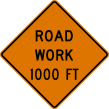
- Drivers toward recreational areas
- Traffic safely through work areas
- Vehicles toward service facilities
- Pedestrians across every intersection
Show answer
Traffic safely through work areas. Work zone signs have an orange background with black letters or symbols. They work with other traffic control devices or flag persons to direct traffic safely through work areas and protect roadway workers. A recreational sign uses a different sign group, while service signs provide facility information rather than work-zone direction. The pedestrian choice is too broad because a work zone may involve different traffic patterns and controls. Slow down, stay alert for changing routes, and follow the signs, cones, and flaggers in the work area.
Study this in the handbook: Regulatory signs: stop, yield and speed
4. What does a solid yellow line generally mean on a Colorado roadway?
- Only vehicles turning right may cross it
- Passing is required before the line ends
- Traffic in both directions may use the shoulder
- Passing is not permitted, with a limited bicyclist exception
Show answer
Passing is not permitted, with a limited bicyclist exception. A solid yellow line separates opposing traffic and generally prohibits passing. Colorado identifies a narrow exception when passing a bicyclist with at least three feet of space and a clear oncoming travel lane. That exception does not turn the marking into a general passing permission. The line does not require a pass, authorize shoulder travel, or limit crossing only to right turns. Read the marking together with traffic conditions, and never cross when the required clearance or safe path is unavailable.
Study this in the handbook: Warning, guide, work zone and special signs
5. When visibility is less than 1,000 feet in Colorado, which lighting rule applies?
- Turn lights off to reduce reflected glare
- Use parking lights only
- Drive with headlights on
- Use hazard flashers instead of headlights
Show answer
Drive with headlights on. Colorado requires headlights from sunset to sunrise and whenever visibility is less than 1,000 feet. Fog, heavy snow, dust, or darkness can make that threshold important even during daytime. Parking lights do not provide the required driving illumination, and hazard flashers do not replace headlights. High beams can reflect from fog and make the view worse, so use low beams or fog lights when appropriate. The practical cue is poor visibility itself: turn on the headlights before objects and road markings become difficult to see.
Study this in the handbook: Headlights, night driving and bad weather
6. What should a Colorado driver do immediately after a tire blowout?
- Turn sharply toward the shoulder before slowing
- Hold the wheel tightly, keep straight, and ease off the gas
- Apply the brakes hard and stop in the travel lane
- Accelerate briefly to stabilize the damaged tire
Show answer
Hold the wheel tightly, keep straight, and ease off the gas. A blowout can pull the vehicle or make steering unstable, so the first priority is control. Hold the steering wheel firmly, keep the vehicle going straight, remove the foot from the accelerator, and slow gradually. Light braking is appropriate rather than a hard application that could worsen the directional change. Turning sharply toward the shoulder before reducing speed works against the handbook's advice to keep the vehicle going straight and can cost you control. After slowing, move off the roadway to a safe place if possible.
Study this in the handbook: Avoiding collisions, animals and vehicle failures
7. How are High Occupancy Vehicle lanes marked on the roadway?
- With a red X above every entrance
- With a white diamond painted in the lane
- With a yellow crossbuck painted before each ramp
- With a blue curb stripe beside the shoulder
Show answer
With a white diamond painted in the lane. HOV lanes use a white diamond marking on the pavement, with signs explaining who may use the lane and any occupant requirement. A red X is not the pavement mark the handbook describes for these lanes. The diamond also appears in other restricted lanes, such as transit or bicycle lanes, so read the posted sign to learn the specific use. Watch for the diamond early so you can decide whether your vehicle qualifies before entering or staying in the restricted lane. Do not enter until the restriction fits your trip.
Study this in the handbook: Lines, crosswalks and special lanes
8. While driving with a Colorado instruction permit, who must sit in the front passenger seat?
- A person at least 21 years old with a valid Colorado license
- Any passenger who is at least 18 years old
- A licensed driver who is at least 16 years old
- No passenger, because permit holders must drive alone
Show answer
A person at least 21 years old with a valid Colorado license. A permit holder must have an adult supervisor in the front passenger seat, and Colorado specifies both qualifications: the person must be at least 21 and must hold a valid Colorado license. An 18-year-old or a 16-year-old does not meet the stated age requirement, even if licensed. The permit creates limited driving privileges for learning, so supervision is part of the privilege rather than an optional safety suggestion. Before moving, check that the supervising passenger is seated beside you and carries the required Colorado license.
Study this in the handbook: Getting a license, instruction permits and the drive test
9. Under Colorado's penalty table for drivers 21 and older, what license action follows a first DUI?
- Revocation for 9 months
- Revocation for 2 years
- 8 points only
- Revocation for 3 months
Show answer
Revocation for 9 months. A first Driving Under the Influence conviction in the table carries a 9 month revocation, a $600 to $1,000 fine, 5 to 365 days in jail and 48 to 96 hours of public service. Two years is the revocation for a third or later conviction. Eight points is the first DWAI penalty, not DUI. Three months is not in the table. Colorado also does not allow plea bargaining out of an alcohol or drug related driving offense.
Study this in the handbook: Drugs, penalties and express consent
10. When a stationary vehicle on a highway has flashing hazard lights, what should a driver try to do under Colorado's Move Over rule?
- Turn around before reaching it
- Pass without changing speed
- Stop in the travel lane
- Move over one lane when safe
Show answer
Move over one lane when safe. Colorado's Move Over Law covers any stationary vehicle on a highway with its hazard lights flashing. The driver must move over one lane when that can be done safely. If the roadway has one lane in each direction or a lane change would be unsafe, the required response is to slow to at least 20 mph below the posted limit. Passing at the same speed provides no protective space. Stopping in the travel lane creates a new danger, and turning around is not the prescribed response. Check mirrors early and create separation before reaching the stopped vehicle.
Study this in the handbook: Crash duties, the Move It Law and the Move Over Law
11. For a Colorado driver younger than 21, what BAC level is listed as a basis for license revocation?
- 0.05%
- 0.04%
- 0.02%
- 0.08%
Show answer
0.02%. A driver younger than 21 can face revocation based on a BAC over 0.02 percent. That youth threshold is much lower than the adult DUI per se figure, so a minor cannot use the adult number as a safe target. The 0.04 percent choice belongs to CDL drivers, and 0.05 percent is the first DWAI table figure for adults. Age is the key cue: identify the under 21 rule before comparing BAC options.
Study this in the handbook: Losing your license, seat belts and child restraints
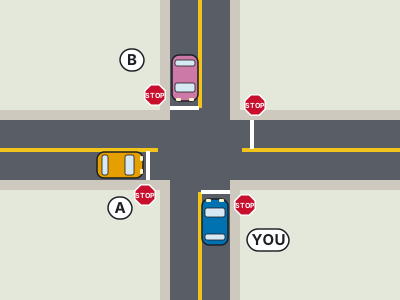
12. At a four-way stop, which vehicle normally proceeds first when it arrived before the others?
- The vehicle with more passengers
- The vehicle traveling fastest
- The vehicle turning right
- The vehicle that reached the intersection first
Show answer
The vehicle that reached the intersection first. At a four-way stop, the vehicle that reached the intersection first has priority to go first. Arrival order controls this situation, not speed, passenger count, or a blanket preference for right turns. If two vehicles arrive together, use the separate left yields to right rule. Even after identifying priority, make a full stop and check for pedestrians or another driver who has not recognized the order, since avoiding a crash remains each driver's responsibility.
Study this in the handbook: Right of way at intersections, roundabouts and mountain roads
13. When must a Colorado driver reduce a speed below the maximum limit?
- Only when a police officer directs it
- When conditions require a slower speed
- Only when the vehicle has passengers
- Never, because the maximum is always safe
Show answer
When conditions require a slower speed. The handbook says maximum speed limits assume ideal conditions. Rain, snow, poor visibility, traffic, pedestrians, animals, railroad tracks, and other hazards can require a driver to slow below the displayed maximum. A police direction is not the only reason to reduce speed, and passengers do not determine the safe speed. The maximum is not a guarantee that the roadway is safe at that number. Check the conditions ahead and leave enough control margin to stop or respond to a hazard.
Study this in the handbook: Fitness to drive, distractions and basic control
14. What is the first precaution when entering a designated animal crossing?
- Slow down and look for animals
- Sound the horn continuously while accelerating
- Move to the shoulder and stop for ten minutes
- Turn off headlights so animals are not startled
Show answer
Slow down and look for animals. Colorado treats animal crossings as places where a driver should reduce speed and actively search before a hazard appears. Honking while accelerating gives less time to react, and stopping on the shoulder is not the normal first step. The sign or crossing area is your cue to scan both sides of the road, especially near rural or mountain habitat. Early speed reduction gives animals time to move.
Study this in the handbook: Avoiding collisions, animals and vehicle failures
15. What is the recommended first response when the gas pedal is jammed?
- Turn the steering wheel sharply toward oncoming traffic
- Pump the accelerator until it releases
- Shift quickly to neutral while keeping your eyes on the road
- Turn off the engine before controlling the vehicle
Show answer
Shift quickly to neutral while keeping your eyes on the road. A jammed accelerator can keep the vehicle moving faster than intended, so the first priority is to stop the engine from driving the wheels while maintaining visual control. The handbook directs the driver to keep eyes on the road and quickly shift to neutral, then pull off when safe and turn off the engine. Pumping the stuck pedal may worsen the problem. A sharp move toward oncoming traffic creates a new hazard, and switching off the engine before stabilizing the car can reduce control unexpectedly.
Study this in the handbook: Avoiding collisions, animals and vehicle failures
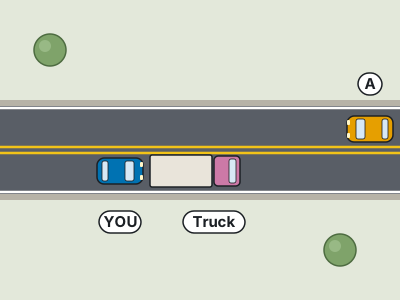
16. What do double solid yellow lines generally tell drivers?
- Both directions may pass whenever visibility is good
- Neither side may pass
- Only the lane nearest the shoulder may pass
- The roadway is reserved for bicycles
Show answer
Neither side may pass. Double solid yellow lines separate opposing traffic and generally prohibit passing from either direction. The handbook includes a limited exception for passing a bicyclist with at least three feet of space when the oncoming lane is clear, so ordinary visibility alone does not make passing permissible. The shoulder side has no special passing privilege, and these markings do not identify a bicycle-only roadway. Read the complete marking and the surrounding traffic before considering any lawful crossing, especially where opposing vehicles may appear.
Study this in the handbook: Warning, guide, work zone and special signs
17. What do Colorado regulatory signs tell drivers?
- The safe speed around a curve in ideal conditions
- The distance to recreational attractions
- The laws and regulations that apply at a location
- The presence of a changing weather pattern
Show answer
The laws and regulations that apply at a location. Regulatory signs communicate enforceable laws and regulations for the place where they are posted. Ignoring one can be a traffic violation, so a driver should read the instruction and comply rather than treat it as a suggestion. Recreation and cultural destinations use guide or service sign categories, while advisory speed signs address curves under ideal conditions. A weather warning may require caution, but it is not the definition of a regulatory sign.
Study this in the handbook: Fitness to drive, distractions and basic control
18. Where must a Colorado driver stop when a stop sign has no marked stop line?
- Before the near-side crosswalk, or nearest the roadway if there is no crosswalk
- In the center of the intersection after checking for traffic
- At least 20 feet beyond the crosswalk
- Beside the sign, even if that point blocks the sidewalk
Show answer
Before the near-side crosswalk, or nearest the roadway if there is no crosswalk. A stop sign requires a complete stop, and the stopping point follows a sequence. Use the marked stop line first. If none exists, stop before entering the near-side crosswalk. If there is no crosswalk, stop at the nearest point to the intersecting roadway where approaching traffic can be seen. The intersection center and a point beyond the crosswalk are too far forward, while stopping beside the sign may obstruct people. Find the proper limit before the front wheels cross it.
Study this in the handbook: Fitness to drive, distractions and basic control
19. What do speed limit signs show?
- The maximum or minimum speed allowed
- A suggested speed only for clear weather
- The speed of the vehicle ahead
- The distance to the next speed-zone change
Show answer
The maximum or minimum speed allowed. Colorado speed limit signs identify the maximum or minimum speed allowed for that roadway. A maximum is written for ideal conditions, so rain, ice, pedestrians, animals, or other hazards can require a lower speed. Treating the sign as a mere suggestion or copying the vehicle ahead ignores the posted control and the obligation to adapt. On a road with a minimum, going below it can also be a violation unless road or weather conditions justify the slower pace.
Study this in the handbook: Fitness to drive, distractions and basic control
20. About how far does an average freight train at 55 mph need to stop?
- About 200 feet
- About 500 feet
- About a quarter mile
- About one mile
Show answer
About one mile. Colorado's handbook warns that a train appears to move slower than it really does because of its size, and that the average freight train traveling at 55 mph requires about one mile to stop. Two hundred feet is the stopping distance for a lightweight car at the same speed. Five hundred feet and a quarter mile both badly understate a train's stopping distance. Never try to beat a train to a crossing.
Study this in the handbook: Railroad crossings and light rail
QualitySpace is expanding to Colorado
We are a California-based independent insurance brokerage working on licensing in more states. We cannot help with Colorado insurance yet. Leave your email and we will let you know when we can.
Every question is written from the official Colorado Driver Handbook. Need paper? Printable CO practice test with answer key.
Last verified 2026-10-05. How we check every question · Study all 213 as flashcards
Frequently asked questions
How many questions are on this Colorado practice test?
This fixed set has 20 questions. It is test 3 of 10 from the 213 question Colorado bank.
How does this fixed test relate to the full Colorado bank?
Each numbered test is a fixed set of questions in a fixed order, so you can retake the same test later and compare. Every test mixes road signs and the other topics in about the same proportion as the full bank. Tests 1 to 10 together cover 200 of the 213 questions in the Colorado bank, each once. The full practice page mixes the whole bank at random.
Last verified 2026-10-05. See the Colorado DMV facts page for sourced state details.
Return to the full Colorado practice test · Study road signs