
Test 6 of 10 · 20 questions · Free 2026
CO Permit Practice Test 6
Jump to the test ↓A fixed 20 question set from the Colorado bank with answers and plain English explanations.
Question 1 of 20 · 0 right so far
All 20 questions in test 6
Every question below comes from the Colorado question bank on this page. Open a question to see the correct answer and the explanation. Nothing here is hidden behind a signup.
1. A Colorado child is 5 years old and weighs 45 pounds. How must the child ride?
- In a rear-facing seat in the front
- In a child restraint system or booster seat in the rear seat, if one is available
- With only a lap belt in any seat
- Unrestrained, if a parent holds the child
Show answer
In a child restraint system or booster seat in the rear seat, if one is available. Children 4 years of age or older but less than 9, and weighing at least 40 pounds, must be properly secured in a child restraint system or booster seat in the rear seat if a rear seat is available. A rear-facing seat in the front is the rule for none of these age groups. A lap belt alone skips the booster requirement, and being held is never allowed. If no parent is in the vehicle, the driver is responsible for restraining each child.
Study this in the handbook: Losing your license, seat belts and child restraints
2. What do the shapes and colors of Colorado traffic signs indicate?

- The driver's eligibility for a license
- The mechanical condition of the vehicle
- The type of information the sign provides
- Whether a railroad train is approaching
Show answer
The type of information the sign provides. Colorado explains that the shapes and colors of traffic signs indicate the type of information they provide. A driver can use those visual clues to distinguish regulatory controls, warnings, guide signs, and service or recreation information before reading the full message. They do not report the vehicle's mechanical condition, the driver's licensing status, or whether a train is currently approaching. The divided-highway image is a warning example, but the handbook passage supports the broader classification skill tested here. Notice the sign's background, shape, symbol, and words, then respond to the category it signals.
Study this in the handbook: Fitness to drive, distractions and basic control
3. A new Colorado resident who is not in the military or a student must get a Colorado driver license within how many days of becoming a resident?
- 90 days
- 30 days
- 60 days
- One year
Show answer
30 days. Colorado requires a new resident to get a Colorado driver license within 30 days of becoming a resident. Ninety days is part of how residency is defined, since living in the state continuously for 90 days is one example of being a resident, so it is the easy mix-up. Sixty days and one year are not in the rule. Active duty service members, their dependents, and people living in Colorado mainly to go to school are the listed exceptions.
Study this in the handbook: Getting a license, instruction permits and the drive test
4. What may happen if you refuse to sign a traffic ticket in Colorado?
- The ticket is automatically dismissed
- You may be arrested
- You pay double the fine
- Nothing, since signing is optional
Show answer
You may be arrested. Signing a Colorado traffic ticket is not an admission of guilt, and disagreements belong in court or other legal channels. The handbook warns that refusing to sign a traffic ticket may result in your arrest. The ticket is not dismissed, and the handbook sets no doubled fine for refusing. Treating the signature as optional ignores the arrest warning. You may ask to speak to a supervisor about an officer's conduct.
Study this in the handbook: Scanning, following distance, phones and traffic stops
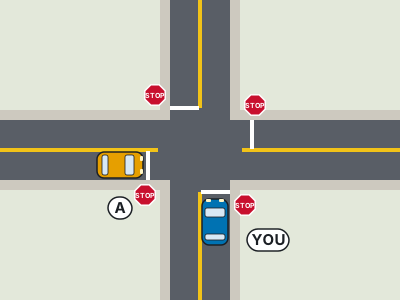
5. Two vehicles reach a four-way stop at the same time. Which one has priority?
- The vehicle carrying more passengers
- The vehicle on the left
- The vehicle with the larger engine
- The vehicle on the right
Show answer
The vehicle on the right. At a four-way stop, simultaneous arrival gives priority to the vehicle on the right, so the driver on the left must yield. Arrival order still matters when one vehicle reaches the intersection first, and every driver remains responsible for avoiding a crash even when another vehicle should yield. Vehicle size or engine power does not determine priority. Make the stop, confirm that the other driver is yielding, and proceed only after checking for pedestrians and other hazards in the intersection.
Study this in the handbook: Right of way at intersections, roundabouts and mountain roads
6. A school bus is stopped with red lights flashing on the opposite side of an undivided road. What must you do?
- Stop only if the bus driver extends the stop arm toward you
- Proceed because the bus is facing the other direction
- Pass at 15 mph after checking that no child is visible
- Stop and remain stopped until the red lights stop flashing
Show answer
Stop and remain stopped until the red lights stop flashing. A Colorado driver must stop for the bus even when it is on the opposite side of the roadway, unless a median or other physical barrier separates the bus from the vehicle. The flashing red lights establish the stopping condition; a driver does not get an exception because no child is currently visible or because the stop arm is angled away. Remain stopped until the lights are no longer flashing. The key visual cue is an undivided road with the bus's red lights active.
Study this in the handbook: Emergency vehicles, school buses and work zones
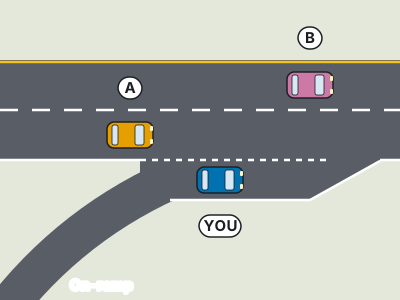
7. When merging, to whom must a driver yield?
- Only vehicles with flashing hazard lights
- Only vehicles directly behind in the same lane
- All vehicles on the roadway being entered
- No vehicles if the driver signals for three seconds
Show answer
All vehicles on the roadway being entered. A turn signal communicates intent, but it does not transfer priority. Colorado’s right-of-way rule requires a merging driver to yield to all vehicles already on the roadway being entered. If another vehicle must slow down for your merge, the gap was not adequate. The cue is the traffic stream you are joining, including vehicles beside and behind the opening. A clean merge never makes others brake suddenly.
Study this in the handbook: Right of way at intersections, roundabouts and mountain roads
8. What is the purpose of a blue railroad Emergency Notification System sign?
- To report crossing problems or emergencies by telephone
- To show that trains never use horns at that crossing
- To mark a county highway route number
- To give the legal speed limit near the tracks
Show answer
To report crossing problems or emergencies by telephone. The blue ENS sign is for reporting a railroad crossing emergency or problem, using the phone number posted at that location. It is not the same as a quiet-zone notice, which concerns train horns. When a vehicle is stuck, gates malfunction, or another hazard blocks a crossing, the sign gives the contact point needed to alert the railroad quickly. Keep the posted number visible when calling.
Study this in the handbook: Railroad crossings and light rail
9. What may happen after a driver younger than 21 is convicted of DUI or DWAI for the first time?
- The license is permanently canceled in every first-conviction case
- The license may be revoked if the driver fails to complete a court-ordered evaluation or program
- The driver receives only a warning and keeps the license without conditions
- Revocation is possible only after a third conviction
Show answer
The license may be revoked if the driver fails to complete a court-ordered evaluation or program. For a first DUI or DWAI conviction involving a driver younger than 21, the handbook says the license is subject to revocation when the driver fails to complete a court-ordered evaluation or program. The rule is conditional, so permanent cancellation in every first case overstates it. A warning with no conditions ignores the stated consequence, while waiting for a third conviction misses the separate first-conviction provision. The practical cue is to connect the driver’s age, the first conviction, and completion of the court order before deciding what the license consequence may be.
Study this in the handbook: Drugs, penalties and express consent
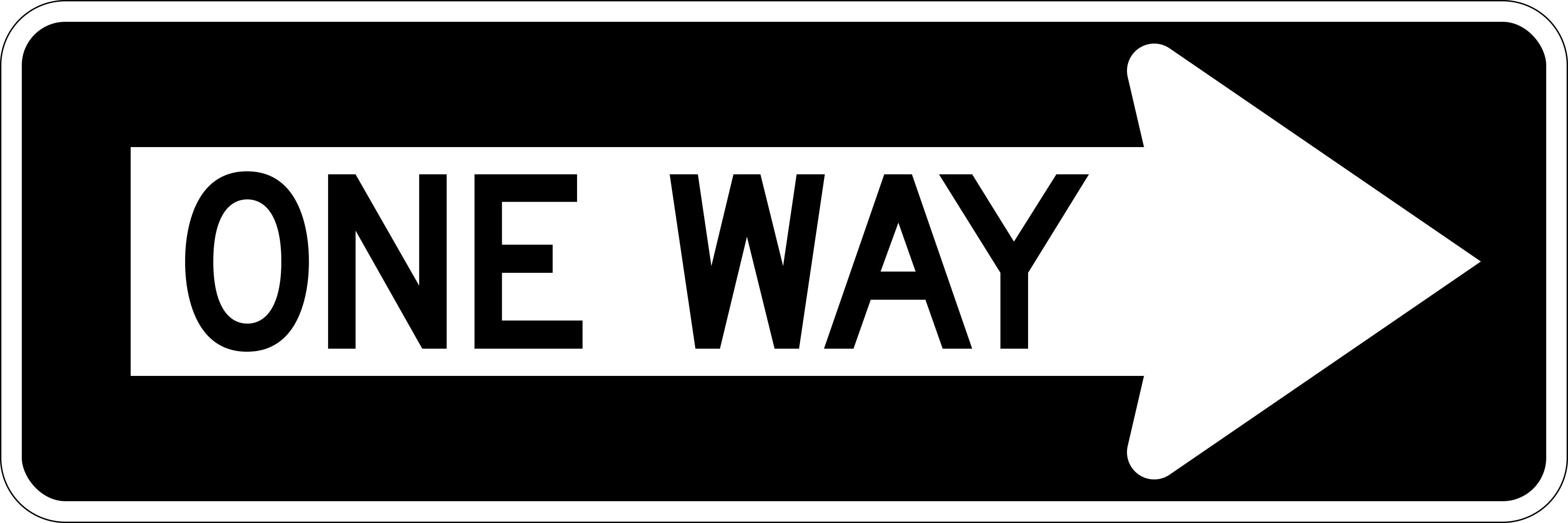
10. What direction may a driver follow after seeing a One Way sign?
- Only toward the nearest service facility
- Any direction if the street is empty
- Only the direction indicated by the sign’s arrow
- The opposite direction during daylight
Show answer
Only the direction indicated by the sign’s arrow. A One Way sign indicates that travel is allowed only in the direction shown by its arrow. An empty street does not cancel the restriction, and the sign is unrelated to service facilities or daylight. Before entering the street, match your intended movement to the arrow and choose another route if your direction is not permitted. One-way control is especially important on narrow streets and freeway ramps, where an opposing vehicle may not expect traffic coming from your direction.
Study this in the handbook: Regulatory signs: stop, yield and speed
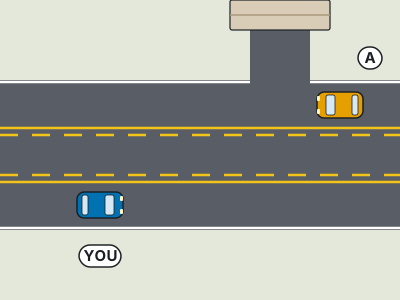
11. A shared center turn lane may be used for which movement?
- Parking while waiting for a green light
- Passing slower traffic straight ahead
- Continuous travel through the intersection
- Left turns in either direction
Show answer
Left turns in either direction. The shared center lane is reserved for vehicles preparing to turn left from either direction. It may provide a place to wait until the turn can be completed, but it is not a through lane and cannot be used to pass. Parking there or using it as a shortcut through an intersection blocks the turning space and surprises opposing drivers. Enter only for the left-turn movement, check for traffic and pedestrians, and leave the center lane as soon as the turn is safely completed.
Study this in the handbook: Lines, crosswalks and special lanes
12. Where is parking prohibited around the crosshatched section of a disabled parking space?
- In the crosshatched van-access area at any time
- Only within 30 feet of the crosshatched area
- Only during business hours
- Only if the curb is painted yellow
Show answer
In the crosshatched van-access area at any time. The handbook says crosshatched sections next to disabled parking spaces are for van access only and parking is not allowed there at any time. The rule is not tied to a distance, to business hours, or to curb paint. It is a separate rule from the disabled space itself, which may be used only when the person who owns the placard is entering or exiting the vehicle. Treat the crosshatched striping as a cue that the area must stay open at all times.
Study this in the handbook: Warning, guide, work zone and special signs
13. A Colorado driver's refusal revocation is followed by another suspension from the same incident. How is it served?
- At the same time as the revocation
- It is dropped, because refusal replaces it
- Added onto the end of the revocation, one after the other
- Only if the driver is under 21
Show answer
Added onto the end of the revocation, one after the other. Refusing a chemical test brings a one year revocation and two years of ignition interlock. The handbook adds that if other suspensions or revocations come from the same incident, they are added onto the end of the revocation, which means they run consecutively. They do not run at the same time, and the refusal does not cancel them. The rule applies to all drivers, not only those under 21.
Study this in the handbook: Drugs, penalties and express consent
14. Unless otherwise posted, what is the Colorado speed limit in a residence district?
- 30 mph
- 25 mph
- 20 mph
- 40 mph
Show answer
30 mph. Colorado's default speed limits are 20 mph on narrow, winding mountain highways and blind curves, 25 mph in any business district, 30 mph in any residence district, 40 mph on open mountain highways, 55 mph on urban interstates and highways, and 65 to 75 mph on designated rural interstates and highways. So a residence district is 30 mph. Twenty-five is the business district figure, 20 is for winding mountain roads, and 40 is for open mountain highways.
Study this in the handbook: Emergency vehicles, school buses and work zones
15. If a solid yellow line is on your side and a broken yellow line is on the other side, may you pass?
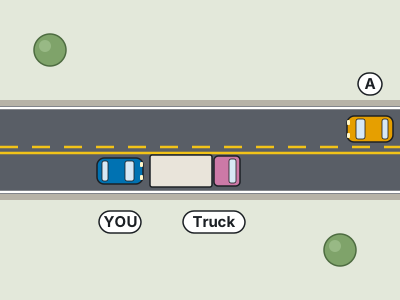
- No, but you may use the shoulder to get around the vehicle
- Yes, if you accelerate before the broken line ends
- Yes, because either side may cross a solid yellow line
- No, you may not pass from the side with the solid line
Show answer
No, you may not pass from the side with the solid line. With solid and broken yellow lines together, the line on your side controls your movement. A solid line on your side means passing is prohibited. The driver on the broken-line side may pass when it is safe and must return before that broken line becomes solid. Accelerating does not cancel the restriction, and crossing the shoulder is not a lawful substitute for passing. Check the pavement beside your vehicle, not just the line beside the other traffic, before deciding whether a pass is allowed.
Study this in the handbook: Freeways, lane changes and passing
16. How far ahead should a Colorado driver look to reduce last-minute braking?
- Only one car length ahead
- At least 10 seconds ahead
- Exactly three seconds ahead
- No farther than the next lane marking
Show answer
At least 10 seconds ahead. Scanning well ahead gives time to spot slowing traffic, pedestrians, signals, and hazards before they become urgent. Colorado recommends looking at least 10 seconds down the road, which is about one block in the city or half a mile on open road. A three-second count is for following distance, not visual search. Use distant traffic flow as your cue. This habit creates room for calm decisions.
Study this in the handbook: Scanning, following distance, phones and traffic stops
17. When a red arrow is displayed, which movement is forbidden?
- Turning in the direction shown by the arrow
- Stopping before the marked line
- Proceeding straight when another signal permits it
- Yielding to a pedestrian in the crosswalk
Show answer
Turning in the direction shown by the arrow. A red arrow controls the movement shown by its direction. The driver must stop and may not turn that way while the red arrow is displayed. It does not eliminate the need to stop at the proper line, and it does not authorize a driver to ignore pedestrians or other signals controlling separate movements. The straight-ahead choice may depend on another signal, but it cannot override a restriction that applies to the arrow direction. Identify the arrowhead before entering the intersection.
Study this in the handbook: Fitness to drive, distractions and basic control
18. What THC level creates a permissible inference that a driver was DUI in Colorado?
- 15 nanograms per milliliter of saliva
- 0.08 nanograms per breath sample
- 5 nanograms per milliliter of blood
- Any detectable THC level in urine
Show answer
5 nanograms per milliliter of blood. Colorado separates the THC inference from alcohol BAC rules. The handbook says 5 nanograms of THC per milliliter of blood permits an inference of DUI, while DWAI has no THC permissible inference level. A saliva or urine figure is not the stated standard. The practical cue is that marijuana impairment can be judged through behavior as well as blood results.
Study this in the handbook: Drugs, penalties and express consent
19. Which steering-wheel hand positions give a driver better vehicle control?
- 3 and 9 o'clock or 4 and 8 o'clock
- 12 and 6 o'clock
- Both hands inside the wheel spokes
- One hand at the top and one on the gear selector
Show answer
3 and 9 o'clock or 4 and 8 o'clock. The handbook recommends placing both hands on opposite sides of the outside of the steering wheel, at 3 and 9 o'clock or 4 and 8 o'clock. The handbook adds that a driver should never grip the inside of the wheel when turning it. Holding the wheel at 12 and 6, gripping its inside, or leaving a hand on the gear selector reduces consistent control. Keep the grip firm but gentle, use your fingers, and keep your thumbs along the wheel face.
Study this in the handbook: Fitness to drive, distractions and basic control
20. You are following a truck carrying hazardous materials as it approaches a railroad crossing. What should you expect?
- The truck may ignore the crossing if no train is visible
- The truck must accelerate because hazardous loads have priority
- The truck may use the shoulder while other traffic passes
- The truck may be required to stop, so be prepared to stop too
Show answer
The truck may be required to stop, so be prepared to stop too. Commercial trucks carrying hazardous materials must stop at most railroad crossings. A driver behind one should anticipate that stop and leave enough room to stop safely rather than assuming the truck will continue through. Hazardous cargo does not give the truck priority or authorize shoulder travel. Watch the crossing, the truck's brake lights, and any signals, then remain behind it until the crossing can be navigated safely. Following too closely would leave little time to respond to the required stop.
Study this in the handbook: Railroad crossings and light rail
QualitySpace is expanding to Colorado
We are a California-based independent insurance brokerage working on licensing in more states. We cannot help with Colorado insurance yet. Leave your email and we will let you know when we can.
Every question is written from the official Colorado Driver Handbook. Need paper? Printable CO practice test with answer key.
Last verified 2026-10-05. How we check every question · Study all 213 as flashcards
Frequently asked questions
How many questions are on this Colorado practice test?
This fixed set has 20 questions. It is test 6 of 10 from the 213 question Colorado bank.
How does this fixed test relate to the full Colorado bank?
Each numbered test is a fixed set of questions in a fixed order, so you can retake the same test later and compare. Every test mixes road signs and the other topics in about the same proportion as the full bank. Tests 1 to 10 together cover 200 of the 213 questions in the Colorado bank, each once. The full practice page mixes the whole bank at random.
Last verified 2026-10-05. See the Colorado DMV facts page for sourced state details.
Return to the full Colorado practice test · Study road signs