
Test 2 of 10 · 20 questions · Free 2026
CO Permit Practice Test 2
Jump to the test ↓A fixed 20 question set from the Colorado bank with answers and plain English explanations.
Question 1 of 20 · 0 right so far
All 20 questions in test 2
Every question below comes from the Colorado question bank on this page. Open a question to see the correct answer and the explanation. Nothing here is hidden behind a signup.
1. Which road features do Colorado advisory speed signs cover?
- The safe speed around curves, corners, and off-ramps in ideal conditions
- The legal minimum speed on every freeway
- Directions and mileage to specific destinations
- The location of emergency services
Show answer
The safe speed around curves, corners, and off-ramps in ideal conditions. Advisory speed signs show a safe speed for curves, corners, and off-ramps in ideal conditions. They help a driver choose an appropriate speed for a roadway feature, but they are not destination signs or universal freeway limits. Poor weather, traffic, visibility, or pavement conditions can require an even lower speed. Read the advisory number together with the curve or ramp ahead, slow before entering it, and keep enough control margin to respond if conditions change.
Study this in the handbook: Regulatory signs: stop, yield and speed
2. What do blue backgrounds on Colorado service signs provide?
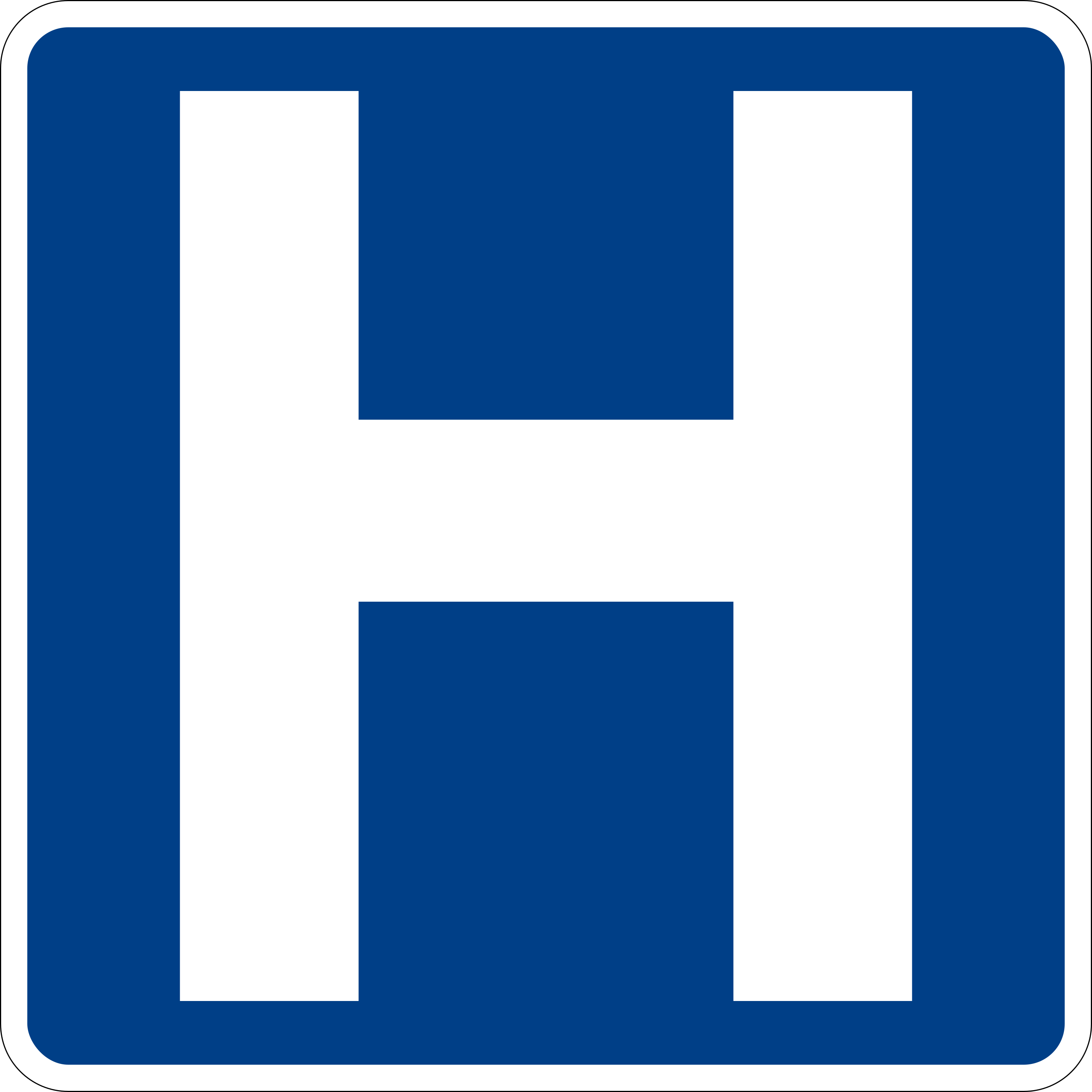
- Directions to service facilities
- Warnings about school zones and curves
- Mileage to specific destinations only
- Rules prohibiting a turn
Show answer
Directions to service facilities. Blue backgrounds identify signs that provide directions to service facilities. They help drivers locate services, while warning signs alert drivers to hazards, guide signs provide destination and mileage information, and regulatory signs state enforceable rules. The color is a useful first clue, but read the wording or symbol before changing lanes or turning. Do not treat a blue service sign as permission to ignore another traffic control. Follow the roadway signs that govern the maneuver and use the service information to plan the stop safely.
Study this in the handbook: Regulatory signs: stop, yield and speed
3. When are most deer and elk crashes described in the Colorado handbook as occurring?
- Only during heavy snowfall at midday
- Only during the middle of the afternoon
- Between dusk and dawn
- Between sunrise and noon on city streets
Show answer
Between dusk and dawn. The handbook identifies the period between dusk and dawn as the time when approximately 90 percent of deer and elk crashes occur. Darkness and reduced visibility make animal movement harder to detect, especially in rural and mountainous areas. The other choices narrow the risk to times the handbook does not identify. Slow when entering a marked animal crossing, scan the shoulders, and avoid a sudden swerve that could create a more serious loss-of-control crash.
Study this in the handbook: Avoiding collisions, animals and vehicle failures
4. What jail range does Colorado's table list for a first DUI for a driver 21 or older?
- 2 to 180 days
- 60 to 365 days
- 5 to 365 days
- No jail for a first offense
Show answer
5 to 365 days. The handbook's table lists 5 to 365 days of jail for a first DUI, along with a 9 month revocation, a $600 to $1,000 fine and 48 to 96 hours of public service. Two to 180 days is the first DWAI range. Sixty to 365 days is the range for a third or later conviction. Saying there is no jail for a first offense contradicts the table, which lists a jail range for every row.
Study this in the handbook: Drugs, penalties and express consent
5. What is the safest timing for slowing before a curve on a Colorado roadway?
- Brake sharply after leaving the curve
- Wait until the vehicle reaches the middle of the curve
- Accelerate before the curve so the tires grip harder
- Slow before entering the curve
Show answer
Slow before entering the curve. The handbook says to reduce speed before entering a curve because the tires need available grip to guide the vehicle. Entering too fast can cause a skid, especially on a wet, icy, or unfamiliar roadway. The manual places acceleration after the vehicle reaches the middle of the curve, so accelerating before the turn is not the safe sequence. Waiting until the vehicle is already deep in the bend makes a sudden correction more likely. Look through the curve, set a manageable speed early, and steer smoothly.
Study this in the handbook: Hills, curves, snow, ice and mountain roads
6. A Colorado teen applies for a license before age 16 and 6 months. What training is required on top of the 50 hour log?
- 30 hours of classroom training only
- An extra 20 hours of night driving
- 6 hours of behind-the-wheel training with an approved driver education instructor
- No extra training
Show answer
6 hours of behind-the-wheel training with an approved driver education instructor. Colorado requires every minor to hold a permit 12 months and log 50 hours, 10 at night. An applicant younger than 16 and 6 months must also complete 6 hours of behind-the-wheel training with an approved driver education instructor. Classroom time alone does not meet the rule, and there is no extra 20 hour night requirement. If no approved school offering enough training is within 30 miles, 12 more hours with a parent or permit supervisor may be substituted.
Study this in the handbook: Getting a license, instruction permits and the drive test
7. An angry driver is following you aggressively. What response does the handbook recommend?
- Match the driver's speed to prevent being passed
- Back off, give way, and let that driver go
- Make eye contact and confront the driver at the next stop
- Brake hard whenever the driver gets close
Show answer
Back off, give way, and let that driver go. The safest response to an aggressive driver is disengagement. Create space, yield the interaction, and allow the angry driver to move away instead of competing for position. Matching speed keeps the conflict active, while eye contact and confrontation can escalate a situation that is already unsafe. Do not retaliate with braking, gestures, or pursuit. Keep attention on the roadway, use ordinary defensive driving, and contact authorities only when you can do so without creating another distraction or hazard.
Study this in the handbook: Distracted, reckless and aggressive driving
8. During a Colorado minor driver's first year, when is driving between midnight and 5 a.m. generally prohibited?
- Only when the driver is alone during the afternoon
- Unless accompanied by an instructor, parent, or legal guardian
- Unless another passenger younger than 21 is present
- Only on weekends when school is not in session
Show answer
Unless accompanied by an instructor, parent, or legal guardian. A newly licensed minor faces a nighttime curfew during the first year. Driving from midnight through 5 a.m. is not allowed unless an instructor, parent, or legal guardian accompanies the driver. The rule is tied to the clock, not to weekends, school schedules, or whether a young passenger is present. Certain exceptions exist for school, work, medical emergencies, and emancipated minors, but ordinary late-night driving needs the listed adult supervision. Plan trips so the departure and return times fit the restriction.
Study this in the handbook: Passenger limits and curfew for young drivers
9. Near the merge area shown by this sign, what freeway-driving courtesy should a driver use when safe?

- Drive across the median to avoid the ramp
- Stop in the acceleration lane until all traffic clears
- Move over to make room for vehicles entering
- Block the right lane so entering traffic must wait
Show answer
Move over to make room for vehicles entering. A merge sign warns that entering traffic may need space. On freeways, Colorado advises drivers already on the road to move over when it is safe near a merge area. Stopping in an acceleration lane is reserved for absolute necessity and blocking traffic makes merging less predictable. Use the sign as an early cue to scan left, check mirrors, and create room.
Study this in the handbook: Signaling, turns, U turns and parking
10. On a four-lane highway posted faster than 40 mph, how far before a turn or lane change must you signal?
- 50 feet
- 100 feet
- 200 feet
- Only after the lane change begins
Show answer
200 feet. Urban streets use a 100-foot signal rule, but Colorado gives a longer distance for four-lane highways when the posted speed is faster than 40 mph. In that setting, the signal must be on for 200 feet before turning or changing lanes. The 100-foot choice is tempting because it applies elsewhere. Use the roadway type and speed limit together as your cue.
Study this in the handbook: Signaling, turns, U turns and parking
11. When may a driver turn in the direction shown by a lighted green arrow?
- Only after waiting for every nearby vehicle to stop
- While the arrow is lit, in the direction it points
- In any direction, because a green arrow cancels lane markings
- Only after the signal changes to a flashing red light
Show answer
While the arrow is lit, in the direction it points. A lighted green arrow, shown alone or together with a red, green, or yellow light, means you may turn in the direction the arrow points. Once the arrow goes off, the protected phase is over: you may still turn only while the circular green is on, after yielding to through vehicles and pedestrians, and only if no sign or red arrow prohibits it. The arrow does not erase lane markings or require a flashing red display, and you need not wait for every nearby car to stop.
Study this in the handbook: Fitness to drive, distractions and basic control
12. If a vehicle loses traction on snow or ice, what should the driver do first?
- Press the accelerator firmly to regain grip
- Remove both feet from the brake and accelerator pedals
- Lock the wheels with maximum braking pressure
- Turn the front wheels away from the desired path
Show answer
Remove both feet from the brake and accelerator pedals. Snow and ice reduce tire grip, so continued pressure on either pedal can make the loss of control worse. Colorado's guidance is to take your foot off both the brake and accelerator, then turn the front wheels in the direction you want the car to go. Heavy acceleration can spin the tires, and locked wheels cannot guide the vehicle effectively. Steering away from the intended path compounds the drift. The useful cue is gentle hands and no pedal input while the tires regain contact, followed by smooth steering rather than a sudden correction.
Study this in the handbook: Hills, curves, snow, ice and mountain roads
13. What does a sign showing a crossed U-turn arrow prohibit?
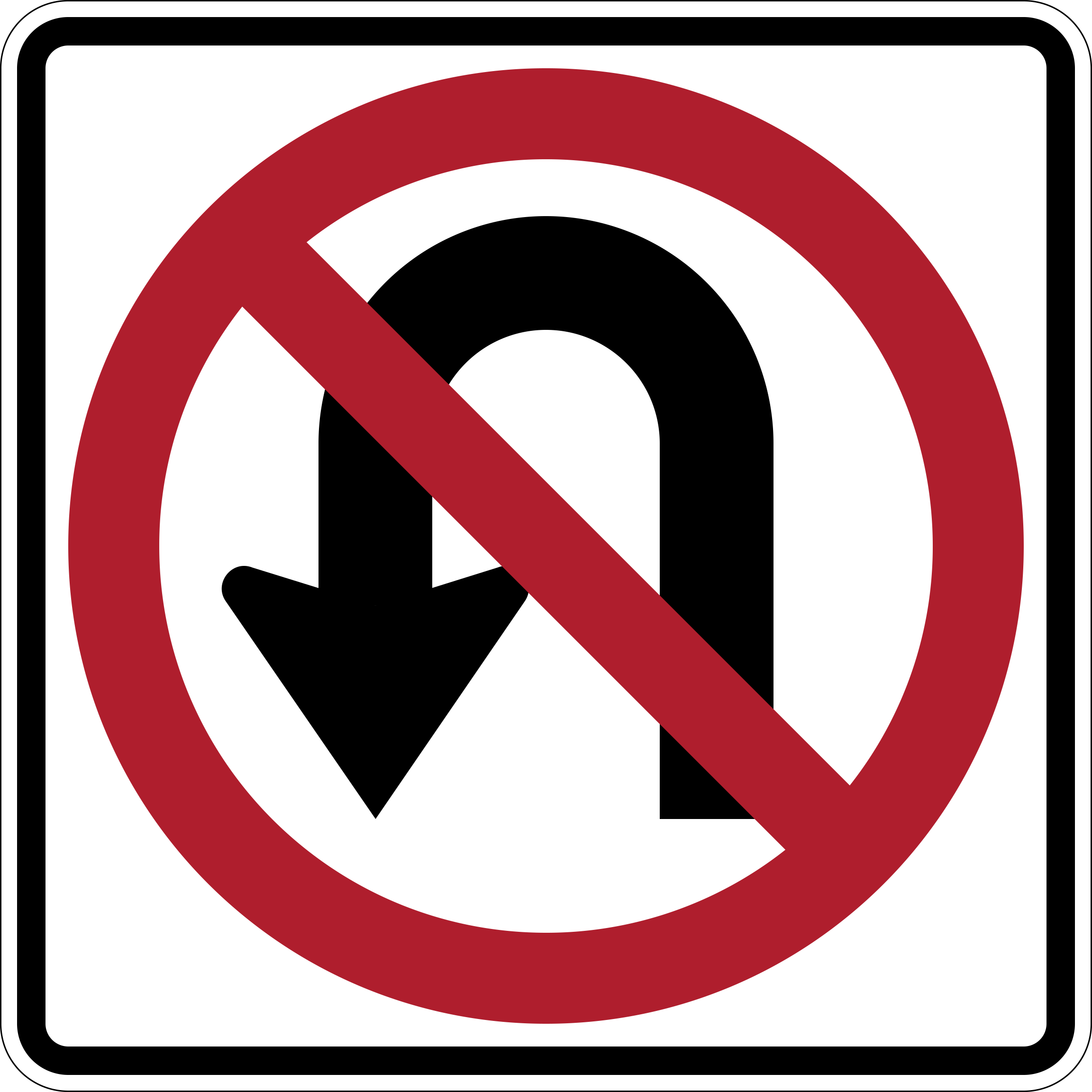
- Travel in the direction of the arrow
- All left turns at every nearby intersection
- Passing another vehicle on the roadway
- U-turns at that location
Show answer
U-turns at that location. A crossed U-turn symbol is a prohibited sign for the pictured maneuver, so the driver must not reverse direction with a U-turn at that location. It does not automatically ban every left turn, and it is not a passing restriction. The crossed symbol should be read together with the movement it covers. Continue straight or use a permitted turn farther ahead rather than forcing a reversal here.
Study this in the handbook: Regulatory signs: stop, yield and speed
14. What can happen to a Colorado driver younger than 21 after a first DUI or DWAI conviction if the required program is not completed?
- Only the vehicle registration is canceled
- The driver license can be revoked
- The driver automatically receives a lifetime license
- No licensing action is possible for a first conviction
Show answer
The driver license can be revoked. For a driver under 21, a first DUI or DWAI conviction can lead to license revocation when the driver fails to complete a court-ordered evaluation or program. The rule concerns the driving privilege, not merely registration, and it does not create immunity or a lifetime credential. The conditional wording matters: the handbook describes revocation tied to failure to complete the ordered requirement. Treat the evaluation or program deadline as a licensing obligation, not an optional recommendation.
Study this in the handbook: Drugs, penalties and express consent
15. On which Colorado roads does the handbook list a possible 65 to 75 mph limit?
- Designated rural interstates and highways
- All city streets
- Any business district
- Narrow mountain highways
Show answer
Designated rural interstates and highways. The 65 to 75 mph range is listed for designated rural interstates and highways. It is not a universal rural permission: the actual posted limit controls, and the handbook says speed signs show the maximum allowed in ideal conditions. City streets may have lower limits, business districts default to 25 mph, and narrow winding mountain highways default to 20 mph. Confirm the sign and reduce speed when weather, traffic, or roadway conditions demand it.
Study this in the handbook: Speed limits and stopping distance
16. At a four-way stop, two vehicles arrive at the same time. Which driver must yield?
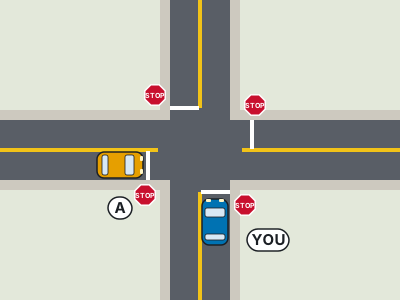
- The driver on the left
- The driver on the right
- The driver going straight
- The driver in the heavier vehicle
Show answer
The driver on the left. When vehicles reach a four-way stop simultaneously, the vehicle on the left yields and lets the vehicle on the right proceed first. Vehicle weight and intended direction do not change this tie breaking rule. The driver on the right does not yield merely because both cars arrived together. Still stop fully, observe the other vehicle, and proceed only when the intersection is clear, because the handbook says every driver remains responsible for avoiding a crash.
Study this in the handbook: Right of way at intersections, roundabouts and mountain roads
17. During Colorado Accident Alert Status, you have a minor crash with no injuries, no alcohol and drivable cars. What must you do after exchanging information?
- Wait at the scene for an officer, however long it takes
- File a report within 10 days with the DMV only
- Nothing further
- File an accident report with law enforcement within 24 hours
Show answer
File an accident report with law enforcement within 24 hours. Accident Alert Status is declared when weather is so severe that officers cannot respond to the volume of crashes. If alcohol and drugs are not involved, no one is hurt, and all vehicles can be driven, the drivers exchange names, addresses, phone numbers, registration and insurance, and then must file an accident report with law enforcement within 24 hours. Waiting indefinitely defeats the purpose of the status. Ten days to the DMV and doing nothing are not the rule.
Study this in the handbook: Avoiding collisions, animals and vehicle failures
18. A posted speed limit sign shows a maximum for ideal conditions. What must a driver do when conditions require it?
- Increase speed until the road returns to ideal conditions
- Drive at least the posted maximum to avoid a violation
- Ignore the sign only when a vehicle behind is close
- Reduce speed below the posted maximum
Show answer
Reduce speed below the posted maximum. A speed limit is not a promise that the listed speed is safe in every setting. The handbook describes the maximum as applying to ideal conditions, so rain, traffic, poor visibility, roadway hazards, or other circumstances can require a lower speed. Driving at least the number on the sign confuses a maximum with a mandatory target. A close follower also does not cancel the need to slow. Reduce speed early and leave enough room to respond to the condition that caused the lower safe speed.
Study this in the handbook: Fitness to drive, distractions and basic control
19. What does a flashing yellow light warn an approaching driver to do?
- Slow down and proceed with caution
- Stop fully and wait for a green signal
- Accelerate before the light changes
- Turn around before reaching the warning
Show answer
Slow down and proceed with caution. A flashing yellow light is a warning that a hazard may be present. The driver should reduce speed, observe the intersection or roadway, and continue only with caution. It is not handled like a flashing red light or a stop sign, so a mandatory full stop is not the general instruction. Accelerating to beat the signal increases risk because it gives less time to detect traffic, pedestrians, or another hazard. Use the warning as a cue to slow, look, and choose a safe path.
Study this in the handbook: Fitness to drive, distractions and basic control
20. Under Colorado’s Move It Law, which crash should be moved off a divided highway?
- A crash with injuries if traffic is heavy
- Any crash involving a vehicle that cannot move
- Every crash before drivers exchange information
- A minor crash with drivable vehicles, no injuries, and no drugs or alcohol involved
Show answer
A minor crash with drivable vehicles, no injuries, and no drugs or alcohol involved. The Move It Law applies to minor crashes on divided highways when the vehicles can still be driven, no one is injured, and drugs or alcohol are not involved. It does not tell drivers to move disabled vehicles or ignore injury scenes. Once the vehicles are in a safer location, drivers can contact law enforcement and exchange information. The cue is a drivable, noninjury crash blocking traffic.
Study this in the handbook: Crash duties, the Move It Law and the Move Over Law
QualitySpace is expanding to Colorado
We are a California-based independent insurance brokerage working on licensing in more states. We cannot help with Colorado insurance yet. Leave your email and we will let you know when we can.
Every question is written from the official Colorado Driver Handbook. Need paper? Printable CO practice test with answer key.
Last verified 2026-10-05. How we check every question · Study all 213 as flashcards
Frequently asked questions
How many questions are on this Colorado practice test?
This fixed set has 20 questions. It is test 2 of 10 from the 213 question Colorado bank.
How does this fixed test relate to the full Colorado bank?
Each numbered test is a fixed set of questions in a fixed order, so you can retake the same test later and compare. Every test mixes road signs and the other topics in about the same proportion as the full bank. Tests 1 to 10 together cover 200 of the 213 questions in the Colorado bank, each once. The full practice page mixes the whole bank at random.
Last verified 2026-10-05. See the Colorado DMV facts page for sourced state details.
Return to the full Colorado practice test · Study road signs