
Test 5 of 10 · 20 questions · Free 2026
CO Permit Practice Test 5
Jump to the test ↓A fixed 20 question set from the Colorado bank with answers and plain English explanations.
Question 1 of 20 · 0 right so far
All 20 questions in test 5
Every question below comes from the Colorado question bank on this page. Open a question to see the correct answer and the explanation. Nothing here is hidden behind a signup.
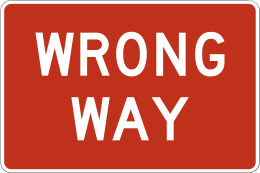
1. What does a WRONG WAY sign tell a driver?
- A truck route begins ahead
- The pavement is rough but travel may continue normally
- The driver is traveling against the permitted direction and must not proceed
- The next intersection requires a U-turn
Show answer
The driver is traveling against the permitted direction and must not proceed. A WRONG WAY sign confirms that the vehicle is headed in a direction where travel is prohibited. The safest response is to stop or pull over without creating another hazard, then use a legal route to correct the mistake. The rough pavement choice confuses a warning about road condition with a restriction on direction. Do not continue simply because the lane looks open, since opposing traffic may approach from an unexpected angle.
Study this in the handbook: Regulatory signs: stop, yield and speed
2. When following another vehicle at night, when must low beams be used?
- Only on urban streets with streetlights
- Only when you are within 50 feet
- When you are within 200 feet of the vehicle ahead
- High beams remain required until you reach an intersection
Show answer
When you are within 200 feet of the vehicle ahead. Colorado requires low beams, with fog lights off, when following another vehicle within 200 feet. The handbook ties the rule to the distance to the vehicle ahead, not to streetlights or to reaching an intersection, and the 50 foot choice understates that distance. A separate rule requires dimming high beams before coming within 500 feet of an oncoming vehicle. Watch your spacing as it changes and switch to low beams before entering the 200 foot range rather than waiting until the vehicle is very close.
Study this in the handbook: Freeways, lane changes and passing
3. What two actions are most important when driving in rain, fog, ice, high winds, or dust?
- Slow your speed and increase your following distance
- Maintain the limit and follow more closely
- Use high beams and accelerate through the hazard
- Stop in the travel lane and turn off all lights
Show answer
Slow your speed and increase your following distance. Colorado identifies slower speed and a larger following distance as the two most important responses to inclement weather. Reduced visibility and reduced traction make hazards harder to see and stopping harder to complete, so extra space and a controlled pace provide more time. Maintaining the limit exactly can be too fast for conditions, and following closely removes the cushion you need. High beams can create glare in fog. Scan farther ahead and adjust before traction or visibility deteriorates.
Study this in the handbook: Headlights, night driving and bad weather
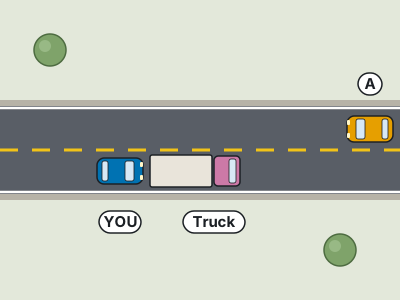
4. What does a broken yellow line between opposing traffic lanes tell a driver?
- Passing is prohibited until the line becomes white
- Passing is permitted when the maneuver is safe
- Traffic on both sides must travel in the same direction
- The lane is reserved for emergency vehicles
Show answer
Passing is permitted when the maneuver is safe. A broken yellow centerline separates traffic moving in opposite directions and marks a place where passing is permitted. The permission is conditional: the driver still needs adequate sight distance, room to return, and no other restriction that makes the maneuver unsafe. A yellow line does not mean the lanes share one direction, and the line does not have to turn white before passing. Scan for oncoming vehicles and roadway hazards before crossing the centerline, then return to the proper lane when clear.
Study this in the handbook: Warning, guide, work zone and special signs
5. What must a driver do when approaching an intersection where another vehicle is already in the intersection?
- Continue first if the signal is green
- Yield to the vehicle already there
- Sound the horn and claim priority
- Stop only if the other vehicle is turning left
Show answer
Yield to the vehicle already there. A driver approaching an intersection must yield to another driver already in that intersection. A green signal does not erase that obligation, and a horn cannot transfer priority. The duty also applies when the other road user is a bicyclist or pedestrian, so the scan must include the full crossing area. Reduce speed as you approach, identify anyone already committed to the intersection, and wait until the path is clear before proceeding.
Study this in the handbook: Right of way at intersections, roundabouts and mountain roads
6. About how far does the Colorado handbook say a lightweight passenger car at 55 mph needs to stop?
- About 200 feet
- About 50 feet
- About one mile
- About 1,000 feet
Show answer
About 200 feet. Citing the National Safety Council, the handbook says a lightweight passenger car traveling 55 mph can stop in about 200 feet, and other vehicles need different distances. Fifty feet is far too short at highway speed. About one mile is the stopping distance the handbook gives for an average freight train at 55 mph. A thousand feet is the visibility distance that triggers the headlight rule.
Study this in the handbook: Emergency vehicles, school buses and work zones
7. Before giving first aid to a conscious crash victim, what should a Good Samaritan do?
- Give care beyond the rescuer’s training
- Move the victim even when no danger exists
- Wait until every bystander leaves
- Ask the victim for permission
Show answer
Ask the victim for permission. Good Samaritan guidance expects common sense and care within the rescuer’s training. For a conscious victim, Colorado says to ask permission before giving care. Moving someone without a life-threatening reason or trying procedures beyond your skill can create new harm. The cue is whether the victim is awake and able to respond before you start helping. Permission comes before nonurgent assistance begins.
Study this in the handbook: Crash duties, the Move It Law and the Move Over Law
8. Where must a driver stop when a Colorado stop sign has no clearly marked stop line?
- Directly beside the stop sign post
- Before entering the near-side crosswalk, or before the nearest point with a view of approaching traffic
- After entering the intersection so the driver can see better
- At least one car length beyond the crosswalk
Show answer
Before entering the near-side crosswalk, or before the nearest point with a view of approaching traffic. Colorado uses a sequence for locating the stop: stop at a clearly marked line when one exists; otherwise stop before entering the near-side crosswalk; if neither is present, stop at the point nearest the intersecting roadway where approaching traffic can be seen. The signpost itself does not define the stopping point. Moving beyond the crosswalk or into the intersection risks blocking pedestrian space and entering cross traffic. Look for markings first, then use the next available location in that sequence.
Study this in the handbook: Regulatory signs: stop, yield and speed
9. What consequences does Colorado list for refusing or failing to comply with a required chemical test?
- A lifetime revocation with no possibility of reinstatement
- A warning with no effect on driving privileges
- A 30-day license suspension and no vehicle device
- A one-year license revocation and a two-year ignition interlock requirement
Show answer
A one-year license revocation and a two-year ignition interlock requirement. If a driver refuses a required chemical test or does not comply with being tested, Colorado revokes the driver license for one year. The driver must also install an ignition interlock device on every motor vehicle driven for two years. A warning-only response omits both consequences, while a 30-day suspension understates the license action. Lifetime revocation is more severe than the handbook's stated result. The interlock requires a breath sample before starting and can request more samples while driving, so refusal affects both licensing and the conditions of later vehicle use.
Study this in the handbook: Drugs, penalties and express consent
10. What can Colorado traffic signs tell drivers?
- Traffic rules, hazards, current location, directions, or services
- Only the vehicle's mechanical maintenance schedule
- Only the name of the nearest private business
- Permission to disregard traffic signals
Show answer
Traffic rules, hazards, current location, directions, or services. Colorado traffic signs communicate rules, hazards, location, directions, and services. Their shape and color help identify which kind of information is being presented. Regulatory signs state laws, warning signs call attention to roadway conditions, guide signs provide destination information, and service or recreation signs point toward facilities or places. A sign cannot authorize ignoring a traffic signal, and traffic signs are not limited to a private business or vehicle maintenance. Build the habit of classifying the sign before acting, then follow the specific words or symbol shown.
Study this in the handbook: Fitness to drive, distractions and basic control
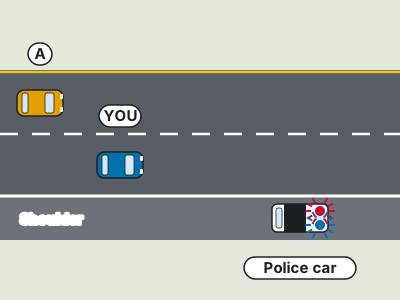
11. If an emergency vehicle is stopped on the shoulder, what should a driver do when possible?
- Move toward the shoulder to give the emergency vehicle less room
- Pass immediately beside it at the posted speed
- Stop in the adjacent lane next to the emergency vehicle
- Leave at least one lane between the vehicle and the emergency vehicle
Show answer
Leave at least one lane between the vehicle and the emergency vehicle. When approaching an emergency vehicle stopped along the road, the handbook says to try to leave at least one lane between the vehicles. If the road design or traffic prevents a lane change, slow to a safe speed and pass with care. Maintaining speed or moving closer to the shoulder reduces the buffer needed by responders. Scan early, signal before changing lanes, and return only after clearing the emergency scene safely.
Study this in the handbook: Right of way at intersections, roundabouts and mountain roads
12. What does a solid white line along a lane require?
- Treat the line as the center dividing opposing traffic
- Cross into the next lane immediately
- Stay within the lane
- Use the lane only for left turns
Show answer
Stay within the lane. White lines separate lanes moving in the same direction. A solid white line requires the driver to stay within that lane and also marks the roadway shoulder, so it is not an invitation to make an immediate lane change. Yellow center lines separate opposing directions, and a left-turn-only restriction must come from a different marking or sign. Keep the vehicle between the boundaries, monitor nearby traffic, and wait for a lawful, clearly marked opportunity if a lane change becomes necessary.
Study this in the handbook: Warning, guide, work zone and special signs
13. What visibility condition does Colorado identify as requiring headlights?
- Only complete darkness
- Visibility of exactly 2,000 feet
- Visibility of less than 1,000 feet
- Only a snowstorm with closed roads
Show answer
Visibility of less than 1,000 feet. Colorado law requires headlights from sunset to sunrise and when visibility is less than 1,000 feet. The visibility trigger is not limited to complete darkness or to one named kind of storm. The 2,000 foot option changes the stated distance, while a road closure is not part of the lighting rule. Watch how far you can see through fog, snow, dust, or another obstruction, and turn on the lights when the view falls below the handbook threshold.
Study this in the handbook: Freeways, lane changes and passing
14. How many points toward suspension does Colorado's penalty table list for a first DWAI for a driver 21 or older?
- 8 points
- 12 points
- 4 points
- No points, because DWAI is only a warning
Show answer
8 points. Table 1 of the handbook lists possible penalties for impaired driving at 21 and older. A first Driving While Ability Impaired conviction, at a BAC of 0.05%, carries 8 points toward suspension, along with a $200 to $500 fine, 2 to 180 days in jail and 24 to 48 hours of public service. Twelve and four points are not in the table. DWAI is a conviction, not a warning, even though it is the least severe row.
Study this in the handbook: Drugs, penalties and express consent
15. What do Colorado prohibited signs indicate?
- The location of a service facility
- The safe speed around a curve in ideal conditions
- An action the driver cannot take, such as a U-turn or left turn
- The direction and mileage to a destination
Show answer
An action the driver cannot take, such as a U-turn or left turn. Prohibited signs identify an action that is not allowed at the posted location. The handbook gives no U-turn and no left turn as examples, so the driver must read the symbol as a restriction rather than a suggestion. Advisory speed signs describe a safe curve speed, service signs point to facilities, and guide signs provide destination information. Notice the crossed or restricted maneuver before beginning the turn, because waiting until the vehicle is committed may leave no safe way to comply.
Study this in the handbook: Regulatory signs: stop, yield and speed
16. A Colorado child is 3 years old and weighs 30 pounds. How must the child ride?
- In a booster seat with a lap belt
- In the front seat with a shoulder belt
- With an adult seat belt only
- In a rear-facing or forward-facing child restraint in the rear seat, if one is available
Show answer
In a rear-facing or forward-facing child restraint in the rear seat, if one is available. Children 2 years of age but less than 4, and weighing at least 20 pounds, must be secured in a rear-facing or forward-facing child restraint system in the rear seat if one is available. A booster seat is for children 4 to under 9 weighing at least 40 pounds. The front seat and a plain adult belt do not meet the rule for a child this young. Children under 2 and under 40 pounds must ride rear-facing in the rear seat.
Study this in the handbook: Losing your license, seat belts and child restraints
17. At Colorado intersections and crosswalks, which road user must drivers always yield to?
- Only vehicles turning left
- Pedestrians
- The largest vehicle
- No one when the driver signals
Show answer
Pedestrians. Pedestrians have the right of way at all intersections and crosswalks, and the driver must stop completely so the person can pass safely. Signaling a turn does not replace that duty, and vehicle size has no bearing on who may cross first. The handbook specifically warns drivers to watch for children, seniors, and people with disabilities. A practical cue is to scan both sides of the crossing before rolling through, even when the roadway appears quiet.
Study this in the handbook: Bicyclists, motorcycles, trucks and pedestrians
18. Which of these can get a Colorado driving privilege suspended, revoked or canceled even though it is not a moving violation?
- Lending your license to someone else
- Driving a car with a manual transmission
- Moving to a new apartment and reporting it within 30 days
- Renewing your license early
Show answer
Lending your license to someone else. Colorado lists many ways to lose the privilege beyond bad driving. Lending your license to someone else or misusing it is one. Others include failing to pay ordered child support, failing to appear for a re-examination, giving false information on the application, and failing to show proof of insurance. Driving a manual car and renewing early are lawful. Reporting an address change within 30 days is exactly what the law requires.
Study this in the handbook: Getting a license, instruction permits and the drive test
19. When a collision appears likely and turning will not create another collision, which option should a driver consider?
- Accelerate toward the other vehicle
- Turn to avoid the collision
- Close your eyes and hold the wheel still
- Keep the same speed regardless of the roadway
Show answer
Turn to avoid the collision. A driver has several ways to reduce the consequences of an impending crash, including slowing, turning, or speeding up when conditions make that safe. Turning is worth considering when it avoids the collision without creating a second one. Accelerating toward the other vehicle is the opposite of creating space, and shutting your eyes removes the visual information needed to control the car. Holding speed no matter what ignores the available escape path and changing hazards. The practical cue is to scan for an open route, steer smoothly toward it, and then regain control after the immediate danger has passed.
Study this in the handbook: Distracted, reckless and aggressive driving
20. A yellow curve-right warning sign is posted before a bend. When should you begin accelerating?

- Only after stopping at the end of the curve
- Before entering the curve to keep speed steady
- As soon as the front wheels start turning
- Only after reaching the middle of the curve
Show answer
Only after reaching the middle of the curve. A curve warning calls for speed control before the bend, then a gradual return to power only after the vehicle reaches the middle of the curve. Accelerating before entry can overload the tires just when they need grip for steering. Waiting until the middle gives you time to confirm the lane path, surface, and traffic around the bend before adding speed.
Study this in the handbook: Freeways, lane changes and passing
QualitySpace is expanding to Colorado
We are a California-based independent insurance brokerage working on licensing in more states. We cannot help with Colorado insurance yet. Leave your email and we will let you know when we can.
Every question is written from the official Colorado Driver Handbook. Need paper? Printable CO practice test with answer key.
Last verified 2026-10-05. How we check every question · Study all 213 as flashcards
Frequently asked questions
How many questions are on this Colorado practice test?
This fixed set has 20 questions. It is test 5 of 10 from the 213 question Colorado bank.
How does this fixed test relate to the full Colorado bank?
Each numbered test is a fixed set of questions in a fixed order, so you can retake the same test later and compare. Every test mixes road signs and the other topics in about the same proportion as the full bank. Tests 1 to 10 together cover 200 of the 213 questions in the Colorado bank, each once. The full practice page mixes the whole bank at random.
Last verified 2026-10-05. See the Colorado DMV facts page for sourced state details.
Return to the full Colorado practice test · Study road signs