
Test 7 of 10 · 20 questions · Free 2026
CO Permit Practice Test 7
Jump to the test ↓A fixed 20 question set from the Colorado bank with answers and plain English explanations.
Question 1 of 20 · 0 right so far
All 20 questions in test 7
Every question below comes from the Colorado question bank on this page. Open a question to see the correct answer and the explanation. Nothing here is hidden behind a signup.
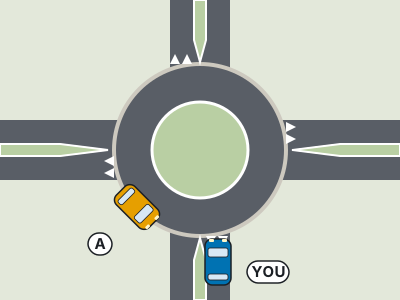
1. At a Colorado roundabout, which traffic has the right-of-way when you enter?
- The vehicle entering from the right, every time
- Traffic already circulating in the roundabout
- The vehicle carrying the most passengers
- The vehicle that reaches the yield line last
Show answer
Traffic already circulating in the roundabout. A roundabout directs vehicles to the right around a center island, and entering traffic must yield to traffic already circulating. The entering driver should read signs and pavement markers, check for pedestrians, and merge only after a suitable gap appears. The entering vehicle does not automatically go first. Colorado does add a separate rule requiring drivers to yield to a truck, bus, emergency vehicle, or recreational vehicle, but for ordinary traffic the circulating vehicle has priority. On approach, do not stop completely unless existing traffic prevents you from merging. Signal when changing lanes or exiting so other road users can anticipate your movement.
Study this in the handbook: Lines, crosswalks and special lanes
2. Unless otherwise posted, what is the Colorado speed limit on urban interstates and highways?
- 65 mph
- 45 mph
- 55 mph
- 75 mph
Show answer
55 mph. The handbook sets 55 mph on urban interstate and highways unless another limit is posted. Sixty-five to 75 mph is reserved for designated rural interstates and highways, so both 65 and 75 describe rural roads, not urban ones. Forty-five mph is the limit for vehicles in the business of hauling trash. Cities and towns may adopt lower limits by ordinance, so always obey posted signs.
Study this in the handbook: Emergency vehicles, school buses and work zones
3. Can a Colorado driver plea bargain out of an alcohol or drug related driving offense?
- No, Colorado law does not allow it
- Yes, on a first offense
- Yes, if BAC was under 0.08%
- Yes, if the driver completes a class first
Show answer
No, Colorado law does not allow it. Colorado law does not allow you to plea bargain out of an alcohol or drug related driving offense. There is no first offense exception, no BAC exception, and no class that unlocks a plea deal in the handbook's rule. The handbook adds that the only sure way to avoid the consequences, which can include jail, fines and loss of the license, is not to use alcohol or drugs at all when driving.
Study this in the handbook: Drugs, penalties and express consent
4. What does a STOP sign require under Colorado's handbook?
- A rolling slowdown when no other vehicle is visible
- A complete stop at the marked line, or at the required location if no line exists
- A stop only if a pedestrian is waiting
- A stop after entering the crosswalk so the driver can see better
Show answer
A complete stop at the marked line, or at the required location if no line exists. A STOP sign requires a complete stop. Use the clearly marked stop line first; if there is no line, stop before the near-side crosswalk, or if neither exists, at the nearest point where you can see approaching traffic. A rolling slowdown and conditional stop are not enough. Stopping inside the crosswalk blocks pedestrians and places the vehicle beyond the proper stopping point. Come to rest before the required boundary, then yield and proceed when safe.
Study this in the handbook: Fitness to drive, distractions and basic control
5. When is a driver not required to stop for a school bus with flashing red lights?
- When a median or other physical barrier separates the bus from the vehicle
- When the driver is traveling in the opposite direction on any road
- When the driver cannot see children near the bus
- When the driver slows to walking speed before passing
Show answer
When a median or other physical barrier separates the bus from the vehicle. The Colorado exception depends on roadway separation, not on direction alone or the driver's speed. A median or other physical barrier must separate the bus from the approaching vehicle. On an undivided road, opposite-direction traffic still stops. Seeing no children does not remove the requirement, and creeping past at walking speed remains passing a stopped bus. Identify the actual barrier before continuing, and otherwise stop at least 20 feet away until the red lights stop flashing.
Study this in the handbook: Right of way at intersections, roundabouts and mountain roads
6. What does an orange work-zone sign with black letters or symbols identify?
- A destination guide on a green route sign
- A hospital service area
- A work area where traffic may need direction
- A recreational site with a brown background
Show answer
A work area where traffic may need direction. Orange signs identify work zones and are used with other traffic-control devices or flaggers to guide vehicles through an area where crews and roadway conditions may change. A hospital service sign is part of service information, a green sign guides toward destinations, and a brown sign identifies recreation or historic locations. At an orange sign, expect altered lanes, workers, equipment, or temporary directions. Slow down early, follow the posted channel, and be ready for a person or device to control your movement.
Study this in the handbook: Regulatory signs: stop, yield and speed
7. If an emergency vehicle approaches while you are in an intersection, what should you do?
- Turn left and follow the emergency vehicle
- Stop immediately in the intersection
- Drive through the intersection, then pull over
- Reverse to the edge you just entered from
Show answer
Drive through the intersection, then pull over. A driver already in an intersection should not stop where the emergency vehicle needs to travel or reverse into other traffic. Continue through the intersection, then pull over when clear. Stopping in the crossing can block the responder and expose your vehicle to a second conflict. Following the emergency vehicle is also unsafe because it removes the required separation. Watch for pedestrians and other vehicles while clearing the intersection, then stop at the right edge when possible.
Study this in the handbook: Emergency vehicles, school buses and work zones
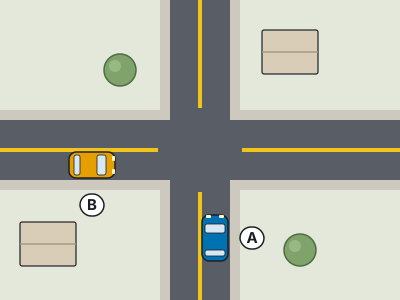
8. At an uncontrolled intersection, when vehicles arrive at the same time, who yields?
- The faster vehicle always proceeds first
- The vehicle on the right yields to the vehicle on the left
- The larger vehicle always proceeds first
- The vehicle on the left yields to the vehicle on the right
Show answer
The vehicle on the left yields to the vehicle on the right. At an uncontrolled intersection, equal arrival time creates a right-of-way rule: the driver on the left yields and lets the vehicle on the right go first. Vehicle size and speed do not replace that rule. Even with priority, each driver remains responsible for avoiding a crash, so scan for late arrivals and pedestrians before moving. Reduce speed as you approach an intersection without control devices, and be ready to yield if the situation is not clear.
Study this in the handbook: Right of way at intersections, roundabouts and mountain roads
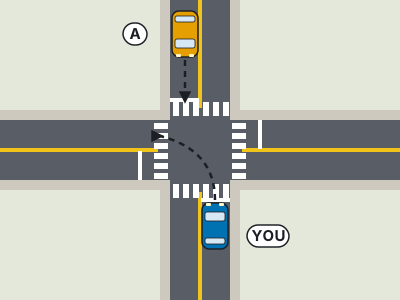
9. Before turning left, what traffic must a driver yield to?
- All oncoming traffic unless protected by a green arrow or first at a four-way stop
- Only vehicles that are turning right
- Only pedestrians who are already in the roadway
- No traffic when the turn signal has been on for three seconds
Show answer
All oncoming traffic unless protected by a green arrow or first at a four-way stop. A left turn crosses the path of oncoming road users, so the driver must yield to all oncoming traffic unless a green arrow protects the movement or the driver arrived first at a four-way stop. A turn signal communicates intent but never grants priority. Restricting the yield to right-turning vehicles or pedestrians already in the lane misses bicyclists, motorcyclists, and other vehicles. Wait at the stop line or crosswalk until the gap is large enough to complete the turn safely.
Study this in the handbook: Signaling, turns, U turns and parking
10. What does a flashing yellow arrow require from a driver turning left?
- Stop and wait until a green arrow appears
- Proceed with caution and yield to oncoming traffic and pedestrians
- Turn immediately because opposing traffic must yield
- Use the arrow as permission to pass through the intersection
Show answer
Proceed with caution and yield to oncoming traffic and pedestrians. A flashing yellow arrow permits a left turn only after the driver checks the path and yields to oncoming traffic and pedestrians. It is not the same as a protected green arrow, so the opposing lane still controls whether the turn can safely begin. Stopping forever for a green arrow misunderstands the signal, while turning immediately ignores the required yield. Slow down, scan the crosswalk and opposing lane, and enter only when the route is clear.
Study this in the handbook: Traffic signals and arrows
11. When approaching a roundabout with no large vehicle present, to whom must you yield before entering?
- Approaching traffic on the left
- Only traffic approaching from behind
- Vehicles waiting to enter on the right
- No one if you signal first
Show answer
Approaching traffic on the left. At a roundabout, entering traffic must fit into the circulating movement rather than force vehicles already moving to brake. When no large truck, bus, emergency vehicle, or recreational vehicle is present, Colorado directs the approaching driver to yield to traffic on the left. A turn signal communicates intent but does not grant priority, and traffic behind you is not the controlling conflict. Do not make a full stop unless traffic requires it. Check the crosswalk as well, because pedestrians and bicyclists have priority there.
Study this in the handbook: Lines, crosswalks and special lanes
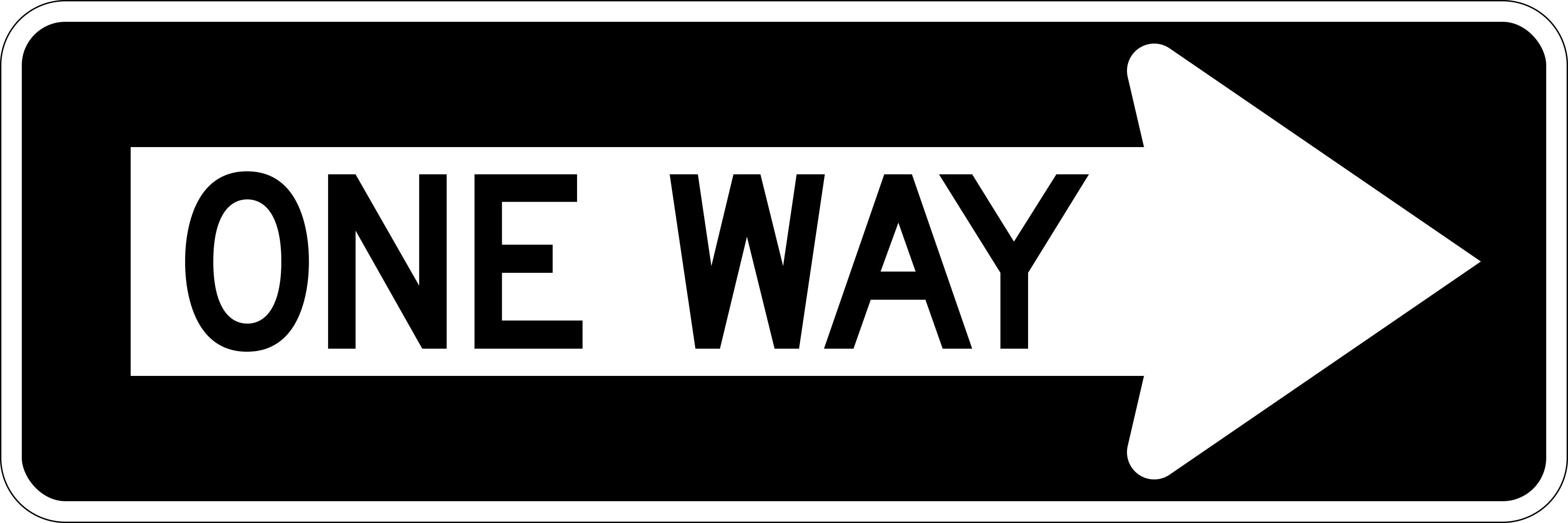
12. What does the arrow on a ONE WAY sign indicate?
- Drivers may turn only when the signal is red
- The arrow identifies a lane reserved for buses
- Traffic may travel only in the arrow's direction
- The road permits travel in either direction
Show answer
Traffic may travel only in the arrow's direction. A ONE WAY sign limits travel to the direction shown by its arrow. This applies to the roadway or portion of roadway controlled by the sign, not merely to a preferred lane. The two direction choice is especially risky because it could place a driver against traffic. Look at the arrow before entering, and keep the vehicle aligned with that direction through the block or ramp.
Study this in the handbook: Regulatory signs: stop, yield and speed
13. What proof must Colorado drivers have while operating a vehicle?
- A mechanic's inspection report from that day
- A receipt for the most recent fuel purchase
- A printed map of every planned trip
- Valid evidence of insurance
Show answer
Valid evidence of insurance. Colorado requires drivers to have valid evidence of insurance while operating a vehicle and identifies failure to provide it when requested by an officer as a way the driving privilege may be affected. A fuel receipt, trip map, or same-day inspection report does not prove financial responsibility. Keep the accepted insurance evidence available before driving, including when using a vehicle that belongs to someone else. The document requirement follows operation on the roadway, not ownership.
Study this in the handbook: Losing your license, seat belts and child restraints
14. What does Colorado's handbook say about marijuana used for medical purposes and DUI or DWAI?
- Medical use is not a defense to DUI or DWAI
- Medical use always makes driving legally safe
- Medical use is a defense whenever the driver has a prescription
- Medical use matters only for commercial drivers
Show answer
Medical use is not a defense to DUI or DWAI. The handbook states that marijuana or other drugs used for medical purposes do not provide a defense to DUI or DWAI. A prescription does not erase impairment or transform unsafe driving into legal driving. The choices “Medical use always makes driving legally safe” and “Medical use is a defense whenever the driver has a prescription” improperly create immunity, while the commercial-driver limitation is not in the rule. Medication decisions belong before the trip: check warnings, ask a health professional about side effects, and do not drive when a substance can impair safe operation.
Study this in the handbook: Drugs, penalties and express consent
15. What does the Colorado handbook say about alcohol in the body?
- It has no effect unless the driver is over 21
- It affects everyone identically after the same number of drinks
- It depends only on the vehicle being driven
- It affects people differently even when they consumed the same amount over the same time
Show answer
It affects people differently even when they consumed the same amount over the same time. The handbook warns that alcohol in the body affects people differently, even when they have consumed the same amount over the same time period. That difference means one person cannot safely rely on another person’s experience as a measure of impairment. The identical-response choice ignores individual variation, while vehicle type and age do not remove alcohol’s effects. Factors such as body weight, time spent drinking, time since the last drink, and sex also influence BAC. The safest driving decision is to avoid driving after drinking rather than estimate a personal limit.
Study this in the handbook: Losing your license, seat belts and child restraints
16. Colorado's seat belt law applies to the driver, front seat passengers and children under 16. Which of these people is exempt?
- A driver on a short trip under 5 miles
- A front seat passenger over 65
- A driver whose car has air bags
- A driver of a delivery van while on the job
Show answer
A driver of a delivery van while on the job. The only exceptions Colorado lists are emergency personnel, passenger and school buses, farm equipment, the driver of a delivery van while on the job, and anyone carrying a written medical statement from a physician. Short trips, age over 65 and air bags are not exceptions. A car with air bags still requires the driver to buckle up, because the handbook lists no air bag exception. Passengers riding with a driver under 18 must all be restrained.
Study this in the handbook: Losing your license, seat belts and child restraints
17. What does a lighted yellow arrow tell a driver?
- The driver must turn before checking traffic
- The turn has permanent priority
- A red arrow is about to appear
- Pedestrians may no longer cross in any direction
Show answer
A red arrow is about to appear. A yellow arrow warns that the protected arrow phase is ending and a red arrow is about to appear. It is not permission to hurry through without checking traffic. If you are not already in the intersection and can stop safely, prepare to stop. Treat the yellow arrow as a transition cue, especially when oncoming traffic and pedestrians are nearby.
Study this in the handbook: Fitness to drive, distractions and basic control
18. You move to a new address in Colorado. How long do you have to notify the DMV?
- 10 days
- 60 days
- Until your license renewal
- 30 days
Show answer
30 days. The handbook says you have 30 days to notify the DMV of a name or address change. Ten and 60 days are not the Colorado period. Waiting until renewal is not allowed either, because the handbook sets the 30 day deadline for any name or address change. The same 30 day figure also appears in the rule for new residents getting a Colorado license, so the number is worth remembering.
Study this in the handbook: Getting a license, instruction permits and the drive test
19. How often should you check traffic behind you in the rearview mirror?
- Only before backing up
- Every 5 to 8 seconds
- Every 30 seconds on city streets
- Only after another vehicle honks
Show answer
Every 5 to 8 seconds. Rear scanning should be routine, not limited to lane changes or backing. Colorado recommends checking the rearview mirror every 5 to 8 seconds so you know whether a vehicle is closing fast or following too closely. Waiting thirty seconds can leave you unaware of a developing hazard. Use each straight, low-workload moment as a cue to glance behind. Frequent checks keep surprises from building unnoticed.
Study this in the handbook: Scanning, following distance, phones and traffic stops
20. What is the purpose of an advisory speed sign near a sharp turn?

- It sets a required minimum speed for the entire highway
- It shows a safe speed around a curve or corner in ideal conditions
- It identifies the legal speed for a school zone in all weather
- It authorizes drivers to ignore the posted speed limit
Show answer
It shows a safe speed around a curve or corner in ideal conditions. An advisory speed sign gives cautionary guidance for a curve, corner, or off-ramp under ideal conditions. It is not a blanket minimum speed, and it never authorizes ignoring a regulatory speed limit. Because the figure assumes ideal conditions, poor weather or a slick surface can call for going slower than the plaque shows. The school-zone choice assigns the plaque a different purpose. Use the number as a cue to reduce speed before the turn, then account for traction, visibility, and traffic.
Study this in the handbook: Regulatory signs: stop, yield and speed
QualitySpace is expanding to Colorado
We are a California-based independent insurance brokerage working on licensing in more states. We cannot help with Colorado insurance yet. Leave your email and we will let you know when we can.
Every question is written from the official Colorado Driver Handbook. Need paper? Printable CO practice test with answer key.
Last verified 2026-10-05. How we check every question · Study all 213 as flashcards
Frequently asked questions
How many questions are on this Colorado practice test?
This fixed set has 20 questions. It is test 7 of 10 from the 213 question Colorado bank.
How does this fixed test relate to the full Colorado bank?
Each numbered test is a fixed set of questions in a fixed order, so you can retake the same test later and compare. Every test mixes road signs and the other topics in about the same proportion as the full bank. Tests 1 to 10 together cover 200 of the 213 questions in the Colorado bank, each once. The full practice page mixes the whole bank at random.
Last verified 2026-10-05. See the Colorado DMV facts page for sourced state details.
Return to the full Colorado practice test · Study road signs