
Test 8 of 10 · 20 questions · Free 2026
CO Permit Practice Test 8
Jump to the test ↓A fixed 20 question set from the Colorado bank with answers and plain English explanations.
Question 1 of 20 · 0 right so far
All 20 questions in test 8
Every question below comes from the Colorado question bank on this page. Open a question to see the correct answer and the explanation. Nothing here is hidden behind a signup.
1. Who may sign the Affidavit of Liability for a Colorado applicant under 18?
- Only a biological parent
- Any licensed driver 16 or older
- A parent, stepparent, grandparent with power of attorney, legal guardian, spouse older than 18, or another responsible adult
- The applicant, once they turn 17
Show answer
A parent, stepparent, grandparent with power of attorney, legal guardian, spouse older than 18, or another responsible adult. A Colorado applicant under 18 needs an Affidavit of Liability (DR2460) signed and verified by a parent, stepparent, grandparent with power of attorney, legal guardian, spouse older than 18, or any other responsible adult willing to accept legal liability. Limiting it to a biological parent is too narrow. A 16 year old is not an adult who can take on legal liability, and the minor cannot sign for themselves. The affidavit is signed in front of a DMV employee or a notary.
Study this in the handbook: Getting a license, instruction permits and the drive test
2. What license action does Colorado list for a third or later DWAI or DUI for a driver 21 or older?
- Revocation for 1 year
- Revocation for 2 years
- Revocation for 9 months
- Permanent cancellation
Show answer
Revocation for 2 years. A third or subsequent DWAI or DUI carries a 2 year revocation in the table, along with a $600 to $1,500 fine, 60 to 365 days in jail and 48 to 120 hours of public service. One year is the second offense revocation and 9 months the first DUI revocation. The table does not list permanent cancellation. Jail time rises sharply at this level, with a 60 day minimum instead of 10.
Study this in the handbook: Drugs, penalties and express consent
3. When stopping quickly with ABS, what does the Colorado handbook advise?
- Use the parking brake before touching the service brake
- Pump the pedal rapidly until the vehicle stops
- Release the pedal as soon as it pushes back
- Apply hard, firm pressure and keep the brake pedal down
Show answer
Apply hard, firm pressure and keep the brake pedal down. With ABS, apply the brakes with hard, firm pressure and keep the pedal down while the system works. You might feel the brake pedal pushing back, and that is not a signal to release it, because the handbook says the ABS system will only work with the brake pedal pushed down. Pumping the pedal lets up on it, which the handbook tells you not to do. The parking brake is not the handbook's quick stop step. With ABS you can also turn while braking without skidding.
Study this in the handbook: Avoiding collisions, animals and vehicle failures
4. A bicyclist riding on a sidewalk or in a crosswalk has the same rights and responsibilities as which road user?
- A train
- A parked car
- A maintenance vehicle
- A pedestrian
Show answer
A pedestrian. Colorado gives a bicyclist on a sidewalk or in a crosswalk the same rights and responsibilities as a pedestrian. That means a driver should look for the bicycle at the crossing and yield as required, rather than treating it like a vehicle traveling in a normal traffic lane. The parked car and train options have no connection to the rule. Scan for a bicycle entering from either side before turning across a sidewalk or crosswalk.
Study this in the handbook: Right of way at intersections, roundabouts and mountain roads
5. Does a Colorado bike lane continue through an intersection when paint does not connect on both sides?
- Only if a bicycle is already inside the intersection
- No, the lane ends whenever the paint is interrupted
- Yes, the bike lane extends through the intersection
- Only during daylight hours
Show answer
Yes, the bike lane extends through the intersection. Colorado treats the bike lane as continuing through an intersection even when the painted line disappears between approaches. The missing paint does not remove bicyclists' right to use the lane or authorize a driver to occupy it casually. The other choices add conditions that the handbook does not state. When crossing or turning through a bike lane, check for bicyclists, yield as required, and cross only for the permitted maneuver while keeping the path clear.
Study this in the handbook: Lines, crosswalks and special lanes
6. A Colorado child is younger than 2 and weighs less than 40 pounds. What restraint is required?
- A seat belt alone in any seating position
- A forward-facing restraint in the front seat
- A rear-facing child restraint properly secured in the rear seat
- A booster seat in the rear seat
Show answer
A rear-facing child restraint properly secured in the rear seat. For a child younger than 2 who weighs less than 40 pounds, Colorado requires a rear-facing child restraint properly secured in the rear seat. A forward-facing device changes the required orientation, while a seat belt alone or a booster seat does not match this age and weight category. The rear-seat requirement is part of the protection rule, not merely a suggestion about comfort. Confirm both measurements before choosing the restraint, because the handbook gives different options when the child is 40 pounds or more.
Study this in the handbook: Losing your license, seat belts and child restraints
7. What is the lowest blood alcohol concentration covered by Colorado's general DUI per se threshold?
- Any measurable amount, regardless of driver or conduct
- Exactly 0.02% for every driver
- More than 0.04% only for a commercial driver
- 0.08% or higher
Show answer
0.08% or higher. Colorado’s DUI per se threshold includes a BAC of 0.08% or higher. That threshold is different from the separate figures mentioned for drivers under 21 and CDL drivers, and it is not the same as saying every measurable amount automatically creates a DUI per se conviction. Impaired driving can also be established through behavior and the total circumstances. When reading a BAC question, identify the driver category and whether the question asks about per se evidence or broader impairment.
8. What do Colorado speed limit signs show?
- The maximum speed allowed in ideal conditions
- A speed that must be maintained in every weather condition
- The minimum speed permitted on every road
- A recommended speed that may never be enforced
Show answer
The maximum speed allowed in ideal conditions. A posted limit is a ceiling for ideal conditions, not a promise that traveling at that number is safe during snow, poor visibility, congestion, or a hazard near the roadway. The choice “A speed that must be maintained in every weather condition” ignores the need to reduce speed when conditions require it. The choice “The minimum speed permitted on every road” confuses maximum and minimum limits, which appear only on some roads. The choice “A recommended speed that may never be enforced” is wrong because speed limit signs communicate an enforceable rule. Check the road and weather before choosing your speed.
Study this in the handbook: Emergency vehicles, school buses and work zones
9. What action does a Colorado yield sign require?
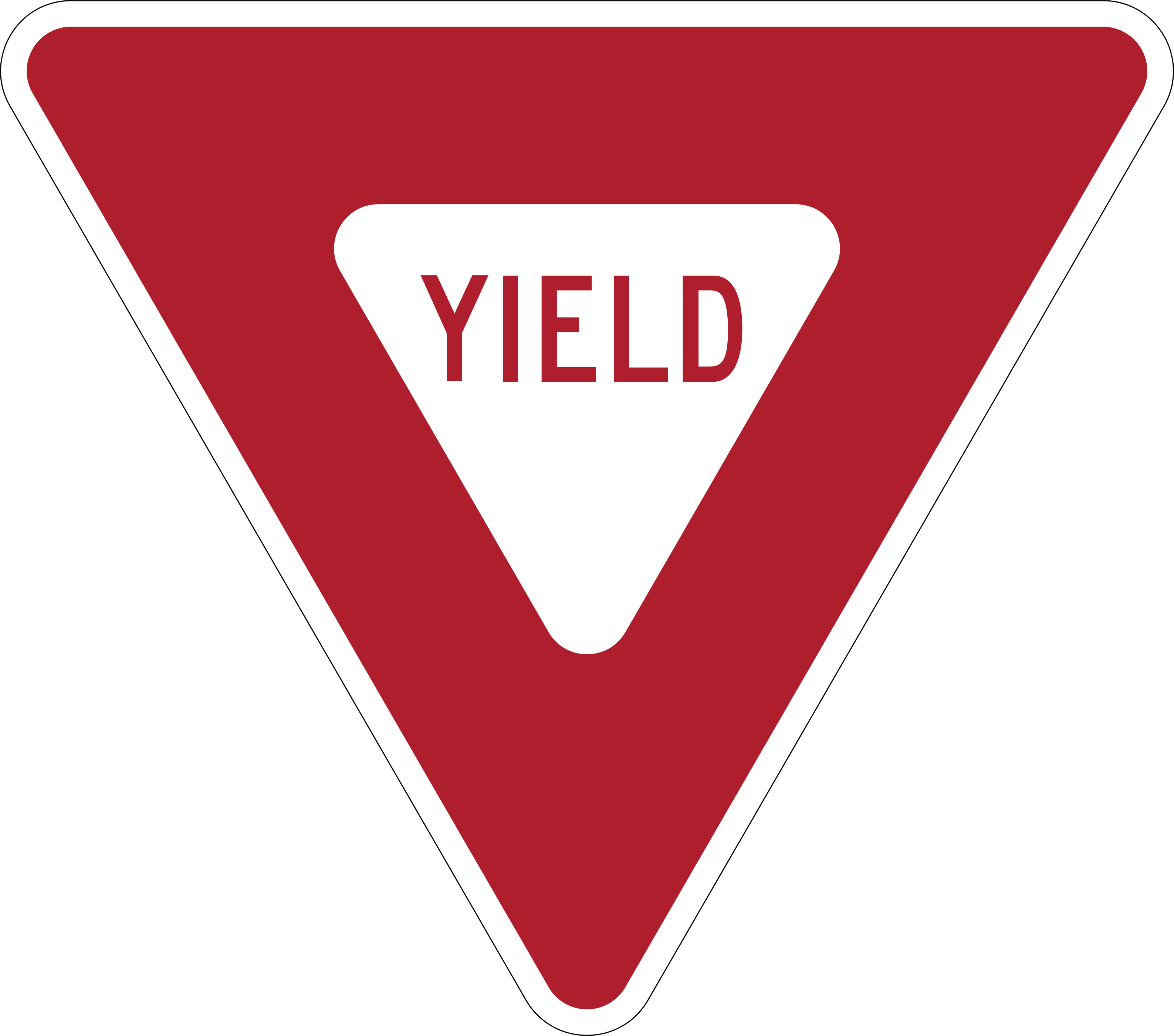
- Stop every time, even when the intersection is empty
- Slow or stop and yield to pedestrians and vehicles with the right of way
- Continue at the posted speed because the sign is advisory
- Enter only after a traffic officer waves you through
Show answer
Slow or stop and yield to pedestrians and vehicles with the right of way. A yield sign requires a driver to reduce speed and give priority to pedestrians and vehicles that already have the right of way. Stopping is required when needed, but an empty approach does not require an unnecessary full stop. The choice saying the sign is merely advisory is unsafe because regulatory traffic signs carry legal requirements. A useful cue is to scan for people walking and traffic with priority before entering, then stop if either makes proceeding unsafe.
Study this in the handbook: Regulatory signs: stop, yield and speed
10. How should a driver treat a railroad crossbuck sign?
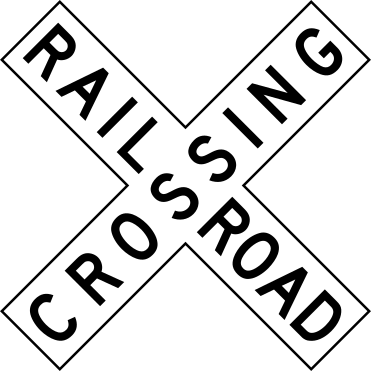
- As a warning that U-turns are required
- The same as a green traffic signal
- As permission to stop on the tracks
- The same as a yield sign
Show answer
The same as a yield sign. Colorado says a railroad crossbuck should be treated the same as a yield sign. Slow down, look and listen for a train, and enter only when the crossing is safe. A crossbuck does not give permission to stop on the rails, and it is not equivalent to a green signal. If another sign below it lists more than one track, continue checking because a second train may be approaching. The U-turn option invents a maneuver that the railroad sign never commands. Leave enough room beyond the tracks to clear them completely.
Study this in the handbook: Railroad crossings and light rail
11. There is no painted stop line at a Colorado railroad crossing. How far from the tracks must you stop while a train passes?
- At least 3 feet
- At least 50 feet
- At least 10 feet
- At least 20 feet
Show answer
At least 10 feet. Always stay behind the painted stop line while waiting for a train. If no line is visible, you must be at least 10 feet from the tracks, because trains overhang the tracks by 3 feet. Three feet is the overhang itself, so stopping there puts you in the train's path. Twenty feet is the school bus stopping distance, and 50 feet is not the Colorado rule for this situation.
Study this in the handbook: Railroad crossings and light rail
12. If pumping failed brakes does not stop the vehicle, what should a driver try next?
- Use the parking brake slowly
- Turn the ignition key off at highway speed
- Shift immediately into reverse
- Aim for the nearest parked vehicle
Show answer
Use the parking brake slowly. Colorado’s brake-failure sequence starts with lifting off the accelerator and pumping the brake pedal. If that fails, the parking brake can help, but it must be applied slowly so the rear wheels do not lock and skid. Turning the engine off or shifting into reverse can remove control. The cue is a brake pedal that no longer slows the car.
Study this in the handbook: Avoiding collisions, animals and vehicle failures
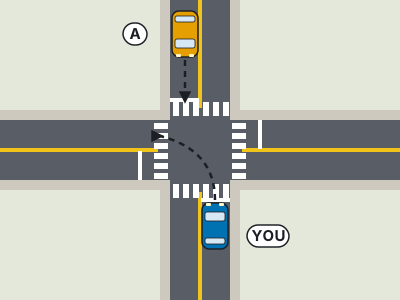
13. Before completing a left turn, which road users must you yield to unless a green arrow or four-way-stop rule changes the situation?
- Only vehicles behind your car
- Pedestrians in the crosswalk and oncoming traffic
- No one because the turning vehicle enters first
- Only parked vehicles along the curb
Show answer
Pedestrians in the crosswalk and oncoming traffic. A left turn crosses paths with people in the crosswalk and vehicles or smaller road users approaching from the opposite direction. The handbook says to look for and yield to pedestrians, bicyclists, motorcyclists, and other oncoming traffic, except when a green arrow or an applicable four-way-stop rule supplies priority. Vehicles behind you and parked cars are not the central conflict described here. Check speed and distance carefully before moving across the opposing path, then complete the turn only after the crossing area is clear.
Study this in the handbook: Right of way at intersections, roundabouts and mountain roads
14. What fine range does the Colorado handbook give for a conviction for parking in a disabled space without a placard or plate?
- $25 to $100
- $350 to $5,000
- Exactly $200 and no other penalty
- A $10,000 minimum
Show answer
$350 to $5,000. The Colorado handbook says illegally parking in a designated disabled space without a placard or plate can bring a charge and, on conviction, a fine of $350 to $5,000, plus possible jail time, loss of driving privileges or impoundment. Colorado law scales the fine by offense: $350 to $1,000 for a first offense, $600 to $1,000 for a second, and $1,000 to $5,000 for a third or later. A $25 penalty understates the rule, and no fixed $200 or $10,000 minimum applies. Using someone else's placard brings doubled fines.
Study this in the handbook: Warning, guide, work zone and special signs
15. When may a driver proceed after stopping for a school bus stop arm?
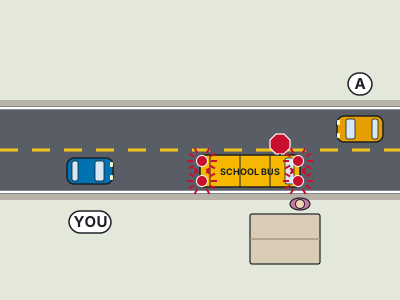
- After the stop arm is retracted and the red warning lights are off
- As soon as all visible children reach the curb
- After waiting exactly twenty seconds
- When another driver starts moving first
Show answer
After the stop arm is retracted and the red warning lights are off. A stopped school bus creates a controlled danger zone for children, so traffic must remain stopped until the bus driver retracts the stop arm and turns off the red warning lights. Moving just because children are no longer visible is risky because another student may cross late or from behind the bus. The stop arm and red lights are the cues that control your movement.
Study this in the handbook: Bicyclists, motorcycles, trucks and pedestrians
16. What should you do if a traffic signal is malfunctioning?
- Follow the vehicle ahead without stopping
- Proceed as if you have a green light
- Wait only for a flashing yellow signal
- Treat the intersection as a four-way stop
Show answer
Treat the intersection as a four-way stop. A malfunctioning signal removes the normal assignment of movement, so Colorado treats the intersection as a four-way stop. Approach cautiously, stop, check for other road users, and proceed according to stop-sign right-of-way. Assuming a green light or following another vehicle can put you into the path of traffic that also lacks a working signal. A flashing yellow signal is a separate operating condition and does not replace the four-way-stop instruction for a broken signal.
Study this in the handbook: Traffic signals and arrows
17. Which sign background color points to recreational, historic, or cultural areas?
- Brown
- Orange
- Red
- Fluorescent green
Show answer
Brown. Brown backgrounds are used on service and recreation signs to identify recreational, historic, or cultural areas. Orange is reserved for work-zone information, and red is usually part of regulatory commands such as stop or prohibited movements. When looking for parks, historic sites, or cultural destinations, the brown sign background is the visual cue. That color separates attractions from service directions.
Study this in the handbook: Regulatory signs: stop, yield and speed
18. If a vehicle with ABS begins to skid, what should the driver do?
- Let up on the accelerator, press the brake, and steer where the car should go
- Pump the brake rapidly and steer opposite the intended path
- Release the steering wheel and wait for the vehicle to stop
- Apply the parking brake and turn the wheel fully
Show answer
Let up on the accelerator, press the brake, and steer where the car should go. For a skid in a vehicle with anti-lock brakes, Colorado advises easing off the accelerator, pressing the brake, and turning the front wheels in the direction you want the car to go. The goal is controlled braking with steering, not a panic maneuver. Pumping the brake is not the handbook procedure for ABS, and abandoning the wheel or applying the parking brake can remove useful control. Keep inputs measured and look toward the path you need to follow.
Study this in the handbook: Hills, curves, snow, ice and mountain roads
19. A circular green light remains on after the green arrow goes off, and no sign or red arrow prohibits turning. When may you still turn?
- Without yielding because the arrow was green earlier
- Only if a police officer is standing nearby
- After yielding to through vehicles and pedestrians
- Never, because the missing arrow always prohibits turns
Show answer
After yielding to through vehicles and pedestrians. When the arrow ends but the circular green remains, Colorado allows the turn only after yielding to through vehicles and pedestrians unless a sign or red arrow prohibits it. The earlier arrow phase no longer protects the movement. Treat the circular green as permission to proceed when the path is clear, not as priority over crosswalk users or oncoming traffic.
Study this in the handbook: Traffic signals and arrows
20. What is Colorado's rule for an open alcohol container in the passenger area of a vehicle on a public road?
- It is lawful if the container is below half full
- Possessing one is unlawful
- It is lawful whenever the vehicle is moving slowly
- Only an open marijuana container is prohibited
Show answer
Possessing one is unlawful. Colorado prohibits possessing an open alcohol container in the passenger area of a motor vehicle that is on a public road. The prohibition is not limited by how full the container is or by the vehicle's speed. It also reaches an open marijuana container, so the choice “Only an open marijuana container is prohibited” is incomplete. Keep containers closed and outside the passenger area as required. A designated driver does not turn an otherwise prohibited open container into a lawful one.
Study this in the handbook: Losing your license, seat belts and child restraints
QualitySpace is expanding to Colorado
We are a California-based independent insurance brokerage working on licensing in more states. We cannot help with Colorado insurance yet. Leave your email and we will let you know when we can.
Every question is written from the official Colorado Driver Handbook. Need paper? Printable CO practice test with answer key.
Last verified 2026-10-05. How we check every question · Study all 213 as flashcards
Frequently asked questions
How many questions are on this Colorado practice test?
This fixed set has 20 questions. It is test 8 of 10 from the 213 question Colorado bank.
How does this fixed test relate to the full Colorado bank?
Each numbered test is a fixed set of questions in a fixed order, so you can retake the same test later and compare. Every test mixes road signs and the other topics in about the same proportion as the full bank. Tests 1 to 10 together cover 200 of the 213 questions in the Colorado bank, each once. The full practice page mixes the whole bank at random.
Last verified 2026-10-05. See the Colorado DMV facts page for sourced state details.
Return to the full Colorado practice test · Study road signs