
Test 10 of 10 · 20 questions · Free 2026
CO Permit Practice Test 10
Jump to the test ↓A fixed 20 question set from the Colorado bank with answers and plain English explanations.
Question 1 of 20 · 0 right so far
All 20 questions in test 10
Every question below comes from the Colorado question bank on this page. Open a question to see the correct answer and the explanation. Nothing here is hidden behind a signup.
1. What do Colorado traffic signals tell drivers?
- Which private business to visit
- When or where to stop and go
- How far away a service station is
- Where a railroad emergency phone is located
Show answer
When or where to stop and go. Traffic signals are lights that tell drivers when or where to stop and go. Their indications control movement at intersections and other locations, so a driver must watch the actual signal rather than treating an advance sign as the control itself. A business, service station, or railroad emergency phone requires a different sign or source of information. Approach the signal with enough room to stop, observe its color or arrow, and follow any pedestrian or vehicle right-of-way requirements. The choice “When or where to stop and go” describes the function stated by the handbook.
Study this in the handbook: Fitness to drive, distractions and basic control
2. What must a driver do before entering a railroad crossing?
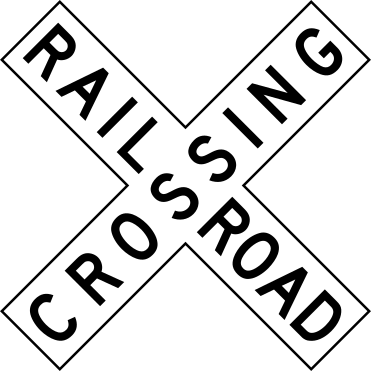
- Make sure there is enough room beyond the tracks for the vehicle to clear them
- Enter as soon as the warning sign is visible
- Shift gears while crossing to maintain momentum
- Try to beat the train if the gates are still raised
Show answer
Make sure there is enough room beyond the tracks for the vehicle to clear them. A railroad crossing requires space on the far side, not merely a clear view of the rails. The vehicle must be able to leave the tracks completely, because stopping on them creates a serious collision risk. The choice about shifting gears is unsafe because the handbook warns that a stalled vehicle may become trapped. Raised gates do not make racing a train acceptable. Treat the crossing as a place to pause, look, and continue only when the exit is open.
Study this in the handbook: Regulatory signs: stop, yield and speed
3. At the pictured STOP sign, where should you stop when a marked stop line is present?

- At the clearly marked stop line
- Past the crosswalk in the intersection
- Only after another vehicle arrives
- Anywhere on the approach as long as the vehicle slows
Show answer
At the clearly marked stop line. The red octagonal sign requires a complete stop, and a clearly marked stop line is the first stopping location named by the handbook. Stopping beyond the crosswalk can obstruct people crossing, while waiting for another vehicle or merely slowing fails to obey the sign. After stopping at the line, check for pedestrians and other traffic, yield as required, and proceed only when the intersection is safe. The sign applies even when the road appears empty.
Study this in the handbook: Fitness to drive, distractions and basic control
4. What does a flashing yellow light at a Colorado intersection tell a driver?
- It requires the driver to reverse before continuing
- It has the same meaning as a stop sign
- It guarantees that cross traffic will stop
- It warns of a hazard, so slow down and proceed cautiously
Show answer
It warns of a hazard, so slow down and proceed cautiously. A flashing yellow light is a warning rather than a protected right-of-way signal. The driver should reduce speed, look for the hazard, and continue only with appropriate caution. A flashing red light, not a flashing yellow, carries the stop-sign requirement. The yellow indication does not guarantee that another road user will stop, so scanning remains essential. Reversing is unrelated to the signal. Approach the intersection prepared to yield or stop if traffic, pedestrians, or another hazard makes movement unsafe.
Study this in the handbook: Fitness to drive, distractions and basic control
5. What does a reflective orange triangle on the rear of a vehicle mean?
- The vehicle is designed to travel slower than 25 mph
- The vehicle is carrying hazardous materials over 55 mph
- The vehicle is exempt from stopping at railroad crossings
- The vehicle is allowed to ignore work-zone flaggers
Show answer
The vehicle is designed to travel slower than 25 mph. A reflective orange triangle is a slow-moving vehicle marker. It warns that the vehicle is built for speeds below 25 mph, so closing speed can be much faster than it looks. It is not a hazardous-material placard or a railroad exemption. Treat the marker as a cue to reduce speed early and pass only when distance, sight line, and markings allow.
Study this in the handbook: Warning, guide, work zone and special signs
6. Before a Colorado minor applies for a driver license, what driving experience must the signed log show?
- 75 hours, including 20 hours at night
- 30 hours, including 5 hours at night
- 50 hours, all during daylight
- 50 hours, including 10 hours at night
Show answer
50 hours, including 10 hours at night. Before applying for a driver license, a Colorado minor must submit a completed and signed driving log showing 50 hours of driving experience. Ten of those hours must have been at night. The permit must also have been held for 12 months, but that separate timing rule does not change the log total. Thirty hours is too few, daylight-only driving misses the nighttime requirement, and 75 hours with 20 at night adds figures not stated here. Keep the log accurate as practice occurs so both totals can be verified at application time.
Study this in the handbook: Getting a license, instruction permits and the drive test
7. What should you avoid using when the highway is wet or icy?
- The windshield defroster
- Low beam headlights
- The rearview mirror
- Cruise control
Show answer
Cruise control. On wet or icy pavement, cruise control can keep adding power when tires need gentle input. Colorado’s weather advice is to avoid cruise control on those surfaces and manage speed yourself. Low beams, mirrors, and defrosters can all help visibility and awareness, so they are not the problem. The cue is any slick or shiny roadway surface under the tires.
Study this in the handbook: Headlights, night driving and bad weather
8. Why is following another vehicle too closely dangerous?
- It improves your ability to see around curves
- It guarantees the vehicle ahead will change lanes
- It limits your view and leaves less time to avoid a crash
- It makes braking distance identical at every speed
Show answer
It limits your view and leaves less time to avoid a crash. Tailgating creates two problems at once: the vehicle ahead blocks more of the roadway view, and the short gap leaves little time to recognize and respond to a hazard. The handbook connects that loss of sight and reaction time with a greater chance of a crash. Following closely does not make the lead vehicle change lanes, and it cannot improve vision around a curve. Choose a reference point and maintain enough space to react, increasing the gap when weather or traffic raises stopping demands.
Study this in the handbook: Scanning, following distance, phones and traffic stops
9. On a divided Colorado highway posted above 45 mph, how should you respond when you cannot change lanes near a stopped emergency vehicle?
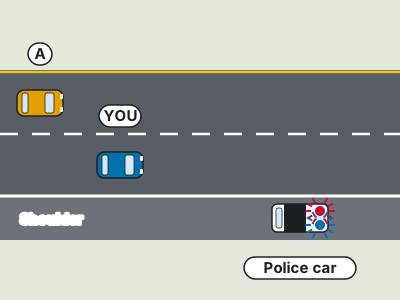
- Reduce speed to 25 mph regardless of the posted limit
- Maintain the posted speed because the emergency vehicle is on the shoulder
- Slow to 20 mph below the posted speed limit and pass carefully
- Stop in the travel lane until the emergency vehicle leaves
Show answer
Slow to 20 mph below the posted speed limit and pass carefully. When a lane change is not possible near a stopped emergency vehicle, Colorado requires a substantial reduction in speed. If the posted limit is above 45 mph, the handbook specifies 20 mph under that posted limit. The 25 mph figure applies when the posted limit is 45 mph or less, so it is not the matching rule here. Maintaining speed ignores the roadside hazard, and stopping in a travel lane can create a rear-end collision. Slow, watchful passage protects responders and occupants.
Study this in the handbook: Right of way at intersections, roundabouts and mountain roads
10. When reversing, which traffic must a driver yield to?
- Only vehicles approaching from the left
- All vehicles close enough to be a hazard
- Only vehicles traveling above the speed limit
- No vehicles if the backup lights are on
Show answer
All vehicles close enough to be a hazard. Backup lights warn others, but the reversing driver still has the yielding duty. Colorado requires yielding to all vehicles close enough to create a hazard. Limiting the rule to traffic from the left misses vehicles, bicyclists, or pedestrians coming from other directions. The cue is any nearby movement that could reach your path while you are backing. Stop if the hazard space is uncertain.
Study this in the handbook: Right of way at intersections, roundabouts and mountain roads
11. When entering a Colorado roundabout, what traffic must an ordinary driver yield to?
- No traffic, because entering vehicles have priority
- Only vehicles behind the entrance
- Traffic already inside the roundabout and approaching traffic on the left
- Only trucks after they exit
Show answer
Traffic already inside the roundabout and approaching traffic on the left. A driver approaching a roundabout must look left for approaching traffic and must also yield to traffic already circulating when entering or leaving. People walking or riding bicycles in a crosswalk receive priority as well. The rule for large vehicles has additional details, but an ordinary driver should never assume the entry lane grants priority. Reduce speed, scan the left side and crosswalk, and enter only after the circulating path is clear. The choice about vehicles behind the entrance reverses the location of the hazard, while the truck-only choice ignores ordinary traffic.
Study this in the handbook: Right of way at intersections, roundabouts and mountain roads
12. A Colorado driver under 18 has held a license for 8 months. How many passengers under 21 may ride along without a parent or licensed adult?
- None
- One, with siblings and medical emergencies as exceptions
- Two
- As many as there are seat belts
Show answer
One, with siblings and medical emergencies as exceptions. Colorado's passenger rule changes with time. For the first six months, a driver under 18 cannot carry any passenger under 21 unless a parent or another licensed adult driver is in the vehicle. After 6 months, one passenger younger than 21 is allowed, and siblings and passengers with medical emergencies are exceptions. None applies only to the first six months. Two is not a Colorado step. Filling every seat belt is allowed only after one year.
Study this in the handbook: Getting a license, instruction permits and the drive test
13. You fail the Colorado drive test. When may you retake it?
- The next business day
- After 7 days
- After 30 days
- After 6 months
Show answer
The next business day. Colorado keeps the retest wait short. If you fail the drive test, you must wait until the next business day before retaking it. Seven days, 30 days and six months do not appear in the Colorado drive test rule, so none of them is the required wait. Only the driver and examiner may be in the vehicle during the test, and it is scored from start to finish.
Study this in the handbook: Getting a license, instruction permits and the drive test
14. On a long trip, how does the Colorado handbook suggest breaking up your driving to fight fatigue?
- Into four-hour segments
- Every 300 miles
- Only when you feel sleepy
- Into two-hour segments
Show answer
Into two-hour segments. Colorado advises breaking long driving periods into two-hour segments, and pulling off the road to rest if you become drowsy. Tired drivers have slower reactions and worse decisions. Four-hour segments and 300 mile legs are longer than the handbook recommends. Waiting until you already feel sleepy is too late as a plan, although stopping when drowsy is also part of the advice.
Study this in the handbook: Drugs, penalties and express consent
15. Unless a different limit is posted, what speed applies on narrow, winding mountain highways and blind curves?
- 30 mph
- 25 mph
- 20 mph
- 40 mph
Show answer
20 mph. Colorado lists 20 mph for narrow, winding mountain highways and blind curves unless a different limit is posted. The nearby default figures can be confusing: 25 mph applies in a business district, 30 mph in a residence district, and 40 mph on open mountain highways. The road description controls here, not the general mountain setting alone. Slow further if weather, visibility, traffic, or the curve itself makes even the posted maximum unsafe.
Study this in the handbook: Speed limits and stopping distance
16. At a railroad crossing, what should you do if trying to cross would leave your vehicle unable to clear the tracks?
- Enter the crossing because the train has not reached it
- Wait until there is enough room on the other side
- Stop on the tracks briefly, then move when traffic opens
- Drive onto the tracks and wait for the crossing to clear
Show answer
Wait until there is enough room on the other side. The crossing is not usable merely because a train is not visible. Before entering, the driver must have enough open space beyond the tracks for the entire vehicle to clear them. Entering while traffic is backed up can strand the vehicle on the rails, creating a severe hazard even if warning lights are not active. Stopping on the tracks is never a safe temporary solution. If the far side is blocked, remain behind the crossing and wait for a clear path before proceeding.
Study this in the handbook: Regulatory signs: stop, yield and speed
17. What does a broken white lane line mean?
- Traffic on each side moves in opposite directions
- Passing is forbidden in both directions
- You may change lanes if it is safe
- Only emergency vehicles may cross it
Show answer
You may change lanes if it is safe. White lane lines divide traffic moving in the same direction, and a broken white line allows a lane change when the move is safe. It is not the same as double solid yellow lines, which control passing between opposing directions. Before crossing the broken white line, check ahead, mirrors, blind spot, and whether another driver would have to slow for you.
Study this in the handbook: Freeways, lane changes and passing
18. What is the safest response when tires begin hydroplaning?
- Brake hard and turn sharply toward the shoulder
- Take your foot off the gas and steer slowly until traction returns
- Accelerate to force the tires through the water
- Turn off the engine while holding the wheel straight
Show answer
Take your foot off the gas and steer slowly until traction returns. Hydroplaning means the tires are riding on water and may lose contact with the road, which can remove steering control. Take your foot off the gas so the vehicle slows, then slowly steer in the direction of the hydroplaning until control returns. Keep steering gentle because jerking the wheel can cause an overcorrection. Do not try to stop or turn until the tires grip the road again. Hard braking and a sharp shoulder turn add sudden movement during the least stable moment. Smooth inputs give the tires time to realign with the vehicle.
Study this in the handbook: Freeways, lane changes and passing
19. In Colorado, which minimum alcohol concentration triggers the commercial rule when the vehicle being operated requires a CDL?
- 0.04%
- 0.02%
- 0.05%
- 0.08%
Show answer
0.04%. The commercial alcohol threshold is 0.04 percent or higher while operating a commercial motor vehicle requiring a CDL. This rule concerns the vehicle being operated, not simply possession of a commercial license while driving a personal car. The general adult per se DUI threshold is 0.08 percent, but lower readings do not establish that driving is safe or permitted. Always identify the vehicle category before applying a BAC threshold.
20. A Colorado driver 21 or older is convicted of a second DWAI or DUI. What license action does the table list?
- Revocation for 9 months
- Revocation for 2 years
- 8 points toward suspension
- Revocation for 1 year
Show answer
Revocation for 1 year. The table lists a 1 year revocation for a second DWAI or DUI, with a $600 to $1,500 fine, 10 to 365 days in jail and 48 to 120 hours of public service. Nine months is the first DUI revocation. Two years is for a third or later conviction. Eight points goes with a first DWAI only. Each step up the table adds time, so repeat offenses cost more than the first.
Study this in the handbook: Drugs, penalties and express consent
QualitySpace is expanding to Colorado
We are a California-based independent insurance brokerage working on licensing in more states. We cannot help with Colorado insurance yet. Leave your email and we will let you know when we can.
Every question is written from the official Colorado Driver Handbook. Need paper? Printable CO practice test with answer key.
Last verified 2026-10-05. How we check every question · Study all 213 as flashcards
Frequently asked questions
How many questions are on this Colorado practice test?
This fixed set has 20 questions. It is test 10 of 10 from the 213 question Colorado bank.
How does this fixed test relate to the full Colorado bank?
Each numbered test is a fixed set of questions in a fixed order, so you can retake the same test later and compare. Every test mixes road signs and the other topics in about the same proportion as the full bank. Tests 1 to 10 together cover 200 of the 213 questions in the Colorado bank, each once. The full practice page mixes the whole bank at random.
Last verified 2026-10-05. See the Colorado DMV facts page for sourced state details.
Return to the full Colorado practice test · Study road signs