
Key points
Warning signs are yellow or fluorescent green with black symbols.
Source: Handbook p. 8
“Warning signs: These signs are yellow or fluorescent green with black symbols”
Colorado Driver Handbook, Handbook p. 8Advisory speed signs show the safe speed around curves, corners and off ramps in ideal conditions.
Source: Handbook p. 8
“Advisory speed signs: These cautionary signs show the safe speed around curves, corners and off-ramps in ideal conditions.”
Colorado Driver Handbook, Handbook p. 8Work zone signs are orange with black letters or symbols.
Source: Handbook p. 8
“Work zone signs: These signs have an orange background with black letters or symbols.”
Colorado Driver Handbook, Handbook p. 8Blue signs lead to services, and brown signs mark recreational, historic or cultural areas.
Source: Handbook p. 8
“Signs with blue backgrounds provide directions to service facilities. Signs with brown backgrounds indicate recreational, historic or cultural areas.”
Colorado Driver Handbook, Handbook p. 8When passing or overtaking bicyclists, you must allow 3 feet of clearance on all roadways.
Source: Handbook p. 9
“when passing or overtaking bicyclists, must allow for clearance of 3 feet to avoid sideswiping on all roadways”
Colorado Driver Handbook, Handbook p. 9A reflective orange triangle marks a vehicle designed to go slower than 25 mph.
Source: Handbook p. 9
“A reflective orange triangle on the rear of a vehicle means it is designed to travel at speeds slower than 25 miles per hour.”
Colorado Driver Handbook, Handbook p. 9Parking in a disabled space without a placard or plate can bring a $350 to $5,000 fine.
Source: Handbook p. 9
“If you park illegally in a designated disabled parking spot without a placard or plate, you could be charged with a misdemeanor, and if convicted, subject to a $350-$5,000 fine”
Colorado Driver Handbook, Handbook p. 9Crosshatched sections next to disabled spaces are for van access only. No parking at any time.
Source: Handbook p. 9
“Crosshatched sections are for van access only and parking is not allowed at any time.”
Colorado Driver Handbook, Handbook p. 9
Numbers to know
| Number | What it means | Manual |
|---|---|---|
| 3 feet | minimum clearance when passing bicyclists | Handbook p. 9 |
| 25 mph | vehicles with the slow moving triangle travel slower than this | Handbook p. 9 |
| $350 to $5,000 | fine for illegally parking in a disabled space | Handbook p. 9 |
Recognize these signs

Merging traffic 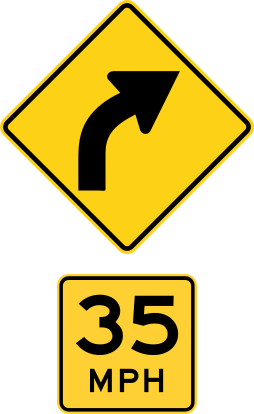
Curve with advisory speed 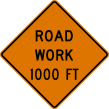
Road work ahead 
Slow moving vehicle 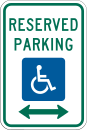
Disabled parking
3 questions from the Colorado practice test
1. Which color and symbol combination identifies Colorado warning signs?
- Blue with white service symbols
- Green with white mileage numbers
- Yellow or fluorescent green with black symbols
- Brown with white recreation symbols
Show answer
Yellow or fluorescent green with black symbols. Warning signs use yellow or fluorescent green with black symbols to call attention to roadway conditions. The handbook lists examples such as school zones, curves, slippery surfaces, merging traffic, and pedestrian-dense areas. Green guide signs give directions and mileage, blue signs identify service facilities, and brown signs point toward recreation or cultural locations. Treat the warning color as a cue to scan farther ahead and prepare for the pictured condition. It does not tell you to stop at every sign, but it does require earlier attention and an appropriate speed.
2. What does a reflective orange triangle on the rear of a vehicle mean?
- The vehicle is designed to travel slower than 25 mph
- The vehicle is carrying hazardous materials over 55 mph
- The vehicle is exempt from stopping at railroad crossings
- The vehicle is allowed to ignore work-zone flaggers
Show answer
The vehicle is designed to travel slower than 25 mph. A reflective orange triangle is a slow-moving vehicle marker. It warns that the vehicle is built for speeds below 25 mph, so closing speed can be much faster than it looks. It is not a hazardous-material placard or a railroad exemption. Treat the marker as a cue to reduce speed early and pass only when distance, sight line, and markings allow.
3. A white sign with black letters says PASS 3 FT MIN. What clearance does it remind drivers to give bicyclists?
- At least 12 inches
- At least 3 feet
- At least 10 feet
- Only enough room to avoid touching handlebars
Show answer
At least 3 feet. The PASS 3 FT MIN sign points to Colorado's bicyclist passing clearance. When passing bicyclists, including those in a bike lane, a driver must give a minimum of three feet from the outermost part of the vehicle or any attachments, such as mirrors, and the rule applies even where no sign is posted. Twelve inches is the parallel parking distance from the curb, not a passing clearance, and 10 feet is not the stated minimum. If you cannot give three feet, slow down and stay behind the bicyclist until it is safe to pass.
Practice this topic
Lock it in with road signs questions from the free Colorado practice test. Every answer comes with a plain English explanation.
Source: the Colorado Driver Handbook, Traffic Signs. This lesson is a plain English summary, not the law itself; where it differs, the manual and the statute govern. Last checked 2026-09-27.