
Test 16 of 25 · 20 questions · Free 2026
CO Permit Practice Test 16
Jump to the test ↓A fixed 20 question set from the Colorado bank with answers and plain English explanations.
Question 1 of 20 · 0 right so far
All 20 questions in test 16
Every question below comes from the Colorado question bank on this page. Open a question to see the correct answer and the explanation. Nothing here is hidden behind a signup.
1. What are truck and bus No Zones?
- Lanes that are set aside for trucks on steep downhill grades
- Special spaces where trucks may park overnight on the roadside
- Stretches of road where cars are required to speed up and pass
- Blind spot areas around a truck or bus where cars become hard for the driver to see
Show answer
Blind spot areas around a truck or bus where cars become hard for the driver to see. The handbook says trucks and buses have blind spots called No Zones. These are areas around the vehicle where cars disappear into blind spots, or are so close that they restrict the truck or bus driver's ability to stop or maneuver safely. Staying out of these zones, or passing quickly and not lingering, keeps you in a place where the truck driver can see you.
Study this in the handbook: Bicyclists, motorcycles, trucks and pedestrians
2. What hidden hazards should a rural driver expect?
- Intersections hidden by trees, brush, or crops, plus animals near the road
- Only the hazards that are announced by guide signs ahead
- Traffic signals that are hidden behind hills and bends
- Animals that stay inside marked farm zones only
Show answer
Intersections hidden by trees, brush, or crops, plus animals near the road. The handbook tells rural drivers to be prepared for intersections hidden by trees, brush or crops and for animals on or near the roadway. Slow down where the view is blocked, so you have time to react. Rural roads often hide cross traffic and wildlife until the last moment, so slowing early gives you time to stop if something appears.
Study this in the handbook: Hills, curves, snow, ice and mountain roads
3. During a three-point turnabout, when should the left signal start before crossing the road?
- At least 200 feet before, or a minimum of three seconds
- Only after the vehicle reaches the far side of the road
- About 50 feet before you begin crossing the road
- Right after you finish checking your blind spots
Show answer
At least 200 feet before, or a minimum of three seconds. For a three-point turnabout, the handbook says to activate your left turn signal at least 200 feet before the turn, or a minimum of three seconds, and check traffic and any blind spots. The early signal warns drivers behind you what you plan to do. Starting the signal early gives following drivers time to see it and slow down before you begin the maneuver across the road.
Study this in the handbook: Signaling, turns, U turns and parking
4. How should a driver handle a freeway exit?
- Slow down on the freeway lanes before the exit lane even starts
- Do not exit at the last second, and slow down in the exit lane
- Brake hard at the very end of the exit ramp
- Go faster than the exit ramp speed limit to clear the lane
Show answer
Do not exit at the last second, and slow down in the exit lane. The handbook lists tips for exiting a freeway: keep your speed consistent with the flow of traffic while on the freeway, do not exit at the last second, and slow down after turning into the deceleration lane. It also says not to exceed the posted speed limit for the exit ramp. The freeway section warns that high-speed roadways such as freeways can be dangerous due to the speeds at which people are driving.
Study this in the handbook: Freeways, lane changes and passing
5. How should a driver leave a parallel parked position?
- Signal, check mirrors and blind spots, then pull away when safe
- Pull out quickly before you have checked the traffic behind you
- Back up first to gain a wider angle for leaving
- Sound the horn and then enter traffic right away
Show answer
Signal, check mirrors and blind spots, then pull away when safe. To pull away from a parallel parked position, the handbook says to activate your signal, check your mirrors and blind spots, and pull away when it is safe. Doing so warns others and ensures no vehicle or cyclist is already in your path. Leaving a space safely is just as important as entering it, because traffic that was not there when you parked may now be approaching.
Study this in the handbook: Signaling, turns, U turns and parking
6. An officer stops you at night. What helps the officer see inside your vehicle?
- Turn on your interior lights so the officer can see in
- Keep the cabin dark so that your privacy is protected
- Turn on your high beams so they point toward the officer
- Open all of the doors before you are asked to do so
Show answer
Turn on your interior lights so the officer can see in. The handbook says to turn on your interior lights if you are pulled over at night to assist with visibility. This lets the officer see inside the vehicle and who is in it. Lighting the inside of the car helps the officer see who is inside, which makes a night stop go more smoothly for both of you. Stay calm and wait for the officer to approach.
Study this in the handbook: Scanning, following distance, phones and traffic stops
7. Your lightweight passenger car travels at 55 mph on dry pavement. About how much room does a stop need under ideal conditions?
- About 100 feet
- About 200 feet
- About 300 feet
- About 400 feet
Show answer
About 200 feet. According to the National Safety Council figure quoted in the handbook, a lightweight passenger car traveling 55 mph can stop in about 200 feet. Heavier vehicles and poor conditions need more room. This is only an average under ideal conditions, so allow more distance on wet roads, in a heavier vehicle, or at higher speeds. Allow more distance if the pavement is wet, if the vehicle is heavier, or if you are driving faster, because each of these makes the stop longer than the figure shown.
Study this in the handbook: Emergency vehicles, school buses and work zones
8. A car with a valid disabled placard parks in a marked disabled space while a friend of the placard owner runs the errand alone. What rule is broken?
- Friends may use the space for up to one hour
- The space is open to anyone at all when the store is quiet
- The placard owner must be entering or leaving the vehicle
- Placards may be lent to any borrower freely
Show answer
The placard owner must be entering or leaving the vehicle. The handbook says that in order to park in a disabled parking space, the person who owns the disabled placard must be entering or exiting the vehicle. A friend cannot use the space for the owner, because the placard is only valid when the owner is entering or leaving the vehicle, so the owner must be present. Parking in a disabled space without the placard owner entering or exiting is a misuse of the placard, so always have the owner with you when you use a disabled space.
Study this in the handbook: Warning, guide, work zone and special signs
9. A rectangular white sign with black lettering orders traffic ahead of you. Which family does its look identify?
- Warning signs, which are yellow and use symbols
- Regulatory signs, black or red on white
- Guide signs, which have green backgrounds
- Recreation signs, which have brown backgrounds
Show answer
Regulatory signs, black or red on white. The handbook says regulatory signs tell you of laws and regulations that apply at a location, and that they are black or red on a white background. A white rectangle with black or red markings is therefore a rule you must follow, whereas a yellow sign warns and a green one guides. Obey these signs the same way you would obey a posted speed limit, because they describe the laws that apply right where you are driving, such as speed, stopping, turning and parking rules.
Study this in the handbook: Fitness to drive, distractions and basic control
10. Two cars bump on a divided highway: no injuries, both drivable, no alcohol involved. What does the Move It Law require?
- Move the vehicles off the highway to a safe place
- Leave both cars where they are so photos can be taken
- Block one lane of traffic until the police arrive
- Exchange information while staying in the travel lane
Show answer
Move the vehicles off the highway to a safe place. State law requires motorists involved in a minor crash on a divided highway to move their vehicles off the highway when the vehicle is drivable, no drugs or alcohol are involved, and there are no injuries. All three conditions apply here. Moving the vehicles clears the lanes so traffic can keep flowing and lowers the chance of another crash, and you can still exchange information once you have moved to a safe location.
Study this in the handbook: Avoiding collisions, animals and vehicle failures
11. The white sign shown hangs over your lane and directs turning traffic. What does this kind of sign provide?
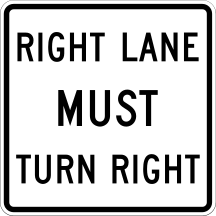
- The distance remaining to the next town ahead
- A warning that the road surface may be icy
- Direction about where a driver can turn
- Permission to park in the lane beneath the sign
Show answer
Direction about where a driver can turn. The handbook says lane control signs give direction and information about where you can turn, and often use an arrow symbol. These signs usually appear over or beside the lane and use arrows, so read them early and get into the correct lane before the turn. A lane control sign tells you which lanes may turn and which must go straight, so read it early and move into the right lane well before the intersection, and avoid changing lanes at the last moment.
Study this in the handbook: Regulatory signs: stop, yield and speed
12. You reach an intersection where the traffic signal is completely dark. How must you treat it?
- Proceed through, since no signal is controlling you
- Treat the intersection as a yield in all directions
- Treat the intersection as a four-way stop
- Stop only when cross traffic is actually present there
Show answer
Treat the intersection as a four-way stop. The handbook says that if the traffic signal is not operating or is malfunctioning, you should treat the intersection as a four way stop. Everyone stops, then goes in turn. Each driver stops, looks, and then takes a turn, with the vehicle on the right going first if two arrive together. Treat it carefully, because other drivers may not be sure what to do.
Study this in the handbook: Fitness to drive, distractions and basic control
13. What gear habit should a driver avoid while crossing railroad tracks?
- Shift into neutral so the car can coast across
- Shift to the lowest gear as you cross over the tracks
- Stop on the tracks and then shift once there
- Do not shift gears on the tracks, in case you stall
Show answer
Do not shift gears on the tracks, in case you stall. The handbook says not to shift gears when crossing the railroad tracks, in case your vehicle stalls. Pick the gear before you reach the tracks so that you can drive straight across. A stalled vehicle on a crossing is in danger from a train, which is why the handbook tells drivers to avoid anything that could cause one. Making the decision early lets you cross without taking a hand off the wheel or a foot off the pedal.
Study this in the handbook: Regulatory signs: stop, yield and speed
14. You cannot see over the top of a hill. What speed choice fits?
- Keep to the posted speed to maintain the flow of traffic
- Speed up so that less time is spent unable to see
- Follow the vehicle ahead of you at whatever speed it goes
- Slow down until you reach the crest and can see again
Show answer
Slow down until you reach the crest and can see again. The handbook says that if you cannot see over the top of a hill, you should slow down to an appropriate speed until you crest the hill and regain sight of the roadway. Speeding up or holding speed means you could meet a stopped or slow vehicle beyond the crest with no distance left in which to stop. Slowing early also helps you notice cars or people ahead.
Study this in the handbook: Freeways, lane changes and passing
15. Your roundabout entry is clear of circulating traffic, and the crosswalk stands empty. Must you stop completely?
- Yes, because every roundabout entry needs a full stop
- No, stop only when traffic keeps you from merging
- Yes, unless a sign says that a rolling entry is allowed
- Only when a truck happens to be circulating in it
Show answer
No, stop only when traffic keeps you from merging. The handbook says not to stop completely unless existing traffic prevents you from merging, and to check crosswalks for any pedestrians. When the roundabout is clear, you can enter without coming to a full stop. Check crosswalks and look for circulating traffic as you approach. If there is a gap, keep rolling in and merge, and stop only when you must wait for a vehicle already in the circle.
Study this in the handbook: Lines, crosswalks and special lanes
16. What should a driver do before opening a car door into the roadway?
- Honk once to warn people nearby
- Check behind for passing bicyclists or other vehicles
- Open it quickly to leave the lane sooner
- Check only the mirror on the passenger side
Show answer
Check behind for passing bicyclists or other vehicles. The handbook lists a common cause of crashes with bicyclists: a motorist opening a vehicle door without looking behind for a passing bicyclist. To prevent it, always check behind you before opening a door into the roadway. A quick look over your shoulder takes only a moment and can save someone from striking an opened door. Opening it slowly, and with the arm farthest from the door, also helps you turn and see what is coming.
Study this in the handbook: Bicyclists, motorcycles, trucks and pedestrians
17. Before driving after taking prescription or over-the-counter medicine, what should a driver check?
- Whether the medicine happens to taste bitter or sweet
- Whether friends felt fine after taking the same medicine
- The medication labels for warnings, and then a doctor or pharmacist
- The expiration date that is printed on the bottle
Show answer
The medication labels for warnings, and then a doctor or pharmacist. The handbook says drivers must check medication labels for warnings about the medication's effects before driving. If the label is missing or unclear, check with your doctor or pharmacist about possible side effects. Many medicines cause drowsiness or slow reactions, so read the label before you drive and ask a doctor or pharmacist if you are unsure. Check the label each time you take a new medicine or a different dose, because both prescription and over-the-counter drugs can affect your ability to drive safely.
Study this in the handbook: Drugs, penalties and express consent
18. How do light rail vehicles behave when running on city streets?
- They always have the right of way over every car
- They may ignore red lights whenever they are on time
- They obey all signals and signs, with the same duties as other drivers
- They travel the wrong way on every street they use
Show answer
They obey all signals and signs, with the same duties as other drivers. The handbook says light rail vehicles are governed by all traffic signals and signs and have the same rights and responsibilities as other motorists when operating on the streets. Treat a light rail vehicle at an intersection as you would any other vehicle, and obey the signals while staying alert for its approach. Do not assume the vehicle will yield to you or that it has priority over you. Stay alert for its approach, and obey signs and signals just as you would for any vehicle.
Study this in the handbook: Railroad crossings and light rail
19. Hard braking in a car without anti-lock brakes locks the wheels and a skid starts. What fixes it?
- Press the brake pedal harder to finish stopping
- Ease off the brake slightly, then press again once the skid stops
- Release the brake fully and coast straight ahead
- Turn the wheel sharply while you keep braking hard
Show answer
Ease off the brake slightly, then press again once the skid stops. The handbook says that if the brakes lock up, you will feel the vehicle start to skid. Slightly let up on the brake pedal. As soon as the vehicle stops skidding, press the brake pedal again. Letting up slightly allows the wheels to turn again so the car can grip and be steered, then braking again lets you continue to slow without locking the wheels a second time.
Study this in the handbook: Distracted, reckless and aggressive driving
20. Double solid yellow lines run down your road's center. What do they generally tell both sides?
- Only trucks are barred from passing there
- Passing is allowed as long as you use some extra care
- The lines mark a lane shared for left turns
- Neither side may pass, with only narrow exceptions
Show answer
Neither side may pass, with only narrow exceptions. The handbook says double solid yellow lines mean neither side can pass, unless to pass a bicyclist with a minimum of three feet of space when the oncoming travel lane is clear. These lines divide traffic going opposite ways, so crossing them to pass is not allowed except to pass a bicyclist, and only when the oncoming lane is clear.
Study this in the handbook: Warning, guide, work zone and special signs
Every question is written from the official Colorado Driver Handbook. Need paper? Printable CO practice test with answer key.
Last verified 2026-10-05. How we check every question · Study all 500 as flashcards
Frequently asked questions
How many questions are on this Colorado practice test?
This fixed set has 20 questions. It is test 16 of 25 from the 500 question Colorado bank.
How does this fixed test relate to the full Colorado bank?
Each numbered test is a fixed set of questions in a fixed order, so you can retake the same test later and compare. Every test mixes road signs and the other topics in about the same proportion as the full bank. Tests 1 to 25 together cover every question in the Colorado bank once. The full practice page mixes the whole bank at random.
Last verified 2026-10-05. See the Colorado DMV facts page for sourced state details.
Return to the full Colorado practice test · Study road signs