
Test 4 of 10 · 20 questions · Free 2026
CO Permit Practice Test 4
Jump to the test ↓A fixed 20 question set from the Colorado bank with answers and plain English explanations.
Question 1 of 20 · 0 right so far
All 20 questions in test 4
Every question below comes from the Colorado question bank on this page. Open a question to see the correct answer and the explanation. Nothing here is hidden behind a signup.
1. With low beams and fog lights on in Colorado, when must you dim them for an oncoming vehicle?
- Before coming within 200 feet
- Before coming within 1,000 feet
- Before coming within 500 feet of the oncoming vehicle
- Only if the other driver flashes high beams
Show answer
Before coming within 500 feet of the oncoming vehicle. If you are driving with low beam lights and fog lights on, you must dim them before coming within 500 feet of any oncoming vehicle so the other driver is not blinded. Two hundred feet is the distance for using low beams when following a vehicle. One thousand feet is the visibility distance that requires headlights. Waiting for the other driver to flash high beams is not part of the rule.
Study this in the handbook: Freeways, lane changes and passing
2. Where are Colorado bicycle and pedestrian crossing signs used?

- Only at vehicle inspection stations
- Only where pedestrians are prohibited
- Where both bicyclists and pedestrians might cross the roadway
- Where the road becomes bicycle-only
Show answer
Where both bicyclists and pedestrians might cross the roadway. Colorado uses bicycle and pedestrian crossing signs where both bicyclists and pedestrians might cross the roadway, including an intersection with a shared use path. The sign warns the driver to look for people entering the crossing area, not to exclude them. It does not designate an inspection station or turn the roadway into a bicycle-only route. Slow before the crossing, check around parked vehicles and other sight obstructions, and be ready to yield when a person is present. The prohibition choice gives the sign exactly the opposite meaning.
Study this in the handbook: Warning, guide, work zone and special signs
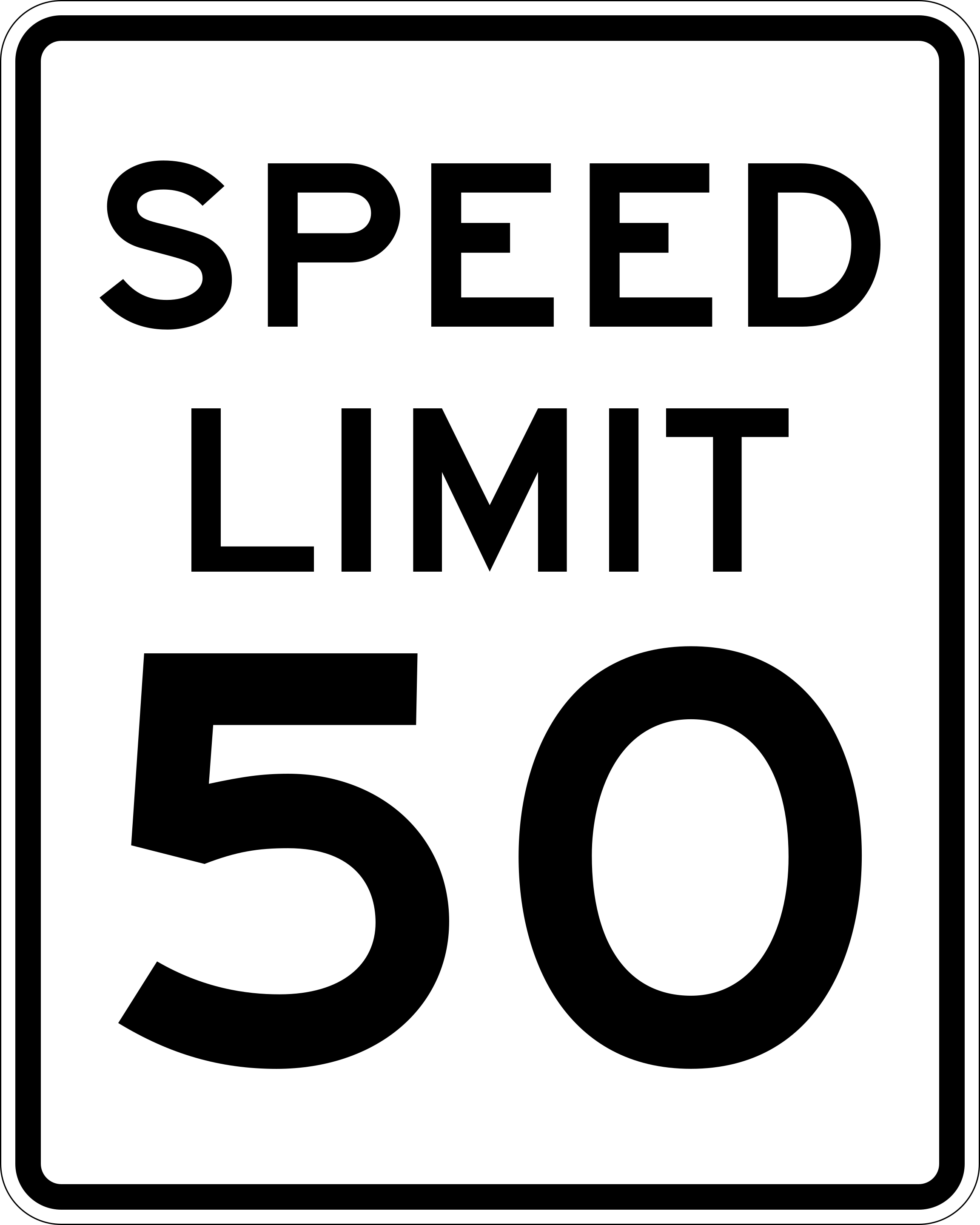
3. What can happen if a driver fails to obey a regulatory sign?
- The driver may ignore it if traffic is light
- The sign becomes advisory only
- The rule applies only at night
- It is a traffic violation
Show answer
It is a traffic violation. Regulatory signs communicate laws and regulations that apply at a location, and failure to obey them is a traffic violation. Their black or red symbols on a white background help distinguish them from warning, guide, and service signs, but the legal effect is the key point. Light traffic does not make a regulatory sign optional, and the rule does not disappear at night. Read the sign before entering the controlled area and comply with its instruction unless another lawful control changes the movement.
Study this in the handbook: Fitness to drive, distractions and basic control
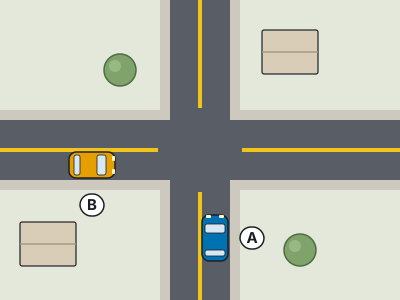
4. At an uncontrolled intersection, what does the vehicle on the left do when both vehicles arrive together?
- Accelerate so it crosses before the vehicle on the right
- Yield and allow the vehicle on the right to go first
- Stop in the center until the other driver waves
- Turn left automatically because it has the inside path
Show answer
Yield and allow the vehicle on the right to go first. The left-side driver yields when two vehicles reach an uncontrolled intersection at the same time. The right-side vehicle may proceed first after checking that the path is safe. Speeding into the crossing, waiting in its center, or claiming an inside path creates uncertainty and can cause a collision. This rule applies where stop signs and traffic lights are absent. Approach with enough speed control to identify arrival order, communicate if needed, and keep looking for pedestrians or late traffic.
Study this in the handbook: Right of way at intersections, roundabouts and mountain roads
5. What adjustment is especially important when high winds affect the roadway?
- Slow down and increase the space behind the vehicle ahead
- Use cruise control and reduce the following gap
- Maintain speed so gusts cannot affect the vehicle
- Open the window and steer with one hand
Show answer
Slow down and increase the space behind the vehicle ahead. High winds can change how a vehicle tracks and can make a sudden correction or obstacle harder to manage. Slowing down gives the driver more control, while increasing following distance provides room to react if another vehicle drifts or debris enters the roadway. Cruise control does not solve the changing conditions, and a shorter gap removes useful stopping space. Keep both hands ready on the wheel, scan for exposure near open areas, and adjust speed before the gust becomes a problem.
Study this in the handbook: Freeways, lane changes and passing
6. If a road has only one lane on your side near a stopped emergency vehicle, how should you pass?
- Maintain the posted speed without changing position
- Slow to a safe speed and use care and caution
- Stop beside the vehicle and wait for a green light
- Use the shoulder at full speed
Show answer
Slow to a safe speed and use care and caution. When a lane change is impossible because the road has only one lane on your side, the handbook directs the driver to slow to a safe speed and use care and caution while passing. Maintaining full speed ignores the hazard, and the shoulder is not a substitute for a safe legal lane. A complete stop is not the routine instruction either. Check whether a lane change is truly available, then reduce speed and give the stopped vehicle a wide safety margin.
Study this in the handbook: Right of way at intersections, roundabouts and mountain roads
7. Does a green traffic signal eliminate a driver's duty to yield in Colorado?
- Yes, a green light always grants priority
- Only on rural highways
- Yes, unless a cyclist is present
- No, the driver may still need to yield
Show answer
No, the driver may still need to yield. A green signal does not give anyone an unlimited claim to proceed. Colorado requires a driver to yield to pedestrians, bicyclists, and other drivers already in the intersection being approached. The choice “Yes, a green light always grants priority” mistakes a signal for absolute priority, and the rural option invents a location exception. Before moving on green, scan the intersection and crosswalk, check for road users already committed to the path, and be prepared to wait.
Study this in the handbook: Right of way at intersections, roundabouts and mountain roads
8. What fine range does Colorado list for a first DWAI for a driver 21 or older?
- $600 to $1,000
- $600 to $1,500
- $200 to $500
- $50 to $100
Show answer
$200 to $500. For a first Driving While Ability Impaired conviction, the handbook's table lists a fine of $200 to $500, with 8 points, 2 to 180 days in jail and 24 to 48 hours of public service. The $600 to $1,000 range belongs to a first DUI, and $600 to $1,500 to second and later convictions. Fifty to one hundred dollars is not in the table. DWAI applies when a driver is impaired to the slightest degree.
Study this in the handbook: Drugs, penalties and express consent
9. After a Colorado driver under 18 has held a license for 1 year, how many passengers may ride along?
- Only one passenger under 21
- Three passengers at most
- As many as there are seat belts in the vehicle
- None without a parent
Show answer
As many as there are seat belts in the vehicle. After 1 year, a Colorado driver under 18 may carry as many passengers as there are seat belts in the vehicle. The one passenger limit belongs to months six through twelve, and the no passengers rule to the first six months. Colorado sets no three passenger cap. The seat belt count also ties into a separate law: the number of passengers in a vehicle driven by someone under 18 must not exceed the number of seat belts.
Study this in the handbook: Passenger limits and curfew for young drivers
10. Unless otherwise marked, how close may a Colorado driver park to a traffic signal, stop sign, or railroad crossing?
- Within 30 feet is prohibited
- Within 5 feet is prohibited
- Within 15 feet is prohibited for all three locations
- Parking is allowed beside each one if hazard lights are on
Show answer
Within 30 feet is prohibited. Colorado lists a 30-foot no-parking distance for a traffic signal, stop sign, or railroad crossing. The same parking section separately gives a 15-foot distance for a fire hydrant, which is why that number should not be substituted for these three locations. Hazard lights do not authorize parking in a prohibited place, and five feet is far too close. Before leaving a vehicle, scan for nearby controls, crossings, hydrants, driveways, and other restricted areas rather than relying on warning lights.
Study this in the handbook: Signaling, turns, U turns and parking
11. Colorado’s Move Over Law protects which group besides emergency and maintenance personnel?
- Only vehicles carrying hazardous materials
- Only drivers of passenger buses
- Only people crossing at school zones
- Tow truck drivers and you
Show answer
Tow truck drivers and you. The Move Over Law is broader than police, fire, and maintenance vehicles. The handbook says it also protects tow truck drivers and ordinary drivers. That is why a vehicle with flashing hazards on a highway deserves a lane change when safe, or a significant speed reduction when moving over is not possible. The flashing hazards are the cue to create space.
Study this in the handbook: Crash duties, the Move It Law and the Move Over Law
12. If the brake pedal stops slowing the vehicle, what should a Colorado driver try first?
- Take the foot off the accelerator and pump the brake pedal
- Pull the parking brake hard and lock the rear wheels
- Turn off the ignition and coast without steering
- Continue driving until the brakes cool down
Show answer
Take the foot off the accelerator and pump the brake pedal. For brake failure, Colorado advises removing the foot from the accelerator and pumping the brake pedal several times. That pumping may rebuild enough pressure to stop. If it does not, apply the parking brake slowly, because locking the rear wheels can produce a skid. Lower gears can help after those steps, but the vehicle must be brought off the roadway and should not be driven without functioning brakes. Shutting off the ignition or coasting removes useful control rather than restoring braking.
Study this in the handbook: Avoiding collisions, animals and vehicle failures
13. Under normal conditions, how should a Colorado driver judge the space behind another vehicle?
- Keep exactly one car length for every ten miles per hour
- Use the three-second rule with a fixed roadside reference point
- Wait until the vehicle ahead begins braking before choosing a gap
- Use the vehicle's brake lights as the distance measurement
Show answer
Use the three-second rule with a fixed roadside reference point. Colorado recommends the three-second rule in normal conditions. Watch the vehicle ahead pass a mile marker, sign, or telephone pole, then count one-thousand-one through one-thousand-three. If your vehicle reaches that reference before the count ends, increase the gap. A car-length formula changes with vehicle size and speed, while waiting for brake lights leaves less time to respond. Brake lights also tell you that the other driver is slowing, not whether your following distance is adequate. Rain, ice, darkness, traffic, and other conditions require still more space.
Study this in the handbook: Scanning, following distance, phones and traffic stops
14. With solid and broken yellow lines, when may a driver pass?
- Only after crossing both lines and using the shoulder
- Whenever the solid yellow line is on the driver's side
- When the broken yellow line is on the driver's side and the maneuver is safe
- At any time before the broken lines become solid
Show answer
When the broken yellow line is on the driver's side and the maneuver is safe. For a solid-and-broken yellow combination, the line on your side controls. A driver may pass when the broken line is on that side and the maneuver is safe. If the solid line is on your side, passing is prohibited. The driver must also return before the broken lines become solid, so beginning a pass is not permission to remain in the opposing lane. Check visibility, traffic, and available space before crossing, then complete the maneuver within the marked window.
Study this in the handbook: Freeways, lane changes and passing
15. A white sign with black letters says PASS 3 FT MIN. What clearance does it remind drivers to give bicyclists?
- At least 12 inches
- At least 3 feet
- At least 10 feet
- Only enough room to avoid touching handlebars
Show answer
At least 3 feet. The PASS 3 FT MIN sign points to Colorado's bicyclist passing clearance. When passing bicyclists, including those in a bike lane, a driver must give a minimum of three feet from the outermost part of the vehicle or any attachments, such as mirrors, and the rule applies even where no sign is posted. Twelve inches is the parallel parking distance from the curb, not a passing clearance, and 10 feet is not the stated minimum. If you cannot give three feet, slow down and stay behind the bicyclist until it is safe to pass.
Study this in the handbook: Warning, guide, work zone and special signs
16. What do Colorado regulatory signs usually look like?
- Blue or brown with white symbols
- Black or red on a white background
- Orange with black letters only in rural areas
- Green with mileage numbers and route arrows
Show answer
Black or red on a white background. Regulatory signs communicate laws that apply at that location and are normally black or red on white. Blue and brown point drivers toward services or recreation, while green guide signs handle route and distance information. When the sign uses a red or black message on a white background, read it as a rule you must obey, such as a turn restriction or speed control.
Study this in the handbook: Regulatory signs: stop, yield and speed
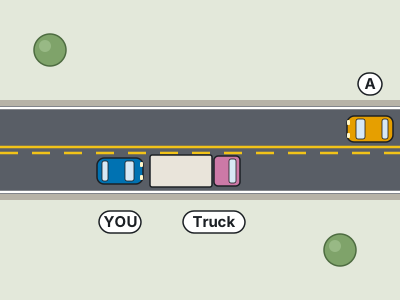
17. When the broken yellow line is on your side of a solid and broken pair, when may you pass?
- When it is safe to do so
- Never, under any roadway condition
- Only after crossing the solid line first
- Only while following a school bus
Show answer
When it is safe to do so. A solid and broken yellow pair assigns a different rule to each side of the roadway. If the broken line is beside your lane, passing is allowed when the maneuver is safe, and you must return before your broken line becomes solid. The opposite arrangement, with the solid line on your side, prohibits passing. Crossing the solid marking first reverses the intended rule, while a school bus offers no permission to pass. Confirm clear sight distance, oncoming traffic, and a safe return path before starting.
Study this in the handbook: Lines, crosswalks and special lanes
18. What does a prohibited sign tell a driver?
- The pictured action is allowed only on weekends
- The pictured action is required immediately
- The pictured action is recommended in heavy traffic
- The pictured action cannot be performed
Show answer
The pictured action cannot be performed. Prohibited signs identify an action that drivers may not perform at that location. The handbook gives no U-turn and no left turn as examples, so the red slash is a restriction rather than permission or a recommendation. It also does not create a weekend-only schedule or require the pictured maneuver. Read the symbol before beginning the movement, then continue in a legal direction and look for the next permitted place to turn. Treat the restriction as active unless another sign clearly changes it.
Study this in the handbook: Regulatory signs: stop, yield and speed
19. For a Colorado driver age 21 or older, which BAC is identified as DUI per se?
- 0.02%
- 0.04%
- 0.08%
- 0.05%
Show answer
0.08%. For drivers age 21 and older, the handbook identifies DUI per se at a BAC greater than 0.08 percent. The 0.05 percent figure is associated with the first DWAI table entry, while 0.04 percent is the threshold noted for a CDL driver. A BAC number does not excuse unsafe behavior at a lower level, since impairment can also be established through driving conduct and observed symptoms. Separate the per se threshold from every other alcohol rule.
Study this in the handbook: DUI, DWAI and how alcohol works
20. What does Colorado require when no different speed is posted?
- Follow the default speed limit for the road or district
- Always drive 10 mph below the posted limit
- Use the rural interstate limit on every road
- Choose any speed that feels comfortable
Show answer
Follow the default speed limit for the road or district. Colorado provides default speed limits for different road settings when no other limit is posted. A driver must identify the road or district and then apply the stated default, while also slowing for weather, traffic, visibility, or hazards. Driving 10 mph below every posted limit is not the rule, and a rural interstate limit does not apply to every road. Comfort alone is not a legal measure. Look for a posted sign first, then use the handbook category and conditions to select a safe speed.
Study this in the handbook: Emergency vehicles, school buses and work zones
QualitySpace is expanding to Colorado
We are a California-based independent insurance brokerage working on licensing in more states. We cannot help with Colorado insurance yet. Leave your email and we will let you know when we can.
Every question is written from the official Colorado Driver Handbook. Need paper? Printable CO practice test with answer key.
Last verified 2026-10-05. How we check every question · Study all 213 as flashcards
Frequently asked questions
How many questions are on this Colorado practice test?
This fixed set has 20 questions. It is test 4 of 10 from the 213 question Colorado bank.
How does this fixed test relate to the full Colorado bank?
Each numbered test is a fixed set of questions in a fixed order, so you can retake the same test later and compare. Every test mixes road signs and the other topics in about the same proportion as the full bank. Tests 1 to 10 together cover 200 of the 213 questions in the Colorado bank, each once. The full practice page mixes the whole bank at random.
Last verified 2026-10-05. See the Colorado DMV facts page for sourced state details.
Return to the full Colorado practice test · Study road signs