
Test 9 of 25 · 20 questions · Free 2026
OH Permit Practice Test 9
Jump to the test ↓A fixed 20 question set from the Ohio bank with answers and plain English explanations. The real OH exam is 40 questions, 75 percent to pass; take the full length version on the main practice page.
Question 1 of 20 · 0 right so far
All 20 questions in test 9
Every question below comes from the Ohio question bank on this page. Open a question to see the correct answer and the explanation. Nothing here is hidden behind a signup.
1. A 16-year-old Ohio driver is convicted of a traffic offense in the first months of licensing. What may be required?
- A permanent license revocation
- A parent or guardian must accompany the driver for six months or until age 17
- Only a written warning
- Retaking driver education
Show answer
A parent or guardian must accompany the driver for six months or until age 17. Ohio may require a parent or legal guardian to ride along for six months, or until the driver turns 17, after a traffic conviction in the first months of licensing. Permanent revocation is far beyond the rule, a written warning understates it, and retaking driver education is not the stated consequence. Separate rules suspend a teen's license for three months after two moving violations and one year after three.
Study this in the handbook: Probationary license limits for drivers under 18
2. What does an Ohio crosswalk define?
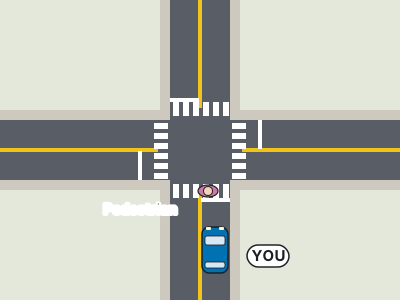
- A lane reserved for passing traffic
- A shoulder where vehicles may park
- A zone where bicycles must dismount
- The area where pedestrians may cross the roadway
Show answer
The area where pedestrians may cross the roadway. An Ohio crosswalk marks the area where pedestrians may cross the roadway. It is not a passing lane, a parking shoulder, or a bicycle-only space. The crosswalk's function helps drivers anticipate pedestrian movement and scan the full crossing area. When a pedestrian is entering or already in that area, the separate right-of-way rule requires yielding, and a stop line before the crosswalk must be obeyed. Remember the basic cue: painted crossing space means watch for people on foot.
Study this in the handbook: Reasonable speed and the assured clear distance rule
3. At an intersection, another driver is already there before you arrive. Who should you yield to?
- The driver turning right
- The driver who sounds the horn
- The vehicle carrying more passengers
- The driver who is at or arrives before you
Show answer
The driver who is at or arrives before you. Ohio's right-of-way list tells drivers to yield to the driver who is already at the intersection or arrived before them. This is an arrival-order rule, not a preference for right turns, larger passenger loads, or horn use. A vehicle that got there first may be preparing to cross or turn, so approaching traffic should wait and watch its movement. Use a simple sequence at an uncontrolled intersection: identify who arrived first, yield to that vehicle, then proceed when the path is open.
Study this in the handbook: Right of way
4. Which headlights should an Ohio driver use when driving in fog?
- Low beams, not high beams
- High beams, to light the fog more strongly
- No headlights until the fog clears
- Hazard lights instead of headlights
Show answer
Low beams, not high beams. Ohio calls fog one of the most hazardous conditions a motorist can drive in. The manual tells drivers to slow down, keep a consistent distance behind the vehicle ahead, use low beam headlights rather than high beams, and keep scanning for potential hazards. Ohio also requires lights during fog regardless of the time of day, so driving without headlights until the fog clears is not an option, and hazard lights are not listed as a substitute. Shift your gaze instead of staring, and be ready to stop at any time.
Study this in the handbook: Headlights, night driving and bad weather
5. How far from a railroad crossing should a driver stop when a train is approaching?
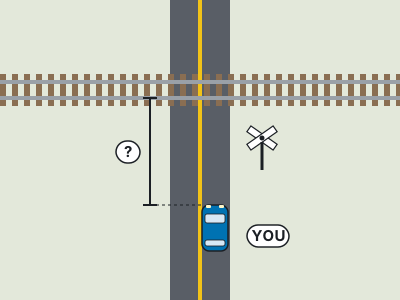
- No closer than 15 feet and no farther than 50 feet
- At least 100 feet away in every case
- Exactly 5 feet from the nearest rail
- Only after the front of the train reaches the crossing
Show answer
No closer than 15 feet and no farther than 50 feet. Ohio sets a stopping range for an approaching train: the vehicle must be at least 15 feet from the crossing and no more than 50 feet away. Stopping five feet from the rail is too close, and the manual does not require a universal 100-foot distance. Waiting until the train reaches the crossing delays the stop and may place the vehicle in danger. Watch for the warning signs and signals, stop within the stated range, and wait for the train and warnings to clear.
Study this in the handbook: Turns, school buses and railroad crossings
6. On a two-lane, two-way road with a broken yellow center line, when may vehicles pass?
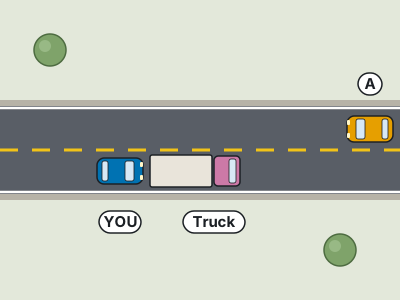
- Never, because yellow always bans passing
- Whenever traffic in the opposite lane is faster
- Only while turning into a driveway
- When it is safe to pass vehicles traveling in the same direction
Show answer
When it is safe to pass vehicles traveling in the same direction. A broken yellow line allows passing of vehicles traveling the same direction when the maneuver is safe. The never choice confuses a broken yellow line with a solid yellow restriction. Before moving left, check for oncoming traffic, hills, curves, intersections, and enough clear space to return. The cue is the broken center marking on a two-way road: it permits passing, but only after the driver confirms the opposing lane can be used safely.
Study this in the handbook: Traffic signals and pavement markings
7. What type of sign uses an orange background with black letters or symbols?
- A work zone sign
- A railroad crossing sign
- A school zone speed sign
- A guide sign for a service area
Show answer
A work zone sign. Ohio uses orange backgrounds for work zone signs, so the color itself is a useful advance warning that roadway work may be ahead. A guide sign points toward destinations or services and is commonly green, brown, or blue. Railroad crossings use the round yellow warning sign or the white crossbuck described in the manual. A school zone sign gives a school related regulation or warning, not the general orange work zone designation. When orange appears, reduce speed, watch for cones and equipment, and be ready for workers or a sudden stop.
Study this in the handbook: Headlights, night driving and bad weather
8. How far ahead does Ohio say you should ideally look while driving?
- Two to three seconds ahead
- 20 to 30 seconds in front of your car
- Just to the bumper of the car ahead
- One vehicle length for every 10 mph
Show answer
20 to 30 seconds in front of your car. Visual search is about seeing problems early. Ohio tells drivers to look down the planned path of travel and, ideally, to watch what is happening 20 to 30 seconds in front of the car. That distance shows you road users, signals, and traffic changes while there is still time to change speed or lane position smoothly. Drivers who look only at the car directly ahead end up reacting late and braking hard.
Study this in the handbook: Reasonable speed and the assured clear distance rule
9. When must an Ohio driver show proof of insurance after a traffic crash?
- Only when someone is killed
- When the crash causes more than $400 in property damage
- Only when damage exceeds $5,000
- Never, if the police do not come
Show answer
When the crash causes more than $400 in property damage. Ohio requires proof of financial responsibility when the driver or vehicle owner is in a crash with more than $400 in property damage. Proof is also required whenever a traffic ticket is issued, at inspection stops, at every Traffic Court appearance, and when the BMV requests it. Limiting it to fatal crashes or damage above $5,000 sets the bar far too high. Police presence is not the trigger.
Study this in the handbook: Probationary license limits for drivers under 18
10. Two vehicles approach a narrow bridge from opposite ends where an Ohio bridge warning sign is posted. Under that sign, which vehicle has the right-of-way?
- The vehicle traveling uphill in every case
- The vehicle farthest from the bridge
- The vehicle with more passengers
- The vehicle nearest the bridge
Show answer
The vehicle nearest the bridge. Ohio’s warning sign list includes the rule that the vehicle nearest the bridge has the right of way. The uphill choice adds a condition that is not in this sign entry. When approaching a narrow bridge or one-lane bridge warning, identify which vehicle is closest and be ready to yield before the bridge if you are farther away. The cue is the bridge warning context: it resolves priority before two vehicles meet in the restricted space.
Study this in the handbook: Reasonable speed and the assured clear distance rule
11. An Ohio driver under 21 fails the driving test. How long must they wait to retest?
- One day
- Two days
- Seven days
- 30 days
Show answer
Two days. In Ohio, an applicant under 21 who fails the driving test must wait two days before retesting. One day is the wait after a failed knowledge test. Seven and 30 days are not Ohio's waits. Applicants 21 and older who fail the maneuverability or road skills test must instead complete an Abbreviated Adult Driver Training Course before a second try, unless they took approved driver education within the past year.
12. What should you anticipate after seeing a traffic signal ahead warning sign?
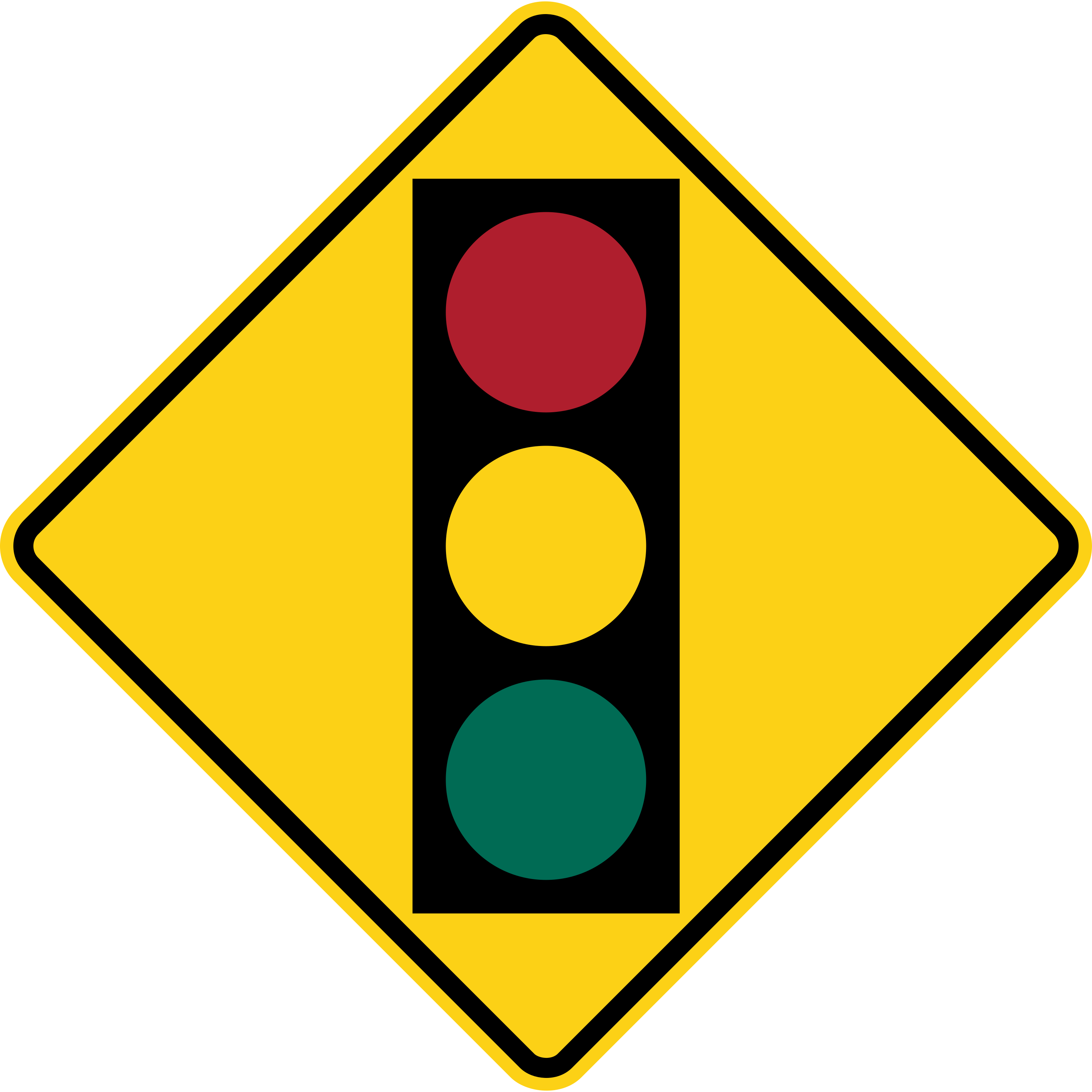
- A police checkpoint that always requires a U-turn
- A broken streetlight that traffic may ignore
- A signalized intersection ahead where you may need to stop
- A railroad gate that remains open for all vehicles
Show answer
A signalized intersection ahead where you may need to stop. A signal ahead warning gives you time to adjust before reaching the intersection. Be ready for a red, yellow, or green indication and obey the signal when you arrive. The sign does not describe a broken streetlight, a mandatory U-turn, or a railroad gate. Ohio explains that traffic signals tell drivers when to stop and go, and a red light requires stopping before entering the intersection. Use the warning as a prompt to check your speed, lane, and following distance so a sudden change does not force hard braking.
Study this in the handbook: Reasonable speed and the assured clear distance rule
13. In Ohio, when may a child under 16 ride in the open cargo area of a pickup truck?
- Any time, if a parent drives
- Only on highways
- Whenever the tailgate is closed
- Not when the truck is going faster than 25 mph, unless an exception such as a secured seat and belt applies
Show answer
Not when the truck is going faster than 25 mph, unless an exception such as a secured seat and belt applies. Ohio bars a truck driver from knowingly letting anyone under 16 ride in an open cargo area when the vehicle goes faster than 25 mph. The exceptions are a properly secured seat with a federally compliant safety belt, an emergency threatening life, or public highway workers doing maintenance or construction. A parent driving is not an exception, highways are not safer, and a closed tailgate does not satisfy the rule. No one may ride on the outside of a moving vehicle.
Study this in the handbook: Probationary license limits for drivers under 18
14. What driving adjustment is recommended before entering a curve?

- Accelerate hard before checking whether the end is visible
- Wait until the middle of the curve to brake sharply
- Reduce speed to a safe level before the curve
- Keep the same speed even when traction is poor
Show answer
Reduce speed to a safe level before the curve. Reduce speed before entering a curve so the vehicle is balanced and controllable through the bend. Ohio recommends slight, constant acceleration through the curve after choosing a safe entry speed, with further reduction when traction is poor, another vehicle is nearby, or the end cannot be seen. Sharp braking in the middle can upset the vehicle, and holding speed despite poor traction ignores the road condition. The cue is timing: prepare before the steering demand begins, then use smooth control while you follow the curve.
Study this in the handbook: Reasonable speed and the assured clear distance rule
15. Which conditions require headlights under Ohio law?
- Only darkness after 9 p.m.
- Sunset to sunrise, poor visibility, or precipitation wipers in use
- Only rain during daylight
- Only travel above 45 mph
Show answer
Sunset to sunrise, poor visibility, or precipitation wipers in use. Ohio requires headlights from sunset to sunrise, whenever visibility is poor such as in rain, snow, or fog, and whenever windshield wipers are operating because of precipitation. The rule is broader than a clock time and applies in daylight weather conditions too. The rain-only option misses snow, fog, and the wiper trigger. Use the cue of darkness, visibility, or precipitation wipers.
Study this in the handbook: Vehicle equipment, seat belts and child seats
16. Two vehicles reach an uncontrolled four-way intersection at the same time. Which vehicle has priority?
- The vehicle traveling faster
- The vehicle on the left
- The vehicle on the right
- The larger vehicle
Show answer
The vehicle on the right. When two drivers arrive at a four-way intersection simultaneously, Ohio assigns priority to the driver on the other vehicle's right. The driver on the left must yield, even if that vehicle is larger or moving faster. Arrival at the same moment is the important condition, so this rule is different from the first-arrival rule. Before entering, scan both sides and identify whether another vehicle is to your right. If so, let that vehicle proceed first, then continue only after checking that the intersection is clear.
Study this in the handbook: Right of way
17. What should a driver do when the vehicle begins to skid on an Ohio roadway?
- Turn sharply away from the skid
- Release pressure from the brake or accelerator and turn into the skid
- Accelerate hard to restore traction
- Lock the brakes immediately
Show answer
Release pressure from the brake or accelerator and turn into the skid. Ohio's emergency guidance for a skid is to release pressure from the brake or accelerator and turn the wheel into the skid. This response helps the tires regain a manageable path instead of adding a sudden control input. Turning sharply away can produce an overcorrection, while hard acceleration or locked brakes can worsen the loss of traction. Keep the movement deliberate, reduce the cause of the slide, and steer with the direction the vehicle is actually skidding.
Study this in the handbook: Vehicle emergencies and crashes
18. What happens immediately when an Ohio chemical test shows a BAC of 0.08 or higher?
- The officer confiscates the license and notifies the driver of the suspension
- The suspension begins after five years
- The officer must wait for an acquittal
- The driver receives only a warning letter
Show answer
The officer confiscates the license and notifies the driver of the suspension. When a chemical test within two hours shows a BAC of 0.08 or higher, the officer confiscates the Driver License and notifies the driver of the suspension. The administrative suspension begins immediately, so a warning letter alone, a five-year delay, or waiting for an acquittal misses the stated process. The independent test mentioned by the manual is an option at the driver's expense, not a reason to postpone the initial action. Watch for the test result and immediate notice.
Study this in the handbook: Probationary license limits for drivers under 18
19. What does Ohio prohibit a probationary driver from doing while operating a vehicle?
- Using a phone only at a red light
- Using a phone only on a highway
- Using any device, including a phone
- Using a device only after midnight
Show answer
Using any device, including a phone. The probationary license restrictions in Section 12 say the driver may not use any devices, including phones, while operating a vehicle. Section 3 adds that drivers under 18 may not use an electronic device even hands free or while stopped at a traffic light, with exceptions only for navigation device purposes and emergency services calls. The highway and red light choices shrink the ban, and the midnight choice confuses it with the separate nighttime driving restriction.
Study this in the handbook: Probationary license limits for drivers under 18
20. When should a driver use hazard lights according to the Ohio manual?
- To announce every ordinary lane change
- To replace a turn signal before a normal turn
- To increase the visibility of a vehicle stopped on or near a roadway
- To give a moving vehicle priority at an intersection
Show answer
To increase the visibility of a vehicle stopped on or near a roadway. Hazard lights are intended to make a stopped vehicle more visible when it is on or near a roadway. They are not a substitute for the directional signal used for a lane change or turn, and they do not give a moving vehicle priority at an intersection. The key cue is an unusual stopped position that other drivers need to notice. Activate the warning lights for visibility, then place the vehicle in the safest available location rather than treating them as permission to keep driving normally.
Study this in the handbook: Vehicle equipment, seat belts and child seats
QualitySpace is expanding to Ohio
We are a California-based independent insurance brokerage working on licensing in more states. We cannot help with Ohio insurance yet. Leave your email and we will let you know when we can.
Every question is written from the official Digest of Ohio Motor Vehicle Laws. Need paper? Printable OH practice test with answer key.
Last verified 2026-10-05. How we check every question · Study all 500 as flashcards
Frequently asked questions
How many questions are on this Ohio practice test?
This fixed set has 20 questions. It is test 9 of 25 from the 500 question Ohio bank. The real OH exam asks 40 questions and you need 30 correct.
What is the passing score for the real Ohio test?
Applicants must answer 75 percent of the questions correctly to pass That figure comes from the official Ohio source cited on the DMV facts page.
How does this fixed test relate to the full Ohio bank?
Each numbered test is a fixed set of questions in a fixed order, so you can retake the same test later and compare. Every test mixes road signs and the other topics in about the same proportion as the full bank. Tests 1 to 25 together cover every question in the Ohio bank once. The full practice page mixes the whole bank at random.
Last verified 2026-10-05. See the Ohio DMV facts page for sourced state details.