
Test 3 of 25 · 20 questions · Free 2026
OH Permit Practice Test 3
Jump to the test ↓A fixed 20 question set from the Ohio bank with answers and plain English explanations. The real OH exam is 40 questions, 75 percent to pass; take the full length version on the main practice page.
Question 1 of 20 · 0 right so far

All 20 questions in test 3
Every question below comes from the Ohio question bank on this page. Open a question to see the correct answer and the explanation. Nothing here is hidden behind a signup.
1. This yellow right-angle arrow sign warns a driver about what condition ahead?
- A no passing zone ending
- A required right turn at every signal
- A one-way street ending
- A sharp right turn ahead
Show answer
A sharp right turn ahead. A yellow right-angle arrow is a warning sign, not a regulatory command. In Ohio’s sign list, that symbol points to a sharp right turn ahead, so the driver should reduce speed before reaching the bend and stay in the lane. The required-turn choice would fit a white regulatory sign rather than a yellow warning. The cue is the yellow background with a bent arrow: it warns about roadway shape before the vehicle reaches the turn.
Study this in the handbook: Reasonable speed and the assured clear distance rule
2. What is required when a school bus is stopped on a road with fewer than four lanes and its red lights are flashing?
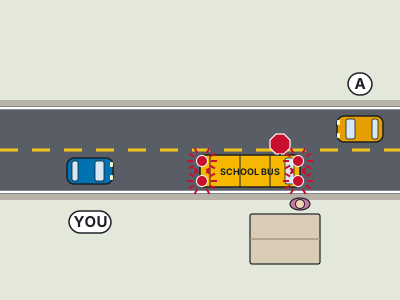
- Only traffic behind the bus must stop at least 5 feet away
- All traffic may proceed after slowing to 15 mph
- Oncoming traffic may pass if it uses the opposite shoulder
- Traffic approaching from either direction must stop at least 10 feet away
Show answer
Traffic approaching from either direction must stop at least 10 feet away. On a road with fewer than four lanes, Ohio requires traffic approaching a stopped school bus from either direction to stop at least 10 feet from the front or rear of the bus. The stop continues until the bus moves or the driver signals motorists to proceed. The rule is not satisfied by slowing, using a shoulder, or stopping only behind the bus. Count the lanes and remember the distance: fewer than four lanes means both directions stop, with a 10 foot buffer.
Study this in the handbook: Turns, school buses and railroad crossings
3. An Ohio driver age 30 is caught holding a phone while driving for the first time in two years. What is the penalty?
- 2 points and a fine of up to $150
- 6 points and a $1,000 fine
- A 60-day suspension
- No penalty for a first offense
Show answer
2 points and a fine of up to $150. For drivers 18 and older, a first handheld device offense in two years brings 2 points and a fine of up to $150, and a distracted driving course can help avoid both. A second offense in two years brings 3 points and up to $250, and a third brings 4 points, up to $500, and a possible 90 day suspension. Six points and $1,000 do not match. A 60 day suspension is the penalty for drivers under 18.
Study this in the handbook: Probationary license limits for drivers under 18
4. What should you do if you miss your freeway exit?
- Stop and back up on the shoulder
- Use the median opening reserved for emergency vehicles
- Take the next exit
- Make a U-turn at the end of the ramp
Show answer
Take the next exit. Ohio's driving guidance is simple when an exit is missed: take the next one. Backing on a shoulder creates a serious conflict with vehicles that may be entering or leaving the roadway. The median opening is reserved for emergency and public safety vehicles, so it is not a shortcut for a missed exit. A U-turn at the ramp also creates an unexpected movement. Continue forward, leave at the next legal exit, and use the regular roadway to correct the route.
Study this in the handbook: Right of way
5. Which warning sign alerts Ohio drivers that traffic ahead travels in opposite directions?
- No bicycles allowed
- County route marker
- Hospital services ahead
- Traffic travels in opposite directions
Show answer
Traffic travels in opposite directions. Ohio’s warning sign list includes a sign for traffic traveling in opposite directions. That warning prepares a driver for a two-way traffic pattern or a change from separated travel to opposing traffic nearby. The county route marker choice is a guide sign, not a warning about traffic flow. Watch for yellow warning signs before lane patterns change, and be ready to keep right, avoid drifting over the center line, and check for oncoming vehicles.
Study this in the handbook: Reasonable speed and the assured clear distance rule
6. What forms may white pavement lines take?
- Solid or broken (dashed) lines
- Only yellow broken lines
- Only double solid lines
- Arrows and crosswalk stripes only
Show answer
Solid or broken (dashed) lines. Ohio identifies white lines as lane markings that may be solid or broken, also called dashed. White markings generally organize traffic moving in the same direction, while yellow markings separate opposing traffic. A double solid yellow center line is not a white line, and arrows or crosswalk stripes are different pavement-marking types. When studying roadway markings, first identify the color, then determine whether the line is solid or broken. That quick scan helps distinguish lane separation from passing rules and pedestrian markings.
Study this in the handbook: Reasonable speed and the assured clear distance rule
7. Which roadway areas can pavement markings define for pedestrians?
- Fuel station entrances
- Pedestrian walkways
- Vehicle registration zones
- Roadside service plazas
Show answer
Pedestrian walkways. Pavement markings do more than divide lanes; Ohio says they can define pedestrian walkways. The fuel station choice is unrelated because markings in this rule guide traffic lanes, turns, passing, stopping places, and pedestrian areas. Look for crosswalk stripes, stop lines, arrows, and words painted on the road. Those markings help tell drivers where pedestrians may be expected and where vehicles should stop or travel.
Study this in the handbook: Reasonable speed and the assured clear distance rule
8. For a driver age 21 or older operating a noncommercial vehicle in Ohio, what is the lowest BAC covered by the general alcohol per se threshold?
- .02% or higher
- .04% or higher
- .08% or higher
- .12% or higher
Show answer
.08% or higher. Ohio lists .08 percent or higher as unlawful operation for a driver of any age. The .04 percent threshold applies to commercial drivers, while .02 percent applies when the driver is under 21. Those figures are tied to different classifications and should not replace the general threshold in this question. A useful memory cue is to match the number with the driver category before choosing. Regardless of the number, alcohol or drugs can impair judgment and reaction time below a legal threshold, so a safe driver never treats the limit as a target.
Study this in the handbook: OVI, BAC limits and chemical test refusal
9. What does OVUAC describe in Ohio?
- Operating a Vehicle Using an Automobile Club permit
- Operating a Vehicle Until Alcohol Clears
- Operating a Vehicle Under Active Citation
- Operating a Vehicle after Underage Alcohol Consumption
Show answer
Operating a Vehicle after Underage Alcohol Consumption. OVUAC expands to Operating a Vehicle after Underage Alcohol Consumption. It identifies a distinct under-21 alcohol-related offense, rather than a permit, citation, or waiting procedure. The manual notes that an OVUAC can lead to a license suspension lasting three months to two years and other requirements, which shows why the abbreviation matters beyond vocabulary. The cue is to link the final letters with underage alcohol consumption, not general impaired driving.
Study this in the handbook: Probationary license limits for drivers under 18
10. A pedestrian carrying a white cane is waiting to cross. What priority does that pedestrian have?
- No priority unless a signal is green
- Priority only after waving at traffic
- The right of way
- Priority only in a school zone
Show answer
The right of way. Ohio identifies a pedestrian who is blind or visually impaired by a white cane or guide dog and gives that pedestrian priority. The signal-only choice is too limited because the listed cue itself establishes the right of way. Slow early, avoid crowding the crosswalk, and be ready for the person to enter more cautiously than other pedestrians. The white cane or guide dog is the concrete warning that extra patience and a full yield are required.
Study this in the handbook: Reasonable speed and the assured clear distance rule
11. What following practice does Ohio recommend while traveling through a work zone?
- Maintain a clear distance from the vehicle ahead and do not tailgate
- Follow closely so another driver cannot merge ahead
- Use the shoulder to create a longer gap
- Match the vehicle ahead even if it exceeds the posted limit
Show answer
Maintain a clear distance from the vehicle ahead and do not tailgate. Work zones contain workers, equipment, barriers, and changing traffic paths, so Ohio advises maintaining a clear distance from the vehicle ahead. Tailgating leaves little room for a sudden stop and reduces the time available to react. Following closely to block a merge creates the very hazard the rule addresses. The shoulder is not a substitute travel lane, and matching a speeder does not override the posted limit. Watch the work area, lower your speed when needed, and preserve a space cushion.
Study this in the handbook: Reasonable speed and the assured clear distance rule
12. At a green traffic signal, what should a driver do before turning left?
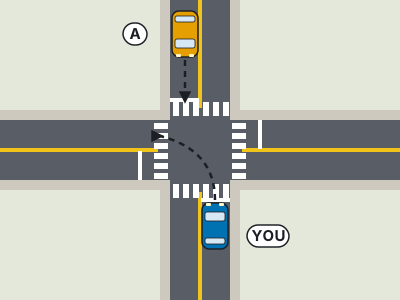
- Turn immediately because green traffic always has priority
- Wait for an opportunity, yield to pedestrians and oncoming traffic, then turn safely
- Enter the opposing lane before checking for pedestrians
- Reverse to the stop line and wait for a red signal
Show answer
Wait for an opportunity, yield to pedestrians and oncoming traffic, then turn safely. A green signal allows movement, but it does not remove the hazards involved in a left turn. Ohio directs the driver to wait for an opportunity, yield to pedestrians and oncoming traffic, and turn as soon as it is safe. Turning immediately can cross the path of an approaching vehicle or person. Reversing is unnecessary, and entering the opposing lane before checking creates an avoidable conflict. Treat the green as permission to search and yield, not as a guarantee of an open turn.
Study this in the handbook: Right of way
13. How close to another parked vehicle may you stop, stand, or park in Ohio?
- No closer than 10 feet
- No closer than one foot
- No closer than 20 feet
- There is no minimum gap between parked vehicles
Show answer
No closer than one foot. Ohio's list of places where you may not stop, park, or stand includes the space right next to another parked vehicle. You must stay at least one foot away from it, which leaves room for both drivers to pull out and keeps bumpers from touching. The same list includes 20 feet from an intersection or crosswalk and 10 feet from a fire hydrant, along with sidewalks and driveways. Learn each distance separately, because test questions often swap them.
Study this in the handbook: Right of way
14. What action is required when a pedestrian is entering a marked crossing?

- Sound the horn and continue without changing speed
- Pass the pedestrian before the crosswalk begins
- Yield and be prepared to stop
- Yield only if a crossing guard is present
Show answer
Yield and be prepared to stop. A pedestrian warning sign calls for attention well before the crossing. Ohio requires drivers to yield to pedestrians entering or already in a crosswalk, and a stop line before the crosswalk must also be obeyed. A horn does not replace yielding, and passing before the painted lines can still put a person in danger. The duty is not limited to locations with crossing guards. Reduce speed, scan around parked vehicles, and leave the person enough space to cross safely. The strongest cue is movement toward the roadway, not whether the pedestrian has stepped into your exact lane yet.
Study this in the handbook: Reasonable speed and the assured clear distance rule
15. A red slash crosses a left-turn arrow on a regulatory sign. Which movement is prohibited?
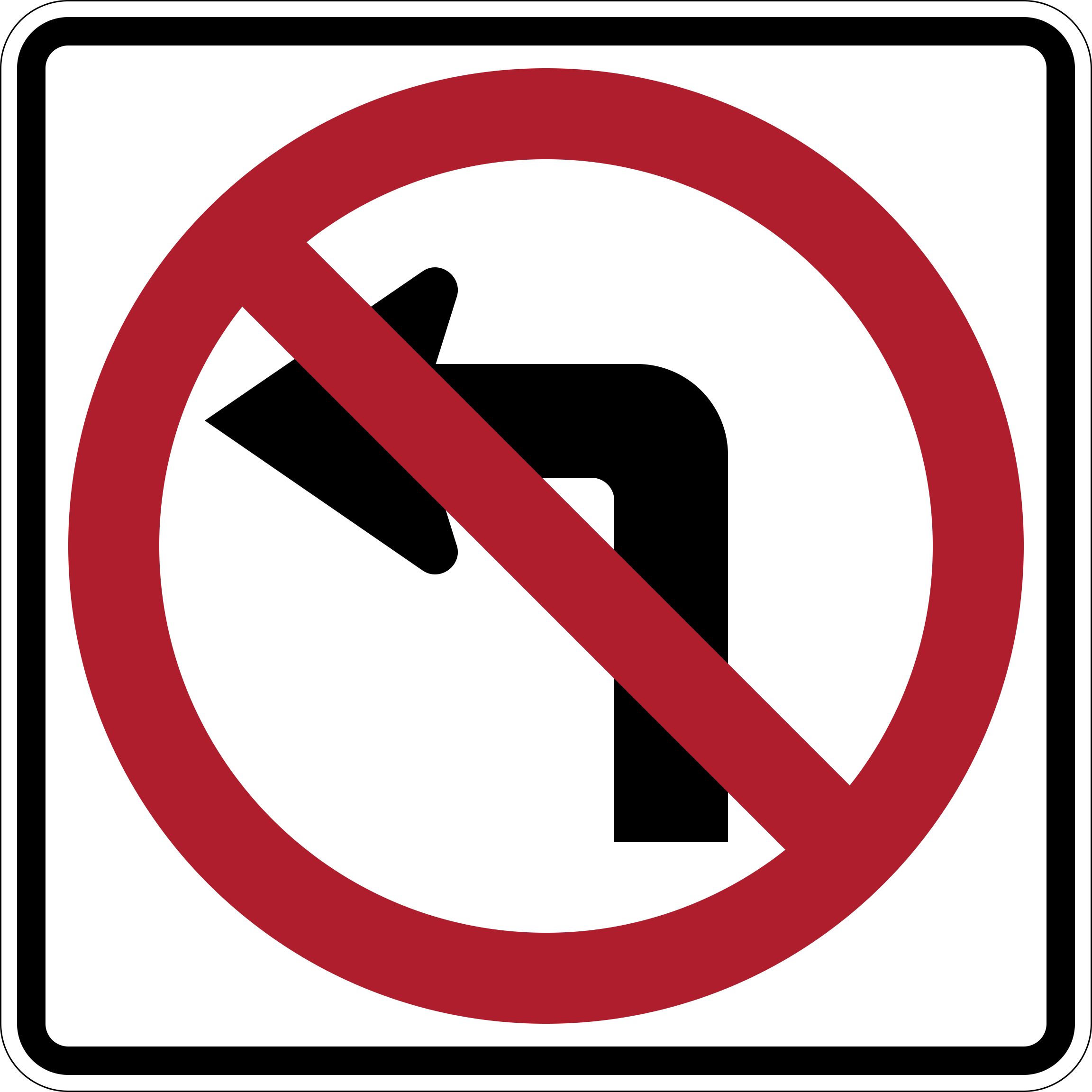
- Making a U-turn
- Turning left
- Passing a slower vehicle
- Crossing a railroad track
Show answer
Turning left. A prohibition sign applies to the movement shown inside it. Because this sign displays a left-turn arrow, the forbidden maneuver is a left turn at that location. A U-turn uses a different arrow, and passing or railroad-crossing restrictions require other markings, signs, or signals. Look at the symbol before reacting to the red slash. The slash does not mean every movement is forbidden; it tells you that the illustrated action cannot be made. Continue only by following another available route or movement that is legally permitted.
Study this in the handbook: Reasonable speed and the assured clear distance rule
16. How much side clearance should a motor vehicle maintain when passing a bicyclist?
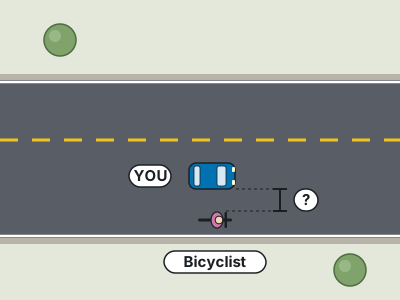
- At least one foot
- At least three feet
- Exactly two feet
- Only enough to avoid touching handlebars
Show answer
At least three feet. Ohio tells drivers to maintain at least three feet of safety zone between a motor vehicle and a bicycle. The one-foot choice leaves too little margin for wobble, road debris, or a bicyclist avoiding a hazard. When approaching a bicycle, slow down, check the next lane or opposing traffic, and pass only when the space is available. The cue is a bicyclist near your lane edge, especially on wet, sandy, or narrow pavement.
Study this in the handbook: Reasonable speed and the assured clear distance rule
17. Why may a driver need to travel below the posted speed in Ohio?
- Because every posted limit is only an optional suggestion
- Because a driver must always travel 10 mph below the sign
- Because lower speed is required only on a dry, empty roadway
- Because conditions can make a slower speed necessary for control and stopping
Show answer
Because conditions can make a slower speed necessary for control and stopping. Ohio says a reasonable speed can be lower than the posted speed when weather, road conditions, or traffic make the signed number unsafe. The purpose is to maintain control and preserve the ability to stop within the distance available. A posted limit is not merely an optional suggestion, and the manual does not impose a universal 10 mph reduction. Dry, empty pavement is not the condition that triggers this adjustment. Before entering a patch of poor pavement or reduced visibility, ease down smoothly and leave more room ahead rather than waiting for an emergency braking decision.
Study this in the handbook: Reasonable speed and the assured clear distance rule
18. According to the Ohio manual, how far does a loaded truck at 55 mph need to stop under ideal conditions?
- At least 335 feet
- About 100 feet, less than a car
- The same distance as a car
- About 50 feet
Show answer
At least 335 feet. Ohio's manual says a loaded truck with good tires and brakes at 55 mph under ideal conditions needs at least 335 feet to stop, more than one and a half times a passenger vehicle's distance. Trucks need more room, not the same or less, so the other choices are wrong. Before pulling in front of a truck after passing, see its whole front in your rear view mirror. Trucks also have blind spots behind them that extend up to 200 feet.
Study this in the handbook: Reasonable speed and the assured clear distance rule
19. How soon after becoming an Ohio resident must you get an Ohio driver license?
- Within 10 days
- Within 60 days
- Within 30 days
- Within one year
Show answer
Within 30 days. Ohio drivers must have an Ohio issued license within 30 days of establishing residency. Ohio treats you as a resident once you are employed, sign a lease, buy a home, or enroll children in school. Ten days is shorter than required, and 60 days or a year are longer. A vehicle you own also needs an Ohio title and registration, which come with Ohio plates and a registration sticker.
20. A parent co-signs an Ohio license application for a 16-year-old. What responsibility does the parent take on?
- None, once the license is issued
- Liability only for parking tickets
- Joint liability for damages from the minor's negligent or willful driving until the minor turns 18
- Liability until the minor turns 25
Show answer
Joint liability for damages from the minor's negligent or willful driving until the minor turns 18. In Ohio, a parent or guardian who co-signs a minor's license application is jointly and severally liable with the minor for damages caused by negligent or willful driving until the minor's 18th birthday. The responsibility does not end at issuance, is not limited to parking tickets, and does not run to 25. After a collision, filing proof of financial responsibility for the minor can end that liability, and the co-signer can cancel the minor's authorization at any time.
Study this in the handbook: Probationary license limits for drivers under 18
QualitySpace is expanding to Ohio
We are a California-based independent insurance brokerage working on licensing in more states. We cannot help with Ohio insurance yet. Leave your email and we will let you know when we can.
Every question is written from the official Digest of Ohio Motor Vehicle Laws. Need paper? Printable OH practice test with answer key.
Last verified 2026-10-05. How we check every question · Study all 500 as flashcards
Frequently asked questions
How many questions are on this Ohio practice test?
This fixed set has 20 questions. It is test 3 of 25 from the 500 question Ohio bank. The real OH exam asks 40 questions and you need 30 correct.
What is the passing score for the real Ohio test?
Applicants must answer 75 percent of the questions correctly to pass That figure comes from the official Ohio source cited on the DMV facts page.
How does this fixed test relate to the full Ohio bank?
Each numbered test is a fixed set of questions in a fixed order, so you can retake the same test later and compare. Every test mixes road signs and the other topics in about the same proportion as the full bank. Tests 1 to 25 together cover every question in the Ohio bank once. The full practice page mixes the whole bank at random.
Last verified 2026-10-05. See the Ohio DMV facts page for sourced state details.