
Key points
A turn signal must be given at least 100 feet before the turn.
Source: Section 5
“A turn signal must be given at least 100 feet before the intended turn.”
Ohio Driver Manual, Digest of Motor Vehicle Laws, Section 5When turning right on red, come to a complete stop and let all crossing traffic and pedestrians clear the intersection first.
Source: Section 5
“When making a right turn on red, you must come to a complete stop and allow all crossing traffic and all pedestrians to clear the intersection before you proceed.”
Ohio Driver Manual, Digest of Motor Vehicle Laws, Section 5You may turn left on red only from the far left lane of a one-way street onto another one-way street, unless a sign forbids it.
Source: Section 5
“You may turn left at a red traffic signal, only from the extreme left lane of a one-way street onto another one-way street, unless the intersection has a sign posted forbidding a left turn on red.”
Ohio Driver Manual, Digest of Motor Vehicle Laws, Section 5If traffic fills the far side of the intersection, wait before the intersection even on green. Do not block it.
Source: Section 5
“When you encounter a situation where you have a green light, but traffic fills the roadway across the intersection, stop prior to the intersection and wait until traffic across the intersection moves forward. Do not move into the intersection and stop.”
Ohio Driver Manual, Digest of Motor Vehicle Laws, Section 5When passing, keep going until both headlights of the passed vehicle show in your rear-view mirror.
Source: Section 5
“Continue to pass until both headlights of the passed vehicle are visible in the rear-view mirror.”
Ohio Driver Manual, Digest of Motor Vehicle Laws, Section 5Stop no closer than 15 feet and no farther than 50 feet from a crossing when a train is approaching.
Source: Section 5
“Stop no closer than 15 feet and no farther than 50 feet from the crossing when a train is approaching.”
Ohio Driver Manual, Digest of Motor Vehicle Laws, Section 5On a road with fewer than four lanes, all traffic must stop at least 10 feet from a stopped school bus.
Source: Section 5
“If the bus is stopped on a street or road with fewer than four lanes, all traffic approaching the bus from either direction must stop at least 10 feet from the front or rear of the bus”
Ohio Driver Manual, Digest of Motor Vehicle Laws, Section 5On a road with four or more lanes, only traffic going the same direction as the bus must stop.
Source: Section 5
“If the bus is stopped on a street or road with four or more lanes, only traffic proceeding in the same direction as the bus must stop”
Ohio Driver Manual, Digest of Motor Vehicle Laws, Section 5If you miss your exit, take the next one. Do not use the opening through the median.
Source: Section 5
“If you miss your exit, take the next one. Do not use the opening through the median”
Ohio Driver Manual, Digest of Motor Vehicle Laws, Section 5
Numbers to know
| Number | What it means | Manual |
|---|---|---|
| 100 feet | signal distance before a turn | Section 5 |
| 15 to 50 feet | where to stop from a crossing | Section 5 |
| 10 feet | minimum stopping distance from a school bus | Section 5 |
Recognize these signs
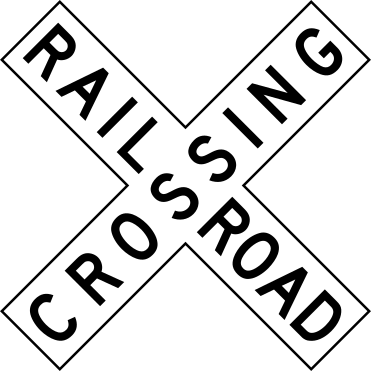
Railroad crossbuck 
Railroad crossing ahead 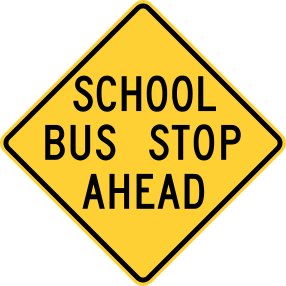
School bus stop ahead
3 questions from the Ohio practice test
1. How far from a railroad crossing should a driver stop when a train is approaching?
- No closer than 15 feet and no farther than 50 feet
- At least 100 feet away in every case
- Exactly 5 feet from the nearest rail
- Only after the front of the train reaches the crossing
Show answer
No closer than 15 feet and no farther than 50 feet. Ohio sets a stopping range for an approaching train: the vehicle must be at least 15 feet from the crossing and no more than 50 feet away. Stopping five feet from the rail is too close, and the manual does not require a universal 100-foot distance. Waiting until the train reaches the crossing delays the stop and may place the vehicle in danger. Watch for the warning signs and signals, stop within the stated range, and wait for the train and warnings to clear.
2. What is the Ohio rule for turning right at a red traffic signal?
- Turn only after the signal changes to yellow
- Turn without stopping when no car is visible
- Stop completely, yield to crossing traffic and pedestrians, then turn unless prohibited
- Turn from any lane if the road is one way
Show answer
Stop completely, yield to crossing traffic and pedestrians, then turn unless prohibited. A right turn on red is allowed unless a sign specifically prohibits it, but the driver must first make a complete stop. After stopping, the driver must let all crossing traffic and pedestrians clear the intersection. An empty-looking lane does not remove either requirement, making a turn without stopping unsafe. Yellow is not the required waiting signal, and a one-way road does not permit turning from any lane. At the intersection, stop behind the line or crosswalk, check for a prohibition sign, scan for people and traffic, then turn only after the path is clear.
3. What is required when a school bus is stopped on a road with fewer than four lanes and its red lights are flashing?
- Only traffic behind the bus must stop at least 5 feet away
- All traffic may proceed after slowing to 15 mph
- Oncoming traffic may pass if it uses the opposite shoulder
- Traffic approaching from either direction must stop at least 10 feet away
Show answer
Traffic approaching from either direction must stop at least 10 feet away. On a road with fewer than four lanes, Ohio requires traffic approaching a stopped school bus from either direction to stop at least 10 feet from the front or rear of the bus. The stop continues until the bus moves or the driver signals motorists to proceed. The rule is not satisfied by slowing, using a shoulder, or stopping only behind the bus. Count the lanes and remember the distance: fewer than four lanes means both directions stop, with a 10 foot buffer.
Practice this topic
Lock it in with emergencies questions from the free Ohio practice test. Every answer comes with a plain English explanation.
Source: the Ohio Driver Manual, Digest of Motor Vehicle Laws, Section 5: Learning to Drive. This lesson is a plain English summary, not the law itself; where it differs, the manual and the statute govern. Last checked 2026-09-27.