
Key points
Vehicles travel counterclockwise around a roundabout, and entering traffic yields to circulating traffic.
Source: Section 5
“Vehicles travel counterclockwise around a raised center island, with entering traffic yielding the right-of-way to circulating traffic.”
Ohio Driver Manual, Digest of Motor Vehicle Laws, Section 5You cannot change lanes once you are in the roundabout. Once inside, keep moving and do not stop.
Source: Section 5
“Once you have entered the roundabout, keep moving. Do not stop or change lanes.”
Ohio Driver Manual, Digest of Motor Vehicle Laws, Section 5Use the 1st exit to turn right, the 2nd to go straight, the 3rd to turn left and the 4th to make a U-turn.
Source: Section 5
“Use the 1st exit to turn right. Use the 2nd exit to go straight. Use the 3rd exit to turn left. Use the 4th exit to make a U-turn.”
Ohio Driver Manual, Digest of Motor Vehicle Laws, Section 5On a road with four or more lanes, drive in the right lane and use the lane just right of center to pass and turn left.
Source: Section 5
“When driving on a road with four or more lanes, drive in the right lane. Use the lane just right of center to pass and make left turns.”
Ohio Driver Manual, Digest of Motor Vehicle Laws, Section 5Park facing the direction of traffic on that side of the street, parallel to and no more than 12 inches from the right curb.
Source: Section 5
“Vehicles must be parked facing the direction of traffic on that side of the street, parallel to and not more than 12 inches from the right curb.”
Ohio Driver Manual, Digest of Motor Vehicle Laws, Section 5Do not park within 20 feet of an intersection or crosswalk.
Source: Section 5
“In or within 20 feet of an intersection or crosswalk;”
Ohio Driver Manual, Digest of Motor Vehicle Laws, Section 5Do not park within 10 feet of a fire hydrant or within one foot of another parked vehicle.
Source: Section 5
“Within 10 feet of a fire hydrant; Within one foot of another parked vehicle;”
Ohio Driver Manual, Digest of Motor Vehicle Laws, Section 5On a hill, turn the front wheels toward the curb side, shift to park, set the parking brake and turn off the engine.
Source: Section 5
“park your vehicle on a hill or graded surface, turn the front wheels toward the curb-side of the road to stabilize the vehicle, shift from “DRIVE” gear to “PARK” gear, set the parking brake, and turn the engine off.”
Ohio Driver Manual, Digest of Motor Vehicle Laws, Section 5
Numbers to know
| Number | What it means | Manual |
|---|---|---|
| 1st exit | turn right | Section 5 |
| 2nd exit | go straight | Section 5 |
| 3rd exit | turn left | Section 5 |
| 4th exit | U-turn | Section 5 |
| 12 inches | maximum distance from the curb | Section 5 |
| 20 feet | no parking distance from an intersection or crosswalk | Section 5 |
| 10 feet | no parking distance from a fire hydrant | Section 5 |
| 1 foot | minimum gap to another parked car | Section 5 |
Recognize these signs

Roundabout ahead 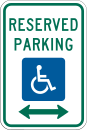
Disabled parking
3 questions from the Ohio practice test
1. In which direction must vehicles travel after entering an Ohio roundabout?
- Straight across the center island
- Clockwise around the center island
- Either direction based on the exit
- Counterclockwise around the center island
Show answer
Counterclockwise around the center island. Vehicles enter and circulate counterclockwise around a roundabout's raised center island. Clockwise travel moves against the manual's traffic pattern, and neither the selected exit nor the island permits a straight crossing. The direction stays the same for every exit. A helpful visual cue is to picture traffic flowing around the island with the island kept to the driver's left while circulating.
2. What should a driver do with lane position after entering an Ohio roundabout?
- Do not change lanes once inside
- Change lanes only at the center island
- Change lanes before every exit
- Stop and wait before changing lanes
Show answer
Do not change lanes once inside. The manual says a driver cannot change lanes once inside the roundabout. The safest preparation is choosing the appropriate lane before entry and then following the circulating path to the exit. Changing at every exit or at the center island ignores the restriction, while stopping to change creates a separate hazard. The cue is simple: lane choice before entry, steady movement inside.
3. In an Ohio roundabout, which exit do you normally use to turn left?
- The 1st exit
- The 3rd exit
- The 2nd exit
- The 4th exit
Show answer
The 3rd exit. Traffic in an Ohio roundabout moves counterclockwise, so the exits come up in a fixed order. The digest lays out the exit pattern drivers should expect: the 1st exit turns you right, the 2nd exit takes you straight, the 3rd exit turns you left, and the 4th exit makes a U turn. Knowing the count ahead of time lets you stay in the correct lane, signal before your exit, and avoid stopping inside the circle.
Practice this topic
Lock it in with signals and markings questions from the free Ohio practice test. Every answer comes with a plain English explanation.
Source: the Ohio Driver Manual, Digest of Motor Vehicle Laws, Section 5: Learning to Drive. This lesson is a plain English summary, not the law itself; where it differs, the manual and the statute govern. Last checked 2026-09-27.