
Test 10 of 25 · 20 questions · Free 2026
OH Permit Practice Test 10
Jump to the test ↓A fixed 20 question set from the Ohio bank with answers and plain English explanations. The real OH exam is 40 questions, 75 percent to pass; take the full length version on the main practice page.
Question 1 of 20 · 0 right so far
All 20 questions in test 10
Every question below comes from the Ohio question bank on this page. Open a question to see the correct answer and the explanation. Nothing here is hidden behind a signup.
1. What should a driver do with lane position after entering an Ohio roundabout?
- Do not change lanes once inside
- Change lanes only at the center island
- Change lanes before every exit
- Stop and wait before changing lanes
Show answer
Do not change lanes once inside. The manual says a driver cannot change lanes once inside the roundabout. The safest preparation is choosing the appropriate lane before entry and then following the circulating path to the exit. Changing at every exit or at the center island ignores the restriction, while stopping to change creates a separate hazard. The cue is simple: lane choice before entry, steady movement inside.
Study this in the handbook: Roundabouts, lane use and parking
2. A 25-year-old fails the Ohio driving test for the first time. What must they do before a second attempt?
- Complete an Abbreviated Adult Driver Training Course, unless they had approved driver education within the past year
- Wait 30 days and retest with no course
- Retake the knowledge test only
- Nothing; they may retest the same day
Show answer
Complete an Abbreviated Adult Driver Training Course, unless they had approved driver education within the past year. An Ohio applicant 21 or older who fails the maneuverability or road skills test must complete an Abbreviated Adult Driver Training Course before the second attempt, unless they took an approved driver education course within one year of testing. Course options pair a 4 hour class, in person or online, with either 4 hours of behind the wheel instruction or 24 hours of driving with a licensed driver 21 or older. A waiting period alone, a knowledge retest, or a same day retry does not satisfy the rule.
3. What must a driver do when entering a roundabout?
- Change lanes immediately after entering
- Enter clockwise because entering traffic has priority
- Stop in the circle before selecting an exit
- Yield to traffic already in the roundabout and travel counterclockwise
Show answer
Yield to traffic already in the roundabout and travel counterclockwise. Ohio’s roundabout instructions combine two essential actions: enter in a counterclockwise direction and yield to traffic already circulating. Entering vehicles do not take priority, and the driver should not stop in the circle after getting in. Lane changes are also prohibited once inside. Slow down on approach, scan for circulating traffic, choose the correct lane beforehand, and continue moving until the selected exit is reached. The strongest memory cue is yield before entry, counterclockwise inside.
Study this in the handbook: Right of way
4. Which situation is identified as an example of aggressive driving in Ohio?
- Following another vehicle too closely
- Checking mirrors before changing lanes
- Reducing speed for poor weather
- Leaving a normal space before a turn
Show answer
Following another vehicle too closely. Ohio lists following too closely as an example of aggressive driving because it intentionally creates danger for another road user. Leaving a normal gap is a protective habit, not an aggressive act. Mirror checks support a safe lane change, and slowing for poor weather responds to conditions rather than endangering others. When a driver is tempted to pressure traffic by closing the gap, the manual’s warning points to a better choice: leave room and avoid escalating the situation.
Study this in the handbook: Probationary license limits for drivers under 18
5. What minimum following distance does Ohio give for following a motorcyclist at low speed in ideal conditions?
- One second
- Two seconds
- Three seconds
- Six seconds
Show answer
Three seconds. Motorcycles can stop quickly and riders often shift position to avoid potholes, gravel, or pavement seams. Ohio says that when following a motorcyclist at low speeds in ideal conditions, keep at least a three second following distance. When anything is less than ideal, such as higher speeds, heavy traffic, poor visibility, bad weather, unfamiliar roads, or fatigue, increase it to four seconds or more. Give the rider a full lane width as well.
Study this in the handbook: Reasonable speed and the assured clear distance rule
6. If a tire blows out while driving, what braking response does Ohio recommend?
- Shift to park before slowing
- Brake as hard as possible immediately
- Pump the brake pedal while steering sharply
- Do not brake; slow down gradually
Show answer
Do not brake; slow down gradually. For a tire blowout, Ohio says to grip the wheel, keep the vehicle straight, avoid braking, and slow down gradually. Hard braking can make the vehicle harder to control, especially if the damaged tire is pulling or wobbling. The shift-to-park choice is unsafe while moving. The cue is a sudden pull, shake, or wobble. Hold the steering wheel firmly, let speed bleed off, and then pull off safely with hazard lights.
Study this in the handbook: Vehicle emergencies and crashes
7. What does a red traffic light require before you enter the intersection?
- Slow down, then continue if traffic appears light
- Stop after the crosswalk so pedestrians can see you
- Turn without stopping whenever the signal is red
- Stop before the intersection and wait behind the stop line or crosswalk until green
Show answer
Stop before the intersection and wait behind the stop line or crosswalk until green. A red light requires a complete stop before entering the intersection. Ohio identifies the stop line, crosswalk, or intersection as the place to wait, and the vehicle remains there until the signal turns green. Merely slowing is not enough, while stopping beyond the crosswalk blocks the pedestrian space. A red signal does not create a general turn-without-stopping exception. Remember the sequence: stop first, stay behind the marked boundary, then wait for green.
Study this in the handbook: Reasonable speed and the assured clear distance rule
8. What does a solid yellow line separate?
- Traffic traveling in opposite directions
- Traffic traveling in the same direction
- A parking lane from a bike rack
- A roundabout exit from its guide sign
Show answer
Traffic traveling in opposite directions. Ohio uses a solid yellow line to separate traffic moving in opposite directions. White lines separate traffic traveling the same way, so the same-direction answer confuses the two marking families. The remaining choices describe objects that are not the purpose of a centerline. When a solid yellow line is between opposing lanes, use it as a visual boundary, check the specific passing rule, and avoid drifting across it without a lawful reason and a clear path.
Study this in the handbook: Reasonable speed and the assured clear distance rule
9. What must a driver do when an officer is directing traffic at a non-working signal?
- Ignore the officer and use the normal signal cycle
- Wait for the signal to turn green before moving
- Follow the officer's directions
- Give priority to the widest roadway
Show answer
Follow the officer's directions. The four-way-stop treatment applies when no law enforcement officer is directing traffic. If an officer is present, the officer's directions control the movement through the intersection. Waiting for a green light may never resolve a power outage, and roadway width does not create an automatic priority. Reduce speed, watch the officer's signals, stop when directed, and proceed only when the path is released. Keep looking for other drivers who may misunderstand the failure.
Study this in the handbook: Vehicle emergencies and crashes
10. What average perception time does Ohio list for an alert driver?
- Five to 7 seconds
- Exactly 3 seconds
- Three quarters of a second to 1 second
- A full 10 seconds
Show answer
Three quarters of a second to 1 second. Ohio separates stopping distance into parts, including perception time. For an alert driver, average perception time is three quarters of a second to 1 second. The 3-second choice is too long for this specific factor and may be confused with following-distance guidance. A practical cue is the moment you first recognize trouble, such as brake lights ahead. That recognition time happens before your foot even starts moving toward the brake pedal.
Study this in the handbook: Scanning, following distance and space cushion
11. What does this sign require before entering the roadway?
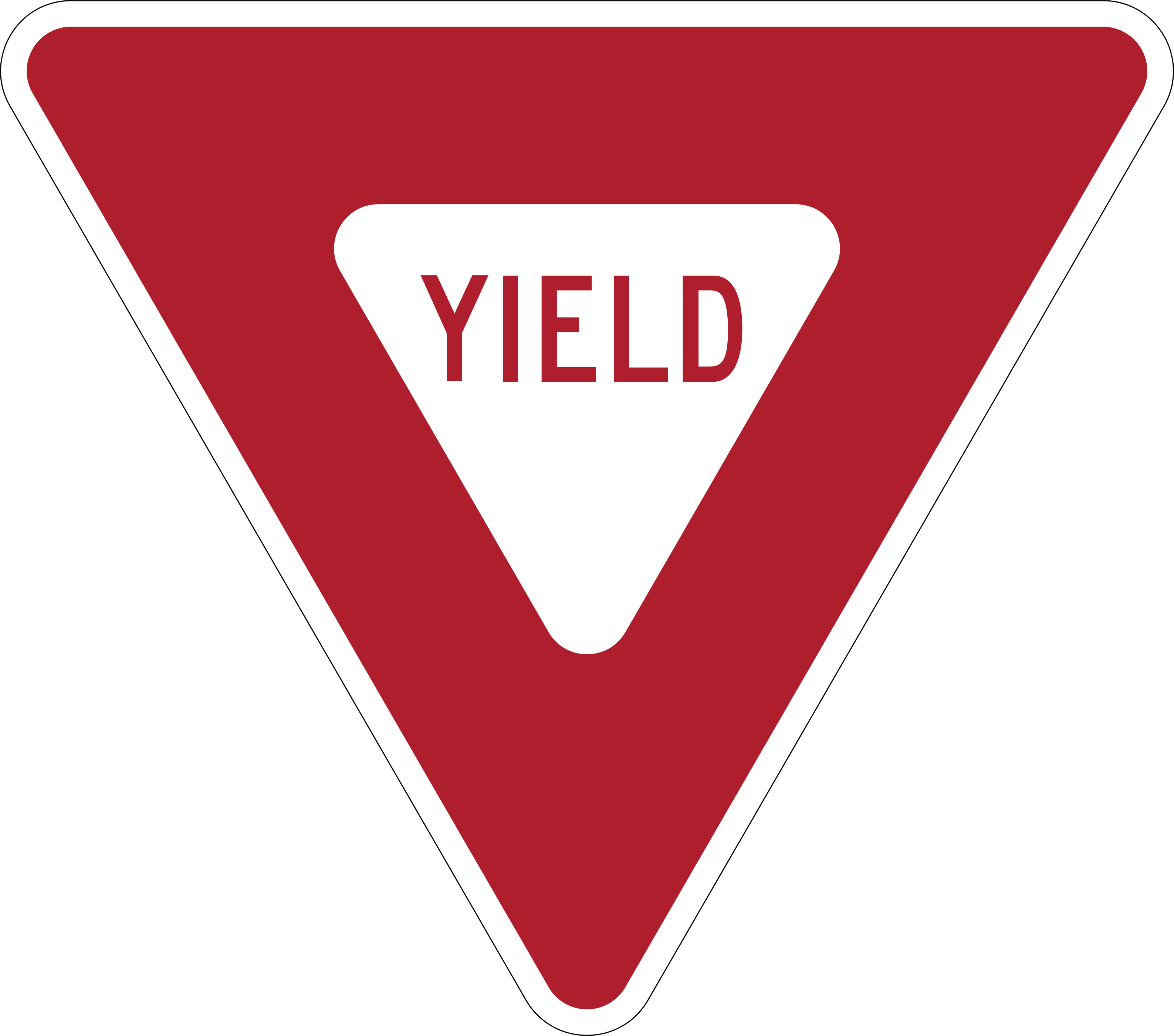
- Make a complete stop every time
- Proceed only after a police officer signals
- Enter without checking for pedestrians
- Slow and yield, stopping if needed
Show answer
Slow and yield, stopping if needed. A yield sign tells the driver to slow down and give priority to traffic and pedestrians, stopping when necessary. It does not require a complete stop in every circumstance, but entering without checking would defeat the yielding duty. A police officer is not required for the sign to apply. Treat the inverted triangle as a prompt to reduce speed, scan, and stop if another road user has priority.
Study this in the handbook: Reasonable speed and the assured clear distance rule
12. During the first 12 months of an Ohio probationary license, how many non-family passengers may the driver carry without a parent or guardian?
- Two
- One
- Three
- No limit
Show answer
One. During the first 12 months of holding a probationary Driver License, the driver may not operate a vehicle with more than one non-family member as a passenger unless a parent or guardian is along. One non-family passenger is therefore the most allowed. Two or three already exceed the limit, even if the vehicle has enough belts, and no limit ignores the rule. Family members are not counted, and a parent or guardian in the vehicle removes the restriction.
Study this in the handbook: Probationary license limits for drivers under 18
13. Besides police and emergency vehicles, which Ohio roadside vehicles are covered by the Move Over Law?
- Only ambulances
- Tow trucks, snowplows, waste collection, highway maintenance, and public utility vehicles with warning lights
- Only school buses with red lights
- Any parked passenger car, even without warning lights
Show answer
Tow trucks, snowplows, waste collection, highway maintenance, and public utility vehicles with warning lights. Ohio's Move Over Law covers road service vehicles such as tow trucks or snowplows, waste collection vehicles, highway maintenance vehicles, and public utility commission vehicles when their warning lights are activated. It is not limited to ambulances or school buses. A passenger car parked without warning lights does not fit the listed authorized-vehicle trigger. Identify the vehicle type and confirm the warning lights before applying the rule.
Study this in the handbook: Emergency vehicles, Move Over and sharing the road
14. What does the five-sided school sign warn drivers to expect?

- A hospital entrance where vehicles must stop
- A public park where children have no crossing priority
- An adult pedestrian crossing with no speed restriction
- A school zone or school crossing requiring extra caution
Show answer
A school zone or school crossing requiring extra caution. The school sign alerts you to a school zone or school crossing. Slow down, watch for children, and obey any slower school-zone limit when its conditions apply. A park, hospital, or generic adult crossing has a different purpose and does not define this five-sided warning. Ohio specifically says that when school-zone lights flash or children are present, drivers must obey a slower speed limit and follow crossing guards near a school. The practical cue is to expect unpredictable movement near the roadway and to be ready to stop promptly.
Study this in the handbook: Reasonable speed and the assured clear distance rule
15. What happens to an Ohio refusal suspension if the driver is later acquitted of the OVI charge?
- It is automatically canceled
- It still stands
- It changes to a 30-day suspension
- It waits until a second conviction
Show answer
It still stands. Ohio states that a refusal suspension remains in place even if the driver is ultimately acquitted of the OVI charge. Acquittal does not automatically cancel it, convert it to 30 days, or defer it until another conviction. This is an administrative consequence separate from the criminal case outcome. The cue is to keep the two tracks distinct: the court result may resolve the charge, while the refusal suspension still stands.
Study this in the handbook: OVI, BAC limits and chemical test refusal
16. What is the penalty for driving in Ohio while your license is suspended?
- A $50 fine
- A first-degree misdemeanor with a fine of up to $1,000 and a possible extra one-year suspension
- A warning for a first offense
- A felony with a mandatory five-year prison term
Show answer
A first-degree misdemeanor with a fine of up to $1,000 and a possible extra one-year suspension. Driving under suspension in Ohio is a first degree misdemeanor with a fine of up to $1,000, and the driver may also get an additional one year license suspension. A $50 fine and a warning understate the offense, and it is not described as a felony with a mandatory prison term. Vehicle owners who knowingly let someone with a suspended license drive may face the same penalty as the driver.
Study this in the handbook: Probationary license limits for drivers under 18
17. What term does Ohio use for operating a vehicle while impaired by alcohol or drugs?
- DUI, Driving Under the Influence
- DWI, Driving While Impaired
- OVI, Operating a Vehicle Impaired
- OUI, Operating Under Influence
Show answer
OVI, Operating a Vehicle Impaired. Ohio identifies the offense as OVI, meaning operating a vehicle while impaired. DUI, DWI, and OUI are not the terms the Ohio manual uses for this offense. The manual also notes that an administrative suspension will stand even if the person is ultimately acquitted of the OVI charge. When reading an Ohio citation, study guide, or warning, connect OVI with impairment from alcohol, drugs, or both, and keep it separate from OVUAC, the under 21 offense.
18. What driver education must an Ohio driver under 21 complete?
- 30 hours of classroom and 6 hours of driving
- 24 hours of classroom or online instruction and 8 hours of driving time
- 8 hours of classroom and 24 hours of driving
- 50 hours of classroom only
Show answer
24 hours of classroom or online instruction and 8 hours of driving time. An Ohio driver under 21 must complete driver education at a licensed school with 24 hours of classroom or online instruction and 8 hours of driving time. Thirty and 6 hours does not match Ohio's requirement. The reversed 8 and 24 split swaps the numbers. Fifty hours is the separate practice log, 10 at night, done with an eligible licensed driver, not classroom time. Drivers under 18 must also hold the TIPIC for at least six months.
Study this in the handbook: Knowledge test, TIPIC and driver education
19. What must a driver do at a flashing red traffic signal?
- Slow down but continue without stopping
- Stop only when a pedestrian is present
- Come to a complete stop and yield to traffic that does not have to stop
- Treat it as a flashing yellow signal
Show answer
Come to a complete stop and yield to traffic that does not have to stop. Ohio treats a flashing red signal as a stop condition. The driver must stop completely and yield to traffic that is not required to stop before entering the intersection. The choice about merely slowing down would leave the vehicle moving when a full stop is required. A useful road cue is to handle the signal like a stop sign, then check every direction before proceeding. The rule still applies when the intersection appears empty, because cross traffic may arrive while you are deciding whether to move.
Study this in the handbook: Right of way
20. Which shapes and colors may identify an Ohio guide sign?
- Square or rectangular, with green, brown, or blue colors
- Diamond-shaped, with yellow and black colors
- Triangular, with orange and white colors
- Circular, with red and white colors only
Show answer
Square or rectangular, with green, brown, or blue colors. Ohio guide signs may be square or rectangular, and their colors may be green, brown, or blue. These visual features help distinguish navigation information from other sign categories. A yellow diamond generally signals a warning, while red and white commonly appear on regulatory or prohibitory signs. An orange work-zone sign is also a different category, and the manual does not describe guide signs as triangular. When a sign helps locate a service or destination, its shape and color should fit the guide-sign group.
Study this in the handbook: Regulatory, warning, work zone and guide signs
QualitySpace is expanding to Ohio
We are a California-based independent insurance brokerage working on licensing in more states. We cannot help with Ohio insurance yet. Leave your email and we will let you know when we can.
Every question is written from the official Digest of Ohio Motor Vehicle Laws. Need paper? Printable OH practice test with answer key.
Last verified 2026-10-05. How we check every question · Study all 500 as flashcards
Frequently asked questions
How many questions are on this Ohio practice test?
This fixed set has 20 questions. It is test 10 of 25 from the 500 question Ohio bank. The real OH exam asks 40 questions and you need 30 correct.
What is the passing score for the real Ohio test?
Applicants must answer 75 percent of the questions correctly to pass That figure comes from the official Ohio source cited on the DMV facts page.
How does this fixed test relate to the full Ohio bank?
Each numbered test is a fixed set of questions in a fixed order, so you can retake the same test later and compare. Every test mixes road signs and the other topics in about the same proportion as the full bank. Tests 1 to 25 together cover every question in the Ohio bank once. The full practice page mixes the whole bank at random.
Last verified 2026-10-05. See the Ohio DMV facts page for sourced state details.