
Test 4 of 25 · 20 questions · Free 2026
OH Permit Practice Test 4
Jump to the test ↓A fixed 20 question set from the Ohio bank with answers and plain English explanations. The real OH exam is 40 questions, 75 percent to pass; take the full length version on the main practice page.
Question 1 of 20 · 0 right so far

All 20 questions in test 4
Every question below comes from the Ohio question bank on this page. Open a question to see the correct answer and the explanation. Nothing here is hidden behind a signup.
1. What does a round yellow sign with an X and the letters RR warn a driver about?
- A roundabout ahead
- A bicycle crossing
- A highway-railroad grade crossing
- A no-passing zone
Show answer
A highway-railroad grade crossing. The round yellow sign with an X and RR letters marks a highway-railroad grade crossing ahead. It is an advance warning, so the driver should reduce speed, look and listen, and be ready to stop if a train is approaching. A roundabout, bicycle crossing, and no-passing zone use different symbols or signs. The important cue is the combination of the round shape, railroad X, and RR lettering. Begin preparing before reaching the tracks rather than waiting until the crossing is directly in front of the vehicle.
Study this in the handbook: Right of way
2. From what distance must an Ohio vehicle's horn be audible under the equipment rules?
- 200 feet
- 50 feet
- 500 feet
- 1,000 feet
Show answer
200 feet. Ohio's equipment list requires a horn in good working order that other road users can actually hear. The standard is that it must be audible from 200 feet and recognizable as a motor vehicle horn. The same list uses other distances for other parts: brake lights and the taillight must be visible from 500 feet, rear reflectors and turn signals from 300 feet, and the license plate light from 50 feet. Mixing those numbers up is a common test mistake.
Study this in the handbook: Vehicle equipment, seat belts and child seats
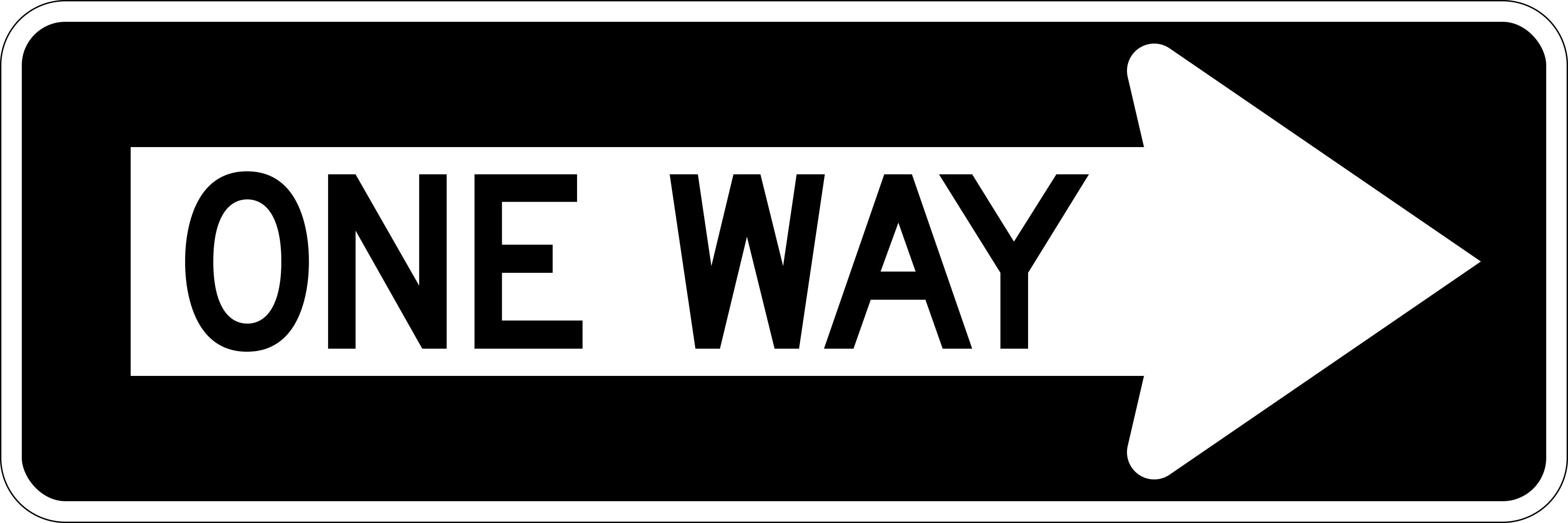
3. What roadway arrangement does this sign identify?
- A two-way road with a center turn lane
- A roadway reserved for buses only
- A road closed to all traffic
- A one-way road
Show answer
A one-way road. Ohio lists this sign as indicating a one-way road. That means traffic on the roadway is organized to travel in one direction, so a driver must watch the arrow and avoid entering against the flow. The sign does not identify a center turn lane, a full closure, or a bus-only facility. Before turning, read the arrow in relation to your intended movement and check for pedestrians, bicycles, and cross traffic. A one-way sign describes roadway direction; it does not by itself tell you where to park or how fast to drive.
Study this in the handbook: Reasonable speed and the assured clear distance rule
4. What is Ohio’s legal drinking age?
- 18 years
- 21 years
- 20 years
- 19 years
Show answer
21 years. Ohio identifies 21 years or older as the legal drinking age. The nearby underage driving rule also uses a .02% BAC threshold for people under 21, but that lower BAC figure does not change the age itself. Eighteen and nineteen are not Ohio’s drinking-age choices, and twenty is still below the stated boundary. The cue is the phrase legal drinking age: remember 21, then separately apply the under-21 driving threshold.
Study this in the handbook: Probationary license limits for drivers under 18
5. At an Ohio intersection, which road user still has priority while clearing the intersection?
- A parked vehicle with hazard lights
- A vehicle waiting on a side street to turn left
- A pedestrian, bicyclist, or driver still in the intersection
- Only a vehicle that arrived after you
Show answer
A pedestrian, bicyclist, or driver still in the intersection. Ohio's right-of-way list includes pedestrians, bicyclists, and other drivers who are still in the intersection. That priority continues even when another driver otherwise believes the signal or arrival order favors movement. A parked vehicle does not gain intersection priority, and a waiting side-street vehicle is not the listed category. Scan the intersection before proceeding and allow users already clearing it to finish.
Study this in the handbook: Reasonable speed and the assured clear distance rule
6. What does a green arrow traffic signal allow a driver to do?
- Turn in the arrow’s direction without stopping
- Turn in any direction after stopping
- Ignore pedestrians in the intersection
- Enter only after the light changes to yellow
Show answer
Turn in the arrow’s direction without stopping. A green arrow gives permission to turn in the direction shown without stopping, provided the movement can be made safely. The any-direction choice is wrong because the arrow limits the permitted turn to the indicated direction. Still scan the intersection before moving, especially for pedestrians or vehicles clearing late. The cue is the arrow shape inside the green signal face: follow that direction rather than treating it like a general circular green light.
Study this in the handbook: Reasonable speed and the assured clear distance rule
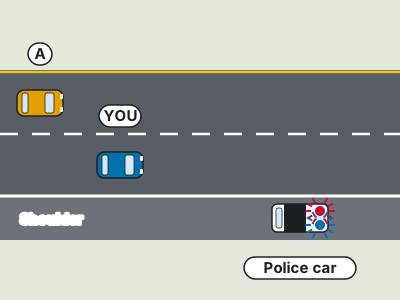
7. When approaching a stopped vehicle with warning lights activated, what should an Ohio driver do if a lane change is safe?
- Maintain speed because only police vehicles qualify
- Pass in the shoulder without reducing speed
- Stop in the lane beside the stopped vehicle
- Change into a lane that is not next to the stopped vehicle
Show answer
Change into a lane that is not next to the stopped vehicle. Ohio's Move Over guidance calls for a lane change away from an authorized roadside vehicle when traffic and safety conditions permit. The shoulder option is unsafe and is not the stated response. Stopping beside the vehicle leaves the driver exposed, while the police-only answer wrongly excludes service, maintenance, waste collection, and public utility vehicles. First identify the warning lights, check the adjacent lane, signal, and move over only when the maneuver can be completed safely.
Study this in the handbook: Reasonable speed and the assured clear distance rule
8. How should you treat an inoperable traffic light when approaching the intersection?
- Enter first because an inoperable signal gives priority
- Treat it like a green light if no car is visible
- Stop only if the signal has been dark for one minute
- Treat it like a stop sign, yield, and use caution
Show answer
Treat it like a stop sign, yield, and use caution. An inoperable signal removes the normal light guidance, so Ohio directs drivers to handle the location like a stop sign. The driver must yield the right of way and use caution while entering. A dark signal is not permission to continue as though it were green, and there is no waiting period that changes the rule. Entering first because the light is out ignores the duty to stop and yield. The practical habit is to stop, scan every approach, yield, and proceed only when the intersection is safe.
Study this in the handbook: Traffic signals and pavement markings
9. A 16-year-old Ohio driver is convicted of two moving violations. What happens to the probationary license?
- An automatic three-month suspension
- A warning letter only
- An automatic one-year suspension
- Nothing until age 18
Show answer
An automatic three-month suspension. For drivers under 18, Ohio automatically suspends the license for three months after a conviction or guilty plea to two moving violations. Three moving violations bring an automatic one year suspension, and a probationary OVI brings six months. A warning letter is the six point notice, not this teen penalty, and the BMV does not wait until 18. Reinstatement requires a TIPIC, a juvenile driver improvement program, and passing the driving exam.
Study this in the handbook: Probationary license limits for drivers under 18
10. An Ohio driver tests over the limit and has two prior OVI convictions within 10 years. How long is the suspension?
- 90 days
- One year
- Five years
- Two years
Show answer
Two years. For a test over the limit, Ohio's administrative suspension grows with prior OVI or drug convictions in the last 10 years: 90 days for a first test, one year with one prior, two years with two priors, and three years with three or more. With two priors, it is two years. Five years is the top refusal suspension, not a test failure suspension. Refusing a test generally brings longer suspensions than failing one.
Study this in the handbook: Probationary license limits for drivers under 18
11. Besides between sunset and sunrise, when must headlights be on in Ohio?
- Only on interstate highways
- When you cannot clearly see objects 1,000 feet ahead, in bad weather, or when wipers are in use for precipitation
- Only when it is fully dark
- Never during the day
Show answer
When you cannot clearly see objects 1,000 feet ahead, in bad weather, or when wipers are in use for precipitation. Ohio requires lights between sunset and sunrise, during rain, snow, fog, or other bad weather at any time of day, whenever natural light does not let you see objects clearly 1,000 feet ahead, and any time the windshield wipers are running because of precipitation. The rule is not limited to interstates or full darkness, and daytime use is required in the listed conditions. Lights help others see you as much as they help you see.
Study this in the handbook: Headlights, night driving and bad weather
12. What should a driver do when traffic volume makes the posted speed unsafe?
- Keep the posted speed because traffic volume cannot affect safe speed
- Choose a slower reasonable speed that maintains control and stopping ability
- Accelerate until the vehicle is ahead of the traffic queue
- Stop immediately in the travel lane whenever traffic increases
Show answer
Choose a slower reasonable speed that maintains control and stopping ability. The Ohio rule recognizes that high traffic volumes can make a slower speed reasonable. The driver should reduce speed enough to preserve control and enough stopping room, while continuing to respond to the traffic pattern. A posted number does not override the need to manage a crowded roadway. The choice saying traffic volume cannot matter conflicts with the manual’s listed conditions. Accelerating through a queue increases risk, and an immediate stop in a travel lane creates a new hazard unless stopping is otherwise required. Look for compressed gaps, frequent braking, and limited escape space as cues to ease off the accelerator.
Study this in the handbook: Reasonable speed and the assured clear distance rule
13. This yellow crossroad sign warns that what is ahead?

- An intersection ahead
- A hospital service exit
- A divided highway ending
- A left turn prohibition
Show answer
An intersection ahead. The plus-shaped yellow sign is a warning for an upcoming intersection. It does not tell drivers that services are available or that a maneuver is illegal. The left-turn prohibition choice would use a red slash, while this sign uses the warning color and shape. Treat it as advance notice to search left, right, and ahead, cover the brake if sight lines are poor, and expect crossing traffic or turning vehicles near the intersection.
Study this in the handbook: Reasonable speed and the assured clear distance rule
14. What steps does the Ohio digest list when you must park on a hill or grade?
- Point the wheels straight, leave it in drive, and set the parking brake
- Turn the wheels toward the street and leave the engine running
- Turn the front wheels toward the curb side, shift to park, set the parking brake, and turn off the engine
- Rely on the parking brake alone and skip the gear change
Show answer
Turn the front wheels toward the curb side, shift to park, set the parking brake, and turn off the engine. A vehicle parked on a slope can roll if a brake or gear slips. Ohio's steps work together to prevent that: turn the front wheels toward the curb side of the road so the tires catch the curb or edge, shift from drive to park, set the parking brake, and turn the engine off. Each step backs up the others. Pointing the wheels toward traffic or leaving the car in gear removes that protection and can send it downhill into the road.
Study this in the handbook: Right of way
15. What should a driver do before entering an Ohio intersection when traffic is backed up on the other side?
- Enter because the signal gives permission
- Move into the crosswalk to reserve a place
- Use the shoulder to bypass the queue
- Stop before the intersection until there is room beyond it
Show answer
Stop before the intersection until there is room beyond it. Ohio requires a driver to wait before entering an intersection when there is not enough space on the far side to accommodate the vehicle. The rule applies even when a traffic signal shows that movement could otherwise proceed. Entering and blocking the crossing area can trap pedestrians and cross traffic, while the shoulder and crosswalk are not overflow lanes. Pause before the intersection and wait for a clear space large enough for the entire vehicle.
Study this in the handbook: Right of way
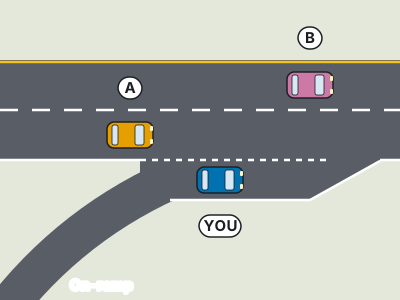
16. Who has priority when you enter a limited access or interstate highway from an entrance ramp?
- Only drivers exiting at the same ramp
- Drivers already on the limited access or interstate highway
- The ramp driver in every case
- Vehicles behind you on the entrance ramp
Show answer
Drivers already on the limited access or interstate highway. Traffic already on a limited access or interstate highway has priority over a driver entering from an entrance or acceleration ramp. The ramp-driver choice reverses the merge responsibility. Use the acceleration lane to build speed, signal, check mirrors and blind spots, and choose a gap without forcing traffic already on the highway to brake hard. The cue is the merge from ramp to mainline lanes: entering traffic must fit into the existing flow.
Study this in the handbook: Reasonable speed and the assured clear distance rule
17. How far before a turn must an Ohio driver activate a turn signal?
- At least 25 feet before the turn
- At least 100 feet before changing direction
- Only after beginning the turn
- At least 500 feet before every lane change
Show answer
At least 100 feet before changing direction. Ohio requires a turn signal at least 100 feet before changing direction. Signaling after the vehicle has started turning gives other road users too little time to react, while 25 feet is shorter than the stated distance. The manual does not require 500 feet for every lane change. Use the 100 foot cue for turns and other direction changes, then keep checking traffic and cancel the signal after the maneuver so it does not confuse following drivers.
Study this in the handbook: Vehicle equipment, seat belts and child seats
18. What does a bicycle crossing warning sign tell a driver to watch for?
- A route marker for a county road
- A lane where bicycles are prohibited
- A place where only bicycles may park
- Bicyclists crossing or entering the roadway ahead
Show answer
Bicyclists crossing or entering the roadway ahead. A bicycle crossing warning sign alerts drivers that bicyclists may cross or enter the roadway ahead. The prohibited-bicycles choice would be a regulatory message, usually tied to a red slash or posted rule, not a yellow warning sign. Look for the warning sign near paths, intersections, parks, or school areas. Reduce speed enough to search both sides of the road and leave room if a bicyclist appears near the crossing.
Study this in the handbook: Reasonable speed and the assured clear distance rule
19. After passing Ohio's vision and knowledge tests, how long do you have to buy a TIPIC?
- 10 days
- 30 days
- 60 days
- One year
Show answer
60 days. An Ohio applicant must visit a Deputy Registrar License Agency within 60 days of passing the vision screening and knowledge test to buy the Temporary Instruction Permit Identification Card. If the 60 days pass without buying it, the applicant must start over with both tests. Ten and 30 days are shorter than allowed, and one year is too long. An applicant under 18 needs a parent or guardian present to co-sign the TIPIC application.
Study this in the handbook: Knowledge test, TIPIC and driver education
20. How long must an Ohio driver under 18 hold a TIPIC before getting a license?
- At least 14 days
- At least 60 days
- At least six months
- At least one year
Show answer
At least six months. Ohio requires drivers under 18 to hold the TIPIC for at least six months before getting a license. Fourteen days is the holding period for temporary residents 21 or older. Sixty days is how long you have to buy the TIPIC after passing the tests. One year is longer than required. Teens must also complete driver education and log 50 hours of practice, including 10 at night.
Study this in the handbook: Knowledge test, TIPIC and driver education
QualitySpace is expanding to Ohio
We are a California-based independent insurance brokerage working on licensing in more states. We cannot help with Ohio insurance yet. Leave your email and we will let you know when we can.
Every question is written from the official Digest of Ohio Motor Vehicle Laws. Need paper? Printable OH practice test with answer key.
Last verified 2026-10-05. How we check every question · Study all 500 as flashcards
Frequently asked questions
How many questions are on this Ohio practice test?
This fixed set has 20 questions. It is test 4 of 25 from the 500 question Ohio bank. The real OH exam asks 40 questions and you need 30 correct.
What is the passing score for the real Ohio test?
Applicants must answer 75 percent of the questions correctly to pass That figure comes from the official Ohio source cited on the DMV facts page.
How does this fixed test relate to the full Ohio bank?
Each numbered test is a fixed set of questions in a fixed order, so you can retake the same test later and compare. Every test mixes road signs and the other topics in about the same proportion as the full bank. Tests 1 to 25 together cover every question in the Ohio bank once. The full practice page mixes the whole bank at random.
Last verified 2026-10-05. See the Ohio DMV facts page for sourced state details.