
Test 15 of 25 · 20 questions · Free 2026
OH Permit Practice Test 15
Jump to the test ↓A fixed 20 question set from the Ohio bank with answers and plain English explanations. The real OH exam is 40 questions, 75 percent to pass; take the full length version on the main practice page.
Question 1 of 20 · 0 right so far
All 20 questions in test 15
Every question below comes from the Ohio question bank on this page. Open a question to see the correct answer and the explanation. Nothing here is hidden behind a signup.
1. According to the Ohio manual’s equipment list for an average motor vehicle, how many front-seat belts should it have at a minimum?
- At least two seat belts in the front seat
- One belt shared by both front occupants
- Belts only where air bags are absent
- Four belts across the front bench
Show answer
At least two seat belts in the front seat. The manual’s vehicle-equipment list requires at least two seat belts in the front seat. It also says safety belts should be worn even if the vehicle has air bags. Consider "One belt shared by both front occupants": One belt does not meet the stated minimum of two front-seat belts. Consider "Belts only where air bags are absent": Belts pair with air bags, not replace them.
Study this in the handbook: Vehicle equipment, seat belts and child seats
2. Who must you yield to when entering a public highway from a private road or driveway?
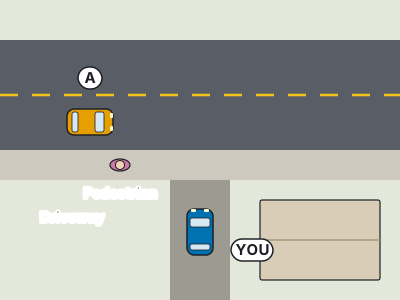
- Only vehicles turning left from the highway
- Drivers already using the public highway
- The last vehicle that entered the driveway
- No one if your vehicle is moving slowly
Show answer
Drivers already using the public highway. Ohio treats traffic already on the public highway as having priority when another driver enters from a driveway or private road. A driver leaving private property must wait for a safe opening before joining traffic. The choice about only left turning vehicles is too narrow because the rule covers drivers on the highway generally, not just one movement. A useful cue is the change from private property to public travel lanes: pause, scan both directions, and enter only when highway traffic has room.
Study this in the handbook: Right of way
3. What is hydroplaning under Ohio guidance?
- Brakes overheating on long hills
- Power steering failure in rain
- Ice forming under the tires
- Steering tires riding on top of pooled water, like water skis
Show answer
Steering tires riding on top of pooled water, like water skis. Hydroplaning occurs when the steering tires start to ride on top of pooled water, similar to the action of water skis. Consider "Brakes overheating on long hills": Hydroplaning is tires riding on pooled water, not brake overheating. Consider "Power steering failure in rain": Hydroplaning is tires riding on pooled water, not power-steering failure. Consider "Ice forming under the tires": The manual defines hydroplaning in terms of pooled water, not ice formation.
Study this in the handbook: Reasonable speed and the assured clear distance rule
4. What label and design must an Ohio child safety seat have?
- A state inspection sticker only
- A label showing it meets federal safety standards, designed to meet the needs of your particular vehicle
- Any label from another country
- No label if the seat looks new
Show answer
A label showing it meets federal safety standards, designed to meet the needs of your particular vehicle. The child seat must be labeled as meeting federal safety standards and be designed to meet the needs of your particular motor vehicle. Consider "A state inspection sticker only": Stickers alone miss federal proof. Consider "Any label from another country": The manual requires a label showing compliance with federal safety standards; any foreign label alone does not establish that. Consider "No label if the seat looks new": Appearance cannot replace certification.
Study this in the handbook: Probationary license limits for drivers under 18
5. What minimum tread depth must Ohio tires have on the road surface to be in safe condition?
- 1/16-inch tread depth
- 1/8-inch tread depth
- 1/4-inch tread depth
- 1/32-inch tread depth
Show answer
1/16-inch tread depth. A tire in safe condition has at least 1/16-inch tread depth on the road surface and is free of major bumps, bulges, breaks, or tread damage. A U.S. penny can be used to check tread depth; if all of Lincoln's head is visible in the deepest groove, the manual says not to drive on the tires and to replace them.
Study this in the handbook: Vehicle equipment, seat belts and child seats
6. How much practice driving must an Ohio driver under age 21 log with an eligible licensed driver?
- 30 hours, with at least 5 hours at night
- 40 hours, with no required night portion
- 50 hours, with at least 10 hours of night driving
- 60 hours, with at least 20 hours of night driving
Show answer
50 hours, with at least 10 hours of night driving. A driver under age 21 must complete and log 50 hours of driving with an eligible licensed driver, including at least 10 hours of night driving. Consider "30 hours, with at least 5 hours at night": Thirty hours fall short of the 50 hour total. Consider "40 hours, with no required night portion": Forty hours miss the total and the night portion. Consider "60 hours, with at least 20 hours of night driving": Sixty hours exceed the stated minimum requirement.
Study this in the handbook: Knowledge test, TIPIC and driver education
7. Which description gives the Ohio manual’s full age-or-weight criteria for requiring a child safety seat in a passenger vehicle to which the child-restraint law applies?
- Children under age 2, regardless of weight
- Infants and children who are either or both under age 4 and weighing less than 40 pounds
- Children under age 6 who ride in front
- Any child shorter than 4 feet
Show answer
Infants and children who are either or both under age 4 and weighing less than 40 pounds. Children who are under age 4 or weigh less than 40 pounds, or both, must be properly restrained in a child safety seat. The seat must be labeled as meeting federal safety standards and designed for the vehicle. The manual lists exemptions for public safety vehicles, taxicabs, and vehicles not required to have safety belts when manufactured. Consider "Children under age 2, regardless of weight": The manual specifies under age 4 or weighing less than 40 pounds, or both.
Study this in the handbook: Probationary license limits for drivers under 18
8. How do you start the engine under Ohio guidance?
- Press the accelerator halfway, then turn the key
- Start the engine with your foot on the accelerator
- Shift to drive first, then start the engine
- Place your right foot on the brake pedal and check the gear selector for park, then turn the key or push Start
Show answer
Place your right foot on the brake pedal and check the gear selector for park, then turn the key or push Start. To start the engine, place your right foot on the brake pedal and check that the gear selector is in park. Insert and turn the key, or push the Start button. Check the vehicle owner’s manual for starting instructions. Consider "Press the accelerator halfway, then turn the key": The manual says to place the right foot on the brake pedal before starting. Consider "Shift to drive first, then start the engine": The manual says to check that the gear selector is in park before starting.
Study this in the handbook: Right of way
9. A driver under 18 in Ohio finishes a probationary suspension. Which reinstatement steps apply before driving again?
- Pay a fee and wait for automatic restoration
- Complete 50 new practice hours with a parent
- Obtaining a TIPIC, completing an approved juvenile driver improvement program, and passing the driving examination
- Retake only the knowledge test online
Show answer
Obtaining a TIPIC, completing an approved juvenile driver improvement program, and passing the driving examination. After serving a probationary suspension, a driver must satisfy reinstatement requirements, including obtaining a TIPIC, completing an approved juvenile driver improvement program, and passing the driving examination. Paying a fee or taking only a knowledge test does not replace these listed steps. Consider "Pay a fee and wait for automatic restoration": Restoration is not automatic after payment and waiting alone. Consider "Complete 50 new practice hours with a parent": Fifty new practice hours are not a substitute for the reinstatement steps listed in Section 6.
Study this in the handbook: Probationary license limits for drivers under 18
10. A sign shows a red circle with a slash over a pictured action. What does that symbol mean in Ohio?
- The illustrated action is prohibited
- The action is allowed with caution
- The action is required at all times
- The sign only guides tourists
Show answer
The illustrated action is prohibited. The red circle with a slash represents the word “NO.” Whenever this symbol appears on a sign, the illustrated action is prohibited. Consider "The action is allowed with caution": Caution understates a ban. Consider "The action is required at all times": A command reverses the meaning. Consider "The sign only guides tourists": Tourist guidance uses guide signs. The matching option reads, "The illustrated action is prohibited."
Study this in the handbook: Reasonable speed and the assured clear distance rule
11. What sworn promise does Ohio require at registration or licensing about insurance?
- That the vehicle will never leave the county
- That premiums will be paid weekly
- That passengers will carry their own policies
- That you will not operate a motor vehicle without liability insurance or other financial responsibility in effect
Show answer
That you will not operate a motor vehicle without liability insurance or other financial responsibility in effect. When you register a vehicle in Ohio or apply for a new, renewal, or duplicate Driver License, you sign a sworn statement that you will not operate a motor vehicle without liability insurance or another form of financial responsibility in effect. Consider "That the vehicle will never leave the county": County limits were never sworn. Consider "That premiums will be paid weekly": Billing cadence is not sworn.
Study this in the handbook: Probationary license limits for drivers under 18
12. Your vehicle starts accelerating out of control in Ohio. Which sequence does the guidance set out first?
- Shift to PARK while still rolling fast
- Turn off the ignition and remove the key
- Pump the brakes until the pedal feels hard
- Turn on emergency flashers, shift to NEUTRAL, and search for an escape route
Show answer
Turn on emergency flashers, shift to NEUTRAL, and search for an escape route. For a stuck accelerator, turn on emergency flashers, shift to NEUTRAL, and search for an escape route. Steer smoothly, brake gradually, and pull off the roadway. Then shift to PARK and turn off the engine. Consider "Shift to PARK while still rolling fast": The manual puts shifting to PARK after pulling off the roadway. Consider "Turn off the ignition and remove the key": The manual puts turning off the engine after pulling off the roadway and shifting to PARK.
Study this in the handbook: Vehicle emergencies and crashes
13. How should a driver enter an Ohio freeway from an entrance ramp?
- Stop at the end of the ramp and wait for an empty lane
- Enter at 35 mph and let traffic adjust
- Signal and use the acceleration lane to reach the speed of other vehicles, then merge
- Merge first, then check mirrors for a gap
Show answer
Signal and use the acceleration lane to reach the speed of other vehicles, then merge. When entering a freeway, look over your shoulder in the direction you are merging and use outside mirrors to identify a gap. Signal and use the acceleration lane to reach the speed of other vehicles and merge with the traffic flow. Cancel your turn signal. Consider "Stop at the end of the ramp and wait for an empty lane": Use the acceleration lane to reach the speed of other vehicles before merging.
Study this in the handbook: Right of way
14. Which Ohio road spots ice over first in winter driving?
- Sunny straight stretches
- Dry gravel shoulders
- Freshly salted city corners
- Bridges, overpasses, and shaded spots on a highway
Show answer
Bridges, overpasses, and shaded spots on a highway. Bridges, overpasses, and shaded spots on a highway ice first. In winter, drive at a slower speed and leave more distance between vehicles because slippery roads increase stopping distance. Consider "Sunny straight stretches": Sunny stretches are not named spots. Consider "Dry gravel shoulders": The manual names bridges, overpasses, and shaded highway spots as the places that ice first. Consider "Freshly salted city corners": Salted corners are not named spots.
Study this in the handbook: Headlights, night driving and bad weather
15. With solid double yellow lines, when may an Ohio driver cross the centerline?
- To pass any vehicle traveling below the limit
- To reach a parking space on the far side
- Only to turn left into driveways or pass a slow-moving vehicle when safe to do so
- Whenever oncoming traffic is more than 200 feet away
Show answer
Only to turn left into driveways or pass a slow-moving vehicle when safe to do so. With solid double yellow lines, crossing the centerline is permitted only to turn left into driveways or pass a slow-moving vehicle, such as a bicycle or a vehicle displaying a slow-moving vehicle sign, when safe to do so. Consider "To pass any vehicle traveling below the limit": The manual’s exception is for a slow-moving vehicle when safe, not for passing any vehicle merely because it is below the limit.
Study this in the handbook: Right of way
16. What can an Ohio OVUAC offense for a driver under age 21 produce?
- A verbal warning and a parent phone call
- A license suspension of three months to two years, plus a remedial driving course, reinstatement fees, and retaking the Driver License examination
- A fine only, with no license action
- Community service with no other requirement
Show answer
A license suspension of three months to two years, plus a remedial driving course, reinstatement fees, and retaking the Driver License examination. An OVUAC can result in a license suspension of three months to two years, a remedial driving course, reinstatement fees, and retaking the Driver License examination. The driver may also have to serve jail time. Consider "A verbal warning and a parent phone call": The manual lists possible license suspension and other requirements, not merely a warning. Consider "A fine only, with no license action": License suspension sits at the center here.
Study this in the handbook: Probationary license limits for drivers under 18
17. Besides an insurance policy or a personal liability bond, how may an Ohio driver meet minimum liability requirements?
- Deposit $30,000 with the Registrar and provide proof of no unsatisfied judgements
- Deposit $5,000 with the county clerk
- Show a credit card with a $25,000 limit
- Register two vehicles under one policy
Show answer
Deposit $30,000 with the Registrar and provide proof of no unsatisfied judgements. Besides maintaining an insurance policy or posting a personal liability bond at the required amounts, a person may deposit $30,000 with the Registrar and provide proof of no unsatisfied judgements. Consider "Deposit $5,000 with the county clerk": The amount and the office are both wrong there. Consider "Show a credit card with a $25,000 limit": A credit limit is not financial responsibility. Consider "Register two vehicles under one policy": A second vehicle proves nothing about coverage.
Study this in the handbook: Probationary license limits for drivers under 18
18. How far can the blind spot directly behind a large truck or bus extend in Ohio guidance?
- Up to 20 feet behind the vehicle
- Up to 200 feet behind the vehicle
- No blind spot exists behind trucks
- Exactly one car length behind the bumper
Show answer
Up to 200 feet behind the vehicle. Large vehicles have blind spots directly behind them that extend up to 200 feet. Avoid following too closely: the large-vehicle driver may not see your vehicle, and you may not see what is ahead. Position your vehicle so the driver can see you in the side-view mirrors. Consider "Up to 20 feet behind the vehicle": The stated maximum is 200 feet, not 20 feet.
Study this in the handbook: Reasonable speed and the assured clear distance rule
19. The traffic light turns green at an Ohio intersection. How may a driver proceed?
- Travel with caution through the intersection if it is clear to do so
- Enter at once because cross traffic must always stop
- Turn in any direction without yielding
- Stop again in the middle of the intersection
Show answer
Travel with caution through the intersection if it is clear to do so. A green light means you may proceed cautiously through the intersection if it is clear. Pause before entering and do not rely on others to obey signals. When turning left, yield to oncoming traffic; when turning, yield to pedestrians. Do not enter if traffic prevents you from clearing the intersection. Consider "Enter at once because cross traffic must always stop": Green does not guarantee the crossing is empty or that others stopped.
Study this in the handbook: Reasonable speed and the assured clear distance rule
20. Where does Ohio prohibit attempting to pass another vehicle?
- On any road with a speed limit over 45 mph
- Only on roads with three or more lanes
- Just before a highway-railroad crossing or bridge
- Whenever the vehicle ahead is a truck
Show answer
Just before a highway-railroad crossing or bridge. Do not attempt to pass at intersections or before a highway-railroad crossing or bridge. The manual also prohibits attempting to pass when an oncoming vehicle is approaching or a curve or hill blocks the view. Consider "On any road with a speed limit over 45 mph": A higher limit alone does not bar passing. Consider "Only on roads with three or more lanes": Multi-lane roads can allow passing.
Study this in the handbook: Right of way
QualitySpace is expanding to Ohio
We are a California-based independent insurance brokerage working on licensing in more states. We cannot help with Ohio insurance yet. Leave your email and we will let you know when we can.
Every question is written from the official Digest of Ohio Motor Vehicle Laws. Need paper? Printable OH practice test with answer key.
Last verified 2026-10-05. How we check every question · Study all 500 as flashcards
Frequently asked questions
How many questions are on this Ohio practice test?
This fixed set has 20 questions. It is test 15 of 25 from the 500 question Ohio bank. The real OH exam asks 40 questions and you need 30 correct.
What is the passing score for the real Ohio test?
Applicants must answer 75 percent of the questions correctly to pass That figure comes from the official Ohio source cited on the DMV facts page.
How does this fixed test relate to the full Ohio bank?
Each numbered test is a fixed set of questions in a fixed order, so you can retake the same test later and compare. Every test mixes road signs and the other topics in about the same proportion as the full bank. Tests 1 to 25 together cover every question in the Ohio bank once. The full practice page mixes the whole bank at random.
Last verified 2026-10-05. See the Ohio DMV facts page for sourced state details.