
Test 7 of 25 · 20 questions · Free 2026
OH Permit Practice Test 7
Jump to the test ↓A fixed 20 question set from the Ohio bank with answers and plain English explanations. The real OH exam is 40 questions, 75 percent to pass; take the full length version on the main practice page.
Question 1 of 20 · 0 right so far
All 20 questions in test 7
Every question below comes from the Ohio question bank on this page. Open a question to see the correct answer and the explanation. Nothing here is hidden behind a signup.
1. During the first 12 months of an Ohio probationary license, when may a driver operate between midnight and 6 a.m.?
- When accompanied by a parent or guardian
- When accompanied by any licensed friend age 18 or older
- When a sibling with a permit sits in front
- When the driver promises to return before 6 a.m.
Show answer
When accompanied by a parent or guardian. For the first 12 months of holding a Driver License, an Ohio driver under 18 may not operate from midnight to 6 a.m. unless an exception applies. A parent or guardian accompanying the driver is one listed exception. The manual also names documented trips to or from work, official school-sponsored events, and religious events. An ordinary friend, a sibling with a permit, or a personal promise does not meet the stated conditions. Check both the clock and the qualifying person or documentation before beginning a restricted-hours trip.
Study this in the handbook: Probationary license limits for drivers under 18
2. How much space should be between a properly adjusted driver's chest and the steering wheel?
- Exactly 6 inches
- At least 4 inches
- At least 10 inches
- No more than 2 inches
Show answer
At least 10 inches. The Ohio manual recommends at least 10 inches between the driver's chest and the steering wheel. That space supports appropriate airbag deployment while still allowing full control of the pedals and wheel. The smaller distances in the other choices leave less room for the restraint system to work as intended, and an exact six inch setting is not the manual's measurement. Adjust the seat before driving, then confirm that your view, reach, and foot movement remain comfortable without moving your body close to the wheel.
Study this in the handbook: Vehicle equipment, seat belts and child seats
3. When the broken yellow line is in your lane and the solid yellow line is in the other lane, what may you do?
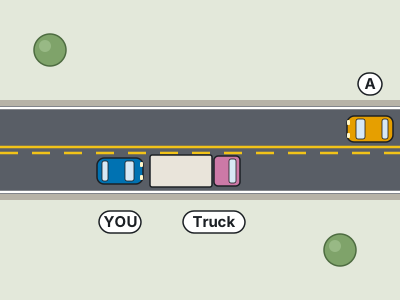
- Pass only after stopping completely in your lane
- Never pass under any condition
- Pass when it is safe to do so
- Drive on the painted line until the next intersection
Show answer
Pass when it is safe to do so. A yellow solid line beside a broken line assigns the passing permission to the motorists traveling beside the broken line. If that broken line is in your lane, you may pass when the movement is safe. The solid-line driver is prohibited from passing, but that restriction does not transfer to your lane. Stopping is not the marking’s requirement, and driving on the paint is not a passing method. Identify your side of the pair before deciding.
Study this in the handbook: Reasonable speed and the assured clear distance rule
4. In a work zone, what must a driver do when a flagger uses a sign to direct traffic?
- Stop only when a police officer is present
- Obey only the painted lane lines
- Proceed if no worker is in the lane
- Follow the flagger’s instructions
Show answer
Follow the flagger’s instructions. Ohio work zones may use a person with a sign or flag to control traffic, and drivers must follow that person’s directions. The painted-lane choice is incomplete because temporary work zone control can override the usual lane pattern. Watch for orange signs, cones, barrels, and workers near the roadway. If a flagger directs you to slow, stop, or shift lanes, treat that instruction as the active traffic control for the work area.
Study this in the handbook: Reasonable speed and the assured clear distance rule
5. How close to a fire hydrant may you stop, park, or stand in Ohio?
- No closer than 5 feet
- No closer than 15 feet
- No closer than 20 feet
- No closer than 10 feet
Show answer
No closer than 10 feet. Ohio prohibits stopping, parking, or standing within 10 feet of a fire hydrant. Fifteen feet is a common guess, but Ohio's list says 10. Twenty feet is the distance from an intersection or crosswalk. Five feet is too close. The same list bars parking within one foot of another parked vehicle, on a sidewalk, and in front of a driveway.
Study this in the handbook: Right of way
6. How many questions are on the Ohio knowledge test, and what score is needed to pass?
- 20 questions, with 70% needed
- 40 multiple choice questions, with 75% needed to pass
- 25 questions, with 80% needed
- 50 questions, with 90% needed
Show answer
40 multiple choice questions, with 75% needed to pass. Ohio's knowledge test has 40 multiple choice questions, and applicants need 75 percent to pass, which means at least 30 correct. The 20 and 25 question versions do not match Ohio's test, and 70 or 80 percent are not its passing mark. Fifty questions with 90 percent is far stricter than the real standard. The test is offered in several languages, including ASL, Arabic, Chinese, French, Japanese, Russian, Somali, and Spanish.
Study this in the handbook: Knowledge test, TIPIC and driver education
7. The other driver in your Ohio crash had no insurance and damage was over $400. How long do you have to file a Crash Report with the BMV?
- Within 24 hours
- Within 10 days
- Within two years
- Within six months after the crash
Show answer
Within six months after the crash. An Ohio driver may file a Crash Report, form BMV 3303, with the BMV within six months after a crash when there was more than $400 in damage or a personal injury, and the other driver or owner had no insurance or other financial responsibility at the time. Twenty four hours and 10 days are much shorter than allowed, and two years is longer. Notify your insurance company as soon as possible, and report a crash with an unattended vehicle to police or leave your information.
Study this in the handbook: Vehicle emergencies and crashes
8. A 17-year-old Ohio driver is cited for the first time for using a phone while driving. What is the penalty?
- 2 points only
- A $50 fine only
- A 60-day suspension and a $150 fine
- A one-year suspension and a $300 fine
Show answer
A 60-day suspension and a $150 fine. Drivers under 18 in Ohio may not use any electronic device while driving, even hands free, and the first violation brings a 60 day suspension and a $150 fine. The second violation brings a one year suspension and a $300 fine. Two points only is closer to the adult first offense, and $50 is not the stated fine. It is a primary offense, meaning it can be the main reason for a traffic stop. Navigation use and emergency calls are the exceptions.
Study this in the handbook: Probationary license limits for drivers under 18
9. You are pulled over in Ohio and have a weapon in the vehicle. When should you tell the officer?
- Only if the officer asks
- Upon first contact with the officer
- After you hand over your license and registration
- Never, since it is not the officer's business
Show answer
Upon first contact with the officer. Ohio's traffic stop steps aim to keep everyone calm and safe. Pull over to the right when safe, shift to park, turn off the ignition, lower the window, and stay in the vehicle with your safety belt on and hands on the wheel. If you have a weapon in the vehicle, tell the officer upon first contact. Then follow directions and present your license, registration, and insurance when asked.
Study this in the handbook: Headlights, night driving and bad weather
10. What do Ohio warning signs tell a driver?

- That every upcoming road is one-way
- Possible danger that might be ahead
- That crossing a median is always permitted
- That passing is required immediately
Show answer
Possible danger that might be ahead. Ohio defines warning signs as advance notice of possible danger ahead. Their usual yellow color, black lettering or symbols, and diamond shape help distinguish them from other sign groups. The warning does not automatically make a road one-way, authorize a median crossing, or order a pass. Drivers should respond by scanning farther ahead, adjusting speed when needed, and following the specific symbol or wording. Treat a warning as time to prepare for a changing roadway condition, not as permission for a maneuver that the sign does not expressly show.
Study this in the handbook: Reasonable speed and the assured clear distance rule
11. What must an Ohio driver do when a vehicle becomes disabled on or near the roadway?
- Stand in the travel lane to direct traffic
- Leave the vehicle dark so the battery is preserved
- Turn on emergency flashers and warn other roadway users
- Remove all warning devices immediately
Show answer
Turn on emergency flashers and warn other roadway users. For a disabled vehicle, Ohio's emergency guidance says to turn on the emergency flashers and try to warn other roadway users that the vehicle is present. If possible, flares may be placed 200 to 300 feet behind it to give approaching drivers time to change lanes. Standing in the travel lane adds personal danger, and leaving the vehicle unmarked removes useful warning. Make the vehicle visible, and as the manual advises, stay in your vehicle until help arrives.
12. What do Ohio prohibitory signs tell the viewer?
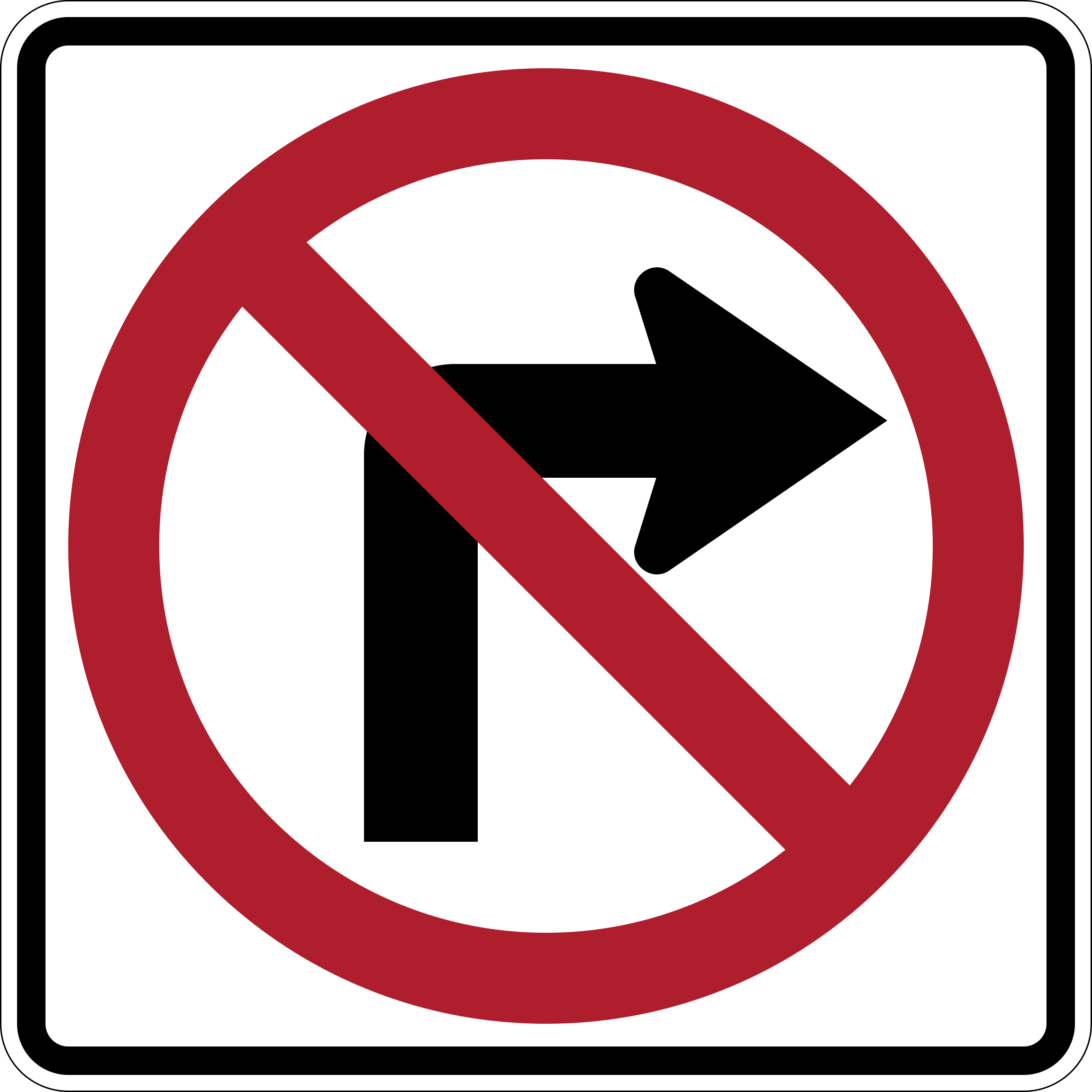
- That a hazard may be ahead
- That an action is prohibited
- That services are available nearby
- That the roadway is a numbered route
Show answer
That an action is prohibited. Ohio uses prohibitory signs to tell the viewer that an action is prohibited. The red circle and slash identify the restriction, while the pictured symbol shows which movement or activity is barred. A warning sign communicates possible danger, guide signs identify services, and route signs identify road classifications or numbers. Look first for the red circle and slash, then read the symbol rather than treating the sign as a general order to stop. This sign category helps distinguish a banned movement from an upcoming hazard or a destination clue. The image supplies the action that the prohibition applies to.
Study this in the handbook: Regulatory, warning, work zone and guide signs
13. What does a yellow traffic light indicate in Ohio?
- The driver has an unlimited right to continue
- The color is about to change to red, so use caution and prepare to stop
- The driver must accelerate through the intersection
- The signal is the same as a green arrow
Show answer
The color is about to change to red, so use caution and prepare to stop. A yellow traffic light indicates that the color is about to change to red. Ohio tells the driver to use caution and prepare to stop, not to accelerate or assume an unlimited right to continue. A green arrow has a different meaning and permits a turn in its displayed direction without stopping. As the signal changes, check the stop line, traffic, and pedestrians, then stop safely when there is enough distance to do so.
Study this in the handbook: Traffic signals and pavement markings
14. What is prohibited in Ohio for most drivers using a cell phone while driving?
- Holding or physically supporting the phone
- Calling emergency services
- Using an amateur radio
- Using a hands-free navigation prompt
Show answer
Holding or physically supporting the phone. For drivers 18 and older, Ohio says it is illegal in most cases to use, hold, or physically support a cell phone or other wireless device while driving. Hands-free calls and other device features are allowed as long as the driver does not hold or support the device or manually enter letters, numbers, or symbols, so a hands-free navigation prompt is not the banned conduct. Reporting an emergency and using an amateur radio as a licensed operator are listed exceptions. Holding the phone is the prohibited act.
Study this in the handbook: Probationary license limits for drivers under 18
15. What is the Ohio minimum tread depth for a tire to be considered safe?
- 1/32 inch
- 1/8 inch
- 1/4 inch
- 1/16 inch
Show answer
1/16 inch. The Ohio manual says a tire in safe condition has at least 1/16 inch of tread depth on the road surface and no major bumps, bulges, breaks, or tread damage. The smaller 1/32-inch figure is below the manual's stated minimum, while the larger measurements are not the threshold given here. A practical check uses a penny in the deepest groove: if all of Lincoln's head is visible, the tire is too worn and should be replaced.
Study this in the handbook: Vehicle equipment, seat belts and child seats
16. Which activity is specifically allowed as an exception to Ohio’s hands-free restriction?
- Reporting an emergency
- Scrolling through social media while driving
- Typing a destination while moving
- Watching a video on the phone while driving
Show answer
Reporting an emergency. Ohio's hands-free law for drivers 18 and older lists reporting an emergency to law enforcement, a hospital, a health care provider, a fire department, or a similar emergency entity as an express exception. Scrolling social media and watching a video are ordinary device use, not emergency reporting, and the law does not let a driver hold or support the device for them. Typing a destination while moving means manually entering letters or symbols, which the law does not allow. The cue is genuine emergency reporting, not convenience or entertainment.
Study this in the handbook: Phone laws, insurance and license points
17. When turning onto a road, what should a driver confirm before proceeding?
- Only that the turn signal is working
- That the road has a posted speed limit
- The path of travel is clear and there is no crossing traffic
- That the nearest vehicle is a truck
Show answer
The path of travel is clear and there is no crossing traffic. Before turning onto a road, the driver should make sure the intended path is clear and that no traffic will cross it. A working signal communicates intent but cannot make an unsafe turn legal. A posted speed limit is useful information, yet it does not answer whether the movement can begin safely. The vehicle type approaching is not the deciding test. Look through the entire path, check for crossing traffic, and wait until there is enough room to enter the appropriate lane and build speed safely.
Study this in the handbook: Right of way
18. An orange and red triangle is displayed on the rear of a farm tractor ahead. What does it tell you?
- The vehicle carries hazardous materials
- The vehicle is about to turn left
- The vehicle is allowed to drive on the shoulder only
- The vehicle travels at less than 25 mph
Show answer
The vehicle travels at less than 25 mph. The fluorescent or reflective orange and red triangle is the slow moving vehicle emblem. In Ohio it appears on the back of vehicles drawn by animals, farm equipment, and construction equipment, and it means the vehicle is moving at less than 25 mph. Spotting it early gives you time to slow down, since you will close on it far faster than on normal traffic. Farm machinery must also use a red flashing light at night.
Study this in the handbook: Reasonable speed and the assured clear distance rule
19. On dry pavement with good brakes, about how far does it take to brake to a stop from 50 mph, according to Ohio?
- About 158 feet
- About 50 feet
- About 335 feet
- About 1,000 feet
Show answer
About 158 feet. Ohio breaks stopping distance into perception time, reaction time, and braking distance. Braking distance alone, measured from when the brakes start working, is about 158 feet at 50 mph on dry pavement with good brakes. Perception and reaction each add roughly three quarters of a second to a second of travel before the brakes even engage. Wet roads, worn brakes, or higher speeds make the distance longer, which is why a large space cushion matters.
Study this in the handbook: Reasonable speed and the assured clear distance rule
20. An Ohio driver tests over the limit for the first time with no prior OVI convictions. How long is the administrative license suspension?
- Three months (90 days)
- 30 days
- One year
- Two years
Show answer
Three months (90 days). A first test over the limit in Ohio brings a three month, or 90 day, administrative license suspension. One prior OVI or drug conviction within 10 years raises it to one year, two priors to two years, and three or more to three years. Thirty days is shorter than the rule. The officer takes the license and the suspension begins immediately, even before any court case.
Study this in the handbook: Probationary license limits for drivers under 18
QualitySpace is expanding to Ohio
We are a California-based independent insurance brokerage working on licensing in more states. We cannot help with Ohio insurance yet. Leave your email and we will let you know when we can.
Every question is written from the official Digest of Ohio Motor Vehicle Laws. Need paper? Printable OH practice test with answer key.
Last verified 2026-10-05. How we check every question · Study all 500 as flashcards
Frequently asked questions
How many questions are on this Ohio practice test?
This fixed set has 20 questions. It is test 7 of 25 from the 500 question Ohio bank. The real OH exam asks 40 questions and you need 30 correct.
What is the passing score for the real Ohio test?
Applicants must answer 75 percent of the questions correctly to pass That figure comes from the official Ohio source cited on the DMV facts page.
How does this fixed test relate to the full Ohio bank?
Each numbered test is a fixed set of questions in a fixed order, so you can retake the same test later and compare. Every test mixes road signs and the other topics in about the same proportion as the full bank. Tests 1 to 25 together cover every question in the Ohio bank once. The full practice page mixes the whole bank at random.
Last verified 2026-10-05. See the Ohio DMV facts page for sourced state details.