
Test 2 of 25 · 20 questions · Free 2026
OH Permit Practice Test 2
Jump to the test ↓A fixed 20 question set from the Ohio bank with answers and plain English explanations. The real OH exam is 40 questions, 75 percent to pass; take the full length version on the main practice page.
Question 1 of 20 · 0 right so far
All 20 questions in test 2
Every question below comes from the Ohio question bank on this page. Open a question to see the correct answer and the explanation. Nothing here is hidden behind a signup.
1. How many Ohio penalty points accumulated within two years cause the BMV to impose a point suspension?
- 9 points
- 6 points
- 12 or more points
- 18 points
Show answer
12 or more points. The BMV imposes a 12-point suspension when a driver accumulates 12 or more points within a two-year period. Six points trigger a warning letter, not the suspension, while nine and eighteen are not the thresholds stated here. The cue is the progression: six means warning, twelve means suspension. Read the time window too, because the rule counts points within two years rather than across an unlimited driving history.
Study this in the handbook: Phone laws, insurance and license points
2. How should an Ohio driver park on a two-way street when no angled spaces are marked?
- Facing against traffic, as close as possible to the center line
- At any angle if one wheel touches the curb
- Facing the direction of traffic, parallel and no more than 12 inches from the right curb
- Parallel and no more than 36 inches from either curb
Show answer
Facing the direction of traffic, parallel and no more than 12 inches from the right curb. Ohio's ordinary parking rule requires a vehicle on a two-way street to face the direction of traffic, sit parallel to the curb, and be no more than 12 inches from the right curb. Facing against traffic creates a conflict for vehicles approaching in that direction, while a one-foot distance is the stated limit rather than three feet. Angled positioning is appropriate only where spaces are marked. Before leaving the vehicle, check its orientation, alignment, and curb distance.
Study this in the handbook: Right of way
3. What additional consequences does Ohio impose on a person convicted of OVI five or more times in 20 years?
- A $100 fine only
- Jail time, possible vehicle immobilization or forfeiture, and placement on the Habitual OVI/OMWI Offender Registry
- A warning and a safety class
- A one-month suspension
Show answer
Jail time, possible vehicle immobilization or forfeiture, and placement on the Habitual OVI/OMWI Offender Registry. Ohio treats five or more OVI convictions in the preceding 20 years very seriously: the offender must serve jail time, may lose the vehicle through immobilization or forfeiture, and is placed on Ohio's Habitual OVI/OMWI Offender Registry. A $100 fine, a warning, or a one month suspension badly understate the consequences. These penalties come on top of the administrative license suspensions tied to test results and refusals.
Study this in the handbook: Probationary license limits for drivers under 18
4. What do the shape and color of a route number sign help identify?
- The number of parking spaces ahead
- The driver license class required
- The type of roadway
- The pavement material used on the route
Show answer
The type of roadway. Ohio route number signs use shape and color to identify whether the road is an interstate, U.S., state, city, county, or local route. The license class choice is unrelated because route signs guide navigation rather than licensing. When scanning a map, GPS display, or roadside shield, use the route sign design to understand what type of road you are following and whether it matches the route you planned to take.
Study this in the handbook: Reasonable speed and the assured clear distance rule
5. In Ohio winter driving, which parts of the highway ice over first?
- Sunny straight stretches
- Bridges, overpasses, and shaded spots
- Toll plazas and rest areas
- Lanes next to the median
Show answer
Bridges, overpasses, and shaded spots. Ohio's winter driving section singles out three places that freeze before the rest of the highway: bridges, overpasses, and shaded spots. A road that seems fine can turn icy without warning at these spots, and a driver who carries normal speed onto them can lose traction. Slow down before you reach them, avoid sudden steering or braking on them, and keep a greater following distance because slippery roads need more room to stop.
Study this in the handbook: Headlights, night driving and bad weather
6. Which item does the Ohio manual list among the things that affect your stopping distance?
- The color of the vehicle
- The expiration date of the registration
- Whether the radio is turned on
- The speed at which the vehicle is traveling
Show answer
The speed at which the vehicle is traveling. The Ohio manual lists several things that affect stopping distance: speed, perception time, reaction time, and braking distance. For speed it explains that the faster you are traveling, the more time and distance is needed to stop, so a driver should not use the same stopping space at every speed. The color of the vehicle and the registration date have nothing to do with how far a vehicle travels before stopping. A radio can distract a driver, but it is not on the manual's list. Add space whenever speed rises.
Study this in the handbook: Reasonable speed and the assured clear distance rule
7. When must an Ohio child use a booster seat rather than only a safety belt?
- At least age 4 but under age 8, unless 4 feet 9 inches or taller
- Only after turning 12 years old
- Only if the child weighs less than 20 pounds
- Whenever the vehicle has no rear seat
Show answer
At least age 4 but under age 8, unless 4 feet 9 inches or taller. Ohio requires a booster seat for a child who is at least 4 but younger than 8 unless the child is 4 feet 9 inches or taller. The age-12 choice is wrong because the booster rule applies much earlier and ends based on age or height. Use the child’s age and height as the cue before every trip. A regular safety belt alone is not enough for a child in that range who has not reached the height threshold.
Study this in the handbook: Vehicle equipment, seat belts and child seats
8. Which emergency-related vehicles are specifically listed in Ohio’s right-of-way guidance?
- Public safety vehicles such as emergency, police, and fire vehicles
- Only privately owned tow trucks
- Only vehicles with hazard lights but no siren
- Only buses leaving a terminal
Show answer
Public safety vehicles such as emergency, police, and fire vehicles. Ohio’s right-of-way list includes public safety vehicles, specifically emergency, police, and fire vehicles. The tow-truck-only choice is too narrow and belongs more closely to roadside Move Over situations, not this general priority list. Watch for flashing lights, sirens, or an officer directing traffic. When a public safety vehicle needs priority, make room promptly and avoid entering an intersection where your vehicle could block its path.
Study this in the handbook: Reasonable speed and the assured clear distance rule
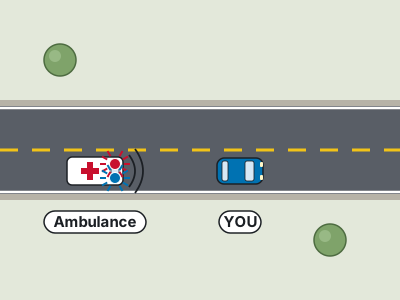
9. After pulling right and stopping for an approaching emergency vehicle, how long must vehicles remain there?
- Until the driver sees the emergency vehicle turn at the next street
- For exactly one minute
- Until another vehicle begins moving
- Until the emergency vehicle has passed or an officer directs otherwise
Show answer
Until the emergency vehicle has passed or an officer directs otherwise. Ohio requires vehicles that have pulled right and stopped for an approaching emergency vehicle to remain in that position until the emergency vehicle has passed or a law enforcement officer gives another direction. Leaving after exactly one minute creates an arbitrary limit that the manual does not use. A turn at the next street does not prove the emergency vehicle has cleared your roadway, and another vehicle moving is not permission. Keep the intersection open and wait for the stated release condition.
Study this in the handbook: Reasonable speed and the assured clear distance rule
10. When may a driver cross a solid double yellow center line in Ohio?
- Whenever the driver wants to pass a car
- Only to turn left into a driveway or pass a slow-moving vehicle when safe
- Only when traveling faster than the posted limit
- Whenever the road has two lanes in each direction
Show answer
Only to turn left into a driveway or pass a slow-moving vehicle when safe. A solid double yellow center line prohibits passing in both directions. Ohio gives two narrow reasons to cross it: turning left into a driveway or passing a slow-moving vehicle when the movement is safe. The answer allowing any pass treats every desired pass as acceptable, but ordinary passing is prohibited by the double line. Driving faster than the posted limit never creates permission, and the number of lanes does not erase the marking. Before crossing, identify one of the listed exceptions, check the oncoming lane, and make sure the maneuver can be completed safely without exceeding the limit.
Study this in the handbook: Right of way
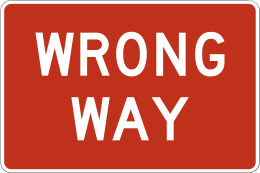
11. What information can Ohio traffic signs communicate?
- Only the current weather and pavement temperature
- Traffic rules, hazards, roadway location, directions, and roadway services
- The driver’s license status and insurance expiration date
- The vehicle’s mechanical condition and fuel level
Show answer
Traffic rules, hazards, roadway location, directions, and roadway services. Ohio describes traffic signs as information sources for traffic rules, hazards, roadway location, roadway directions, and roadway services. A sign may therefore tell a driver how traffic is regulated, warn about a condition ahead, identify where the road leads, or point toward useful services. Weather and pavement temperature are not listed as the sign’s general purpose. A sign also does not diagnose a vehicle or display personal license and insurance records. When viewing a sign, use its shape, color, symbols, and wording to determine which kind of roadway information it supplies before acting.
Study this in the handbook: Reasonable speed and the assured clear distance rule
12. What factors does Ohio use when considering a reasonable driving speed?
- Vehicle color, tire brand, and passenger count
- Driver age, route number, and fuel level
- Insurance company, vehicle make, and time of purchase
- Road design, expected traffic volume, and dry weather visibility
Show answer
Road design, expected traffic volume, and dry weather visibility. Ohio considers road design, expected traffic volume, and dry weather without fog or other visibility problems when describing reasonable speeds. Those conditions help determine whether the posted number is appropriate for maintaining control and stopping within the clear distance ahead. Vehicle color, tire brand, age, and insurance company are not the factors named in this rule. Scan beyond the speed-limit sign: if visibility worsens, traffic builds, or the roadway becomes more demanding, reduce speed enough to keep the vehicle controlled and able to stop safely.
Study this in the handbook: Reasonable speed and the assured clear distance rule
13. What do the visual features of an Ohio traffic sign help identify?

- The exact fuel level of nearby vehicles
- The type of information the sign provides
- The identity of the road maintenance crew
- The driver’s insurance expiration date
Show answer
The type of information the sign provides. Ohio explains that a sign’s shape, color, symbols, and instruction give clues to the type of information it provides. These visual features help a driver distinguish warnings, regulations, directions, and service information before deciding how to respond. They do not reveal a vehicle’s fuel level, identify the maintenance crew, or display an insurance expiration date. Look at the sign’s overall design, then read its symbol or wording and compare it with the roadway ahead. Visual recognition is an early aid, but the actual instruction and surrounding traffic still control the driver’s action.
Study this in the handbook: Reasonable speed and the assured clear distance rule
14. What does this yellow pennant-shaped warning sign tell a driver?
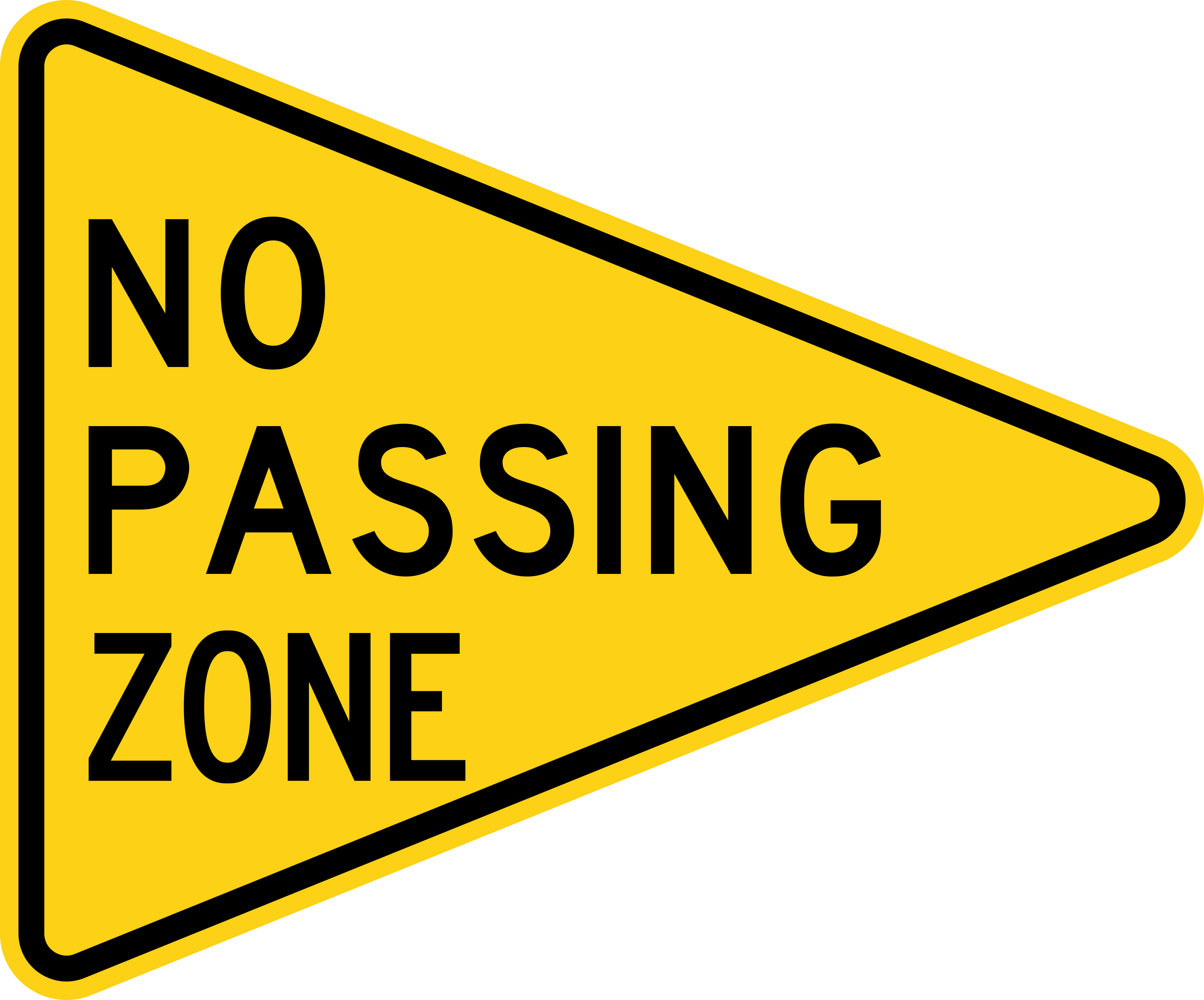
- Passing is prohibited
- Passing is required before the next hill
- All speed restrictions end ahead
- Parking is encouraged on the shoulder
Show answer
Passing is prohibited. Ohio's warning-sign list includes a sign meaning passing is prohibited, shown here as a yellow pennant. When you see it, stay behind the slower vehicle until a legal and safe passing opportunity is available. The sign does not require a pass, end speed restrictions, or invite parking on the shoulder. Ohio also bars passing from both directions where a solid double yellow line runs down the center, so watch the centerline markings along with the sign and wait for a section where the broken line is in your lane.
Study this in the handbook: Reasonable speed and the assured clear distance rule
15. When does an Ohio driver license issued to someone under 21 expire?
- On the 18th birthday
- Four years after issue
- Eight years after issue
- On the driver's 21st birthday
Show answer
On the driver's 21st birthday. An Ohio license issued to someone under 21 expires on the 21st birthday and must be renewed in person, as early as 30 days before that birthday. It does not expire at 18. Four and eight years are the terms offered after renewal: drivers 21 or older but under 65 may choose an 8 year license, and others get 4 years. There is no grace period after expiration.
Study this in the handbook: Probationary license limits for drivers under 18
16. What may Ohio use as evidence of impaired driving?
- A passenger’s estimate of fuel consumption
- Only the driver’s vehicle color and registration county
- Only a roadside speed reading
- Physical findings and results from a blood, breath, plasma, urine, or oral fluid test
Show answer
Physical findings and results from a blood, breath, plasma, urine, or oral fluid test. Ohio describes impaired-driving evidence as a combination of the arresting officer’s physical findings and test results. The listed samples include blood, breath, plasma, urine, and oral fluid. Vehicle color, registration county, speed alone, or fuel use does not establish the evidence described in this passage. A driver should understand that the rule is not limited to one testing method, and officer observations remain part of the evaluation. When studying this topic, separate evidence procedures from the BAC thresholds for different driver categories, because each addresses a different part of Ohio’s alcohol law.
Study this in the handbook: Probationary license limits for drivers under 18
17. What must a reasonable speed allow an Ohio driver to do?
- Maintain control and stop within the assured clear distance ahead
- Stop only after reaching the next intersection
- Match the fastest vehicle nearby and continue without braking
- Drive faster whenever the posted limit permits it
Show answer
Maintain control and stop within the assured clear distance ahead. The manual ties a reasonable speed to two practical abilities: keeping control of the vehicle and bringing it to a stop within the assured clear distance ahead. Matching another driver is not a safety standard, since that vehicle may already be traveling too fast. Waiting until the next intersection ignores hazards that can appear sooner. A posted limit sets an upper legal reference in many situations, but it does not require a driver to use that speed when stopping distance or control would suffer. The useful check is whether the visible roadway gives enough room to stop safely.
Study this in the handbook: Reasonable speed and the assured clear distance rule
18. How many people may ride in a car driven by an Ohio TIPIC holder?
- Any number, if the supervisor approves
- Only the driver and supervisor
- Up to five, regardless of belts
- No more than the number of safety belts installed, with everyone belted
Show answer
No more than the number of safety belts installed, with everyone belted. For every Ohio TIPIC holder, the driver and all passengers must wear safety belts, and the number of occupants cannot exceed the number of safety belts installed. The supervisor cannot waive this. The rule does not limit the car to only the driver and supervisor, and a fixed limit of five ignores the belt count. The same belt rule carries into the first year of a probationary license, along with a ban on using any mobile electronic device.
Study this in the handbook: Knowledge test, TIPIC and driver education
19. From what distance must a vehicle’s turn signals be visible under Ohio equipment rules?
- 100 feet
- 50 feet
- 300 feet
- 500 feet
Show answer
300 feet. Ohio’s vehicle equipment list requires working turn signals visible from 300 feet, with signals at the front and rear. The 100-foot choice can be tempting because Ohio also uses 100 feet for signaling before a turn, but that is a driver-action distance, not equipment visibility. During a predrive check, activate each signal and verify that front and rear lamps work. The cue is whether other roadway users can see your intended movement in time.
Study this in the handbook: Vehicle equipment, seat belts and child seats
20. What following interval does the Ohio manual recommend as a minimum in ordinary conditions?
- One second
- Two seconds
- Four seconds
- Ten seconds in every situation
Show answer
Four seconds. The Ohio manual recommends keeping four seconds between your vehicle and the vehicle ahead, using a stationary object to measure the interval. The one-second and two-second choices leave less reaction and braking time than the stated baseline. Ten seconds is not presented as the universal minimum, although more room is appropriate when visibility, weather, road grip, or the size of the vehicle ahead creates extra risk. Count after the lead vehicle passes a fixed point.
Study this in the handbook: Scanning, following distance and space cushion
QualitySpace is expanding to Ohio
We are a California-based independent insurance brokerage working on licensing in more states. We cannot help with Ohio insurance yet. Leave your email and we will let you know when we can.
Every question is written from the official Digest of Ohio Motor Vehicle Laws. Need paper? Printable OH practice test with answer key.
Last verified 2026-10-05. How we check every question · Study all 500 as flashcards
Frequently asked questions
How many questions are on this Ohio practice test?
This fixed set has 20 questions. It is test 2 of 25 from the 500 question Ohio bank. The real OH exam asks 40 questions and you need 30 correct.
What is the passing score for the real Ohio test?
Applicants must answer 75 percent of the questions correctly to pass That figure comes from the official Ohio source cited on the DMV facts page.
How does this fixed test relate to the full Ohio bank?
Each numbered test is a fixed set of questions in a fixed order, so you can retake the same test later and compare. Every test mixes road signs and the other topics in about the same proportion as the full bank. Tests 1 to 25 together cover every question in the Ohio bank once. The full practice page mixes the whole bank at random.
Last verified 2026-10-05. See the Ohio DMV facts page for sourced state details.