
Test 11 of 25 · 20 questions · Free 2026
OH Permit Practice Test 11
Jump to the test ↓A fixed 20 question set from the Ohio bank with answers and plain English explanations. The real OH exam is 40 questions, 75 percent to pass; take the full length version on the main practice page.
Question 1 of 20 · 0 right so far
All 20 questions in test 11
Every question below comes from the Ohio question bank on this page. Open a question to see the correct answer and the explanation. Nothing here is hidden behind a signup.
1. After pulling over for Ohio law enforcement, what gear and ignition steps should you take?
- Move from drive to park and turn the ignition off, or press stop
- Stay in drive with the engine running
- Shift to neutral and rev the engine
- Turn the engine off before stopping fully
Show answer
Move from drive to park and turn the ignition off, or press stop. After pulling over safely, move the vehicle from DRIVE to PARK and turn the ignition OFF or press the STOP button. Consider "Stay in drive with the engine running": The manual says to shift to PARK and turn the ignition OFF after pulling over. Consider "Shift to neutral and rev the engine": The manual says to shift to PARK and turn the ignition OFF, not shift to neutral and rev.
Study this in the handbook: Headlights, night driving and bad weather
2. An Ohio driver with no priors takes a chemical test that comes back over the limit. How long is the suspension?
- One year
- Five years
- Two years
- Three months (90 days)
Show answer
Three months (90 days). The manual lists a three-month (90-day) suspension for a first test over the limit. With prior OVI/drug convictions within the prior 10 years, the listed suspensions are one year for one prior, two years for two priors, and three years for three or more priors. Consider "One year": The testing-over-the-limit schedule lists one year for one prior OVI/drug conviction within 10 years. Consider "Five years": Five years is a refusal top rung.
Study this in the handbook: Probationary license limits for drivers under 18
3. You see a child alone in a vehicle in Ohio and call 911. The child is in distress or unresponsive. What does the manual say to do?
- Wait in your own vehicle until the parent returns
- Leave once 911 has been called
- Take action to remove the child from the vehicle, breaking a window if necessary
- Wait for the child to respond before acting
Show answer
Take action to remove the child from the vehicle, breaking a window if necessary. If the child is in distress or unresponsive, take action to remove the child from the vehicle and break a window if necessary. Stay with the child until help arrives. Consider "Wait in your own vehicle until the parent returns": Waiting delays help for a child in distress. Consider "Leave once 911 has been called": The manual says to stay with the child until help arrives. Consider "Wait for the child to respond before acting": A child in distress needs action, not waiting.
Study this in the handbook: Reasonable speed and the assured clear distance rule
4. Your Ohio vehicle engine shuts off while driving and will not restart after you pull off. What should you do next?
- Shift to PARK, raise the hood and turn on the emergency flashers
- Leave the vehicle in gear and walk away
- Push the vehicle back into traffic to restart it
- Turn off all lights to save the battery
Show answer
Shift to PARK, raise the hood and turn on the emergency flashers. If the engine shuts off, keep a strong grip on the steering wheel, brake with steady pressure, slow down, and pull off the roadway. Shift to PARK and try to restart. If the restart is unsuccessful, raise the hood and turn on the emergency flashers. Consider "Leave the vehicle in gear and walk away": The manual directs you to shift to PARK and try to restart; if unsuccessful, raise the hood and turn on the flashers.
Study this in the handbook: Vehicle emergencies and crashes
5. Where does Ohio use this DO NOT ENTER sign?
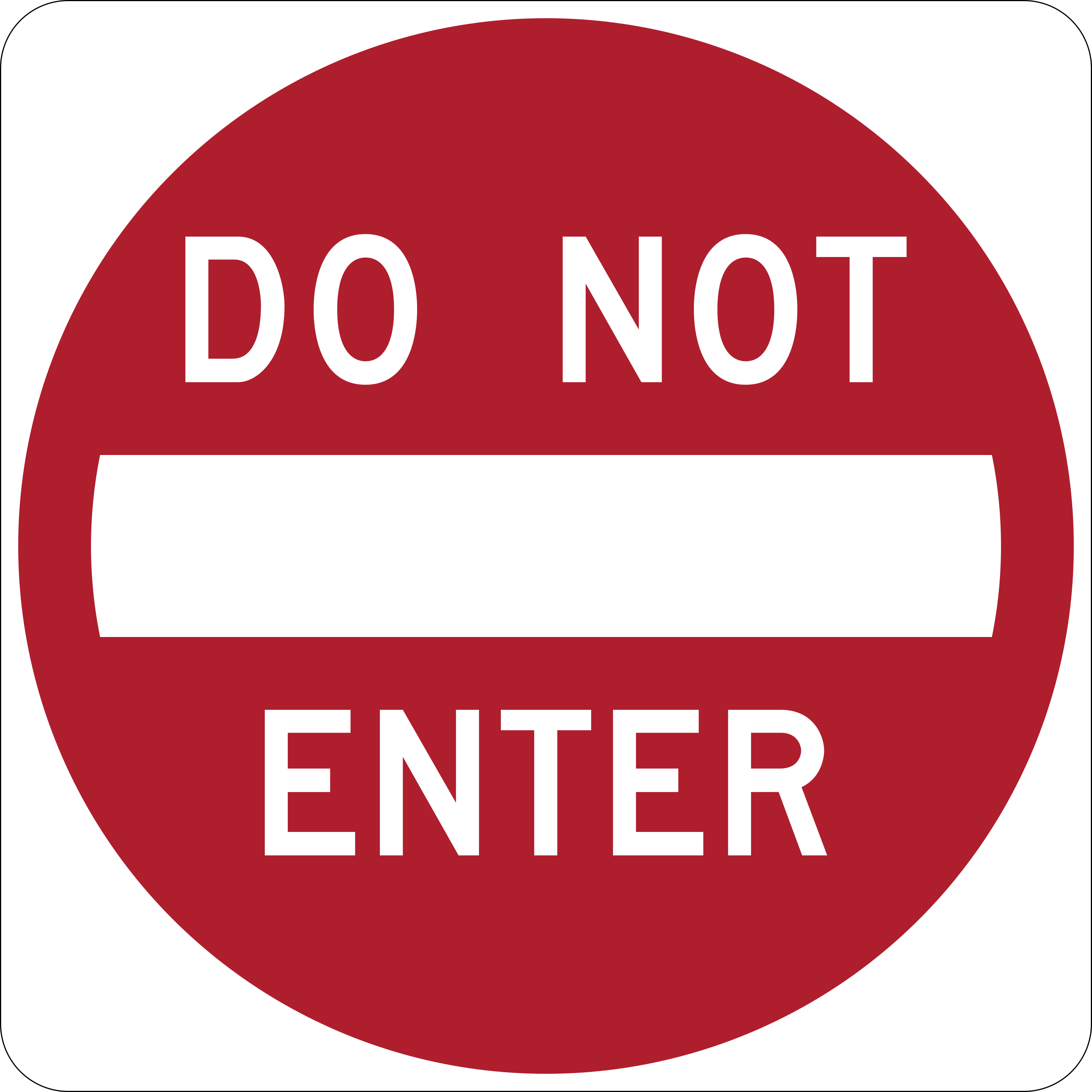
- At intersections of one-way roads and freeway exit ramps
- At every school crossing during recess
- Only at railroad crossings with flashing lights
- At parking spaces reserved for disabled drivers
Show answer
At intersections of one-way roads and freeway exit ramps. Ohio identifies DO NOT ENTER signs for intersections of one-way roads and freeway exit ramps. The sign warns that entering from that approach would place a vehicle against the intended traffic direction or into an exit ramp. A school crossing, railroad crossing, or accessible parking space uses different signs and controls. Look for the red prohibition design and confirm the roadway direction before turning. If the sign faces your approach, choose another legal route rather than entering and attempting to correct direction after the turn.
Study this in the handbook: Reasonable speed and the assured clear distance rule
6. When may an Ohio driver age 40 hold a phone to the ear during a call while driving?
- Whenever traffic is light
- Only during phone conversations, if the call is started or stopped with a single touch or swipe
- At any speed below 35 mph
- While stopped in a travel lane for any reason
Show answer
Only during phone conversations, if the call is started or stopped with a single touch or swipe. Section 3 lists an exception allowing an adult to hold a phone to the ear only during phone conversations if the call is started or stopped with a single touch or swipe. Light traffic or a speed below 35 mph is not a condition of that exception. Other listed exceptions include device use while stopped at a traffic light or parked on a road or highway during an emergency or road closure.
Study this in the handbook: Probationary license limits for drivers under 18
7. Which parking position does Ohio prohibit on a street?
- Parallel parking within 12 inches of the right curb
- Parking alongside a vehicle already stopped at the curb
- Parking in a marked angled space
- Parking in the direction of traffic, parallel to and within 12 inches of the left curb on a one-way street
Show answer
Parking alongside a vehicle already stopped at the curb. Ohio prohibits stopping, parking, or standing alongside a vehicle stopped or parked at a street's edge or curb, except when necessary to avoid conflict with other traffic or to comply with a law enforcement officer or traffic control device. On one-way streets, vehicles may park parallel to and within 12 inches of either curb, facing the direction of traffic. Consider "Parallel parking within 12 inches of the right curb": Close parallel parking at the right curb is standard.
Study this in the handbook: Right of way
8. What is the lane change sequence after checking mirrors and blind spots in Ohio guidance?
- Steer first, then signal if traffic reacts
- Cancel the signal before moving
- Identify a gap in traffic, signal, and look again in the direction of the lane change
- Speed up without a second look
Show answer
Identify a gap in traffic, signal, and look again in the direction of the lane change. Identify a gap in traffic, signal, and look again in the direction of the lane change. Consider "Steer first, then signal if traffic reacts": The manual puts signaling and another look before adjusting speed and steering into the lane. Consider "Cancel the signal before moving": Canceling silences a needed warning. Consider "Speed up without a second look": The manual requires another look in the direction of the lane change after signaling.
Study this in the handbook: Right of way
9. A fallen tree blocks your lane on an Ohio two-lane road, forcing you left of center. What must you do?
- Speed up so oncoming traffic must slow for you
- Yield the right-of-way to oncoming traffic
- Drive on the shoulder regardless of its surface
- Stop and wait until the tree is removed
Show answer
Yield the right-of-way to oncoming traffic. An obstruction is one of the listed reasons a driver may need to drive left of center. When doing so, yield the right-of-way to oncoming traffic. Consider "Speed up so oncoming traffic must slow for you": You must yield to oncoming traffic when an obstruction requires driving left of center. Consider "Drive on the shoulder regardless of its surface": The manual allows driving left of center around an obstruction while yielding to oncoming traffic; it does not direct you onto the shoulder.
Study this in the handbook: Right of way
10. Where does an Ohio school bus stop arm extend, and how is it marked?
- From the right side, with amber lights
- From the roof, with green lights
- From the rear bumper, with white lights
- Beneath the window on the left side of the bus, with flashing red lights
Show answer
Beneath the window on the left side of the bus, with flashing red lights. In addition, the bus may be equipped with a stop arm with flashing red lights that automatically extends beneath the window on the left side of the bus. Consider "From the right side, with amber lights": The manual places the stop arm on the left side and specifies flashing red lights. Consider "From the rear bumper, with white lights": The manual places the stop arm beneath the window on the left side, not on the rear bumper.
Study this in the handbook: Right of way
11. What must you never do on railroad tracks when a train approaches in Ohio guidance?
- Stop on the tracks, or attempt to cross when a train is approaching
- Look both ways before crossing
- Slow down near a crossbuck
- Wait for warning signals to stop
Show answer
Stop on the tracks, or attempt to cross when a train is approaching. Do not stop on the tracks and do not attempt to cross the tracks when a train is approaching. Consider "Look both ways before crossing": Looking for an approaching train is consistent with the manual’s railroad-crossing guidance. Consider "Slow down near a crossbuck": The manual tells drivers to slow down at crossings marked only by pavement markings or crossbucks. Consider "Wait for warning signals to stop": The manual says to wait until the train has passed and any warning signals have stopped before crossing.
Study this in the handbook: Right of way
12. What does an Ohio Class D operator’s license allow its holder to operate?
- A motor vehicle that does not require a CDL or an additional endorsement
- Any commercial vehicle regardless of its weight
- Only a motorcycle with an endorsement
- Only vehicles carrying hazardous materials
Show answer
A motor vehicle that does not require a CDL or an additional endorsement. A Class D operator’s license allows an individual, including a probationary driver under age 18, to operate a motor vehicle that does not require a Commercial Driver License or an additional endorsement. Consider "Any commercial vehicle regardless of its weight": Commercial vehicles that require a CDL are outside a Class D license. Consider "Only a motorcycle with an endorsement": Motorcycles need a separate motorcycle license or endorsement. Consider "Only vehicles carrying hazardous materials": Hazardous materials hauling needs additional endorsements beyond a Class D license.
Study this in the handbook: Probationary license limits for drivers under 18
13. Where should children age 12 and younger ride in Ohio, and where must a rear-facing seat never sit?
- In the front seat, away from the driver
- Properly restrained in the back seat, and a rear-facing seat never goes in front of an active passenger airbag
- In any seat, if the trip is short
- In the back seat only on highways
Show answer
Properly restrained in the back seat, and a rear-facing seat never goes in front of an active passenger airbag. Children age 12 and younger should be properly restrained in the back seat. Never place a rear-facing child safety seat in front of an active passenger airbag. Consider "In the front seat, away from the driver": The manual recommends the back seat for children age 12 and younger. Consider "In any seat, if the trip is short": Short trips change nothing about placement.
Study this in the handbook: Probationary license limits for drivers under 18
14. A probationary driver under age 18 in Ohio pleads guilty to three moving violations. What follows?
- An automatic three-month license suspension
- A 60 day suspension and a $150 fine
- An automatic one-year license suspension
- No suspension until age 21
Show answer
An automatic one-year license suspension. For a driver under age 18, a conviction of or guilty plea to three moving violations results in an automatic one-year license suspension. Two moving violations result in an automatic three-month suspension. Consider "An automatic three-month license suspension": Three months follows two moving violations. Consider "A 60 day suspension and a $150 fine": That penalty belongs to device violations. Consider "No suspension until age 21": Probationary penalties apply before age 18 ends.
Study this in the handbook: Probationary license limits for drivers under 18
15. How far in advance must a driver activate a turn signal before changing direction in Ohio?
- At least 50 feet before the turn
- Only after entering the turn lane
- At least 300 feet before any turn
- At least 100 feet prior to changing direction
Show answer
At least 100 feet prior to changing direction. Activate a turn signal at least 100 feet before changing direction. Signals show an intention to turn, change direction, or change lanes and give other road users time to react. Turn-signal lamps must separately be visible from 300 feet. Consider "At least 50 feet before the turn": Fifty feet halves the required warning distance. Consider "At least 300 feet before any turn": Three hundred feet is lamp visibility, not timing.
Study this in the handbook: Vehicle equipment, seat belts and child seats
16. What minimum chest-to-steering-wheel distance does the Ohio manual specify for proper driver-seat adjustment?
- At least 6 inches
- No minimum, if the pedals are reachable
- At least 18 inches
- At least 10 inches
Show answer
At least 10 inches. With the driver's seat properly adjusted, there should be at least 10 inches between the chest and steering wheel to allow appropriate space for air-bag deployment. The seat should also allow a clear view and full control of the pedals and steering wheel. Consider "At least 6 inches": Six inches is below the stated minimum of 10 inches. Consider "At least 18 inches": Eighteen inches is greater than the stated minimum; the manual specifies at least 10 inches.
Study this in the handbook: Vehicle equipment, seat belts and child seats
17. Across which body areas should a safety belt be worn in Ohio guidance?
- Across the neck and stomach
- Across one shoulder only, with the lap part optional
- Across bony areas, the shoulders and hips
- Across the chest only, below the ribs
Show answer
Across bony areas, the shoulders and hips. Wear a safety belt across bony areas: the shoulders and hips. The shoulder belt should cross the shoulder and chest with minimal slack, and the lap belt should be snug and low across the hips. Consider "Across the neck and stomach": The manual specifies the shoulders and hips, not the neck and stomach. Consider "Across one shoulder only, with the lap part optional": Both shoulder and lap parts are required together.
Study this in the handbook: Vehicle equipment, seat belts and child seats
18. At which event must an Ohio driver show proof of financial responsibility during a vehicle inspection stop?
- Only when the officer suspects no insurance
- At all vehicle inspection stops
- Only after a crash with injuries
- Only when renewing registration online
Show answer
At all vehicle inspection stops. Section 6 requires proof of financial responsibility at all vehicle inspection stops. It also requires proof when law enforcement issues a traffic ticket, at all Traffic Court appearances, when requested by the BMV, and when the driver or vehicle owner is involved in a crash resulting in more than $400 in property damage. Consider "Only when the officer suspects no insurance": The stop itself triggers the duty without any suspicion requirement.
Study this in the handbook: Probationary license limits for drivers under 18
19. What condition must an Ohio vehicle's exhaust system meet?
- It only needs to operate while idling
- It may be removed for rural driving
- It must be in good working order and in constant operation
- It only needs a muffler tip visible at the rear
Show answer
It must be in good working order and in constant operation. The exhaust system must be in good working order and constant operation. Consider "It only needs to operate while idling": The system must operate constantly, not only at idle. Consider "It may be removed for rural driving": The equipment rule applies on rural roads too. Consider "It only needs a muffler tip visible at the rear": A visible muffler tip alone is not the stated requirement; the exhaust system must be in good working order and constant operation.
Study this in the handbook: Vehicle equipment, seat belts and child seats
20. After becoming an Ohio resident, what must a vehicle owner obtain for a vehicle?
- Only an Ohio emissions sticker
- An Ohio-issued certificate of title and registration
- A new Driver License but no vehicle papers
- Plates from any neighboring state
Show answer
An Ohio-issued certificate of title and registration. If you own a vehicle as an Ohio resident, it must have an Ohio-issued certificate of title and registration. Ohio-issued license plates and a registration sticker are provided upon registration. Consider "Only an Ohio emissions sticker": The manual requires an Ohio-issued certificate of title and registration, not just an emissions sticker. Consider "A new Driver License but no vehicle papers": The license duty does not replace vehicle title and registration.
QualitySpace is expanding to Ohio
We are a California-based independent insurance brokerage working on licensing in more states. We cannot help with Ohio insurance yet. Leave your email and we will let you know when we can.
Every question is written from the official Digest of Ohio Motor Vehicle Laws. Need paper? Printable OH practice test with answer key.
Last verified 2026-10-05. How we check every question · Study all 500 as flashcards
Frequently asked questions
How many questions are on this Ohio practice test?
This fixed set has 20 questions. It is test 11 of 25 from the 500 question Ohio bank. The real OH exam asks 40 questions and you need 30 correct.
What is the passing score for the real Ohio test?
Applicants must answer 75 percent of the questions correctly to pass That figure comes from the official Ohio source cited on the DMV facts page.
How does this fixed test relate to the full Ohio bank?
Each numbered test is a fixed set of questions in a fixed order, so you can retake the same test later and compare. Every test mixes road signs and the other topics in about the same proportion as the full bank. Tests 1 to 25 together cover every question in the Ohio bank once. The full practice page mixes the whole bank at random.
Last verified 2026-10-05. See the Ohio DMV facts page for sourced state details.