
Test 1 of 25 · 20 questions · Free 2026
OH Permit Practice Test 1
Jump to the test ↓A fixed 20 question set from the Ohio bank with answers and plain English explanations. The real OH exam is 40 questions, 75 percent to pass; take the full length version on the main practice page.
Question 1 of 20 · 0 right so far
All 20 questions in test 1
Every question below comes from the Ohio question bank on this page. Open a question to see the correct answer and the explanation. Nothing here is hidden behind a signup.
1. A school bus stops with red lights flashing on an Ohio road with four or more lanes. Which traffic must stop?
- Only traffic going the same direction as the bus
- All traffic in both directions
- Only traffic coming toward the bus
- No one, as long as drivers slow to 20 mph
Show answer
Only traffic going the same direction as the bus. Ohio's school bus rule depends on the width of the road. When the bus stops on a road with fewer than four lanes, traffic from both directions stops at least 10 feet away. On a road with four or more lanes, only traffic moving the same direction as the bus must stop behind it, and it stays stopped until the bus moves again. Traffic coming the other way on the far side of the wider road is not required to stop, but should still watch for children.
Study this in the handbook: Right of way
2. A 16-year-old with an Ohio TIPIC is driving at 2 a.m. Which accompanying adult is required?
- Any licensed driver age 18 or older
- No adult if the trip is less than five miles
- A passenger age 16 or older with a valid ID
- A parent, guardian, or custodian who holds a valid Driver License
Show answer
A parent, guardian, or custodian who holds a valid Driver License. A permit holder ages 16 or 17 may normally practice with any valid licensed driver who is at least 21 in the front seat. Ohio adds a tighter overnight condition: from midnight until 6 a.m., the accompanying person must be a parent, guardian, or custodian with a valid Driver License. The age 18 option is too young for the ordinary supervision rule, and distance does not create an exception. Before a late-night practice trip, confirm both the adult's relationship and license status.
Study this in the handbook: Knowledge test, TIPIC and driver education
3. During which part of the year are studded tires legal on Ohio roads?
- Only from December 1 through March 1
- From November 1 through April 15
- All year, as long as the studs are under one inch
- Never, because Ohio bans studded tires
Show answer
From November 1 through April 15. Ohio allows studded tires only during the cold months. The digest sets the legal window from November 1 through April 15, which covers the season when snow and ice are most likely on Ohio roads. Outside those dates the studs chew up pavement without a safety benefit, so they are not legal then. A driver who keeps studded tires on into late spring should switch to regular tires once April 15 has passed.
Study this in the handbook: Vehicle equipment, seat belts and child seats
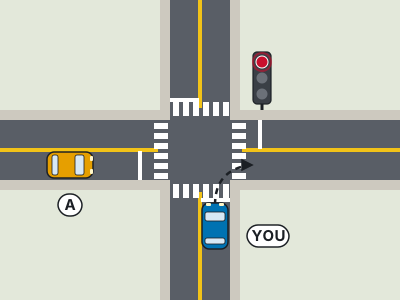
4. What is the Ohio rule for turning right at a red traffic signal?
- Turn only after the signal changes to yellow
- Turn without stopping when no car is visible
- Stop completely, yield to crossing traffic and pedestrians, then turn unless prohibited
- Turn from any lane if the road is one way
Show answer
Stop completely, yield to crossing traffic and pedestrians, then turn unless prohibited. A right turn on red is allowed unless a sign specifically prohibits it, but the driver must first make a complete stop. After stopping, the driver must let all crossing traffic and pedestrians clear the intersection. An empty-looking lane does not remove either requirement, making a turn without stopping unsafe. Yellow is not the required waiting signal, and a one-way road does not permit turning from any lane. At the intersection, stop behind the line or crosswalk, check for a prohibition sign, scan for people and traffic, then turn only after the path is clear.
Study this in the handbook: Turns, school buses and railroad crossings
5. At a stop sign, where must a driver stop before entering the intersection?

- Behind the stop line or crosswalk
- Only where another vehicle can see the car
- In the nearest travel lane
- Past the crosswalk in the intersection
Show answer
Behind the stop line or crosswalk. Ohio requires a driver to stop behind the stop line or crosswalk at a stop sign before entering an intersection. The stop must be complete, not a rolling pause, and the driver must then check for crossing traffic and pedestrians. Stopping beyond the crosswalk can place the vehicle in the path it should yield to. The sign's red octagon is the cue to prepare for a full stop, then look in every direction before proceeding. A clear intersection does not cancel the stopping requirement.
Study this in the handbook: Right of way
6. What light transmission does Ohio require for the side windows next to the front seat?
- 70%, the same as the windshield
- 50%, plus or minus 3%
- 35%, with no tolerance
- Any amount, since only the windshield is regulated
Show answer
50%, plus or minus 3%. Window tint limits are part of Ohio's vehicle equipment rules. The windshield must allow 70% light transmission, which is the standard for most new cars. The side windows beside the front seat have their own limit: they must let through 50% of light, with a tolerance of plus or minus 3%. Darker film on those windows can make the vehicle fail the equipment standard and makes it harder for others, including officers, to see the driver.
Study this in the handbook: Vehicle equipment, seat belts and child seats
7. What does a solid double yellow line generally mean on an Ohio two-way road?
- The center lane is reserved for parking
- Passing is required from both directions
- Only trucks may cross it to pass
- Passing is prohibited from both directions
Show answer
Passing is prohibited from both directions. A solid double yellow center line prohibits passing from both directions. Ohio allows limited crossings for a left turn into a driveway or to pass a slow-moving vehicle when it is safe, but that exception does not turn the marking into a passing permission for ordinary traffic. The other choices reverse or invent the rule. See the paired solid lines as a warning to remain behind the vehicle ahead unless one of the stated limited maneuvers applies.
Study this in the handbook: Right of way
8. When should a driver increase following distance behind a bus or vehicle carrying hazardous materials?
- Only after passing the railroad tracks
- Only when the bus is traveling over the speed limit
- When following vehicles required to stop at railroad crossings
- When the vehicle behind begins to tailgate
Show answer
When following vehicles required to stop at railroad crossings. Ohio tells drivers to leave more space when following vehicles that must stop at railroad crossings, including buses and vehicles carrying hazardous materials. The over-the-speed-limit choice misses the point; the risk is that these vehicles may stop where other drivers might not expect it. A practical cue is a school bus, passenger bus, or placarded vehicle approaching tracks. Add room before the crossing so a sudden required stop does not become an emergency stop for you.
Study this in the handbook: Scanning, following distance and space cushion
9. What suspension range may Ohio impose when a driver refuses a chemical test?
- Only 30 days after conviction
- Exactly six months beginning after trial
- One to five years, beginning immediately
- No suspension if the driver is later acquitted
Show answer
One to five years, beginning immediately. Ohio states that refusing a chemical test can bring a suspension for one to five years, beginning immediately. The consequence is administrative and is not limited to a 30-day period or postponed until trial. The manual also says the suspension stands even if the driver is ultimately acquitted of the OVI charge, so the no-suspension answer reverses the stated rule. The cue is refusal, immediate start, and a one-to-five-year range.
Study this in the handbook: OVI, BAC limits and chemical test refusal
10. After the first 12 months of an Ohio probationary license, what nighttime limit applies when no parent or guardian is along and no documented work, school or religious event trip applies?
- No driving from 1 a.m. to 5 a.m.
- No driving from 10 p.m. to 6 a.m.
- No nighttime restriction remains
- No driving from midnight to 6 a.m.
Show answer
No driving from 1 a.m. to 5 a.m.. After the first year, the restricted period becomes 1 a.m. through 5 a.m. The midnight to 6 a.m. window belongs to the first 12 months, so choosing it carries forward the earlier rule. The restriction has listed exceptions, including a parent or guardian, documented work travel, and documented school or religious events. A useful memory cue is that the restricted period shrinks to a four-hour overnight window after month twelve.
Study this in the handbook: Probationary license limits for drivers under 18
11. Under Ohio law, what restraint must a child age 10 use?
- A safety belt
- A rear-facing child seat
- Nothing in the back seat
- A booster seat until age 15
Show answer
A safety belt. Ohio requires children at least 8 but not older than 15 to be restrained with a safety belt, and the driver is responsible for it. A rear facing seat is for infants, and booster seats cover children 4 to under 8 unless they are at least 4 feet 9 inches tall. Riding unbelted in back is not allowed for this age. The manual also says children 12 and younger should sit in the rear seat to avoid air bag injury.
Study this in the handbook: Probationary license limits for drivers under 18
12. In which direction must vehicles travel after entering an Ohio roundabout?
- Straight across the center island
- Clockwise around the center island
- Either direction based on the exit
- Counterclockwise around the center island
Show answer
Counterclockwise around the center island. Vehicles enter and circulate counterclockwise around a roundabout's raised center island. Clockwise travel moves against the manual's traffic pattern, and neither the selected exit nor the island permits a straight crossing. The direction stays the same for every exit. A helpful visual cue is to picture traffic flowing around the island with the island kept to the driver's left while circulating.
Study this in the handbook: Roundabouts, lane use and parking
13. What must traffic do at a stop sign?
- Slow briefly without checking cross traffic
- Stop completely before proceeding
- Continue if the driver has already reduced speed
- Stop only when a pedestrian is visible
Show answer
Stop completely before proceeding. A stop sign requires a complete stop before proceeding. The driver must stop behind the stop line, crosswalk, or intersection, then make sure traffic is not crossing the intended path before entering. A brief slowdown is not the same as stopping, and prior speed reduction does not remove the command. The rule applies even when no pedestrian is present. Use the stop line as the first reference point, bring the vehicle fully still, and then scan for traffic and pedestrians before moving through the intersection.
Study this in the handbook: Reasonable speed and the assured clear distance rule
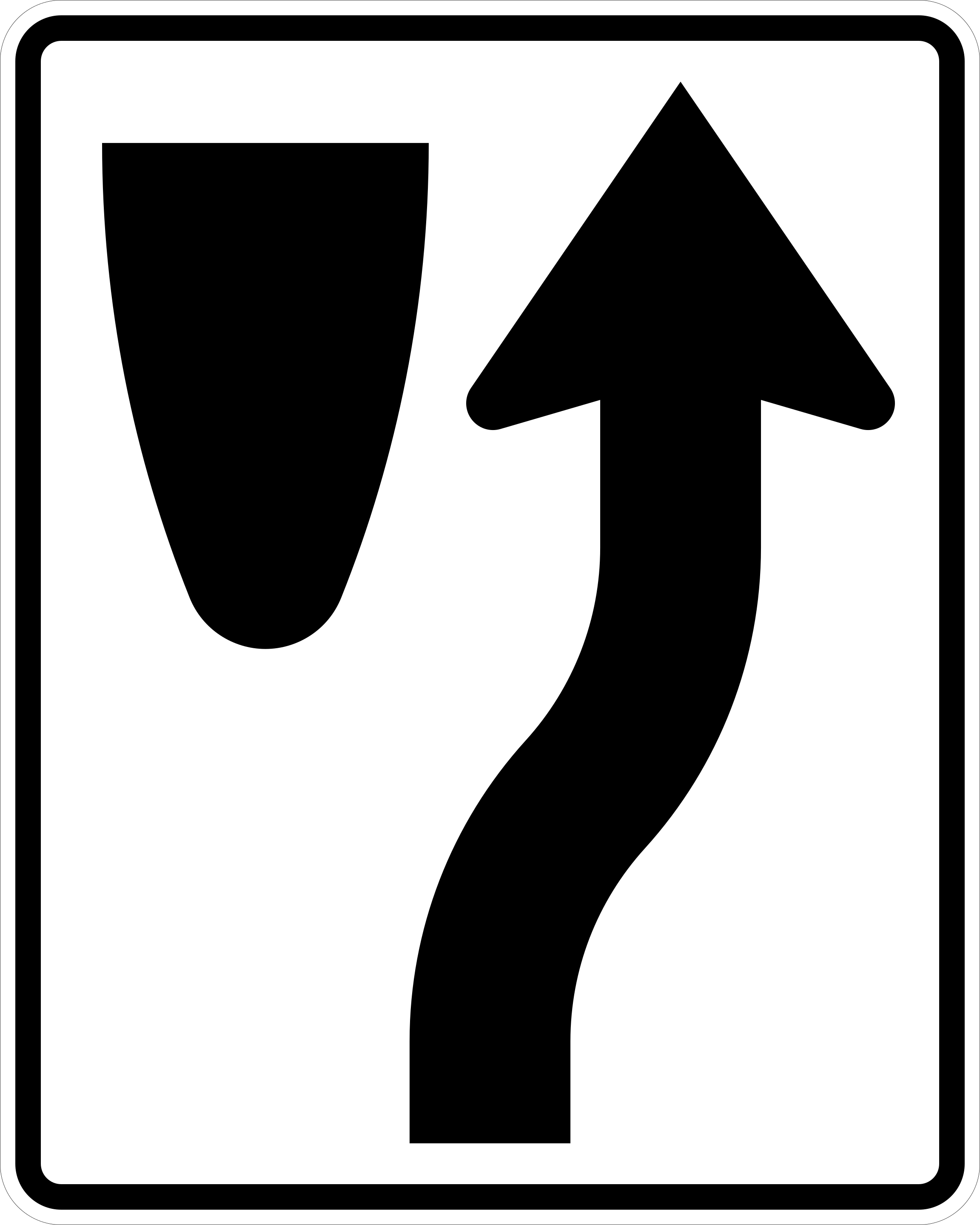
14. Which features help a driver understand the information provided by an Ohio traffic sign?
- The vehicle’s tire pressure and engine temperature
- The driver’s speedometer and fuel gauge
- Its shape, color, symbols, and instruction
- The time remaining before the next traffic signal
Show answer
Its shape, color, symbols, and instruction. Ohio says a sign’s shape, color, symbols, and instruction give clues to the type of information it provides. Those features help a driver recognize whether the sign regulates movement, warns of danger, guides a route, or identifies a service. Tire pressure and engine temperature belong to the vehicle, not the sign. The speedometer, fuel gauge, and signal timing are also unrelated to interpreting sign information. Make a quick visual scan for all four sign features, then follow the instruction while continuing to watch lane markings and other road users around the vehicle.
Study this in the handbook: Reasonable speed and the assured clear distance rule
15. At night, how can you avoid being momentarily blinded by the headlights of an approaching vehicle?
- Stare directly at the oncoming headlights
- Switch your own high beams on
- Look toward the right side of the road
- Put on sunglasses
Show answer
Look toward the right side of the road. Glare from oncoming headlights can leave a driver briefly unable to see the road. Ohio's night driving advice is to look toward the right side of the road as the vehicle approaches. That keeps your eyes off the bright lights while still tracking your lane edge. You must dim your own high beams for approaching traffic, and you should never wear sunglasses or tinted lenses at night, since they cut the light you need.
Study this in the handbook: Headlights, night driving and bad weather
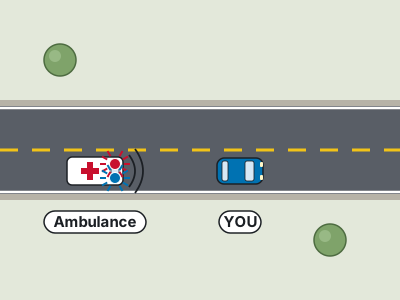
16. What must a driver do when an emergency vehicle approaches with flashing lights and an audible siren?
- Speed up so the emergency vehicle can follow
- Stop immediately in the nearest travel lane
- Turn left at the next intersection without checking traffic
- Pull safely to the right and stop until it has passed
Show answer
Pull safely to the right and stop until it has passed. Ohio directs drivers to pull quickly and safely to the right and stop when an emergency vehicle is approaching with the specified signals. The vehicle should remain in that position until the emergency vehicle passes or an officer gives another direction. Speeding up does not clear a safe path, and stopping in a travel lane can block the response. Avoid stopping inside an intersection, since that can obstruct both the emergency vehicle and crossing traffic.
Study this in the handbook: Emergency vehicles, Move Over and sharing the road
17. When may an Ohio driver cross a solid yellow line to pass a slow-moving vehicle?
- Any time it travels below the posted limit
- When it travels at less than half the posted limit, you stay within the limit, and the oncoming lane is clear
- Only after it signals you to pass
- Whenever you can exceed the limit briefly to get around it
Show answer
When it travels at less than half the posted limit, you stay within the limit, and the oncoming lane is clear. Ohio makes a narrow exception to the no passing rule for slow-moving vehicles such as farm equipment. You may cross a solid yellow line to pass only when three conditions are all met: the vehicle is moving at less than half the posted speed limit, you do not exceed the limit while passing, and there is enough clear space in the oncoming lane to finish. If any condition fails, stay behind it and wait.
Study this in the handbook: Reasonable speed and the assured clear distance rule
18. What does driving safely require regarding vehicle speed?
- Using the posted limit in every condition
- Adjusting speed for roadway and traffic conditions
- Driving faster whenever traffic is heavy
- Keeping the same speed on wet and dry pavement
Show answer
Adjusting speed for roadway and traffic conditions. Ohio says safe driving includes adjusting vehicle speed for roadway and traffic conditions, maintaining an adequate following interval, and obeying appropriate speed limits. The posted number is a reference, not a promise that the same speed is suitable on wet pavement, in heavy traffic, or on a difficult roadway. Speeding up when traffic is heavy reduces time and space to respond. Holding one speed across changing conditions ignores the adjustment the manual calls for. Watch traffic, pavement, visibility, and the vehicle ahead, then choose a speed that preserves control and stopping room.
Study this in the handbook: Reasonable speed and the assured clear distance rule
19. What does an Ohio warning sign for limited clearance tell a driver to expect?
- A place to buy fuel ahead
- A driver license checkpoint ahead
- A low clearance area ahead
- A lane reserved only for buses
Show answer
A low clearance area ahead. A limited-clearance warning sign tells drivers that a low overhead or narrow clearance condition is ahead. It is not a service sign for fuel or a licensing checkpoint notice. Drivers of taller vehicles, vehicles carrying loads, or vehicles towing trailers should respond early by checking posted clearance and choosing another route if needed. The cue is a yellow warning sign connected to clearance: treat it as advance notice of a physical space limit.
Study this in the handbook: Reasonable speed and the assured clear distance rule
20. In Ohio, what status do animal-drawn vehicles and horseback riders have on the roadway?
- They must always move onto the shoulder for motor vehicles
- They have priority only when a warning sign is posted
- They may ignore traffic rules in rural areas
- They have the same rights as a motor vehicle and must follow the same road rules
Show answer
They have the same rights as a motor vehicle and must follow the same road rules. Ohio treats animal-drawn vehicles and horseback riders as roadway users with the same rights as a motor vehicle, and they must follow the same rules of the road. Rural location does not remove those duties, and a warning sign does not create the underlying right. They also do not automatically have to leave the roadway for a car. The useful response is alert, patient driving near them, with special awareness that animals can react unpredictably to noise and movement.
Study this in the handbook: Reasonable speed and the assured clear distance rule
QualitySpace is expanding to Ohio
We are a California-based independent insurance brokerage working on licensing in more states. We cannot help with Ohio insurance yet. Leave your email and we will let you know when we can.
Every question is written from the official Digest of Ohio Motor Vehicle Laws. Need paper? Printable OH practice test with answer key.
Last verified 2026-10-05. How we check every question · Study all 500 as flashcards
Frequently asked questions
How many questions are on this Ohio practice test?
This fixed set has 20 questions. It is test 1 of 25 from the 500 question Ohio bank. The real OH exam asks 40 questions and you need 30 correct.
What is the passing score for the real Ohio test?
Applicants must answer 75 percent of the questions correctly to pass That figure comes from the official Ohio source cited on the DMV facts page.
How does this fixed test relate to the full Ohio bank?
Each numbered test is a fixed set of questions in a fixed order, so you can retake the same test later and compare. Every test mixes road signs and the other topics in about the same proportion as the full bank. Tests 1 to 25 together cover every question in the Ohio bank once. The full practice page mixes the whole bank at random.
Last verified 2026-10-05. See the Ohio DMV facts page for sourced state details.