
Test 5 of 25 · 20 questions · Free 2026
OH Permit Practice Test 5
Jump to the test ↓A fixed 20 question set from the Ohio bank with answers and plain English explanations. The real OH exam is 40 questions, 75 percent to pass; take the full length version on the main practice page.
Question 1 of 20 · 0 right so far
All 20 questions in test 5
Every question below comes from the Ohio question bank on this page. Open a question to see the correct answer and the explanation. Nothing here is hidden behind a signup.
1. Where does the Ohio digest tell drivers to place their hands on the steering wheel?
- At 10 and 2 o'clock near the top
- Both hands together at 12 o'clock
- One hand at the bottom center of the wheel
- At the 4 and 8 o'clock positions on opposite sides
Show answer
At the 4 and 8 o'clock positions on opposite sides. Ohio teaches a lower hand position than older driving lessons did. Both hands go on the outside of the wheel on opposite sides, at about 4 and 8 o'clock. That grip keeps steady control of the vehicle and keeps the forearms out of the way if the air bag deploys from the hub. The grip should be firm but gentle. The 12 o'clock position appears only in the backing instructions, where the left hand holds the top of the wheel.
Study this in the handbook: Right of way
2. What do Ohio work zone signs generally have as their background color?
- Orange
- Purple
- White
- Blue
Show answer
Orange. Work zone signs in Ohio generally use an orange background with black letters or symbols. The purple and white choices do not identify the temporary roadwork sign pattern described in the manual, and blue is associated with guide information and services. Spotting orange should trigger a work zone response: lower your speed, watch for workers and equipment, and follow directions from signs or flaggers rather than assuming the normal lane is unchanged.
Study this in the handbook: Headlights, night driving and bad weather
3. An adult Ohio driver is convicted of a second handheld device violation within two years. What penalty applies?
- 2 points and a fine of up to $150
- 4 points and a fine of up to $500
- 3 points and a fine of up to $250
- A 60 day suspension and a $150 fine
Show answer
3 points and a fine of up to $250. Ohio's distracted driving penalties for drivers 18 and older rise with each offense counted over two years. A first offense brings 2 points and up to a $150 fine, and the second offense in that window brings 3 points and up to a $250 fine. A third or later offense raises it to 4 points, up to $500, and a possible 90 day suspension. Fines are doubled when the violation happens in a work zone.
Study this in the handbook: Probationary license limits for drivers under 18
4. When should an Ohio driver reduce speed for rain, snow, sleet, or ice?
- Only after the vehicle begins to skid
- At the first sign of any of those conditions
- Only when the posted limit is reduced
- Only on roads with curves
Show answer
At the first sign of any of those conditions. The manual directs drivers to reduce speed at the first sign of rain, snow, sleet, or ice because slippery surfaces reduce tire grip, lengthen stopping distance, and make turning harder. Waiting for a skid means waiting until traction has already been lost. A changed posted limit is not required, and straight roads can be slippery too. Ease off early and leave additional room ahead whenever precipitation or frozen material begins affecting the roadway.
Study this in the handbook: Reasonable speed and the assured clear distance rule
5. What does Ohio law prohibit a driver from doing regardless of the posted speed limit?
- Driving below the posted limit when traffic is light
- Driving faster than the distance available allows the driver to stop
- Changing speed when roadway conditions change
- Stopping within an assured clear distance
Show answer
Driving faster than the distance available allows the driver to stop. Ohio makes the stopping-distance rule independent of the number displayed on a speed sign. A driver may not travel faster than the available distance allows the vehicle to stop. The rule does not forbid driving below the posted limit, and it does not prevent a driver from adjusting speed as conditions change. Stopping within the visible clear distance is the safety goal, not a violation. A useful road test is to look beyond the vehicle immediately ahead and ask whether there is enough open pavement to brake to a complete stop if something blocks the path.
Study this in the handbook: Reasonable speed and the assured clear distance rule
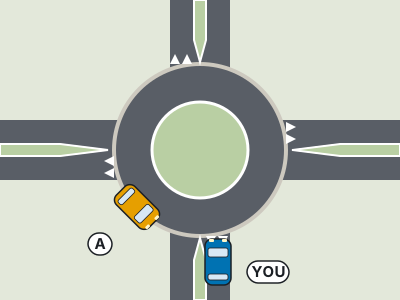
6. Before entering an Ohio roundabout, to whom must you yield?
- Only pedestrians outside the circle
- Vehicles entering behind you
- No one when you have a turn signal
- Traffic already circulating in the roundabout
Show answer
Traffic already circulating in the roundabout. Entering traffic yields to vehicles already circulating in the roundabout. A turn signal helps communicate an intended movement but does not give an entering vehicle priority, and traffic behind you has no special claim over circulating vehicles. Pedestrians may also require attention, yet they are not the sole users with priority. The concrete cue is to slow at the entry, look left for circulating traffic, and enter only after yielding.
Study this in the handbook: Right of way
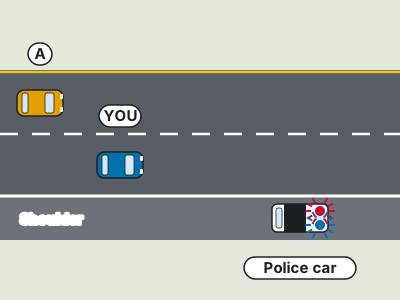
7. A stopped police vehicle displays warning lights on the roadside. What does Ohio's Move Over Law require?
- Stop in the travel lane until the officer leaves
- Maintain speed and sound the horn
- Pass on the shoulder without reducing speed
- Change to a lane not next to it when safe, or slow down and proceed cautiously
Show answer
Change to a lane not next to it when safe, or slow down and proceed cautiously. Ohio requires a driver approaching an authorized vehicle with warning lights activated to move into a lane that is not next to the stopped vehicle when safety and traffic permit. If a lane change is unsafe, the driver must slow down and proceed cautiously at a safe speed for conditions. Stopping in the lane, honking, or using the shoulder does not express either permitted response.
Study this in the handbook: Reasonable speed and the assured clear distance rule
8. On an Ohio one-way street, where may you parallel park?
- Only along the right curb
- Within 12 inches of either the right or left curb
- Within 18 inches of the right curb only
- Anywhere, as long as you face the direction of traffic
Show answer
Within 12 inches of either the right or left curb. Ohio parking law requires a vehicle to be parallel to the curb and no more than 12 inches away from it. On an ordinary two-way street that means the right curb, facing the direction of traffic. A one-way street is different because every vehicle moves the same way, so the digest lets drivers park along either the right or the left curb, still within 12 inches. Angled parking is allowed only where lines mark it.
Study this in the handbook: Right of way
9. If your brakes fail while driving, how should you use the parking brake?
- Apply it slowly so the rear wheels do not lock
- Pull it as hard as possible at highway speed
- Use it only after turning into traffic
- Ignore it and coast until the vehicle stops
Show answer
Apply it slowly so the rear wheels do not lock. If the brakes fail, Ohio says to use the parking brake by pulling the handle or pushing the pedal slowly, so the rear wheels do not lock and cause a skid. Pulling it as hard as possible at speed risks exactly that lockup. If the parking brake does not work, the manual says to turn off the engine, pull off the road, and turn on the emergency flashers. Turning into traffic adds a new conflict, and coasting while ignoring the parking brake skips the first step the manual gives.
Study this in the handbook: Vehicle emergencies and crashes
10. What should you do if your vehicle starts to slide on a slippery roadway?
- Ease off the gas and gently apply the brake
- Press the brake pedal hard and turn sharply
- Accelerate to pull the vehicle straight
- Turn away from the direction of the slide
Show answer
Ease off the gas and gently apply the brake. On a slippery roadway, Ohio advises slowly easing your foot off the gas pedal and gently applying the brake if the vehicle begins to slide. Hard braking and sharp turns are abrupt inputs on a surface where the tires already grip poorly, and accelerating adds force when traction is reduced. Steering away from the slide is also wrong, because the manual's skid guidance is to turn the wheel in the direction of the skid. The practical cue is smoothness: reduce power, brake gently, and avoid abrupt pedal or steering movements.
Study this in the handbook: Reasonable speed and the assured clear distance rule
11. What should you do when an emergency vehicle approaches on a divided highway?
- Stop in the median to let it pass
- Follow it closely through the intersection
- Turn left across the median immediately
- Move right and remain there unless the vehicle is traveling in the opposite direction on a divided highway
Show answer
Move right and remain there unless the vehicle is traveling in the opposite direction on a divided highway. Ohio's emergency vehicle rule requires a driver to move as far right as possible and remain there until the vehicle passes. The manual includes a specific divided highway exception when the public safety vehicle is traveling in the opposite direction, because the separated roadway keeps the response vehicle from sharing the driver's path. Stopping in the median or following closely creates new hazards. First identify whether the vehicle is on your roadway, then clear right and stay stopped when the rule applies.
Study this in the handbook: Right of way
12. An adult Ohio driver commits a third handheld device violation within two years. What can follow?
- 2 points and a $150 fine
- A lifetime revocation
- A warning letter only
- 4 points, a fine of up to $500, and a possible 90-day suspension
Show answer
4 points, a fine of up to $500, and a possible 90-day suspension. Ohio escalates distracted driving penalties within a two year period. The third or later violation brings 4 points, a fine of up to $500, and a possible 90 day license suspension. Two points and $150 is the first offense. Lifetime revocation and a warning letter do not appear in the law's penalties. Fines are doubled if the violation happens in a work zone.
Study this in the handbook: Phone laws, insurance and license points
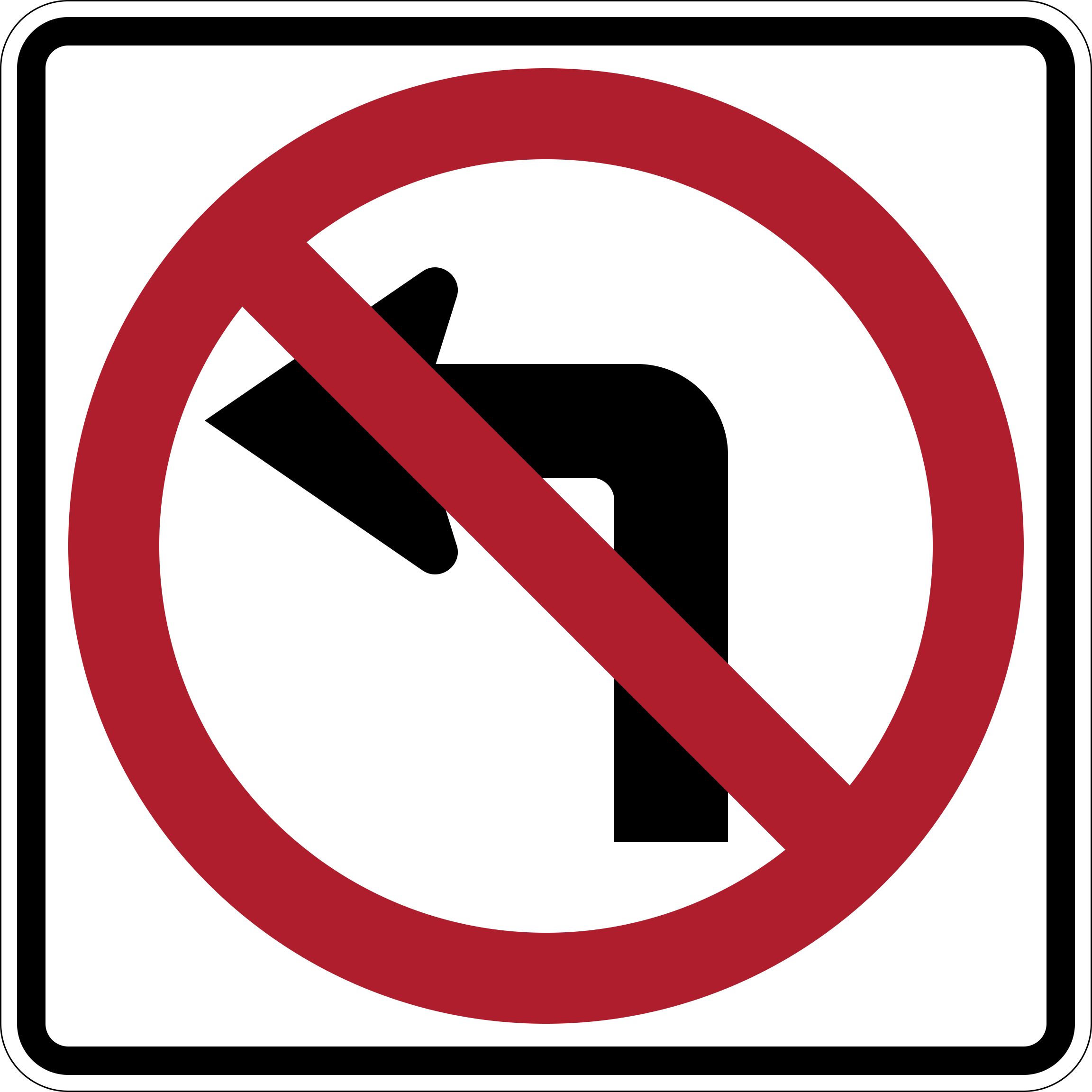
13. What does a red circle with a slash on a traffic sign mean?
- The pictured action is recommended
- The pictured action is prohibited
- The road is entering a work zone
- The sign identifies a nearby service
Show answer
The pictured action is prohibited. Ohio describes the red circle with a slash as a prohibitory symbol. It represents the word no, so the action shown by the symbol is not allowed. That is different from an orange work zone sign, which warns about construction, and from a guide sign, which provides route or service information. A recommendation sign would not use this slash to forbid the pictured movement. Use the cue literally: identify the action inside the circle, then treat the slash as a prohibition against doing it.
Study this in the handbook: Reasonable speed and the assured clear distance rule
14. What should a driver do when approaching a work zone, even if workers are not visible?
- Reduce speed and watch for signs, cones, equipment, and workers
- Keep normal speed until a worker steps into view
- Use the closed lane if it appears shorter
- Follow the vehicle ahead without leaving extra space
Show answer
Reduce speed and watch for signs, cones, equipment, and workers. Ohio directs drivers to reduce speed in a work zone even when no workers are visible. Narrow lanes, rough pavement, cones, barrels, and moving equipment can create danger before a person appears. Normal speed removes the margin needed for those conditions, and a closed lane is not available because it looks faster. Following closely is also risky. Treat the orange signs as an advance warning, leave room ahead, and follow the marked route.
Study this in the handbook: Headlights, night driving and bad weather
15. An Ohio driver under 18 is convicted of Probationary Operating a Vehicle Under the Influence. How long is the suspension?
- 30 days
- Three months
- Six months
- Two years
Show answer
Six months. A conviction or guilty plea to Probationary Operating a Vehicle Under the Influence brings a six month license suspension for a driver under 18. Thirty days is too short. Three months is the suspension for two moving violations. Two years is the top of the OVUAC range for under 21 drivers, not this probationary penalty. After any of these suspensions, the teen must get a TIPIC, finish a juvenile driver improvement program, and pass the driving exam again.
Study this in the handbook: Probationary license limits for drivers under 18
16. How much supervised practice must an Ohio driver under 21 log, and how much of it must be at night?
- 40 hours, including 8 at night
- 55 hours, including 5 at night
- 50 hours, including 10 at night
- 60 hours, including 12 at night
Show answer
50 hours, including 10 at night. A driver under 21 must complete and log 50 hours of supervised driving, with at least 10 hours occurring at night. The 40-hour and 8-hour combination understates both requirements, while the larger totals are not the manual’s stated minimum. These hours are part of the driver education path and must be completed with an eligible licensed driver. The cue is the paired figures: fifty total, ten nighttime.
Study this in the handbook: Knowledge test, TIPIC and driver education
17. What do brake lights communicate to other roadway users?
- That the driver is changing lanes right
- That the vehicle is slowing down or stopping
- That headlights are on high beam
- That the vehicle is parked legally
Show answer
That the vehicle is slowing down or stopping. Brake lights tell other road users that a vehicle is slowing down or stopping. The lane-change choice belongs to turn signals, not brake lights. A driver should avoid surprising traffic behind by braking smoothly when possible and signaling early when turning or parking near an intersection. The cue is red lights brightening at the rear of the vehicle ahead; that message means prepare to reduce speed and increase space.
Study this in the handbook: Reasonable speed and the assured clear distance rule
18. An Ohio driver refuses a chemical test and has one prior refusal within 10 years. How long is the administrative suspension?
- One year
- Three years
- Two years
- Five years
Show answer
Two years. Ohio's refusal suspension depends on prior refusals or OVI and drug convictions within 10 years: one year for a first refusal, two years with one prior, three years with two priors, and five years with three or more. With one prior refusal the suspension is two years. One year is the first refusal, and three or five years require more priors. The suspension starts immediately and stands even if the driver is acquitted of OVI.
Study this in the handbook: Probationary license limits for drivers under 18
19. Before changing lanes, what should an Ohio driver check?

- Mirrors and blind spots by turning the head toward the planned movement
- The radio display and instrument panel before signaling
- The shoulder after moving first, because signaling is optional
- Only the rear-view mirror, without looking beside the vehicle
Show answer
Mirrors and blind spots by turning the head toward the planned movement. Ohio directs a driver changing lanes to check mirrors and blind spots, including areas that cannot be seen in the mirrors. Turning the head and looking over the shoulder toward the intended movement helps reveal a vehicle beside or just behind the car. The rear-view mirror alone cannot show every nearby lane position. The radio and instrument panel do not reveal traffic, and checking the shoulder after moving is too late. Signal, identify a safe gap, look again, adjust speed and steering into the lane, then cancel the signal once the maneuver is complete.
Study this in the handbook: Right of way
20. What should a driver do when rain, snow, sleet, or ice makes the roadway slippery?

- Brake hard and continue at the same speed
- Follow closely to copy the vehicle ahead
- Reduce speed and allow extra distance
- Accelerate through the wet or icy area
Show answer
Reduce speed and allow extra distance. Ohio advises reducing speed at the first sign of rain, snow, sleet, or ice and allowing extra distance from the vehicle ahead. Slippery tires grip less effectively, which increases stopping distance and makes turning without a skid harder. Hard braking can worsen loss of control, close following removes needed reaction room, and acceleration does not restore traction. If the vehicle begins to slide, ease off the gas slowly and apply the brake gently. The cue is smooth control input combined with a larger space cushion.
Study this in the handbook: Reasonable speed and the assured clear distance rule
QualitySpace is expanding to Ohio
We are a California-based independent insurance brokerage working on licensing in more states. We cannot help with Ohio insurance yet. Leave your email and we will let you know when we can.
Every question is written from the official Digest of Ohio Motor Vehicle Laws. Need paper? Printable OH practice test with answer key.
Last verified 2026-10-05. How we check every question · Study all 500 as flashcards
Frequently asked questions
How many questions are on this Ohio practice test?
This fixed set has 20 questions. It is test 5 of 25 from the 500 question Ohio bank. The real OH exam asks 40 questions and you need 30 correct.
What is the passing score for the real Ohio test?
Applicants must answer 75 percent of the questions correctly to pass That figure comes from the official Ohio source cited on the DMV facts page.
How does this fixed test relate to the full Ohio bank?
Each numbered test is a fixed set of questions in a fixed order, so you can retake the same test later and compare. Every test mixes road signs and the other topics in about the same proportion as the full bank. Tests 1 to 25 together cover every question in the Ohio bank once. The full practice page mixes the whole bank at random.
Last verified 2026-10-05. See the Ohio DMV facts page for sourced state details.