
Test 14 of 25 · 20 questions · Free 2026
OH Permit Practice Test 14
Jump to the test ↓A fixed 20 question set from the Ohio bank with answers and plain English explanations. The real OH exam is 40 questions, 75 percent to pass; take the full length version on the main practice page.
Question 1 of 20 · 0 right so far
All 20 questions in test 14
Every question below comes from the Ohio question bank on this page. Open a question to see the correct answer and the explanation. Nothing here is hidden behind a signup.
1. A child age 6 in Ohio weighs 50 pounds and is 4-foot 10-inches tall. Does the manual’s booster-seat rule require a booster seat for this child?
- A booster seat on every trip regardless of height
- No restraint until age 8
- A child safety seat with a full harness
- The booster seat is not required once the child is 4-foot 9-inches or taller
Show answer
The booster seat is not required once the child is 4-foot 9-inches or taller. For a child at least age 4 but under age 8, the manual requires a booster seat unless the child is at least 4-foot 9-inches tall. The child described is taller than that threshold and weighs more than 40 pounds, so the stated booster requirement does not apply. The manual still advises making sure all passengers use safety belts or child restraints.
Study this in the handbook: Probationary license limits for drivers under 18
2. Which vehicle equipment does Ohio forbid because it could injure someone who touches the vehicle?
- A working horn and two headlights
- Protruding objects, broken sharp edges, or parts dangerous to a person coming in contact with them
- A rear view mirror with a clear view behind
- Turn signals visible from 300 feet
Show answer
Protruding objects, broken sharp edges, or parts dangerous to a person coming in contact with them. No vehicle may have protruding objects, broken sharp edges, or parts dangerous to a person coming into contact with them. Consider "A working horn and two headlights": Those items are required safety equipment. Consider "A rear view mirror with a clear view behind": A clear mirror aids rather than endangers. Consider "Turn signals visible from 300 feet": Visible signals are required, not banned.
Study this in the handbook: Vehicle equipment, seat belts and child seats
3. How should a driver respond when a vehicle begins to hydroplane?
- Brake hard and turn sharply
- Accelerate until the tires regain contact
- Move immediately onto the shoulder without steering control
- Slowly ease off the gas pedal
Show answer
Slowly ease off the gas pedal. During hydroplaning, Ohio advises slowly easing the foot off the gas pedal. That gradual release helps the tires regain contact without adding a sudden braking or steering demand. Hard braking and a sharp turn can make the loss of traction worse, while acceleration keeps the vehicle moving over pooled water. The shoulder choice is not a controlled response and may create a second hazard. Keep the steering steady, reduce power smoothly, and wait for grip to return.
Study this in the handbook: Reasonable speed and the assured clear distance rule
4. How must Ohio drivers treat a traffic light that is not working when no law enforcement officer is directing traffic?
- The same as a stop sign
- As a yield sign for cross traffic
- As permission to proceed at the posted speed
- As a green light for the busier street
Show answer
The same as a stop sign. Unless a law enforcement officer is present to direct traffic, treat a non-working traffic signal as a four-way stop. Stop, yield the right-of-way, and proceed cautiously because other drivers may not stop. Consider "As a yield sign for cross traffic": A full stop is required, not just a yield. Consider "As permission to proceed at the posted speed": A non-working signal requires a stop when no officer is directing traffic.
Study this in the handbook: Reasonable speed and the assured clear distance rule
5. Which two conditions does Ohio list among the factors that set stopping distance?
- Driver height and seat position
- Tire brand and paint color
- Condition of the vehicle brakes and condition of the pavement
- Radio volume and passenger count
Show answer
Condition of the vehicle brakes and condition of the pavement. Stopping distance depends on the driver’s reaction time, vehicle speed, the condition of the brakes, and the condition of the pavement, such as whether it is wet, dry, icy, salted, or gravel. Consider "Driver height and seat position": Driver height and seat position are not the stopping-distance factors listed in this section. Consider "Tire brand and paint color": The listed factors include brake and pavement condition, not tire brand and paint color.
Study this in the handbook: Right of way
6. What must you do with your turn signal after completing a turn or lane change in Ohio guidance?
- Leave it on for one full mile
- Remove the bulb until the next turn
- Signal again in the opposite direction
- Cancel your signal so other drivers are not confused
Show answer
Cancel your signal so other drivers are not confused. Use turn signals when changing lanes, merging, or turning. Signal a turn at least 100 feet ahead and cancel the signal to avoid confusing other drivers. Consider "Leave it on for one full mile": Leftover blinking teaches false turns. Consider "Remove the bulb until the next turn": Bulb removal deletes safety gear. Consider "Signal again in the opposite direction": Opposite blinks confuse anew.
Study this in the handbook: Reasonable speed and the assured clear distance rule
7. How are Ohio warning signs usually colored and shaped?
- Orange with black letters
- Green, brown, or blue rectangles
- Yellow with black lettering or symbols, diamond shaped
- Red circles with a slash
Show answer
Yellow with black lettering or symbols, diamond shaped. Warning signs are usually yellow with black lettering or symbols and carry a diamond shape, flagging danger ahead. Orange backgrounds mark work zones, where crews and barrels change the road. Green, brown, or blue rectangles guide drivers toward services, towns, and points of interest. A red circle with a slash prohibits an action outright. Color plus shape forms a quick code: yellow diamond warns, orange warns about work, and red slash forbids.
Study this in the handbook: Reasonable speed and the assured clear distance rule
8. You wait on an entrance ramp to merge onto an Ohio interstate. Who holds the right-of-way?
- Drivers already on the limited access or interstate highway
- You, once your turn signal is on
- The largest vehicle in the merge area
- Nobody, so traffic just alternates
Show answer
Drivers already on the limited access or interstate highway. Drivers already rolling on the limited access or interstate highway keep the right-of-way over a driver waiting on the entrance or acceleration ramp. Signaling announces a wish to merge but grants no priority. Vehicle size never assigns right-of-way under this list. Alternating out of politeness differs from the legal duty, which leaves the ramp driver to find a gap. Speed up on the acceleration lane, match traffic, and slide into open space without forcing freeway drivers to brake.
Study this in the handbook: Reasonable speed and the assured clear distance rule
9. After entering an Ohio roundabout, how should you handle the drive through it?
- Keep moving, without stopping or changing lanes
- Stop midway to let entering cars join
- Back out if your exit looks wrong
- Change lanes near your exit
Show answer
Keep moving, without stopping or changing lanes. Once in a roundabout, keep moving and do not stop or change lanes. Entering traffic yields to circulating traffic. Proceed to the appropriate exit, signal, and exit. Consider "Stop midway to let entering cars join": Entering cars yield to the circle. Consider "Back out if your exit looks wrong": The manual says to keep moving through the roundabout and proceed to the appropriate exit.
Study this in the handbook: Right of way
10. What can happen if a shoulder belt is worn under the arm or behind the back in a crash?
- Nothing changes because the lap belt still works alone
- The air bag turns off automatically
- Serious internal injuries can result
- Only a warning light on the dash appears
Show answer
Serious internal injuries can result. Do not wear the shoulder belt under the arm or behind the back. Wearing it incorrectly could cause serious internal injuries in a crash. Wear it across the shoulder and chest with minimal slack. Consider "Nothing changes because the lap belt still works alone": The manual warns that wearing the shoulder belt incorrectly could cause serious internal injuries. Consider "The air bag turns off automatically": The manual identifies serious internal injuries as a possible result of incorrect belt use; it does not say the air bag switches off.
Study this in the handbook: Vehicle equipment, seat belts and child seats
11. What causes an immediate failure on the Ohio maneuverability test?
- Running over or knocking down a marker, or removing a marker from the test area
- Stopping once to check position
- Pausing before reversing
- Finishing slightly slowly
Show answer
Running over or knocking down a marker, or removing a marker from the test area. Running over or knocking down a marker, removing a marker from the designated area, or other dangerous actions cause immediate failure. Stopping and bumping markers are listed as reasons for point deductions. Consider "Stopping once to check position": Stopping costs points, not instant failure. Consider "Pausing before reversing": A pause before reversing is not listed as an immediate-failure condition; the manual separately lists stopping as a reason for point deductions.
12. What must an Ohio vehicle's rear-view mirror provide?
- An unobstructed view to the rear of the vehicle
- A view of the front bumper area
- A magnified view of the license plate
- A view limited to the back seat
Show answer
An unobstructed view to the rear of the vehicle. The rear-view mirror must provide an unobstructed view to the rear of the vehicle. Before driving, adjust the inside rear-view mirror so it frames the rear window and shows traffic behind the vehicle. Consider "A view of the front bumper area": The mirror watches traffic behind, not the front bumper. Consider "A magnified view of the license plate": The required view is an unobstructed view to the rear of the vehicle, not a magnified view of its plate.
Study this in the handbook: Vehicle equipment, seat belts and child seats
13. At night, what lighting must farm machinery display in Ohio besides the slow-moving emblem?
- Blue flashing lights on the cab
- No lighting beyond the emblem
- A red flashing light at night
- White floodlights aimed at traffic
Show answer
A red flashing light at night. Farm machinery must display the slow-moving emblem and use a red flashing light at night. The manual also tells drivers to pass farm machinery with caution. Consider "Blue flashing lights on the cab": Blue flashing lights are not the farm machinery requirement. Consider "No lighting beyond the emblem": Night operation adds a lighting duty beyond the emblem. Consider "White floodlights aimed at traffic": The manual specifies a red flashing light at night, not white floodlights.
Study this in the handbook: Reasonable speed and the assured clear distance rule
14. What general minimum BAC threshold does the Ohio manual list as unlawful at any age?
- .02 percent or higher at any age
- .08 percent or higher at any age
- .04 percent or higher at any age
- .15 percent or higher at any age
Show answer
.08 percent or higher at any age. The manual lists .08% or higher as an unlawful BAC at any age, .04% or higher for commercial drivers, and .02% or higher for drivers under age 21. Consider ".02 percent or higher at any age": That tighter figure targets drivers under age 21. Consider ".04 percent or higher at any age": That figure applies to commercial drivers. Consider ".15 percent or higher at any age": The general threshold is .08%, not .15%.
Study this in the handbook: Probationary license limits for drivers under 18
15. What counts as a distraction under Ohio guidance?
- Only holding a phone in the hand
- Anything taking attention from driving, through hands off the wheel, eyes off the road, or mind off driving
- Only passengers talking loudly
- Only eating a full meal at speed
Show answer
Anything taking attention from driving, through hands off the wheel, eyes off the road, or mind off driving. A distraction is anything that takes attention away from driving, whether it is physically taking your hands from the wheel, eyes away from the road, or mental activities that take your mind away from driving. Consider "Only holding a phone in the hand": A held phone is only one example. Consider "Only passengers talking loudly": Volume alone was never the test. Consider "Only eating a full meal at speed": Small bites with eyes down count.
Study this in the handbook: Probationary license limits for drivers under 18
16. Does Ohio give drivers a grace period after a driver license expires?
- Yes, 30 days
- Yes, 90 days
- No, there is no grace period for renewing
- Yes, six months
Show answer
No, there is no grace period for renewing. Ohio has no grace period for renewing a license, and it is your responsibility to know when your license expires. Continuing to drive after the license has expired risks a traffic citation. Consider "Yes, 30 days": The manual gives no 30 day grace period. Consider "Yes, 90 days": The manual gives no 90 day grace period. Consider "Yes, six months": The manual gives no six month grace period.
Study this in the handbook: Probationary license limits for drivers under 18
17. On a two-way Ohio road, what does a solid yellow line in your lane mean for passing?
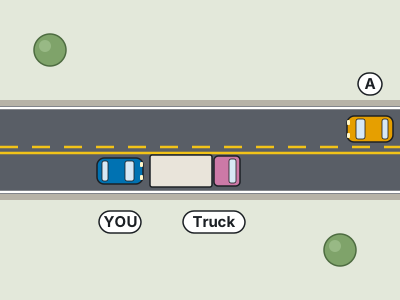
- Passing is required before the next intersection
- Passing is prohibited in your lane
- Passing is allowed if you use a turn signal
- The center lane is reserved for left turns
Show answer
Passing is prohibited in your lane. A solid yellow line in your lane marks the side where passing is prohibited. Passing becomes available when the broken yellow line is in your lane and the maneuver is otherwise safe. A turn signal does not authorize crossing a prohibited marking, and the left-turn center lane is a separate roadway feature with its own restriction. Read the marking from your lane, not from the opposite driver's perspective, before deciding whether a pass is legal. The line controls the passing choice even when the road ahead appears clear.
Study this in the handbook: Right of way
18. A 17-year-old Ohio driver makes a nonemergency phone call hands-free at a red light and is cited for a first device violation. What penalty applies?
- A $150 fine with no suspension
- A 60-day license suspension and a $150 fine
- A one-year suspension and a $300 fine
- 2 points with no fine
Show answer
A 60-day license suspension and a $150 fine. For drivers under 18 the first device violation costs a 60 day license suspension plus a $150 fine, and hands-free use or waiting at a light gives no shelter because nearly all device use is banned at that age. A $150 fine standing alone drops the suspension half of the penalty. One year with $300 is the second violation price. Two points belong to the adult schedule. Youth status changes both the ban and the bill, so check age first.
Study this in the handbook: Probationary license limits for drivers under 18
19. Through the Ohio Next of Kin program, how many emergency contacts may a person list on a driver record?
- One contact only
- Contacts are unlimited
- Five emergency contacts
- Up to two emergency contacts
Show answer
Up to two emergency contacts. The Next of Kin program lets Ohioans identify up to two emergency contacts for law enforcement to notify when a crash or emergency leaves them unable to communicate. Parents may also add contact information to an Ohio ID record for a child who becomes lost or is reported missing. Consider "One contact only": One understates the allowance. Consider "Contacts are unlimited": Unlimited ignores the cap.
20. In which listed situations does Ohio say more front space is needed?
- Only on empty rural roads
- Never, if brakes are new
- Only behind sports cars
- When visibility is limited by weather or night, on slippery roads, and behind large vehicles
Show answer
When visibility is limited by weather or night, on slippery roads, and behind large vehicles. Increase following distance when visibility is limited by weather or night, on slippery roads, and when following large vehicles such as trucks, buses, recreational vehicles, or vehicles pulling trailers. Consider "Only on empty rural roads": The manual lists limited visibility, slippery roads, and following large vehicles as reasons for more space. Consider "Never, if brakes are new": The manual calls for more space in the listed conditions without an exception for new brakes.
Study this in the handbook: Reasonable speed and the assured clear distance rule
QualitySpace is expanding to Ohio
We are a California-based independent insurance brokerage working on licensing in more states. We cannot help with Ohio insurance yet. Leave your email and we will let you know when we can.
Every question is written from the official Digest of Ohio Motor Vehicle Laws. Need paper? Printable OH practice test with answer key.
Last verified 2026-10-05. How we check every question · Study all 500 as flashcards
Frequently asked questions
How many questions are on this Ohio practice test?
This fixed set has 20 questions. It is test 14 of 25 from the 500 question Ohio bank. The real OH exam asks 40 questions and you need 30 correct.
What is the passing score for the real Ohio test?
Applicants must answer 75 percent of the questions correctly to pass That figure comes from the official Ohio source cited on the DMV facts page.
How does this fixed test relate to the full Ohio bank?
Each numbered test is a fixed set of questions in a fixed order, so you can retake the same test later and compare. Every test mixes road signs and the other topics in about the same proportion as the full bank. Tests 1 to 25 together cover every question in the Ohio bank once. The full practice page mixes the whole bank at random.
Last verified 2026-10-05. See the Ohio DMV facts page for sourced state details.