
Test 6 of 25 · 20 questions · Free 2026
OH Permit Practice Test 6
Jump to the test ↓A fixed 20 question set from the Ohio bank with answers and plain English explanations. The real OH exam is 40 questions, 75 percent to pass; take the full length version on the main practice page.
Question 1 of 20 · 0 right so far
All 20 questions in test 6
Every question below comes from the Ohio question bank on this page. Open a question to see the correct answer and the explanation. Nothing here is hidden behind a signup.
1. What does Ohio say about driving while impaired by alcohol or drugs?
- It is allowed below .08% BAC
- It is allowed when medication is prescribed
- It is against the law
- It is prohibited only for commercial drivers
Show answer
It is against the law. Ohio states that driving while impaired under the influence of alcohol or drugs is against the law. A .08 percent figure is a BAC threshold for one legal classification, not permission to drive while visibly impaired below that number. A prescription also does not guarantee safe driving, because legally prescribed or over-the-counter medication may affect driving ability. The commercial-driver rule is only one category of alcohol regulation. The practical cue is impairment, not the source of the substance: if alcohol, drugs, or medication affects control or judgment, driving is unlawful and unsafe.
Study this in the handbook: Probationary license limits for drivers under 18
2. How far from an intersection or crosswalk must you stay when parking in Ohio?
- At least 5 feet
- At least 10 feet
- At least 20 feet
- At least 50 feet
Show answer
At least 20 feet. Ohio bars stopping, parking, or standing in or within 20 feet of an intersection or crosswalk, unless needed to avoid a conflict with traffic or directed by an officer or traffic control device. Five feet is far too close. Ten feet is the fire hydrant distance. Fifty feet is far more than the listed distance. Vehicles must also park facing the direction of traffic within 12 inches of the right curb.
Study this in the handbook: Right of way
3. Your Ohio vehicle starts accelerating out of control because the accelerator is stuck. What should you do first?
- Turn the engine off immediately while still at speed
- Pump the accelerator to free it while steering hard
- Shift into park while the car is still moving
- Turn on emergency flashers, shift to neutral, and look for an escape route
Show answer
Turn on emergency flashers, shift to neutral, and look for an escape route. A stuck accelerator keeps the engine pushing the car forward. Ohio's steps start by turning on the emergency flashers, shifting to neutral so the engine no longer drives the wheels, and searching for an escape route. Then steer smoothly, brake gradually, and pull off the roadway. Only after the car is stopped do you shift to park and turn off the engine. Staying calm and steering smoothly keeps the vehicle under control while it slows.
Study this in the handbook: Vehicle emergencies and crashes
4. You are entering an Ohio freeway and see a merge sign. How should you find room to merge?

- Rely only on the inside rear-view mirror
- Look over your shoulder and use your outside mirrors to find a gap
- Stop at the end of the ramp until no vehicles are in sight
- Drive on the shoulder until a gap opens
Show answer
Look over your shoulder and use your outside mirrors to find a gap. Ohio tells a driver entering a freeway to be aware of the vehicle ahead, look over the shoulder toward the merging side, and use the outside mirrors to identify a gap in traffic. The driver then signals and uses the acceleration lane to reach the speed of other vehicles before merging, and cancels the signal afterward. Relying on the inside mirror alone is not the check the manual describes, stopping at the end of the ramp gives up the speed needed to blend in, and the shoulder is not an entrance lane. Find the gap first, then match speed and merge smoothly.
Study this in the handbook: Right of way
5. While passing another vehicle in Ohio, how do you know you have gone far enough to return to your lane?
- Your rear bumper is even with its front bumper
- You have counted two seconds after pulling alongside
- Both headlights of the passed vehicle appear in your rear-view mirror
- The other driver flashes the high beams at you
Show answer
Both headlights of the passed vehicle appear in your rear-view mirror. Ohio's passing steps end with a clear visual test. Keep going until you can see both headlights of the vehicle you passed in your rear-view mirror. Then signal your return and steer smoothly back into the lane, keeping or adjusting speed as needed. Pulling back in sooner leaves the other driver too little space and can force a sudden brake or a crash. The mirror check works the same on any road where passing is allowed.
Study this in the handbook: Right of way
6. In an Ohio roundabout, which exit do you normally use to turn left?
- The 1st exit
- The 3rd exit
- The 2nd exit
- The 4th exit
Show answer
The 3rd exit. Traffic in an Ohio roundabout moves counterclockwise, so the exits come up in a fixed order. The digest lays out the exit pattern drivers should expect: the 1st exit turns you right, the 2nd exit takes you straight, the 3rd exit turns you left, and the 4th exit makes a U turn. Knowing the count ahead of time lets you stay in the correct lane, signal before your exit, and avoid stopping inside the circle.
Study this in the handbook: Roundabouts, lane use and parking
7. If a railroad crossing has a stop sign posted with the crossbuck, what must drivers do?
- Stop only if a gate is descending
- Stop before proceeding
- Continue after sounding the horn
- Cross without stopping if no train is visible
Show answer
Stop before proceeding. At some railroad crossings, a stop sign is posted with the warning signs. Ohio says every vehicle must stop before going on when that stop sign is present. The gate-only choice is wrong because the stop sign creates the stopping requirement even without a gate. Use the stop sign as the cue, then look both ways and listen before crossing. Proceed only after checking for trains and confirming the tracks can be cleared without stopping on them.
Study this in the handbook: Right of way
8. When entering a freeway, what should a driver use to merge with the traffic flow?
- The shoulder until the next exit
- The median to pass established traffic
- The acceleration lane after reaching the speed of other vehicles
- The deceleration lane before entering
Show answer
The acceleration lane after reaching the speed of other vehicles. Ohio directs a driver entering a freeway to look for a gap, signal, and use the acceleration lane to reach the speed of other vehicles before merging. The shoulder is not a substitute for the entrance lane, and the median is not a travel lane for passing. A deceleration lane serves exiting traffic, so using it to enter reverses its purpose. Match the lane to the maneuver: accelerate and merge from the entrance lane when the gap is safe.
Study this in the handbook: Right of way
9. A driver under 18 in Ohio is cited a second time for using an electronic device while driving. What is the penalty?
- A 60 day suspension and a $150 fine
- A 1-year license suspension and a $300 fine
- 3 points and a fine of up to $250
- A warning letter with no suspension
Show answer
A 1-year license suspension and a $300 fine. Drivers under 18 in Ohio may not use any electronic device while driving, even hands free, except for navigation or emergency calls. It is a primary offense, so an officer can stop the driver for it alone. The first violation brings a 60 day suspension and a $150 fine. A second violation is far more serious: the young driver loses the license for one year and pays a $300 fine.
Study this in the handbook: Probationary license limits for drivers under 18
10. When Ohio school-zone lights are flashing or children are present, what should drivers do?
- Keep the ordinary roadway speed
- Obey the slower school-zone speed limit
- Accelerate before children enter the roadway
- Stop in every lane until dismissal ends
Show answer
Obey the slower school-zone speed limit. Ohio requires drivers to obey a slower speed limit in a school zone when the lights are flashing or children are present. The ordinary roadway speed does not replace the school-zone limit, and accelerating increases risk near children. The rule also directs drivers to obey crossing guards at nearby intersections. The cue is flashing lights or visible children: reduce speed and watch for crossings.
Study this in the handbook: Reasonable speed and the assured clear distance rule
11. At what age may an applicant first complete Ohio’s vision screening and knowledge test for a TIPIC?
- 15 years and 6 months
- 14 years and 6 months
- 16 years exactly
- 17 years and 6 months
Show answer
15 years and 6 months. Ohio sets the minimum age for completing the vision screening and knowledge test at 15 years and six months. This is the starting age described for the TIPIC process, not 14 years and six months or a full sixteenth birthday. The applicant still must complete the required steps and purchase the permit after passing. The cue is the half-year detail: the initial eligibility point is 15 years, 6 months.
Study this in the handbook: Knowledge test, TIPIC and driver education
12. How many points does Ohio assess for failing to stop and disclose your identity after a crash?
- 2 points
- 3 points
- 4 points
- 6 points
Show answer
6 points. Ohio's point categories put failure to stop and disclose identity after a crash at 6 points, with other dangerous and serious actions. Two points is for ordinary moving violations, some speed offenses, and restriction violations. Four points is for willful or wanton disregard for the safety of people or property. Three points appears for a second handheld phone offense, not here. Twelve points within two years brings a suspension.
Study this in the handbook: Probationary license limits for drivers under 18
13. What does a white railroad crossbuck identify, and what should the driver do?
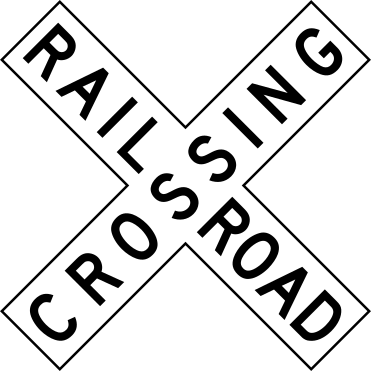
- A highway railroad crossing, approached slowly with readiness to stop
- A one-way road where passing must continue through the intersection
- A parking area where stopping is prohibited even for an approaching train
- A school crossing where the driver should accelerate after checking mirrors
Show answer
A highway railroad crossing, approached slowly with readiness to stop. The white X-shaped crossbuck identifies a highway railroad grade crossing. Ohio tells drivers to slow down and be prepared to stop when they see or hear a train approaching. The sign is not a school, one-way, or parking instruction. Accelerating does not provide the cautious approach required, and the crossing warning does not remove the duty to respond to a train. Look in both directions, listen, and keep enough space to stop before the tracks. Never stop on the rails, since a vehicle there can be trapped in the train’s path.
Study this in the handbook: Right of way
14. What does a double solid yellow center line generally require?
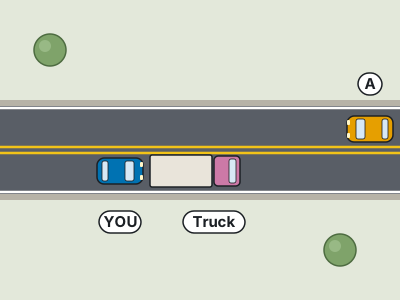
- Do not drive left of the center line except for a permitted crossing
- Pass whenever the road ahead appears empty
- Use the center line as a travel lane
- Cross it to make every right turn
Show answer
Do not drive left of the center line except for a permitted crossing. A double solid yellow line marks a strong restriction against driving to the left of the center line. Ohio allows crossing only for limited purposes such as turning left or passing a slow-moving vehicle when the situation is permitted. An empty-looking road does not make unrestricted passing legal, and the marking is not a travel lane. Right turns do not require crossing the center line. Read the double solid pair as a warning to stay right unless the stated exception applies.
Study this in the handbook: Reasonable speed and the assured clear distance rule
15. When is a driver allowed to turn left on red in Ohio?
- From any lane onto any two way street after slowing
- Whenever the vehicle has a green left turn arrow behind it
- Only after a police officer waves the driver through
- From the extreme left lane of a one way street onto another one way street, unless prohibited
Show answer
From the extreme left lane of a one way street onto another one way street, unless prohibited. Ohio permits a left turn on red only from the extreme left lane of a one way street onto another one way street, unless a posted sign forbids that movement. A two way destination does not meet the stated condition, and slowing alone cannot replace the legal requirements. A police officer is not required when the turn is otherwise lawful, while a separate green arrow would not describe a turn on red. Check both roadway directions and the sign before considering this narrow exception.
Study this in the handbook: Right of way
16. Which drivers are required to stop at railroad crossings even when no train is plainly visible?
- Drivers of vehicles carrying passengers for hire, school buses, or vehicles carrying explosives or flammable liquids
- Only drivers towing small personal trailers
- Only drivers of passenger cars with children aboard
- Drivers of motorcycles and mopeds only
Show answer
Drivers of vehicles carrying passengers for hire, school buses, or vehicles carrying explosives or flammable liquids. Ohio singles out certain vehicles for railroad crossing stops because their passengers or cargo make a train conflict especially severe. Vehicles carrying passengers for hire, school buses, and vehicles carrying explosives or flammable liquids must stop and check carefully. The personal trailer choice adds a category the manual does not list. Watch for buses, placards, or passenger-for-hire vehicles near tracks, and expect them to stop even when other traffic might continue.
Study this in the handbook: Right of way
17. When should Ohio drivers use headlights because of weather or visibility?
- Whenever visibility is poor because of rain, snow, fog, or similar conditions
- Only when visibility falls below 100 feet
- Only after midnight during winter
- Only when another driver flashes headlights first
Show answer
Whenever visibility is poor because of rain, snow, fog, or similar conditions. Ohio requires headlights whenever visibility is poor, including conditions such as rain, snow, or fog. The rule does not wait for a particular 100 foot measurement, midnight, or another driver's signal. Headlights help the driver see and help other roadway users notice the vehicle, so the weather condition itself is the cue. The manual also requires them from sunset to sunrise and whenever windshield wipers are in use because of precipitation, making early use the safer habit.
Study this in the handbook: Headlights, night driving and bad weather
18. When may a driver park in a space marked with a wheelchair symbol?
- Only when all other spaces are full
- Whenever the driver expects to stay less than five minutes
- Only when issued a removable windshield placard or accessible license plate
- Whenever another passenger remains in the vehicle
Show answer
Only when issued a removable windshield placard or accessible license plate. A wheelchair-symbol space is reserved, and Ohio says a driver may use it only with the proper removable windshield placard or accessible license plate. The short-stop choice is wrong because convenience or time does not replace the required authorization. The cue is the wheelchair symbol on the sign or pavement. If the vehicle lacks the placard or plate, choose a regular space even when the reserved space is open.
Study this in the handbook: Right of way
19. What must an Ohio driver do when a school bus has stopped to pick up or drop off students?
- Pass after slowing to 10 mph
- Pass on the right shoulder to get around the bus
- Honk and pass before the red lights activate
- Stop for the bus
Show answer
Stop for the bus. Ohio requires a driver to stop when a school bus is dropping off or picking up students. Amber lights warn that the bus is preparing to stop, so nearby drivers should prepare, but other vehicles are not required to stop during that amber stage. Once the bus has fully stopped and the stop warning applies, passing is not made safe by reducing speed or sounding the horn. Treat the bus as a stop condition and wait until movement is lawful.
Study this in the handbook: Right of way
20. When does the Ohio manual list school zones as a basis for reduced speed limits?
- During weekends when the building is closed
- Only after sunset on school nights
- Only when every lane has a crossing guard posted
- During recess and while children arrive or leave during normal school hours
Show answer
During recess and while children arrive or leave during normal school hours. The school zone speed rule is tied to times when children are likely to be near the roadway: recess and normal arrival or dismissal periods. The weekend choice is wrong because the manual connects the reduced speed setting to school activity, not to an empty building. Watch for school zone signs, flashing lights, children near sidewalks, and buses loading nearby. Those cues mean the posted school zone speed may apply even when the broader road normally allows faster travel.
Study this in the handbook: Reasonable speed and the assured clear distance rule
QualitySpace is expanding to Ohio
We are a California-based independent insurance brokerage working on licensing in more states. We cannot help with Ohio insurance yet. Leave your email and we will let you know when we can.
Every question is written from the official Digest of Ohio Motor Vehicle Laws. Need paper? Printable OH practice test with answer key.
Last verified 2026-10-05. How we check every question · Study all 500 as flashcards
Frequently asked questions
How many questions are on this Ohio practice test?
This fixed set has 20 questions. It is test 6 of 25 from the 500 question Ohio bank. The real OH exam asks 40 questions and you need 30 correct.
What is the passing score for the real Ohio test?
Applicants must answer 75 percent of the questions correctly to pass That figure comes from the official Ohio source cited on the DMV facts page.
How does this fixed test relate to the full Ohio bank?
Each numbered test is a fixed set of questions in a fixed order, so you can retake the same test later and compare. Every test mixes road signs and the other topics in about the same proportion as the full bank. Tests 1 to 25 together cover every question in the Ohio bank once. The full practice page mixes the whole bank at random.
Last verified 2026-10-05. See the Ohio DMV facts page for sourced state details.