
Test 5 of 10 · 20 questions · Free 2026
NV Permit Practice Test 5
Jump to the test ↓A fixed 20 question set from the Nevada bank with answers and plain English explanations. The real NV exam is 25 questions, 80 percent to pass; take the full length version on the main practice page.
Question 1 of 20 · 0 right so far
All 20 questions in test 5
Every question below comes from the Nevada question bank on this page. Open a question to see the correct answer and the explanation. Nothing here is hidden behind a signup.
1. Traffic control lights are not working at an intersection. What must drivers do before proceeding?
- Come to a full stop, yield to pedestrians and vehicles already stopped or in the intersection, then proceed cautiously
- Treat the intersection as an uninterrupted green light and continue without slowing
- Wait for another driver to move first, even after the intersection is clear
- Use the shoulder to bypass the signal and avoid the stopped traffic
Show answer
Come to a full stop, yield to pedestrians and vehicles already stopped or in the intersection, then proceed cautiously. A dark or malfunctioning traffic signal does not give a driver permission to continue through. Nevada calls for a full stop before proceeding, followed by yielding to pedestrians and vehicles that have already stopped or entered the intersection. The green-light choice removes both the stop and the yielding duties. Waiting indefinitely is unnecessary once the intersection can be entered safely, and the shoulder is not an alternate travel lane. The useful habit is to treat the approach like a controlled stop, check every direction, and move only after conflicts are resolved.
Study this in the handbook: Traffic Signals and Arrows
2. Nevada law requires headlights when people or vehicles cannot be clearly seen from what distance?
- 300 feet
- 500 feet
- 1,000 feet
- 200 feet
Show answer
1,000 feet. Headlights are legally required whenever people or vehicles cannot be clearly seen at a distance of 1,000 feet. This rule covers poor visibility even when the driver is not yet in darkness, so waiting until objects are only 500 or 300 feet away is too late. The shorter figures are associated with other handbook distances, including low-beam timing and visibility rules, not this trigger. Use the ability to see other road users as the cue: if they fade from clear view at the required distance, turn on the headlights.
Study this in the handbook: Night Driving, Bad Weather and Skids
3. What should you do if your windshield wipers fail during heavy rain or snow?
- Slow down, improve your view, and pull off the highway to the right if possible
- Continue at the posted speed while looking through the side window
- Stop in the travel lane and wait for the wipers to restart
- Turn on high beams and accelerate until the weather clears
Show answer
Slow down, improve your view, and pull off the highway to the right if possible. Failed wipers during heavy precipitation can remove the driver's view, so reduce speed immediately and, if possible, move right and stop as soon as you can. The handbook also describes lowering the window and looking outside to regain visibility while getting out of the traffic stream. Maintaining speed through obscured vision magnifies the hazard, and stopping in a travel lane exposes the vehicle to a rear impact. High beams and acceleration do not restore safe sight distance.
Study this in the handbook: Driving Emergencies and Flash Floods
4. In Nevada, what do orange roadway signs generally warn drivers about?
- Recreation and scenic areas
- Driver services such as food and lodging
- Road construction or repair
- A traffic law that applies permanently
Show answer
Road construction or repair. Orange is the standard sign color for road construction or repair warnings. When that color appears, expect changed lanes, equipment, workers, uneven pavement, or temporary traffic control and reduce speed as conditions require. Blue points to driver services, brown identifies recreation and scenic information, and white generally carries regulatory information. Color recognition is an early cue, so follow the temporary signs and flaggers rather than assuming the normal roadway pattern continues.
Study this in the handbook: Sign Colors and Shapes
5. What is the longest a Nevada driver license or ID card can be valid?
- Four years
- Eight years
- For life
- Ten years
Show answer
Eight years. At no time will a Nevada driver license or identification card be valid for more than eight years under NRS 483.290, though shorter terms apply to some applicants, such as those with limited lawful stays. Applicants under 18 need a custodial parent, legal guardian or other authorized adult to co sign, and that adult accepts liability for the minor's driving.
6. Where can an applicant obtain more information about a Nevada restricted license?
- At a local DMV office
- Only from a private driving school
- From the nearest court clerk
- Only after passing a commercial road test
Show answer
At a local DMV office. Nevada's restricted-license section directs applicants to a local DMV office for additional information and applications. The private-school, court-clerk, and commercial-test choices add requirements that the cited passage does not state. A restricted license can involve age, hardship, school travel, or a portion of a suspension or revocation period, so an applicant should confirm the applicable category and paperwork with the agency. The useful cue is that the DMV is the source named for both information and applications, not a general driving school or unrelated court office.
Study this in the handbook: License Rules and Demerit Points
7. What protection does a green turn arrow provide?
- It removes the need to check for bicycles
- It permits every movement through the intersection
- It requires a complete stop before turning
- It protects the turn from other traffic, subject to duties toward pedestrians and traffic already present
Show answer
It protects the turn from other traffic, subject to duties toward pedestrians and traffic already present. A green turn arrow protects the indicated movement from other traffic, but it does not erase the driver’s duty to watch for pedestrians, bicycles, and traffic already in the intersection. Turning in any direction exceeds what the arrow shows. A complete stop is not the general meaning of a green arrow, and vulnerable road users still require attention. Follow the arrow, scan the crosswalk and intersection, and complete the turn smoothly only when those road users are clear.
Study this in the handbook: Traffic Signals and Arrows
8. What must a driver do when approaching a Nevada YIELD sign?
- Slow down, yield to required traffic, and check all directions
- Stop for exactly five seconds before moving
- Enter first because the sign gives approaching traffic priority
- Look only to the left before continuing
Show answer
Slow down, yield to required traffic, and check all directions. A yield sign does not automatically require a complete stop. The driver must slow on approach, give way to pedestrians and through traffic, and check all directions before entering. A five-second pause is not part of the rule, and entering first reverses the priority established by the sign. The sign also does not limit the rule to a particular turning movement. Use the sign as a prompt to reduce speed and evaluate who has priority. Stop if the traffic situation requires it, otherwise continue only after the path is safe.
Study this in the handbook: Stop, Yield, Regulatory, Warning and Work Zone Signs
9. Which statement about a Nevada moped operator is true?
- The operator may ignore lane position because mopeds have a 30 mph maximum speed
- The operator must always use the left lane on a multi-lane road
- The operator must remain in the extreme right-hand lane unless a listed exception applies
- The operator may use the shoulder whenever traffic is moving faster
Show answer
The operator must remain in the extreme right-hand lane unless a listed exception applies. Nevada requires moped operators to remain in the extreme right-hand lane, subject to exceptions such as a single-lane road, preparing for a left turn, an unsafe right lane, or a police officer's direction. The speed capability of a moped does not erase its lane duty. A blanket left-lane rule is the opposite of the handbook instruction, and the shoulder is not automatically available as a refuge from faster traffic. Watch the lane position early, signal before a permitted move, and make a left turn within the stated distance when that exception applies.
Study this in the handbook: Trucks, Motorcycles, Mopeds and School Buses
10. What documents must a Nevada applicant under 18 present when applying for a license?
- Only a birth certificate
- A driver education completion certificate and a Beginning Driver Experience Log, DMV Form DLD-130
- A parent's insurance card
- A school report card
Show answer
A driver education completion certificate and a Beginning Driver Experience Log, DMV Form DLD-130. When you apply for a driver's license or driver authorization card under 18, you must present a Certificate of Completion of a driver's education course and a Beginning Driver Experience Log, DMV Form DLD-130, documenting supervised practice. There are three options for meeting the driver education requirement, and a parent or guardian must co sign the application and accept responsibility for the young driver.
Study this in the handbook: Tests and Driver Education
11. How early must a Nevada driver signal a turn on an open highway?
- At least 100 feet ahead
- At least 200 feet ahead
- At least 500 feet ahead
- At least 300 feet ahead
Show answer
At least 300 feet ahead. On an open highway, the turn signal must begin at least 300 feet before the turn. The 100 foot figure belongs to city streets, so applying it on a highway gives following traffic less notice than required. Two hundred feet is also short, and 500 feet is not the handbook's stated threshold. Signal early enough to communicate the planned movement, then watch traffic, pedestrians, signs, and markings while slowing for the turn. The setting is the key cue: identify whether the roadway is an open highway or a city street before choosing the distance.
Study this in the handbook: Turns, Lane Changes, U-Turns and Passing
12. What do Nevada railroad crossing signs warn drivers to do?

- Accelerate before reaching the tracks
- Slow down and possibly stop for a train
- Turn around at every crossing
- Park beside the nearest rail
Show answer
Slow down and possibly stop for a train. Nevada says railroad crossing signs warn drivers to slow down and possibly stop for a train. That warning gives the driver time to check both directions, observe signals, and keep the vehicle clear of the tracks. Accelerating reduces the time available to react, turning around is not required at every crossing, and parking beside a rail creates a separate safety and legal problem. Treat the sign as an advance cue, reduce speed smoothly, and enter the crossing only when the path is clear and the vehicle can fully clear the rails.
Study this in the handbook: Railroad Crossings
13. What do the DO NOT ENTER and WRONG WAY signs indicate on a freeway entrance?
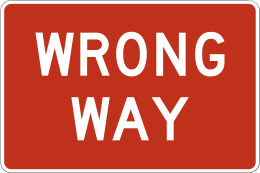
- A rough surface is ahead
- The driver has made a mistaken entry in the wrong direction
- A truck lane begins
- Passing is allowed on either shoulder
Show answer
The driver has made a mistaken entry in the wrong direction. Nevada tells drivers to use the on-ramp when they enter the freeway and says signs will read DO NOT ENTER and WRONG WAY if they have made a mistake. These signs mean the vehicle is entering against the permitted direction of travel. A rough surface or a truck lane would be shown by a different warning or regulatory sign, and shoulders are not passing lanes. The cue is the sign facing the driver at the entrance: do not continue past it, and use the correct on-ramp so the vehicle travels with traffic.
Study this in the handbook: Freeway Driving
14. A Nevada driver reaches an intersection while a funeral procession with headlights on is approaching. What should the driver do?
- Yield only to the last vehicle in the group
- Enter between vehicles after the lead car passes
- Pass the procession on the shoulder
- Yield and let the procession pass as a group
Show answer
Yield and let the procession pass as a group. Nevada directs drivers to yield to a funeral procession and allow the vehicles displaying headlights to pass together as a group. Entering between cars can break the procession and create an unexpected conflict at the intersection. The shoulder choice is not a substitute for yielding and may introduce pedestrians or roadside hazards. Identify the group early, remain stopped at a safe position, and wait until the procession has cleared before moving. The headlights are a useful cue that the vehicles are traveling together for this purpose.
Study this in the handbook: Right of Way
15. Nevada's stopped-vehicle safety duty also covers a person attending to what situation?
- A vehicle being washed
- A private roadside conversation
- A repair of a vehicle
- A parked vehicle at a shopping center
Show answer
A repair of a vehicle. Nevada extends the stopped-vehicle duty to anyone attending to a vehicle repair. This means a driver should not treat an unlit repair scene as ordinary roadside parking. Slow to a reasonable speed below the posted limit, proceed cautiously, stay ready to stop, and move into a nonadjacent lane when conditions make that possible. The tempting shopping-center choice changes the setting and has no repair activity. Spotting a person working beside a disabled vehicle is the cue to create extra space and expect an unexpected movement near the shoulder.
Study this in the handbook: Emergency Vehicles and Stopped Service Vehicles
16. A pedestrian is crossing at a Nevada intersection while the traffic signal turns green for vehicles. What must the driver do?
- Turn around and use a different street
- Proceed immediately because the vehicle signal is green
- Honk until the pedestrian reaches the center line
- Yield to the pedestrian still crossing
Show answer
Yield to the pedestrian still crossing. A green vehicle signal does not erase the right of a pedestrian who is already crossing. Nevada requires drivers to yield to people still in the roadway, including when the light changes. The green-light choice is dangerous because it treats the signal as permission to enter an occupied crossing. Keep the vehicle stopped, watch for people in every lane, and move only after the pedestrian reaches a safe place. This is especially important during a turn, when the driver may otherwise focus on cross traffic and miss the crosswalk.
Study this in the handbook: Pedestrians and Bicyclists
17. On a Nevada road with several lanes moving in the same direction, what should slower traffic do?
- Drive on the shoulder to create room for faster vehicles
- Remain in the left lane so merging traffic cannot enter
- Accelerate above the limit until no vehicle is behind it
- Move to the right and allow other drivers to pass
Show answer
Move to the right and allow other drivers to pass. When two or more lanes travel in one direction, Nevada's guidance places slower traffic on the right so other drivers can pass. Staying left can cause traffic to stack up and may encourage an impatient driver to attempt a risky pass. The choice “Remain in the left lane so merging traffic cannot enter” reverses the lane-management rule. A useful roadside cue is a faster vehicle closing from behind while you are not preparing for a left turn. Hold a steady, lawful speed, check mirrors, and move right when the lane is clear.
Study this in the handbook: Freeway Driving
18. How soon must a new Nevada resident register a vehicle?
- Within one year
- Within 30 days of establishing residency or when obtaining a license, whichever is earlier
- Only at the next renewal
- Within 10 days
Show answer
Within 30 days of establishing residency or when obtaining a license, whichever is earlier. Drivers must register their vehicles within 30 days of establishing residency in Nevada or at the time they obtain a driver license, whichever occurs earlier. In Clark and Washoe counties a passing emissions inspection report is required for most gasoline vehicles of model year 1968 and newer and for diesel vehicles of 1968 or newer up to 14,000 pounds GVWR.
Study this in the handbook: Insurance and What to Do in a Crash
19. A Nevada driver under 18 tests at 0.04 percent blood alcohol. What happens to the license, according to the affidavit minors sign?
- A 30 day suspension
- Nothing, because the level is under 0.08
- Revoked for 185 days
- A warning letter to the parents
Show answer
Revoked for 185 days. Minors applying for a license sign an affidavit saying the license may be revoked for 185 days if a test shows at least 0.02 but less than 0.08 percent alcohol. A 0.04 result is inside that range. Being under 0.08 does not help a driver under 21, and neither a 30 day suspension nor a warning letter is the stated result. A court finding of DUI also brings a 185 day revocation.
Study this in the handbook: Tests and Driver Education
20. Who may supervise a Nevada driver on a Class C instruction permit?
- Any licensed driver age 18 or older
- A licensed driver 21 or older with at least one year of experience, seated beside the learner
- A parent, even without a license
- Any passenger with a learner's permit
Show answer
A licensed driver 21 or older with at least one year of experience, seated beside the learner. A Class C permit holder must be accompanied by a licensed driver who is 21 or older, has at least one year of licensed driving experience, and is seated beside the learner. An 18 year old does not meet the age rule, an unlicensed parent cannot supervise, and another permit holder is not licensed. Motorcycle permit holders instead need direct visual supervision by a licensed rider who meets the same age and experience rules.
Study this in the handbook: Instruction Permits and Teen Restrictions
QualitySpace is expanding to Nevada
We are a California-based independent insurance brokerage working on licensing in more states. We cannot help with Nevada insurance yet. Leave your email and we will let you know when we can.
Every question is written from the official Nevada Driver Handbook. Need paper? Printable NV practice test with answer key.
Last verified 2026-10-05. How we check every question · Study all 204 as flashcards
Frequently asked questions
How many questions are on this Nevada practice test?
This fixed set has 20 questions. It is test 5 of 10 from the 204 question Nevada bank. The real NV exam asks 25 questions and you need 20 correct.
What is the passing score for the real Nevada test?
80% (20 correct answers needed out of 25) That figure comes from the official Nevada source cited on the DMV facts page.
How does this fixed test relate to the full Nevada bank?
Each numbered test is a fixed set of questions in a fixed order, so you can retake the same test later and compare. Every test mixes road signs and the other topics in about the same proportion as the full bank. Tests 1 to 10 together cover 200 of the 204 questions in the Nevada bank, each once. The full practice page mixes the whole bank at random.
Last verified 2026-10-05. See the Nevada DMV facts page for sourced state details.