
Test 2 of 10 · 20 questions · Free 2026
NV Permit Practice Test 2
Jump to the test ↓A fixed 20 question set from the Nevada bank with answers and plain English explanations. The real NV exam is 25 questions, 80 percent to pass; take the full length version on the main practice page.
Question 1 of 20 · 0 right so far
All 20 questions in test 2
Every question below comes from the Nevada question bank on this page. Open a question to see the correct answer and the explanation. Nothing here is hidden behind a signup.
1. A crossing guard is in a Nevada school zone crosswalk. When may you proceed?
- As soon as the children reach the far curb
- Once the guard lowers the sign
- After the guard is completely out of the crosswalk
- As soon as your lane is clear
Show answer
After the guard is completely out of the crosswalk. If a crossing guard is present in a school zone crosswalk, you must wait until the guard is completely out of the crosswalk before proceeding. Moving when children reach the curb, when the sign is lowered, or when only your lane is clear is too soon. Disobeying a school crossing guard's direction is a misdemeanor in Nevada. School zone limits of 15 or 25 mph apply on school days from a half hour before school begins to a half hour after it ends, unless otherwise posted.
Study this in the handbook: Railroad Crossings
2. What does it mean when a vehicle is skidding?
- The fuel tank is nearly empty
- The engine has overheated
- The headlights are aimed too low
- The tires have lost traction
Show answer
The tires have lost traction. A skid begins when the tires lose their grip on the roadway, so steering and braking may not produce the response you expect. Ice and packed snow are common causes, but wet pavement and gravel can also reduce traction. The overheating choice concerns the engine, not tire contact with the road. If a skid starts, stay calm and use the recovery guidance for your vehicle's braking and steering systems. A useful cue is a change in the vehicle's path or a feeling that the tires are sliding instead of tracking the steering wheel.
Study this in the handbook: Night Driving, Bad Weather and Skids
3. By how much can driving over the .08 limit raise crash likelihood, according to a study cited in the Nevada handbook?
- From 5 times up to 30 times
- Not at all
- 1,000 times
- Twice
Show answer
From 5 times up to 30 times. Combining alcohol with driving, especially over the legal limit of .08, can increase the likelihood of a crash from 5 times up to 30 times according to a 2015 NHTSA study. In 2016 alcohol related crashes were a factor in over 31 percent of Nevada roadway fatalities, and from 2012 to 2015 alcohol and drugs contributed to 4,651 injury crashes in the state.
Study this in the handbook: DUI Laws and Penalties
4. What does an inverted triangle road sign mean in Nevada?
- Stop at every approach
- Yield the right-of-way
- Railroad crossing ahead
- No passing in this lane
Show answer
Yield the right-of-way. The inverted triangle is the standard shape for a yield sign. It tells the driver to slow, check the intersection, and give way to pedestrians and traffic that has priority. A stop sign is an eight-sided octagon, a railroad warning uses a circle or crossbuck, and a no-passing warning uses a pennant shape. Yielding does not always require a full stop, but stopping is necessary if traffic or pedestrians make it unsafe to continue. Shape recognition should prompt an immediate search for conflicting movement.
Study this in the handbook: Sign Colors and Shapes
5. What does a double yellow line prohibit on a two-lane road?
- Driving in the lane closest to the center line
- Turning into a private driveway from either direction
- Passing across the center marking
- Stopping at an intersection controlled by a signal
Show answer
Passing across the center marking. The handbook lists a double solid yellow line as a place where passing is prohibited on a two-lane road. The marking controls crossing for an overtaking maneuver; it does not ban every driveway turn, make the inside travel lane unusable, or replace a traffic signal. Before attempting to pass, read the center marking and the surrounding roadway, then wait for a legal and visible opportunity. A solid center line should trigger a no-crossing decision, especially near curves, hills, street crossings, or railroad crossings.
Study this in the handbook: Turns, Lane Changes, U-Turns and Passing
6. An emergency vehicle uses flashing lights while approaching from behind. What should you do on a Nevada road?
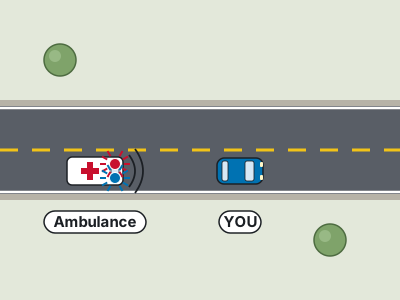
- Stop beside the center line
- Keep your speed so it can pass on the left
- Move right, clear any intersection, and stop
- Turn left immediately into the nearest driveway
Show answer
Move right, clear any intersection, and stop. Flashing lights indicate that the emergency vehicle needs priority. Nevada instructs the driver to move immediately to the right side of the road, stay clear of an intersection, and stop until the vehicle has passed. Maintaining speed assumes the emergency vehicle can safely work around you, while stopping at the center line leaves the roadway obstructed. A sudden driveway turn may create a new conflict and is not the stated response. Signal, check nearby traffic, move right smoothly, and remain stopped until the route is clear.
Study this in the handbook: Right of Way
7. How should following space change when roads are slippery or visibility is reduced?
- Allow a safe distance greater than the usual minimum
- Follow more closely so other vehicles cannot merge
- Keep the same gap because braking distance is unchanged
- Use the shoulder as extra following space
Show answer
Allow a safe distance greater than the usual minimum. Slippery pavement and reduced visibility increase the time and distance needed to stop. The handbook therefore tells drivers to allow a safe distance between their vehicle and the one ahead, beyond the ordinary minimum used in favorable conditions. Following more closely removes reaction space, and braking distance is not unchanged on a wet or slick road. The shoulder is not a substitute for a proper lane position. Slow to match conditions, increase the gap early, and keep scanning for hazards that may require a stop.
Study this in the handbook: Freeway Driving
8. What should a driver do with four-wheel ABS during emergency braking when traction is lost?
- Press the brake firmly, hold it down, and steer where the car should go
- Pump the brake pedal rapidly and release the steering wheel
- Use the parking brake first and shift directly into park
- Turn the wheel hard while alternating between gas and brake
Show answer
Press the brake firmly, hold it down, and steer where the car should go. With four-wheel ABS, the handbook says all drivers must do is brake and steer: push the brake pedal down hard, hold it down firmly, and steer in the direction you want the car to go. The system pumps the brakes automatically, much faster than a driver could, and removing steady pressure or pumping the brakes disengages it. Do not turn the wheel hard or jerk it, because that can put the vehicle in the emergency stopping lane or on the shoulder. Check that traffic is clear where you steer, then return to the original lane once the hazard is cleared.
Study this in the handbook: Freeway Driving
9. Which Nevada vehicles must have lap belts for every passenger?
- All vehicles regardless of year
- Only vehicles built after 2000
- 1970 models or newer, while 1968 or newer need front seat lap belts
- Only commercial vehicles
Show answer
1970 models or newer, while 1968 or newer need front seat lap belts. If your car is a 1968 model or newer it must have lap type seat belts for passengers in the front seat, and if it is a 1970 model or newer it must have lap type belts for each passenger in the vehicle. Children under age six and under 57 inches tall must ride in an approved child restraint, with fines, community service or suspension for violations.
Study this in the handbook: Seat Belts, Children and Phone Laws
10. How often may a Nevada driver attend traffic school to remove demerit points?
- Once every five years
- Once in a 12-month period
- Twice a year
- As often as needed
Show answer
Once in a 12-month period. You may attend traffic school only once in a 12 month period to remove points, and each completion removes at most three demerit points. Twice a year or as often as needed would let drivers erase points faster than the law allows, and once every five years is not the Nevada limit. Points come off when the school reports completion. The conviction record remains in your driving history.
Study this in the handbook: License Rules and Demerit Points
11. What are Nevada's minimum liability insurance limits?
- $15,000 / $30,000 / $5,000
- $25,000 / $50,000 / $20,000
- $25,000 / $50,000 / $25,000
- $50,000 / $100,000 / $50,000
Show answer
$25,000 / $50,000 / $20,000. Nevada requires $25,000 for bodily injury or death of one person, $50,000 for two or more persons, and $20,000 for property damage in any one crash. The 25/50/25 set has the wrong property figure, which is the easiest detail to miss. Fifteen thousand and 50/100/50 are not the Nevada minimums. The NV LIVE program checks registrations against insurance company records to catch lapses.
Study this in the handbook: Insurance and What to Do in a Crash
12. Which consequence is listed for a first DUI offense in Nevada?
- Payment of tuition for DUI school
- Automatic permanent license revocation in every case
- A mandatory one-year vehicle registration suspension
- No education requirement when the first offense involves alcohol
Show answer
Payment of tuition for DUI school. Nevada lists payment of tuition for DUI school among the criminal consequences of a first DUI offense. The same section also lists a license revocation minimum, possible jail or community service, and a fine range. The permanent-revocation choice overstates the first-offense rule, while the handbook lists registration suspension only as a possibility for second and later offenses. Keep the categories separate: administrative action can happen through the DMV, and criminal penalties are imposed through the court. The education requirement is part of the first-offense penalty list.
Study this in the handbook: DUI Laws and Penalties
13. While a Nevada vehicle is being driven, where are opened alcoholic beverages generally prohibited?
- Only in a locked glove compartment
- Only in the trunk of a sedan
- In the driver or passenger areas
- Nowhere if the driver has not consumed alcohol
Show answer
In the driver or passenger areas. Nevada's open-container law generally makes it illegal to have an opened alcoholic beverage in the driver or passenger areas while the vehicle is being driven. The rule concerns where the opened drink is located, not merely whether the driver took a sip. The trunk choice describes a storage area outside those compartments, while the choice “Nowhere if the driver has not consumed alcohol” wrongly makes the driver's consumption the test. Before moving, secure beverages outside the passenger space and remember that special exceptions exist for certain living quarters and commercial passenger areas.
Study this in the handbook: Young Drivers, Alcohol and Open Containers
14. A driver is leaving a private driveway to enter a Nevada main road. To whom must the driver yield?
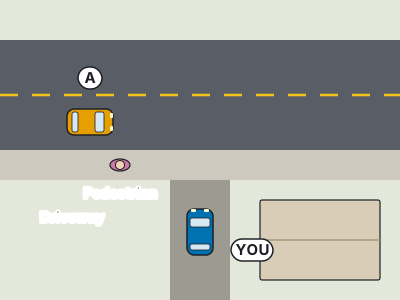
- Only vehicles approaching from the left
- No one, because the driveway is a legal entrance
- Only vehicles using the nearest lane
- All traffic on the main road and pedestrians
Show answer
All traffic on the main road and pedestrians. Entering from a private road or driveway means crossing into an established roadway. Nevada requires the entering driver to yield to all traffic on the main road and to pedestrians. The nearest-lane choice is too narrow because traffic in other lanes can also create a conflict. Stop where you can see clearly, scan both directions and the sidewalk, then proceed only after every affected path is open. A legal driveway provides access, not priority over people already using the public road.
Study this in the handbook: Right of Way
15. At the pictured STOP sign, where should the vehicle stop before yielding and proceeding?
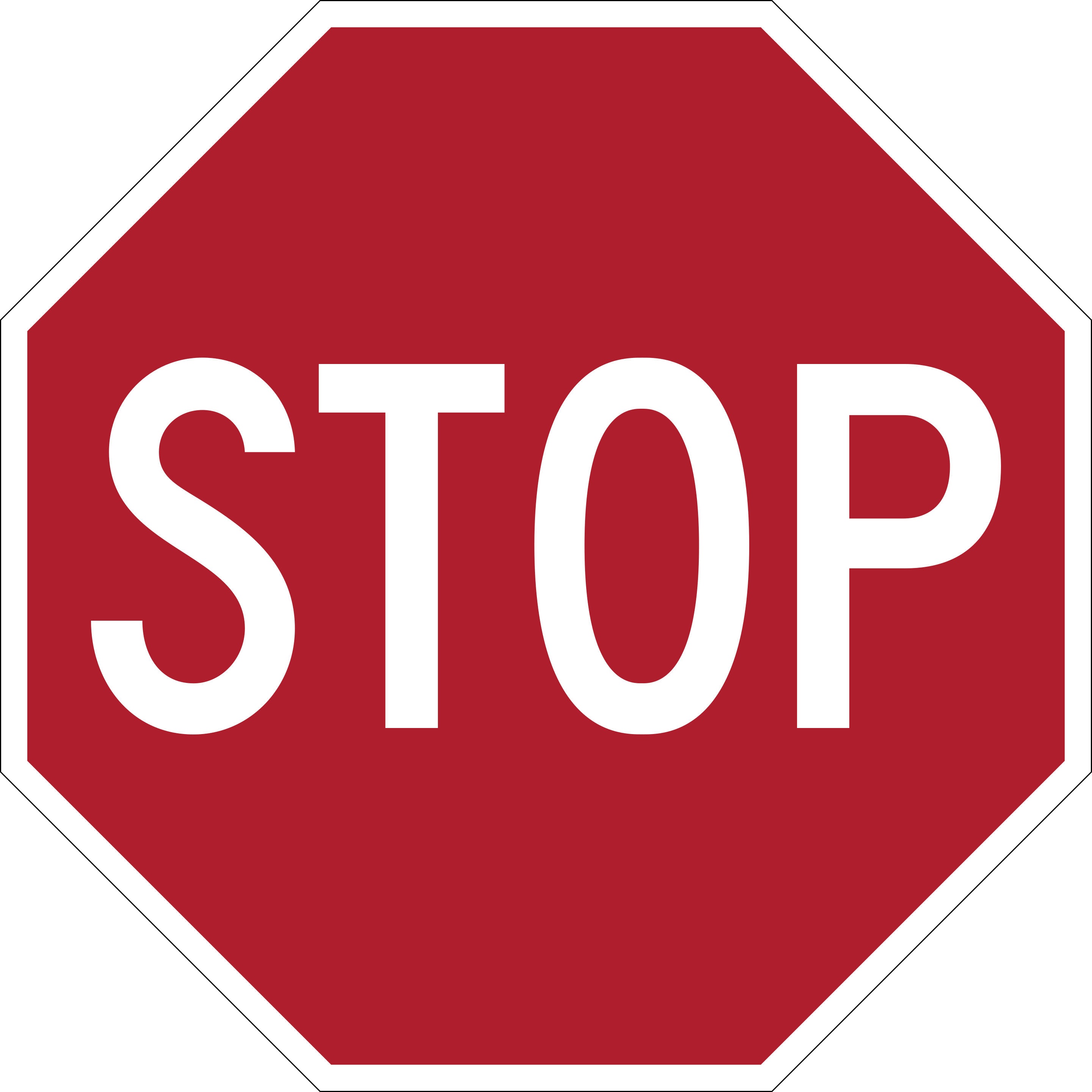
- After entering the crosswalk
- Behind the crosswalk or stop line
- Beside the nearest parked car
- Only at the middle of the intersection
Show answer
Behind the crosswalk or stop line. A STOP sign requires a full stop behind the sign at the crosswalk or stop line. Stopping after entering the crosswalk can block pedestrians and places the vehicle farther into the conflict area. The driver then gives right-of-way to pedestrians and cross traffic before moving forward. If the view is blocked, inch ahead slowly only after the initial stop to find a safe view. The painted line or crosswalk is the visual cue for the stopping point, not the center of the intersection or the position of a nearby parked vehicle.
Study this in the handbook: Stop, Yield, Regulatory, Warning and Work Zone Signs
16. What should a driver be prepared to do after seeing the pictured pedestrian crossing sign?

- Speed up before pedestrians arrive
- Yield to pedestrians
- Enter a no-pedestrian zone
- Stop only for bicycles
Show answer
Yield to pedestrians. A pedestrian crossing warning means the driver should scan for people and be ready to yield. Nevada gives pedestrians in crosswalks and at intersections priority over vehicles, so speeding up would remove the time needed to stop. The sign does not create a no-pedestrian area, and its protection is not limited to bicycle riders. Reduce speed as needed, watch both sides of the roadway, and stop when a pedestrian is crossing or entering the driver's path. The walking figure is the cue to search actively for a person who may be difficult to see.
17. How are speeding fines changed in Nevada work zones?
- They remain identical to ordinary speeding fines
- They are waived when workers are not visible
- They are reduced by half
- They double
Show answer
They double. Nevada doubles speeding fines in work zones. The increased penalty is not dependent on whether a driver can see workers at that moment, so the absence of visible workers does not create a waiver. The handbook also distinguishes black-and-white regulatory speed signs from orange advisory signs, but that sign-color distinction does not reduce the doubled speeding consequence. A driver should slow for orange work-zone warnings, follow the posted controls, and remember that the financial penalty rises even when the roadway appears temporarily clear.
Study this in the handbook: Freeway Driving
18. What is the purpose of a white rectangular regulatory sign?
- It informs drivers of traffic laws and regulations
- It marks a scenic recreation area
- It warns only of temporary weather conditions
- It identifies a railroad track crossing
Show answer
It informs drivers of traffic laws and regulations. A white rectangular regulatory sign communicates a traffic law or regulation, so drivers must obey the instruction shown. A scenic or recreation message belongs to brown information signs, and a railroad crossing has its own warning signs and shapes. Weather warnings are not the defining role of this sign category. When you see a regulatory panel, read the restriction or requirement carefully and adjust your speed, lane, turn, or stopping action before reaching the controlled location.
Study this in the handbook: Stop, Yield, Regulatory, Warning and Work Zone Signs
19. At a Nevada intersection, what does a flashing yellow traffic signal require?
- Speed up before the signal changes to red
- Stop fully and wait for a green light
- Treat the signal as a red arrow and do not turn
- Proceed with caution after checking for conflicts
Show answer
Proceed with caution after checking for conflicts. A flashing yellow signal permits movement, but it calls for caution rather than an automatic stop or a rush through the intersection. Reduce speed as needed, look for vehicles and pedestrians, and proceed only when the path is clear. The full-stop choice describes a flashing red signal. A red arrow prohibits the indicated movement, and speeding is specifically contrary to safe signal handling. Use the pause created by the caution requirement to confirm who has the right of way.
Study this in the handbook: Traffic Signals and Arrows
20. What does a skid mean, and where can it occur besides ice or packed snow?
- The brakes have become wet, and it occurs only after crossing a bridge
- The engine has overheated, and it occurs only on dry pavement
- The steering wheel has locked, and it happens only during a tire change
- The tires have lost traction, and it can also happen on wet pavement or gravel roads
Show answer
The tires have lost traction, and it can also happen on wet pavement or gravel roads. A skid begins when the tires lose their grip on the road. Nevada identifies ice and packed snow as common causes, but wet pavement and gravel can also remove enough traction for the vehicle to slide. The option about overheating describes a mechanical problem rather than a loss of tire contact. A driver should treat any unexpected slide as a control emergency, avoid abrupt steering or braking, and consult the vehicle owner manual because braking and steering systems respond differently. A useful cue is to think traction first: if the tires cannot grip the surface, steering inputs may not produce the expected path.
Study this in the handbook: Night Driving, Bad Weather and Skids
QualitySpace is expanding to Nevada
We are a California-based independent insurance brokerage working on licensing in more states. We cannot help with Nevada insurance yet. Leave your email and we will let you know when we can.
Every question is written from the official Nevada Driver Handbook. Need paper? Printable NV practice test with answer key.
Last verified 2026-10-05. How we check every question · Study all 204 as flashcards
Frequently asked questions
How many questions are on this Nevada practice test?
This fixed set has 20 questions. It is test 2 of 10 from the 204 question Nevada bank. The real NV exam asks 25 questions and you need 20 correct.
What is the passing score for the real Nevada test?
80% (20 correct answers needed out of 25) That figure comes from the official Nevada source cited on the DMV facts page.
How does this fixed test relate to the full Nevada bank?
Each numbered test is a fixed set of questions in a fixed order, so you can retake the same test later and compare. Every test mixes road signs and the other topics in about the same proportion as the full bank. Tests 1 to 10 together cover 200 of the 204 questions in the Nevada bank, each once. The full practice page mixes the whole bank at random.
Last verified 2026-10-05. See the Nevada DMV facts page for sourced state details.