
Test 1 of 10 · 20 questions · Free 2026
NV Permit Practice Test 1
Jump to the test ↓A fixed 20 question set from the Nevada bank with answers and plain English explanations. The real NV exam is 25 questions, 80 percent to pass; take the full length version on the main practice page.
Question 1 of 20 · 0 right so far
All 20 questions in test 1
Every question below comes from the Nevada question bank on this page. Open a question to see the correct answer and the explanation. Nothing here is hidden behind a signup.
1. Who may use the raised truck apron around the center island of a roundabout?
- Bicyclists whenever the roundabout has two entry lanes
- Any passenger car that wants to shorten the circulating path
- Large commercial trucks and trailers negotiating a tight turning radius
- Pedestrians crossing between the entry and exit points
Show answer
Large commercial trucks and trailers negotiating a tight turning radius. The truck apron exists for large commercial trucks and trailers whose rear wheels need additional room to negotiate a tight turn around the center island. Passenger cars should remain on the circulatory roadway, so using the apron to shorten a route is improper. It is not a general bicycle or pedestrian path. Drivers in a car should choose the marked entry lane, yield to circulating traffic, and continue counterclockwise without climbing the raised pavement. The visual cue is simple: the apron is truck turning space, not an extra passenger-car lane.
Study this in the handbook: Roundabouts
2. Nevada's Basic Rule applies in addition to posted limits. Which condition should make a driver choose a lower speed?
- A clean windshield on a clear afternoon
- Wet, icy, or snow-covered pavement
- A road with no traffic and dry pavement
- A familiar route during daylight
Show answer
Wet, icy, or snow-covered pavement. Nevada's Basic Rule asks drivers to judge more than the number on a sign. Pavement covered by water, ice, or snow can greatly reduce traction and increase the distance needed to stop. A driver who keeps the posted limit when the surface is slippery may still be traveling too fast for the actual conditions. The dry-pavement choice describes a less demanding situation, not a reason to reduce speed under this rule. Use the road surface as a quick cue: if tires cannot grip normally, ease off the accelerator before a curve or stop.
Study this in the handbook: Speed Limits and School Zones
3. Which group of conditions can increase a vehicle's stopping distance?
- Only the color of the vehicle and the time of day
- Vehicle speed, tire and brake condition, road surface, reaction time, and weather
- The number of passengers, regardless of speed or road condition
- The radio volume and whether the windows are open
Show answer
Vehicle speed, tire and brake condition, road surface, reaction time, and weather. Stopping distance depends on several connected factors, including vehicle type and weight, speed, tire and brake condition, road surface, reaction time, alertness, and weather. The choice “Vehicle speed, tire and brake condition, road surface, reaction time, and weather” names real influences from the handbook. Vehicle color, radio volume, and open windows do not determine how much pavement the car needs to stop. Passenger count may affect weight, but it cannot be treated as the only factor. Before driving, check tires and brakes, then adjust speed and following space when the surface is wet, icy, or visibility is poor.
Study this in the handbook: Stopping Distance and Following
4. A Nevada driver refuses the officer-directed blood, breath or urine test for the first time. How long is the driver ineligible for a license?
- 185 days
- 30 days
- One year for a first refusal
- Three years
Show answer
One year for a first refusal. Under Nevada's Implied Consent Law, refusing the tests brings revocation and no eligibility for a license, permit or privilege to drive for one year on a first refusal, or three years if the privilege was revoked for refusal in the prior seven years. The 185 day period is the per se revocation for failing a test, 30 days is not the rule, and three years applies to a repeat refusal. An officer may still order a blood draw.
Study this in the handbook: DUI Laws and Penalties
5. A Nevada school bus driver reports your vehicle for passing the bus while its red lights flashed. What does the registered owner receive?
- A warning letter explaining the seriousness of the violation
- An automatic license revocation
- Nothing, since only police can report
- A $5,000 fine by mail
Show answer
A warning letter explaining the seriousness of the violation. Nevada law lets school bus drivers report violations to the school district and the DMV, and the registered owner is sent a warning letter explaining how serious the violation is. Bus drivers can report, so saying only police can is wrong, and the handbook does not describe an automatic revocation or a mailed $5,000 fine from such a report. Drivers must stay stopped until the bus driver turns off the flashing red lights. On a divided highway, only traffic going the same direction as the bus must stop.
Study this in the handbook: Trucks, Motorcycles, Mopeds and School Buses
6. When are U-turns generally allowed in Nevada?
- Only on divided highways
- On any road when they can be made safely
- Only at railroad crossings
- Whenever another driver signals permission
Show answer
On any road when they can be made safely. Nevada generally allows a U-turn on any road when the maneuver can be made safely, subject to the handbook's listed restrictions and local controls. A divided highway is only one setting where a U-turn may be possible, not the universal rule. Railroad crossings are hazardous locations rather than a general permission, and another driver's signal cannot legalize an unsafe or prohibited turn. Before turning around, check visibility, lane markings, signs, traffic, and nearby pedestrians. If any condition is uncertain, continue to a safer lawful location.
Study this in the handbook: Turns, Lane Changes, U-Turns and Passing
7. What do traffic signals control in Nevada?
- The speed of vehicles on freeways
- The color of every road sign
- Traffic at intersections
- Whether a vehicle may park on a shoulder
Show answer
Traffic at intersections. Nevada states that traffic signals control traffic at intersections. Their lights work with pedestrian signals, signs, pavement markings, and other devices in some situations. The choice “Traffic at intersections” names the control described in the handbook. Signals do not determine the color of road signs, set every freeway speed, or grant permission to park on a shoulder. As you approach an intersection, look for the signal head and lane markings, reduce speed when needed, and follow the displayed indication rather than assuming the road is uncontrolled.
Study this in the handbook: Traffic Signals and Arrows
8. What does the pictured railroad crossbuck mark, and what must a driver do there?
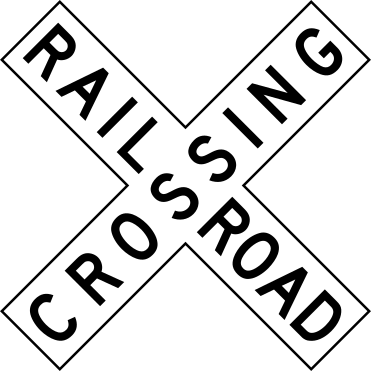
- The actual crossing, where drivers must yield to trains
- A crossing ahead, where drivers may accelerate
- A school zone, where trains have priority only at night
- A truck inspection area with no yielding requirement
Show answer
The actual crossing, where drivers must yield to trains. A railroad crossbuck marks the actual location of the train crossing and requires drivers to yield to trains. The round railroad warning sign is the one that indicates a crossing ahead, so treating the crossbuck as advance notice confuses two distinct signs. Accelerating is especially unsafe because a train cannot stop quickly enough to avoid a vehicle. Slow, look both ways, and remain clear of the tracks whenever a train is approaching. The X shape is the cue that the driver is at the crossing itself, not merely nearing one.
Study this in the handbook: Railroad Crossings
9. What is the lowest BAC threshold for Nevada's under-21 alcohol driving rule?
- .10%
- .04%
- .08%
- .02%
Show answer
.02%. For a driver under 21, Nevada identifies an alcohol concentration of .02% as the threshold for the administrative action described in the handbook. The .08% figure is the general guide for adult drivers, while .04% is the commercial-driver range shown in the separate discussion. Choosing .10% sets the threshold higher than the handbook's young-driver rule. Because this is an administrative consequence, it can affect the driving privilege even apart from what a court later decides. Age and the exact concentration are the key details to separate.
Study this in the handbook: Young Drivers, Alcohol and Open Containers
10. When are Nevada school-zone speed limits generally in effect on school days?
- Only when a crossing guard is standing in the roadway
- Only while recess is taking place
- All day and night, including weekends
- From 30 minutes before school begins through 30 minutes after it ends
Show answer
From 30 minutes before school begins through 30 minutes after it ends. Nevada school-zone speed limits of 15 or 25 mph generally apply on school days from one-half hour before school begins until one-half hour after school ends, unless posted otherwise. Recess timing does not define the period, and the rule is not automatically a round-the-clock or weekend restriction. A crossing guard's presence is not the sole trigger. Drivers should read the signs, observe any flashing controls, and use the posted schedule when available. The half-hour buffer before and after school is the key timing cue.
Study this in the handbook: Speed Limits and School Zones
11. If the accelerator sticks, what should you do after trying to free the pedal?
- Shift into park while traveling quickly
- Shift to neutral, apply the brakes, and pull off to the right
- Pump the accelerator harder until traffic passes
- Turn sharply across the centerline
Show answer
Shift to neutral, apply the brakes, and pull off to the right. For a stuck accelerator, the Nevada handbook says to quickly press your foot hard against the pedal and release, which may free it. If that does not work, shift to neutral, apply the brakes, pull off the highway to the right if possible, and stop. The handbook also says to NEVER place the vehicle into park, so shifting into park at speed is wrong. Pumping the accelerator harder or turning sharply across the centerline are not handbook steps. Shift to neutral first, then brake and make a controlled stop at the right side of the road.
Study this in the handbook: Driving Emergencies and Flash Floods
12. If your brakes fail and pumping the pedal does not restore braking, what should you try next?
- Turn off the ignition and release the steering wheel
- Place the vehicle in park immediately while moving downhill
- Use the emergency parking brake and shift to a lower gear if possible
- Accelerate to reach a repair shop before stopping
Show answer
Use the emergency parking brake and shift to a lower gear if possible. The Nevada handbook says that when the brakes fail, first try pumping the brake pedal. If the brakes still do not respond, use the emergency parking brake and, if possible, shift to a lower gear. The handbook also says to NEVER place the vehicle into park, so selecting park while moving downhill is wrong. Turning off the ignition and releasing the wheel, or accelerating toward a repair shop, are not steps the handbook gives. It also notes that using a lower gear on long downhill stretches helps prevent wear on the brakes in the first place.
Study this in the handbook: Driving Emergencies and Flash Floods
13. What must you do when a green turn arrow is displayed?
- Yield only to vehicles behind you and ignore pedestrians
- Stop and wait because a green arrow never authorizes movement
- Turn without looking because every conflict has been removed
- Move in the arrow's direction while yielding to pedestrians, bicycles, and traffic already in the intersection
Show answer
Move in the arrow's direction while yielding to pedestrians, bicycles, and traffic already in the intersection. A green arrow protects the indicated movement from other conflicting traffic, but it does not erase every duty. Drivers still yield to pedestrians, bicycles, and traffic already in the intersection. The stop choice treats a permission signal as a prohibition, while the no-look choice ignores people who may already be in the path. Yielding only to vehicles behind is unrelated to the crossing hazards. Check the complete path, then turn smoothly within the protected movement.
Study this in the handbook: Traffic Signals and Arrows
14. What does a Nevada crossbuck sign mark?
- The actual location of railroad tracks
- A school crossing several blocks ahead
- A temporary construction detour
- A no-passing zone on a hill
Show answer
The actual location of railroad tracks. The crossbuck is the X-shaped railroad sign, and Nevada says it marks the actual location of the train tracks. Railroad crossing signs warn drivers of the need to slow down and possibly stop for a train, so the approach requires a careful look in both directions. A circle warns of a railroad crossing ahead, but the crossbuck identifies the crossing itself. The school, construction, and hill choices refer to unrelated sign purposes. As the X comes into view, slow, look both ways, and stay clear of the tracks when a train is approaching.
Study this in the handbook: Railroad Crossings
15. A Nevada registration is suspended for an insurance lapse and no coverage was bought for that time. What fines apply?
- No fine, only a letter
- A flat $50
- A reinstatement fee and fines, starting at $250 and totaling up to $1,750 per vehicle
- $5,000 per day uninsured
Show answer
A reinstatement fee and fines, starting at $250 and totaling up to $1,750 per vehicle. When a registration is suspended for a lapse and no coverage was obtained for that period, the owner pays a reinstatement fee and fines, with amounts starting at $250 and totaling up to $1,750 for each registered vehicle. Additional penalties may include an SR-22 filing and a 30 day license suspension. A letter only or a flat $50 understates it, and $5,000 per day is not in the handbook.
Study this in the handbook: Insurance and What to Do in a Crash
16. A Nevada 16 year old is caught placing graffiti on a building. What can happen to the teen's license?
- Nothing, because it is not a driving offense
- A 30 day suspension only
- Permanent revocation
- Suspension or delayed issuance for up to two years
Show answer
Suspension or delayed issuance for up to two years. The affidavit minors sign lists suspension or delayed issuance for up to two years for graffiti or defacing property, any criminal activity involving alcohol or drugs, drug possession or sale, and buying, drinking, or possessing alcohol. Nevada ties these non-driving offenses to the license on purpose, so saying nothing happens is wrong. Thirty days understates it and the manual does not describe a permanent revocation.
Study this in the handbook: Tests and Driver Education
17. How should you respond when this slippery-road warning appears?

- Follow more closely so other vehicles cannot splash your windshield
- Brake hard while entering the slick area to test the pavement
- Reduce speed and increase following space because traction may be reduced
- Use the shoulder to avoid all vehicles traveling on the roadway
Show answer
Reduce speed and increase following space because traction may be reduced. A slippery-road warning calls for a larger safety margin. Slow down smoothly, leave extra space, and avoid abrupt steering or braking that can overwhelm available traction. Hard braking as a test can start a skid, and following closely removes the time needed to react. The shoulder is not a general travel lane and may contain hazards. A practical cue is to assume stopping distance will grow whenever rain, snow, ice, or wet pavement makes the road less predictable.
Study this in the handbook: Freeway Driving
18. At a Nevada intersection, a vehicle going straight is already in the intersection while another vehicle wants to turn left. Who must yield?
- The vehicle turning left
- The vehicle going straight
- The vehicle with the newer license plate
- Both vehicles must reverse from the intersection
Show answer
The vehicle turning left. A vehicle traveling straight through the intersection has priority over a vehicle turning left across its path. The left-turning driver must wait, signal properly, and yield before completing the movement. The straight-through choice ignores the conflict created by crossing oncoming traffic. Watch the front wheels and turn signal of an approaching vehicle, then keep the intersection open until the path is clear. Priority does not remove the duty to slow or stop if the other driver appears likely to continue.
Study this in the handbook: Right of Way
19. Which passenger area is specifically excepted from Nevada's open-container restriction?
- The back seat of a privately owned sedan
- The passenger area of a commercial limousine
- The cab of a pickup used for commuting
- The front seat of a personal sport utility vehicle
Show answer
The passenger area of a commercial limousine. Nevada's rule does not apply to passenger areas of commercial buses, limousines, or taxis. It also has an exception for living quarters of motor homes or house trailers. A private sedan, pickup cab, or personal sport utility vehicle is not included merely because a passenger occupies the area. The commercial status of the limousine is the key cue. Even with an exception, the driver remains responsible for safe operation and must not drive while impaired by alcohol or drugs.
Study this in the handbook: Young Drivers, Alcohol and Open Containers
20. What does a rearward amplification of 3.5 for triple trailers mean, according to the Nevada handbook?
- The last trailer can roll over 3.5 times as easily as the truck
- Triples need 3.5 times the fuel
- Triples are 3.5 times longer
- The last trailer brakes 3.5 times harder
Show answer
The last trailer can roll over 3.5 times as easily as the truck. Rearward amplification describes the crack the whip effect in combinations: a value of 2.0 means the rear trailer is twice as likely to turn over as the truck, and triples have a rearward amplification of 3.5, so the last trailer can roll 3.5 times as easily. Steer gently, brake early and control speed whether loaded or empty, because a sudden swerve at the front becomes a rollover at the back.
QualitySpace is expanding to Nevada
We are a California-based independent insurance brokerage working on licensing in more states. We cannot help with Nevada insurance yet. Leave your email and we will let you know when we can.
Every question is written from the official Nevada Driver Handbook. Need paper? Printable NV practice test with answer key.
Last verified 2026-10-05. How we check every question · Study all 204 as flashcards
Frequently asked questions
How many questions are on this Nevada practice test?
This fixed set has 20 questions. It is test 1 of 10 from the 204 question Nevada bank. The real NV exam asks 25 questions and you need 20 correct.
What is the passing score for the real Nevada test?
80% (20 correct answers needed out of 25) That figure comes from the official Nevada source cited on the DMV facts page.
How does this fixed test relate to the full Nevada bank?
Each numbered test is a fixed set of questions in a fixed order, so you can retake the same test later and compare. Every test mixes road signs and the other topics in about the same proportion as the full bank. Tests 1 to 10 together cover 200 of the 204 questions in the Nevada bank, each once. The full practice page mixes the whole bank at random.
Last verified 2026-10-05. See the Nevada DMV facts page for sourced state details.