
Key points
If you cannot see the truck driver's face in the side mirror, the driver cannot see you.
Source: Handbook p. 62
“If you cannot see the driver’s face in the side view mirror, they cannot see you.”
Nevada Driver's Handbook, Handbook p. 62Large trucks and buses need nearly twice the time and distance to stop as cars.
Source: Handbook p. 63
“These large vehicles need nearly twice the time and distance to stop as cars.”
Nevada Driver's Handbook, Handbook p. 63Never pass behind a truck that is backing up.
Source: Handbook p. 63
“Never pass behind a commercial truck that is backing up!”
Nevada Driver's Handbook, Handbook p. 63Always dim your headlights when approaching a motorcycle.
Source: Handbook p. 64
“Always dim your headlights when approaching a motorcycle.”
Nevada Driver's Handbook, Handbook p. 64Moped operators must stay in the far right lane unless a listed exception applies.
Source: Handbook p. 64
“Moped operators must remain in the extreme right-hand lane of any road unless:”
Nevada Driver's Handbook, Handbook p. 64Stop at any location for a school bus showing a flashing red signal, and do not pass until the driver turns off the red lights.
Source: Handbook p. 64
“requires a driver to stop at any location for a school bus displaying a flashing red signal. You may not attempt to overtake or proceed past the school bus until the bus driver has turned off the flashing red lights.”
Nevada Driver's Handbook, Handbook p. 64On a divided highway, you must stop only if traveling the same direction as the bus.
Source: Handbook p. 64
“on divided highways, you are only required to stop when you are traveling in the same direction as the school bus.”
Nevada Driver's Handbook, Handbook p. 64No one under 18 may ride in a pickup bed on a paved highway.
Source: Handbook p. 66
“Anyone under the age of 18 may not ride on the bed of a flatbed truck or within the bed of a pickup truck in Nevada if the truck is being driven on a paved highway.”
Nevada Driver's Handbook, Handbook p. 66
Numbers to know
| Number | What it means | Manual |
|---|---|---|
| 18 | age under which riding in a pickup bed is banned | Handbook p. 66 |
Recognize these signs
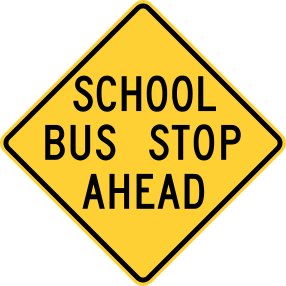
School bus stop ahead
3 questions from the Nevada practice test
1. On a divided Nevada highway, when must a driver stop for a school bus displaying flashing red lights?
- When traveling in the same direction as the bus
- Only when traveling toward the bus
- Only if a crossing guard is present
- Never, because divided highways exempt all traffic
Show answer
When traveling in the same direction as the bus. A flashing red signal on a school bus normally requires drivers to stop. Nevada's divided-highway exception narrows the duty: a driver on the opposite side is not required to stop, while a driver traveling in the same direction as the bus must stop. The presence of a crossing guard is not the condition, and the exemption does not cover every lane on a divided road. Watch the bus's lights and roadway design, stop before reaching it, and remain stopped until the driver turns off the flashing red signals.
2. How should a Nevada driver use headlights when approaching a motorcycle at night?
- Switch to high beams to make the motorcycle more visible
- Dim the headlights
- Turn off all lights until the motorcycle passes
- Use parking lights only
Show answer
Dim the headlights. Nevada advises drivers to dim headlights when approaching a motorcycle. A motorcycle rider uses balance to steer, so the glare from high beams can be especially dangerous and can interfere with control. Switching to high beams increases that hazard rather than improving safety. Turning lights off or using parking lights leaves the roadway harder to see and is not a substitute for proper low beams. Notice a motorcycle early, lower the beam before the encounter, and preserve extra following space if rain or a slippery surface also reduces stability.
3. Which statement about a Nevada moped operator is true?
- The operator may ignore lane position because mopeds have a 30 mph maximum speed
- The operator must always use the left lane on a multi-lane road
- The operator must remain in the extreme right-hand lane unless a listed exception applies
- The operator may use the shoulder whenever traffic is moving faster
Show answer
The operator must remain in the extreme right-hand lane unless a listed exception applies. Nevada requires moped operators to remain in the extreme right-hand lane, subject to exceptions such as a single-lane road, preparing for a left turn, an unsafe right lane, or a police officer's direction. The speed capability of a moped does not erase its lane duty. A blanket left-lane rule is the opposite of the handbook instruction, and the shoulder is not automatically available as a refuge from faster traffic. Watch the lane position early, signal before a permitted move, and make a left turn within the stated distance when that exception applies.
Practice this topic
Lock it in with safe driving questions from the free Nevada practice test. Every answer comes with a plain English explanation.
Source: the Nevada Driver's Handbook, Chapter 6: Sharing the Road. This lesson is a plain English summary, not the law itself; where it differs, the manual and the statute govern. Last checked 2026-09-27.