
Key points
Pedestrians in crosswalks and at intersections have the right of way.
Source: Handbook p. 34
“Pedestrians in crosswalks and at intersections have the right-of-way over vehicles.”
Nevada Driver's Handbook, Handbook p. 34A crosswalk exists wherever two streets meet, even a T intersection, painted or not.
Source: Handbook p. 66
“A crosswalk exists anywhere two streets intersect, even at a “T” intersection. A crosswalk exists even if it is not painted or marked.”
Nevada Driver's Handbook, Handbook p. 66When the light turns green, yield to people still crossing; pedestrians go before right turning cars.
Source: Handbook p. 66
“When a traffic signal turns green, drivers must yield to persons who are still crossing the street. Pedestrians have the right of way over motorists making a right-hand turn.”
Nevada Driver's Handbook, Handbook p. 66Do not pass a vehicle that is slowing or stopped until you know why it stopped.
Source: Handbook p. 66
“It is illegal for motorists to overtake any vehicle that is slowing down or stopped until the motorist slows down enough to determine why the other vehicle has slowed or stopped.”
Nevada Driver's Handbook, Handbook p. 66A blind pedestrian with a white cane or guide animal has the right of way at all times.
Source: Handbook p. 67
“A person who is blind or visually impaired crossing a street on foot with a white cane or animal guide is granted the right of way at all times”
Nevada Driver's Handbook, Handbook p. 67For a blind pedestrian, do not stop your car more than 5 feet from the crosswalk.
Source: Handbook p. 67
“Do not stop your car more than five feet from the crosswalk.”
Nevada Driver's Handbook, Handbook p. 67When passing a bicyclist with no adjacent lane, leave at least 3 feet.
Source: Handbook p. 65
“If an adjacent lane does not exist, pass to the left of the bicycle at a safe distance (which must be no fewer than three feet).”
Nevada Driver's Handbook, Handbook p. 65Causing even a minor collision with a bicyclist or pedestrian can bring a reckless driving charge.
Source: Handbook p. 65
“Motorists who cause even a minor collision with a bicycle or pedestrian or who intentionally interfere with the movement of a bicycle may be charged with reckless driving.”
Nevada Driver's Handbook, Handbook p. 65
Numbers to know
| Number | What it means | Manual |
|---|---|---|
| 5 feet | maximum stopping distance from the crosswalk for a blind pedestrian | Handbook p. 67 |
| 3 feet | minimum passing distance for a bicyclist | Handbook p. 65 |
Recognize these signs

Pedestrian crossing 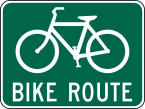
Bicycle route
3 questions from the Nevada practice test
1. A pedestrian is crossing at a Nevada intersection while the traffic signal turns green for vehicles. What must the driver do?
- Turn around and use a different street
- Proceed immediately because the vehicle signal is green
- Honk until the pedestrian reaches the center line
- Yield to the pedestrian still crossing
Show answer
Yield to the pedestrian still crossing. A green vehicle signal does not erase the right of a pedestrian who is already crossing. Nevada requires drivers to yield to people still in the roadway, including when the light changes. The green-light choice is dangerous because it treats the signal as permission to enter an occupied crossing. Keep the vehicle stopped, watch for people in every lane, and move only after the pedestrian reaches a safe place. This is especially important during a turn, when the driver may otherwise focus on cross traffic and miss the crosswalk.
2. A person carrying a white cane is crossing a Nevada street on foot. What duty does an approaching driver have?
- Proceed first unless a painted crosswalk is present
- Yield and stop if necessary before proceeding
- Sound the horn and continue without slowing
- Yield only during daylight hours
Show answer
Yield and stop if necessary before proceeding. Nevada grants a blind or visually impaired person using a white cane or animal guide the right of way on any highway, street, or road. An approaching driver must yield, come to a full stop if needed, and take precautions before moving. The painted-crosswalk choice adds a condition the rule does not require. Reduce speed early, leave room near the crossing, and avoid using the horn to direct the pedestrian. Watch for an electric vehicle hazard too, since quiet operation can make the vehicle harder to hear.
3. A Nevada motorist wants to pass a cyclist on a two-lane road with no adjacent lane. What minimum clearance is required?
- At least three feet to the cyclist's left
- Exactly one foot if the motorist sounds the horn
- No clearance if the cyclist is near the shoulder
- Three inches when passing below the speed limit
Show answer
At least three feet to the cyclist's left. When no adjacent lane exists, Nevada requires the motorist to pass to the cyclist's left at a safe distance of at least three feet. The vehicle must stay left until safely clear before returning right. A horn does not replace physical space, and riding close to the shoulder does not remove the cyclist's protection. Slow down, wait for a clear view, and avoid squeezing through a narrow gap. The three-foot figure is the quick memory cue, but the pass also has to be reasonably safe for surrounding traffic.
Practice this topic
Lock it in with right of way questions from the free Nevada practice test. Every answer comes with a plain English explanation.
Source: the Nevada Driver's Handbook, Chapters 3 and 6: Pedestrians and Bicycles. This lesson is a plain English summary, not the law itself; where it differs, the manual and the statute govern. Last checked 2026-09-27.