
Key points
Railroad signs mean slow down and possibly stop; the crossbuck marks the actual tracks.
Source: Handbook p. 29
“Railroad crossing signs warn drivers of the need to slow down and possibly stop for a train. The crossbuck (X) marks the actual location of the train tracks.”
Nevada Driver's Handbook, Handbook p. 29If a stop sign is posted at the crossing you must stop, and if a train is coming, stop at least 15 feet from the tracks.
Source: Handbook p. 33
“If there is a stop sign at the crossing, drivers must stop. If a train is coming, drivers must stop at least 15 feet from the tracks.”
Nevada Driver's Handbook, Handbook p. 33Passenger buses and trucks carrying flammable or dangerous materials must stop even with no train.
Source: Handbook p. 33
“Even if there is no stop signal and no train is coming, passenger buses and trucks carrying flammable or dangerous materials must stop.”
Nevada Driver's Handbook, Handbook p. 33Do not shift gears while crossing the tracks.
Source: Handbook p. 33
“Do not shift gears while crossing the tracks.”
Nevada Driver's Handbook, Handbook p. 33If a gate is lowered, you may not go around it even if no train is visible.
Source: Handbook p. 33
“If a gate is lowered, you may not proceed around it even if a train is not visible.”
Nevada Driver's Handbook, Handbook p. 33If you get stuck on the tracks, leave the vehicle.
Source: Handbook p. 33
“If a driver gets stuck on the tracks, they should leave the vehicle”
Nevada Driver's Handbook, Handbook p. 33Never park within 50 feet of the nearest rail.
Source: Handbook p. 33
“Never park within 50 feet of the nearest rail of a railroad.”
Nevada Driver's Handbook, Handbook p. 33A crossbuck sign marks a train crossing and means you must yield to trains.
Source: Handbook p. 33
“A crossbuck sign indicates the location of a train crossing and means drivers must yield to trains.”
Nevada Driver's Handbook, Handbook p. 33
Numbers to know
| Number | What it means | Manual |
|---|---|---|
| 15 feet | minimum stopping distance from the tracks | Handbook p. 33 |
| 50 feet | no parking distance from the nearest rail | Handbook p. 33 |
Recognize these signs

Railroad crossing ahead 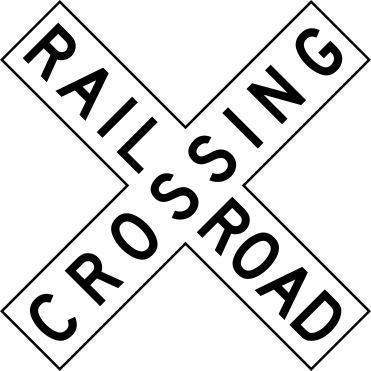
Railroad crossbuck
3 questions from the Nevada practice test
1. What does the pictured railroad crossbuck mark, and what must a driver do there?
- The actual crossing, where drivers must yield to trains
- A crossing ahead, where drivers may accelerate
- A school zone, where trains have priority only at night
- A truck inspection area with no yielding requirement
Show answer
The actual crossing, where drivers must yield to trains. A railroad crossbuck marks the actual location of the train crossing and requires drivers to yield to trains. The round railroad warning sign is the one that indicates a crossing ahead, so treating the crossbuck as advance notice confuses two distinct signs. Accelerating is especially unsafe because a train cannot stop quickly enough to avoid a vehicle. Slow, look both ways, and remain clear of the tracks whenever a train is approaching. The X shape is the cue that the driver is at the crossing itself, not merely nearing one.
2. What do Nevada railroad crossing signs warn drivers to do?
- Accelerate before reaching the tracks
- Slow down and possibly stop for a train
- Turn around at every crossing
- Park beside the nearest rail
Show answer
Slow down and possibly stop for a train. Nevada says railroad crossing signs warn drivers to slow down and possibly stop for a train. That warning gives the driver time to check both directions, observe signals, and keep the vehicle clear of the tracks. Accelerating reduces the time available to react, turning around is not required at every crossing, and parking beside a rail creates a separate safety and legal problem. Treat the sign as an advance cue, reduce speed smoothly, and enter the crossing only when the path is clear and the vehicle can fully clear the rails.
3. At a railroad crossing, the gate is down but no train is visible. What should you do?
- Wait without driving around the gate
- Go around after stopping and looking both ways
- Proceed if no warning bell is sounding
- Drive around if the opposite gate is raised
Show answer
Wait without driving around the gate. Nevada says drivers may not go around a lowered railroad gate even if they cannot see a train. Looking both ways is an important crossing habit, but it does not cancel this restriction. Silence from a warning bell or the position of another gate is not a listed exception. The lowered gate is the controlling cue in this situation. Remain clear of the tracks rather than treating the absence of a visible train as permission to cross.
Practice this topic
Lock it in with road signs questions from the free Nevada practice test. Every answer comes with a plain English explanation.
Source: the Nevada Driver's Handbook, Chapter 3: Railroad Crossings. This lesson is a plain English summary, not the law itself; where it differs, the manual and the statute govern. Last checked 2026-09-27.