
Test 10 of 10 · 20 questions · Free 2026
NV Permit Practice Test 10
Jump to the test ↓A fixed 20 question set from the Nevada bank with answers and plain English explanations. The real NV exam is 25 questions, 80 percent to pass; take the full length version on the main practice page.
Question 1 of 20 · 0 right so far

All 20 questions in test 10
Every question below comes from the Nevada question bank on this page. Open a question to see the correct answer and the explanation. Nothing here is hidden behind a signup.
1. What does the yellow diamond shape of the pictured warning sign tell a driver?
- The route is a legal speed limit
- A hazard or special condition is ahead
- The roadway is an actual railroad crossing
- The street is reserved for parking
Show answer
A hazard or special condition is ahead. Nevada describes warning signs as yellow and diamond-shaped, with black letters and symbols, and says they tell the driver there are special conditions or hazards ahead. The pictured sign uses that shape and color, so it is a warning: look ahead for the condition its symbol shows and be ready to adjust. The shape does not identify a speed limit, a railroad crossing itself, or a parking space. A white rectangular sign gives a regulatory instruction instead. Recognize the warning early and adjust speed to the road, traffic, and visibility before reaching the condition shown.
Study this in the handbook: Stop, Yield, Regulatory, Warning and Work Zone Signs
2. When approaching a stopped emergency or service vehicle on a Nevada roadway, which action is required when possible?
- Stop on the shoulder marked for emergency use
- Maintain the posted speed beside the vehicle
- Use a lane that is not adjacent to the stopped vehicle
- Pass closely so traffic can keep moving
Show answer
Use a lane that is not adjacent to the stopped vehicle. Nevada asks drivers approaching stopped emergency, utility, or service vehicles to slow below the posted limit, proceed cautiously, and use a nonadjacent lane when that can be done safely. The lane change creates a buffer for people working beside the roadway. Maintaining the limit ignores the reduced-speed requirement, while stopping on an emergency shoulder can interfere with authorized responders. Check traffic before moving over, and be prepared to stop if weather, congestion, or another hazard makes the lane change unsafe.
Study this in the handbook: Emergency Vehicles and Stopped Service Vehicles
3. During a Nevada road test, which occupants are barred from the vehicle?
- Only passengers under age 18
- Passengers and animals
- Only animals larger than a small pet
- No one, if they remain in the back seat
Show answer
Passengers and animals. Nevada does not allow passengers or animals in the vehicle during the road test. A person waiting in the back seat is still a passenger, so that location does not create an exception. The rule also covers animals regardless of size or where they are placed. The examiner needs a controlled seating area and an undistracted driver while evaluating vehicle control, lane use, turns, parking, stopping, and other skills. Before arriving, the applicant should arrange for everyone except the examiner and driver to remain outside the test vehicle.
Study this in the handbook: Tests and Driver Education
4. What traffic pattern does Nevada describe as typical of freeways?
- Traffic moves in the same direction without stops
- Traffic must cross opposing lanes at every entrance
- Traffic changes to one lane after every exit
- Traffic always includes intersections and railroad crossings
Show answer
Traffic moves in the same direction without stops. Nevada describes freeways as roads with limited access where traffic generally moves in one direction without stops. That design is different from an ordinary street with frequent intersections, signals, and railroad crossings. The choice “Traffic moves in the same direction without stops” captures the handbook’s description. A claim that opposing lanes must be crossed at every entrance confuses access with the normal travel pattern, while the remaining options add features the passage specifically says freeways do not have. Look for controlled entrances, exits, and same-direction traffic as cues that you are on a freeway.
Study this in the handbook: Freeway Driving
5. A vehicle is already in a Nevada intersection when another vehicle arrives. Which vehicle has priority under the handbook rule?
- The vehicle approaching from the driver's right
- The vehicle that arrived from the wider road
- The vehicle that sounds its horn first
- The vehicle already in the intersection
Show answer
The vehicle already in the intersection. Nevada gives the vehicle already occupying the intersection priority over vehicles that are just getting there. This prevents a late-arriving driver from entering the same space and creating a conflict. The wider-road choice is not the stated test, and a horn does not establish priority. Approach intersections early enough to see whether someone is already committed to crossing. Even with priority, continue looking for a driver who may misunderstand the situation, since the handbook expects every motorist to avoid a crash when possible.
Study this in the handbook: Right of Way
6. At a Nevada railroad crossing, what must a truck carrying flammable materials do even when no train is coming?
- Stop only if a gate is lowered
- Drive through without slowing
- Stop at the crossing
- Use the shoulder to pass the crossing
Show answer
Stop at the crossing. Nevada requires trucks carrying flammable or dangerous materials to stop at a railroad crossing even when there is no stop signal and no train is coming. The absence of a visible train therefore does not remove the special stopping requirement. Waiting only for a lowered gate ignores the rule, and using the shoulder is neither a safe nor lawful substitute for stopping. After stopping, the driver should proceed only when the crossing is clear and the route can be completed safely.
Study this in the handbook: Railroad Crossings
7. On an extended trip with a trailer, a Nevada driver checks the trailer and load-securing devices within the first 50 miles. When should the driver inspect them again?
- Every 10 miles
- After 3 hours or 150 miles of driving
- Only at the destination
- Once a year
Show answer
After 3 hours or 150 miles of driving. The Nevada handbook says to inspect the trailer and the load-securing devices again within 50 miles after beginning an extended trip, make any needed adjustments, and then inspect again after you have driven for 3 hours or 150 miles. It also says it is wise to inspect the trailer during every break you take. Every 10 miles is not the stated interval, waiting until the destination skips the required checks, and once a year is far too rare. The pre-trip inspection also includes checking that the connection is secure and storage doors are latched.
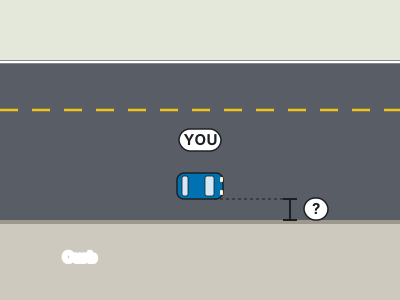
8. How close to the curb should a legally parked vehicle's front and rear wheels be in Nevada?
- At least 18 feet away
- Within 3 feet
- Within 6 inches only
- Within 18 inches
Show answer
Within 18 inches. Nevada describes the legal parking position as having both the front and rear wheels within 18 inches of the curb. Three feet leaves the vehicle too far out, while a six-inch requirement is stricter than the handbook states. The 18-foot option changes inches to feet and would place the car far from the curb. The same parking rules say the vehicle should face the direction normal traffic flows and be visible for 200 feet in each direction. After stopping, turn off the engine, set the parking brake, and look for bicycles before opening the door.
9. What do solid yellow lines indicate on a Nevada roadway?
- The driver is not to cross over or pass
- Passing is required before the next intersection
- The lane is reserved for vehicles turning right
- Traffic in both directions must stop at the line
Show answer
The driver is not to cross over or pass. Solid yellow lines separate traffic moving in opposite directions and indicate that a driver is not to cross over or pass. The marking does not command a passing maneuver, designate a right-turn-only lane, or function as a stop line for both directions. A driver should read the line together with nearby signs and the road layout, especially where a divided highway uses a solid yellow line at its left edge. The practical check is whether the center marking is solid: if it is, do not cross it to overtake another vehicle.
Study this in the handbook: Highway Markings
10. What can happen to a Nevada driver who causes even a minor collision with a pedestrian?
- Nothing, if the pedestrian was jaywalking
- Only a parking ticket
- A charge of reckless driving
- A warning if no one is hurt
Show answer
A charge of reckless driving. The handbook states that motorists who cause even a minor collision with a pedestrian may be charged with reckless driving, which carries 8 demerit points. Drivers must exercise due care to avoid hitting pedestrians. Jaywalking does not automatically excuse the driver, and a parking ticket or warning is not the stated consequence. Causing a collision with a pedestrian or bicyclist is also listed as a reason for license suspension.
Study this in the handbook: Pedestrians and Bicyclists
11. Which of these is listed as a reason for suspension of a Nevada driver license?
- Causing a collision with a pedestrian or bicyclist
- Getting one parking ticket
- Changing address online
- Letting a registration sticker fade
Show answer
Causing a collision with a pedestrian or bicyclist. Nevada lists causing a collision with a pedestrian or a person riding a bicycle as grounds for license suspension. Other listed reasons include 12 or more demerit points in 12 months, DUI, failing to appear on a traffic ticket, and an uninsured crash with more than $750 in damage. A single parking ticket, an online address change, and a faded sticker are not on the list. Any suspension also requires paying a reinstatement fee to restore the license.
Study this in the handbook: Insurance and What to Do in a Crash
12. What does Nevada list for a third or later DUI offense within 7 years?
- A 185 day revocation and a $400 fine
- A three year revocation, 1 to 6 years in prison, and a $2,000 to $5,000 fine
- A one year revocation and 10 days in jail
- A lifetime ban on all driving
Show answer
A three year revocation, 1 to 6 years in prison, and a $2,000 to $5,000 fine. A subsequent DUI within 7 years brings a three year license revocation, a prison sentence of 1 to 6 years, a fine of $2,000 to $5,000, possible registration suspension, and a possible order to attend treatment for at least 3 years. The 185 day and one year revocations belong to first and second offenses. A lifetime driving ban is not in the table, although commercial drivers face lifetime disqualification from commercial driving.
Study this in the handbook: DUI Laws and Penalties
13. Under Nevada law, children of what age may not be left unattended in a vehicle when conditions put their health at significant risk?
- Age 7 or younger
- Age 3 or younger
- Age 12 or younger
- Age 16 or younger
Show answer
Age 7 or younger. Nevada law says never to leave a child aged 7 or younger unattended in a vehicle if conditions present a significant risk to the child's health and safety, unless the child is supervised by and within sight of a person at least 12 years old. Three is too young a cutoff, and 12 is the minimum age of the supervising person, not the protected child. Violations are misdemeanors, as is leaving a dog or cat in extreme heat or cold.
Study this in the handbook: Seat Belts, Children and Phone Laws
14. What license penalty can a Nevada minor face for a first offense of habitual truancy?
- Suspension of 30 days to 6 months, or a 30 day delay in issuance
- No penalty; school attendance is not a DMV matter
- A permanent ban until age 21
- A two year suspension
Show answer
Suspension of 30 days to 6 months, or a 30 day delay in issuance. For a first offense of habitual truancy, a minor's license can be suspended for at least 30 days but not more than 6 months, or issuance can be delayed 30 days. A second or later offense brings 60 days to 1 year or a 60 day delay. Nevada ties school attendance to licensing through the DMV-301 attendance form, so it is a DMV matter. A permanent ban or two year suspension is not the first offense rule.
Study this in the handbook: Tests and Driver Education
15. You are in a Nevada crash with $900 in damage that police did not investigate. What must you do?
- Nothing, because police were not called
- Report it only to your insurer
- File a Report of Crash Form (SR-1) with the DMV within 10 days
- File a report within 30 days only if someone was hurt
Show answer
File a Report of Crash Form (SR-1) with the DMV within 10 days. If a crash is not investigated by law enforcement and causes $750 or more in damage or anyone is injured, you must complete and send an SR-1 Report of Crash form to the DMV within 10 days. This applies whether you are the driver or the registered owner. An insurer report alone does not satisfy it, and the deadline is 10 days, not 30.
Study this in the handbook: Insurance and What to Do in a Crash
16. What do solid white lines separating lanes moving in the same direction mean?
- Change lanes freely because the lines mark a passing area
- Do not change lanes or pass across those lines
- Cross only to enter an opposing traffic lane
- Stop before the line at every intersection
Show answer
Do not change lanes or pass across those lines. A solid white line between same-direction lanes marks a restriction on changing lanes or passing across it. Continue in the lane unless a lawful opening or other roadway instruction provides a different path. The free-passing choice reverses the meaning of a solid line, while crossing into opposing traffic is associated with a different road layout and line color. A stop line is a separate wide marking. Read the line pattern and color together before moving laterally.
Study this in the handbook: Highway Markings
17. What is the most important speed adjustment when driving in bad weather?
- Accelerate briefly whenever rain or snow reduces visibility
- Keep the posted speed so other drivers can predict your movement
- Slow down because slippery roads can greatly increase stopping distance
- Drive at the same speed as the vehicle immediately ahead
Show answer
Slow down because slippery roads can greatly increase stopping distance. Nevada places slowing down at the center of bad-weather driving. Slippery roads can make stopping distances two to ten times longer than on dry pavement, while fog, rain, and snow reduce what drivers can see. Keeping the posted speed may be unsafe when the surface is slick, and acceleration does not restore visibility or traction. Matching the vehicle ahead can simply reproduce another driver’s mistake. A concrete cue is to reduce speed before a curve, intersection, or sudden traffic change, then leave extra room for a longer stop.
Study this in the handbook: Night Driving, Bad Weather and Skids
18. What driving conditions are Nevada speed limits generally set for?
- Only roads with no traffic
- Only icy road conditions
- Normal driving conditions
- Any condition regardless of visibility
Show answer
Normal driving conditions. Nevada explains that speed limits are set for normal driving conditions. When bad weather reduces visibility or makes the road slick, drivers must adjust speed instead of treating the posted number as a guarantee of safety. The icy-road choice is too narrow because rain, fog, snow, traffic, and road surface can also require a reduction. The no-traffic and all-conditions choices ignore the handbook's warning that posted limits assume ordinary conditions. Use the sign as a starting point, then lower speed when the road or visibility changes.
Study this in the handbook: Speed Limits and School Zones
19. What minimum license revocation period does Nevada list for a first criminal DUI offense?
- At least five years
- At least 30 days
- At least 90 days
- At least 185 days
Show answer
At least 185 days. Nevada lists a minimum license revocation of 185 days for a first DUI offense. The judge may count time from an administrative revocation toward that period, but the minimum listed consequence is still 185 days. Thirty and 90 days understate the handbook's figure, while five years belongs to neither the first-offense rule nor the listed range. When reviewing a DUI question, separate the license action from jail, community service, fines, and DUI school because each consequence has its own figure and condition.
Study this in the handbook: DUI Laws and Penalties
20. What color and shape identify Nevada’s common warning signs?
- Blue and circular
- White and rectangular
- Red and octagonal
- Yellow or yellow green and diamond shaped
Show answer
Yellow or yellow green and diamond shaped. Nevada uses yellow or yellow green for general warnings, and warning signs are commonly diamond shaped. This combination alerts a driver to a special condition or hazard ahead. White rectangular signs generally communicate regulations, while red octagons identify STOP and blue signs commonly identify driver services. The shape and color work together as a quick visual cue before the driver has read every symbol. When a yellow diamond appears, scan ahead, prepare for the announced condition, and adjust speed if the roadway requires it.
Study this in the handbook: Sign Colors and Shapes
QualitySpace is expanding to Nevada
We are a California-based independent insurance brokerage working on licensing in more states. We cannot help with Nevada insurance yet. Leave your email and we will let you know when we can.
Every question is written from the official Nevada Driver Handbook. Need paper? Printable NV practice test with answer key.
Last verified 2026-10-05. How we check every question · Study all 204 as flashcards
Frequently asked questions
How many questions are on this Nevada practice test?
This fixed set has 20 questions. It is test 10 of 10 from the 204 question Nevada bank. The real NV exam asks 25 questions and you need 20 correct.
What is the passing score for the real Nevada test?
80% (20 correct answers needed out of 25) That figure comes from the official Nevada source cited on the DMV facts page.
How does this fixed test relate to the full Nevada bank?
Each numbered test is a fixed set of questions in a fixed order, so you can retake the same test later and compare. Every test mixes road signs and the other topics in about the same proportion as the full bank. Tests 1 to 10 together cover 200 of the 204 questions in the Nevada bank, each once. The full practice page mixes the whole bank at random.
Last verified 2026-10-05. See the Nevada DMV facts page for sourced state details.