
Test 7 of 10 · 20 questions · Free 2026
NV Permit Practice Test 7
Jump to the test ↓A fixed 20 question set from the Nevada bank with answers and plain English explanations. The real NV exam is 25 questions, 80 percent to pass; take the full length version on the main practice page.
Question 1 of 20 · 0 right so far
All 20 questions in test 7
Every question below comes from the Nevada question bank on this page. Open a question to see the correct answer and the explanation. Nothing here is hidden behind a signup.
1. How long does a DUI conviction stay on a Nevada driving record?
- Three years
- Seven years
- One year
- Permanently removed after traffic school
Show answer
Seven years. Most violations are reportable to your insurance company for three years, but DUI convictions stay on your Nevada record for seven years. Three years is the general figure for other violations, one year is too short, and traffic school only removes demerit points, not the conviction itself. The seven year window also matters because Nevada counts second and later DUI offenses within 7 years.
Study this in the handbook: License Rules and Demerit Points
2. What is the purpose of a Nevada roundabout?
- To control vehicle right-of-way through an intersection
- To replace every roadway speed limit
- To create a place for vehicles to park
- To allow traffic to travel in opposing directions through one circle
Show answer
To control vehicle right-of-way through an intersection. A roundabout is a circular intersection area designed to control vehicle right-of-way without traffic signals. Traffic entering must yield to vehicles already circulating, then join the circle only after finding a safe gap. The parking choice mistakes the central area for a stopping place, while opposing-direction travel would conflict with the circle's established counterclockwise flow. Slow on approach, identify the lane for the intended exit, and use the right turn signal when leaving. The central island and continuous circulation are the cues that distinguish this intersection design from a conventional signalized junction.
Study this in the handbook: Roundabouts
3. A Nevada motorist wants to pass a cyclist on a two-lane road with no adjacent lane. What minimum clearance is required?
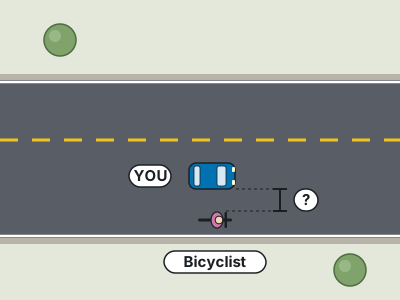
- At least three feet to the cyclist's left
- Exactly one foot if the motorist sounds the horn
- No clearance if the cyclist is near the shoulder
- Three inches when passing below the speed limit
Show answer
At least three feet to the cyclist's left. When no adjacent lane exists, Nevada requires the motorist to pass to the cyclist's left at a safe distance of at least three feet. The vehicle must stay left until safely clear before returning right. A horn does not replace physical space, and riding close to the shoulder does not remove the cyclist's protection. Slow down, wait for a clear view, and avoid squeezing through a narrow gap. The three-foot figure is the quick memory cue, but the pass also has to be reasonably safe for surrounding traffic.
Study this in the handbook: Pedestrians and Bicyclists
4. When yellow center lines are broken, when may you pass?
- Only after crossing a solid white line
- Only while approaching an intersection
- Whenever the vehicle ahead is moving slowly
- When it is safe to do so
Show answer
When it is safe to do so. A broken yellow center line allows passing only when the maneuver is safe. The broken marking gives permission to consider passing, not a command to pass whenever a vehicle is slow. Approaching an intersection may introduce additional hazards, and a solid white line is unrelated to the opposing-direction center marking. Check sight distance, oncoming traffic, roadway space, and nearby intersections before moving left. If any condition is uncertain, remain behind the vehicle and wait for a better section.
Study this in the handbook: Turns, Lane Changes, U-Turns and Passing
5. Under Nevada's Illegal Per Se Law, what alcohol concentration can trigger revocation for a driver who is not under 21?
- 0.02% or more
- 0.08% or more
- 0.04% or more only for a private passenger vehicle
- 0.15% only after a collision
Show answer
0.08% or more. Nevada's Illegal Per Se rule provides that a chemical test showing an alcohol concentration of 0.08% or more can result in revocation for an adult driver. The 0.02% figure belongs to drivers under 21, while the 0.04% range is identified for commercial license holders in the penalty section. A crash is not required for the administrative action. The practical cue is that the chemical test threshold and court case are separate issues, so a driver should never treat 0.08% as a safe target.
Study this in the handbook: DUI Laws and Penalties
6. At 40 mph or less, what minimum following distance does the handbook recommend?
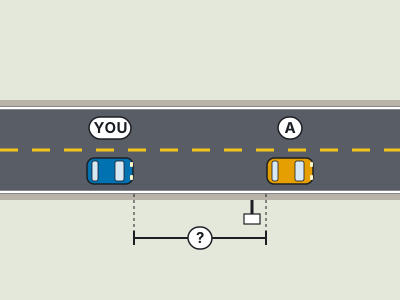
- Exactly one second behind the vehicle ahead
- At least two seconds behind the vehicle ahead
- At least eight seconds behind the vehicle ahead
- No timed gap if the road is dry
Show answer
At least two seconds behind the vehicle ahead. For travel at 40 mph or less, the handbook gives two seconds as the minimum gap behind the vehicle in front. It also notes that instructors often recommend up to four seconds and that higher speeds, slippery surfaces, or reduced visibility call for more room. One second leaves little reaction time, while eight seconds is not the stated minimum for ordinary conditions. Dry pavement does not eliminate the need for space. Choose a fixed roadside object, start counting when the lead vehicle passes it, and make sure your front bumper reaches it after the count.
Study this in the handbook: Stopping Distance and Following
7. An overhead lane use control signal on a Nevada freeway shows a yellow X with the word MERGE above your lane. What should you do?
- Stop in the ending lane until every other lane is empty
- Accelerate so the lane remains open for your vehicle
- Prepare to merge safely into another open lane
- Pass the traffic beside you on the shoulder
Show answer
Prepare to merge safely into another open lane. Nevada explains that a yellow X with MERGE means the lane is ending and the driver should prepare to safely merge into another open lane. Look early for a safe gap, signal, and move into an open lane before the lane ends. Accelerating simply to hold the lane can create a conflict, while stopping in moving traffic increases the chance of a rear end collision. Using the shoulder as a passing route is not a substitute for merging. Drivers must also follow all other traffic signs and signals that apply.
Study this in the handbook: Freeway Driving
8. When approaching a stopped emergency, utility, or service vehicle, which action is required if a peace officer gives no direction?
- Stop immediately in the lane beside the vehicle and wait for a signal
- Maintain the posted speed because the vehicle is outside the travel lane
- Reduce speed below the posted limit, proceed cautiously, and be prepared to stop
- Pass on the shoulder at the same speed used on the main roadway
Show answer
Reduce speed below the posted limit, proceed cautiously, and be prepared to stop. Nevada requires a driver nearing a stopped emergency, utility, or service vehicle to slow to a reasonable speed below the posted limit, use caution, and remain ready to stop. The lane position may also need to change when conditions allow. Maintaining normal speed ignores the people working beside the roadway. Stopping in the adjacent lane can create a new hazard, while using the shoulder is not a general passing privilege. The practical cue is to reduce speed before reaching the vehicle, scan for workers and traffic, then create space if a safe lane is available.
Study this in the handbook: Emergency Vehicles and Stopped Service Vehicles
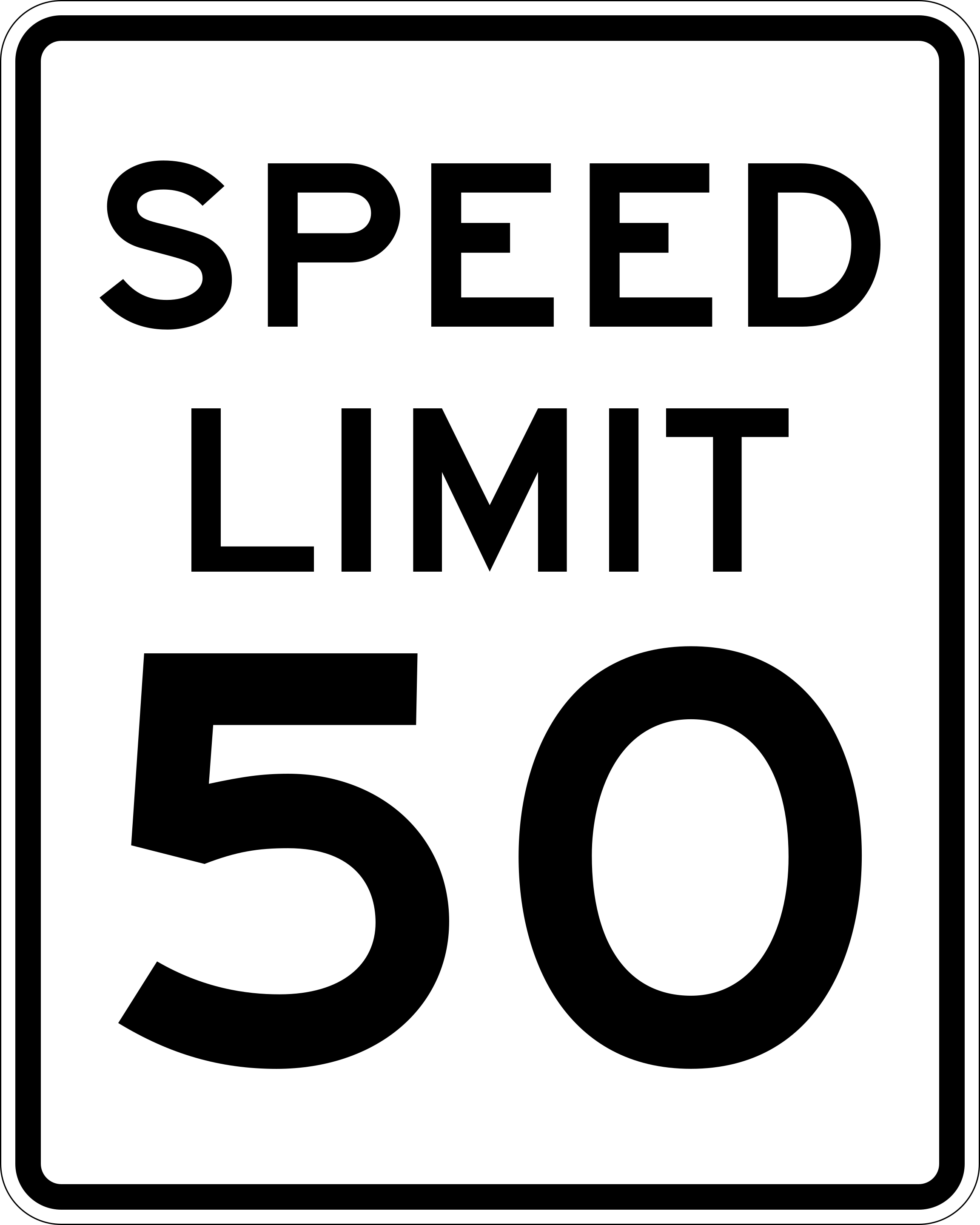
9. What must a driver do when a Nevada regulatory sign applies?
- Treat it as optional advice
- Obey the sign
- Ignore it when traffic is light
- Follow it only during daylight
Show answer
Obey the sign. Nevada states that regulatory signs communicate traffic laws and regulations and that drivers must obey them. The sign remains binding when traffic is light, when the weather is clear, and during both day and night. Treating it as advice would turn an enforceable instruction into a suggestion, while the other conditions invent limits that the handbook does not give. Read the sign before entering the controlled area, check lane markings and signals, and make the required movement only after confirming that it is permitted.
Study this in the handbook: Stop, Yield, Regulatory, Warning and Work Zone Signs
10. How many hours of supervised driving must a Nevada teen who lives near an approved driver's education school log, and how many at night?
- 40 hours, 5 at night
- 100 hours, 10 at night
- 30 hours, none at night
- 50 hours, 10 at night
Show answer
50 hours, 10 at night. Teens within 30 miles of a DMV approved driver's education school must complete 50 hours of supervised driving, 10 of them at night, recorded on the official DMV log. The 100 hour figure applies only to teens who are not within 30 miles of an approved school and cannot take an online class. Forty hours with 5 at night and 30 hours with none are not Nevada's requirements.
Study this in the handbook: Tests and Driver Education
11. How soon must you tell the Nevada DMV about a change of address or name?
- Within 10 days
- Within 30 days
- Within 60 days
- At your next renewal
Show answer
Within 30 days. Nevada law requires you to notify the DMV of any address or name change within 30 days. Ten days is shorter than the law requires, 60 days is too long, and waiting until renewal could mean years of missed notices. You can update your address online at dmv.nv.gov, at a DMV office, or by mail. The rule covers a driver license, a driver authorization card, and an identification card.
Study this in the handbook: License Rules and Demerit Points
12. What does the Nevada handbook tell drivers to do about hydroplaning in heavy rain?
- Accelerate to restore tire contact
- Brake as hard as possible
- Turn sharply toward the shoulder
- Slow down
Show answer
Slow down. The Nevada handbook warns that most cars begin to lose traction and hydroplane between 35 and 55 mph in heavy rainfall, and that when this happens you lose control of your vehicle. Its instruction is simple: slow down. Accelerating, braking as hard as possible, or turning sharply toward the shoulder are not the handbook response. The handbook also notes that stopping distances on a wet highway may be more than double those on dry pavement, so lowering speed before water builds up is the key prevention step.
Study this in the handbook: Stopping Distance and Following
13. Which Nevada children must ride in an approved child restraint system?
- Only infants under one
- All children under 12
- Children under age six and those shorter than 57 inches
- Children under 40 pounds only
Show answer
Children under age six and those shorter than 57 inches. Children under age six and those who measure less than 57 inches tall must be in an approved child restraint system under NRS 484B.157, and failure to restrain them may result in fines, community service and/or suspension of the driver's license. It is also a misdemeanor to leave a dog or cat unattended in a vehicle during extreme heat or cold.
Study this in the handbook: Seat Belts, Children and Phone Laws
14. Under the Nevada handbook's basic search rule for ordinary driving, how far ahead should you look at a minimum?
- 2 seconds
- 5 seconds
- At least 12 seconds ahead of where your vehicle will be
- Only to the vehicle directly ahead
Show answer
At least 12 seconds ahead of where your vehicle will be. Defensive driving starts with searching at least 12 seconds ahead to where your vehicle will be. To check, pick a fixed object ahead and count one thousand one, one thousand two, until the front of your vehicle passes it; if you have not reached one thousand twelve, look farther ahead. The 12 second rule lets you watch traffic patterns and react to changes. At freeway speeds the handbook asks for at least 20 to 30 seconds, while two seconds is the minimum following distance, not the search distance.
Study this in the handbook: Stopping Distance and Following
15. What does Nevada say happens after an applicant fails the DMV motorcycle skills test two or more times?
- The applicant must wait 30 days before another attempt
- Future motorcycle instruction permits are permanently denied
- Only the motorcycle written test must be repeated
- The applicant receives an automatic unrestricted license
Show answer
Future motorcycle instruction permits are permanently denied. Nevada states that failing the DMV motorcycle skills test two or more times results in permanent denial of future motorcycle instruction permits. A 30-day waiting period is not the listed result, and the rule is not limited to repeating the written test. An automatic unrestricted license would reverse the consequence entirely. The phrase two or more times is the trigger, so one unsuccessful attempt should not be treated as the same event. Applicants should identify the test type and count the failures before applying this rule.
16. Orange signs, cones, and barrels are most likely warning a Nevada driver about what?
- A route-number change
- A hospital service area
- A highway work zone
- A permanent speed limit for a residential district
Show answer
A highway work zone. Nevada uses orange signs, cones, and barrels to identify highway work zones. These areas may have narrowed lanes, uneven pavement, stopped traffic, flaggers, equipment, and people working close to moving vehicles. A hospital or route marker uses other sign conventions, while a residential speed limit is not identified by the complete orange work-zone combination. When orange devices appear, slow before reaching the activity, follow every flagger instruction, and leave room for a sudden stop. Work-zone fines can also be increased, adding another reason to obey the temporary controls.
Study this in the handbook: Stop, Yield, Regulatory, Warning and Work Zone Signs
17. For the first six months after a Nevada 16 or 17-year-old receives a license, which passengers are restricted?
- No passengers unless the vehicle is a pickup
- Every passenger, including immediate family members
- Only passengers older than 65
- Passengers under 18, except immediate family members
Show answer
Passengers under 18, except immediate family members. Nevada restricts a newly licensed 16 or 17-year-old from carrying passengers under 18 during the first six months of driving, with an exception for immediate family members. The restriction does not ban every passenger, target older passengers, or depend on whether the vehicle is a pickup. The time window begins when the teen receives the license, not when the instruction permit was issued. Before allowing a young friend to ride, the driver should check the passenger's age, the family relationship, and whether the first six months have ended.
Study this in the handbook: Instruction Permits and Teen Restrictions
18. After stopping at a Nevada stop sign, what must a driver do before moving into the intersection?
- Sound the horn and enter without checking
- Proceed immediately if the vehicle reached the sign first
- Wait only for vehicles approaching from the left
- Yield to pedestrians and cross traffic
Show answer
Yield to pedestrians and cross traffic. A stop sign requires a full stop, followed by giving way to pedestrians and cross traffic before the driver moves forward. Reaching the sign first does not eliminate the duty to check and yield. Watching only the left side is incomplete because traffic can approach from either direction, and a horn does not replace observation. A driver should stop behind the line or crosswalk, look for people and vehicles, and proceed only when the path is safe. This sequence applies even when the intersection appears quiet at first glance.
Study this in the handbook: Stop, Yield, Regulatory, Warning and Work Zone Signs
19. What should Nevada drivers do when approaching a railroad crossing?
- Look both ways and stay clear of the tracks when a train approaches
- Accelerate across without checking if the signal is green
- Stop on the tracks to improve visibility
- Follow the vehicle ahead without watching for trains
Show answer
Look both ways and stay clear of the tracks when a train approaches. Nevada tells drivers to look both ways when approaching a railroad crossing and to stay clear of the tracks when a train is approaching. The other choices remove the observation and clearance duties that protect drivers at crossings. A green signal does not make it safe to accelerate blindly, stopping on the tracks creates a serious hazard, and following another vehicle does not replace an independent check. Slow early, watch the crossing controls, and make sure the vehicle can clear the tracks before entering.
Study this in the handbook: Stop, Yield, Regulatory, Warning and Work Zone Signs
20. On a dark Nevada road, how far before an oncoming vehicle should high beams be changed to low beams?
- 500 feet
- 300 feet
- 100 feet
- 1,000 feet
Show answer
500 feet. Nevada's handbook directs drivers to change from high beams to low beams at least 500 feet before an oncoming vehicle. The separate 300 foot figure applies to a vehicle being followed, not to approaching traffic. Using 100 feet delays the change and can leave the other driver facing glare, while 1,000 feet adds a distance not stated for this situation. Use the oncoming headlights as the cue to begin the 500 foot buffer, and remember that low beams protect visibility for both drivers even when the road itself is empty.
Study this in the handbook: Night Driving, Bad Weather and Skids
QualitySpace is expanding to Nevada
We are a California-based independent insurance brokerage working on licensing in more states. We cannot help with Nevada insurance yet. Leave your email and we will let you know when we can.
Every question is written from the official Nevada Driver Handbook. Need paper? Printable NV practice test with answer key.
Last verified 2026-10-05. How we check every question · Study all 204 as flashcards
Frequently asked questions
How many questions are on this Nevada practice test?
This fixed set has 20 questions. It is test 7 of 10 from the 204 question Nevada bank. The real NV exam asks 25 questions and you need 20 correct.
What is the passing score for the real Nevada test?
80% (20 correct answers needed out of 25) That figure comes from the official Nevada source cited on the DMV facts page.
How does this fixed test relate to the full Nevada bank?
Each numbered test is a fixed set of questions in a fixed order, so you can retake the same test later and compare. Every test mixes road signs and the other topics in about the same proportion as the full bank. Tests 1 to 10 together cover 200 of the 204 questions in the Nevada bank, each once. The full practice page mixes the whole bank at random.
Last verified 2026-10-05. See the Nevada DMV facts page for sourced state details.