
Test 3 of 10 · 20 questions · Free 2026
NV Permit Practice Test 3
Jump to the test ↓A fixed 20 question set from the Nevada bank with answers and plain English explanations. The real NV exam is 25 questions, 80 percent to pass; take the full length version on the main practice page.
Question 1 of 20 · 0 right so far
All 20 questions in test 3
Every question below comes from the Nevada question bank on this page. Open a question to see the correct answer and the explanation. Nothing here is hidden behind a signup.
1. When turning left on a two-way Nevada road, which lane should the driver use?
- Any opposing lane that has no vehicle in it
- The far right lane before and after the turn
- The lane just to the right of the center line, then the nearest lane in the new direction
- The shoulder until the next intersection
Show answer
The lane just to the right of the center line, then the nearest lane in the new direction. Nevada directs a driver making a left turn on a two-way road to use the lane just to the right of the center line and complete the turn into the traffic lane closest to the intended direction. The far-right choice starts from the wrong position, and an opposing lane is not a general turning path. The shoulder is not a substitute for a travel lane. Signal, yield to pedestrians and traffic with the right-of-way, keep the wheels straight until the turn begins, and change lanes only after moving safely away from the intersection.
Study this in the handbook: Turns, Lane Changes, U-Turns and Passing
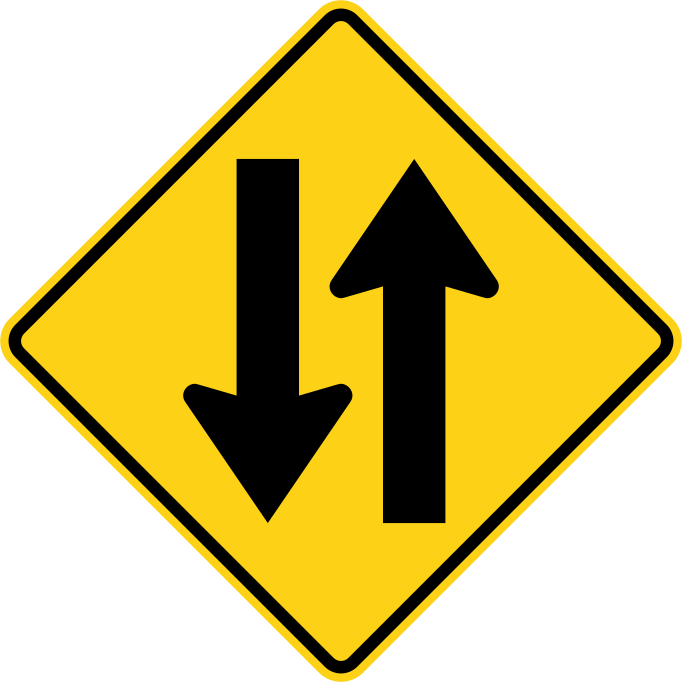
2. What is the safest response to this curve warning sign?

- Rely completely on a warning system instead of judging conditions
- Wait until the middle of the curve to decide whether to slow
- Increase speed so the vehicle exits the curve quickly
- Choose a safe speed before entering the curve
Show answer
Choose a safe speed before entering the curve. The Nevada handbook says the driver should maintain a safe speed while driving and approaching curves or exits, and should not become complacent and dependent on curve speed warnings. A curve warning sign is the cue to settle on that safe speed before entering the bend. Waiting until the middle of the curve leaves the decision too late, and increasing speed works against the handbook instruction. A curve speed warning system can alert the driver through sound or vibration, but the driver still chooses the speed. Match the speed to the curve, the weather, and traffic.
3. What can a sign shape tell a Nevada driver?
- Which emergency worker is nearest
- The exact number of vehicles allowed in a lane
- Whether the pavement was recently repaired
- Whether the sign gives a warning, regulation, or other roadway message
Show answer
Whether the sign gives a warning, regulation, or other roadway message. Nevada assigns meanings to standard sign shapes. A diamond indicates a warning, an octagon marks STOP, and an inverted triangle identifies yield right of way. Shape recognition gives the driver useful information before the wording is fully read. The other choices confuse sign design with traffic volume, pavement history, or emergency response. Notice the outline first, confirm the color and symbol, and then follow the message at a speed that leaves time to react.
Study this in the handbook: Sign Colors and Shapes
4. Who may receive a Nevada restricted license at age 14 or 15?
- Any teen with a parent's permission
- Drivers who have demonstrated family hardship or need to drive to and from school
- Farm workers only
- No one under 16
Show answer
Drivers who have demonstrated family hardship or need to drive to and from school. Restricted licenses may be issued under special circumstances to drivers age 14 and 15 who have demonstrated family hardship or who need to drive to and from school. The only other group on the handbook's list is individuals who have served half of their required suspension or revocation periods. Parent permission alone does not qualify a teen, farm work is not the stated test, and the list does show that some 14 and 15 year olds can qualify. Additional information and applications are available at a local DMV office.
Study this in the handbook: License Rules and Demerit Points
5. What information is normally conveyed by a yellow, diamond-shaped warning sign?
- The location of food, lodging, or another driver service
- A traffic law that sets a maximum speed
- A route number for an interstate highway
- Special conditions or hazards ahead
Show answer
Special conditions or hazards ahead. Nevada describes warning signs as yellow diamonds with black letters or symbols that tell drivers special conditions or hazards are ahead. A white rectangle generally communicates a regulation, while route markers identify routes and blue signs identify services such as food or lodging. The shape and color together provide a quick preview before the driver can read every word. When a yellow diamond appears, scan farther ahead, reduce speed if needed, and prepare for a change in roadway, traffic pattern, or surface condition.
Study this in the handbook: Stop, Yield, Regulatory, Warning and Work Zone Signs
6. What limits apply to a vehicle combination driven on a Nevada Class C license?
- No limits
- Under 40 feet and 10,000 pounds
- Under 100 feet and 80,000 pounds
- No more than 70 feet long and no more than 26,000 pounds combined; heavier combinations need Class A
Show answer
No more than 70 feet long and no more than 26,000 pounds combined; heavier combinations need Class A. Nevada caps any combination driven on a Class C license at 70 feet in length. Without a J endorsement, a non commercial Class C driver may tow a single vehicle or combination with a GVWR of 10,000 pounds or less. With the J endorsement, a Class C driver may tow more than 10,000 pounds, but the combination may not have a combined weight rating or combined weight over 26,000 pounds. If the towing and towed vehicles together exceed 26,000 pounds, a Class A license is required.
7. When an emergency vehicle approaches from any direction with a siren or flashing lights, what duty does a driver have?
- Continue if the driver has a green signal
- Yield only if the vehicle is approaching from behind
- Yield immediately and stop after reaching a safe position
- Follow the emergency vehicle through the intersection
Show answer
Yield immediately and stop after reaching a safe position. The duty to yield is triggered by the emergency vehicle's siren or flashing lights and applies whether it approaches from ahead, behind, or another direction. A green signal does not override that duty, and following the emergency vehicle is not a safe substitute for stopping. The driver should make room, move to the right when possible, clear the intersection, and remain stopped until the emergency vehicle passes. Watch mirrors regularly so the warning is detected early enough to make the move smoothly.
Study this in the handbook: Right of Way
8. What does a flashing red traffic signal require a Nevada driver to do?
- Make a full stop, then proceed only when the way is clear
- Continue at normal speed if no train is visible
- Slow slightly without stopping
- Wait for a police officer before moving
Show answer
Make a full stop, then proceed only when the way is clear. A flashing red signal has the same meaning as a stop sign. The driver must come to a full stop, then may move only after checking that the roadway is clear and that the driver has the right-of-way. Merely slowing does not satisfy the signal, and the rule is not limited to railroad crossings. Police presence is not required when the signal is operating normally. Make the stop before entering the intersection, scan for people and traffic, and proceed with the same care used at a stop sign.
Study this in the handbook: Traffic Signals and Arrows
9. What license revocation period does Nevada list for a subsequent DUI offense within seven years?
- Three years
- Six months
- One year
- Permanent revocation
Show answer
Three years. Nevada lists a three-year license revocation for a subsequent DUI offense within seven years. The one-year period belongs to a second offense, and six months is shorter than the listed consequence. The handbook does not describe this item as a permanent revocation, so that choice goes beyond the stated rule. The same section also lists a prison sentence and fine range, but those criminal consequences should not be substituted for the separate license period. Count the prior offenses first, then match the period to that category.
Study this in the handbook: DUI Laws and Penalties
10. Besides handheld voice communication, what phone activity does Nevada prohibit while driving?
- Using a mounted navigation display for directions
- Listening to music through the vehicle speakers
- Manually sending, reading, searching the Internet, or using non-voice messaging
- Receiving an emergency call through a hands-free accessory
Show answer
Manually sending, reading, searching the Internet, or using non-voice messaging. Nevada prohibits manually sending or reading communications, searching the Internet, and engaging in non-voice messaging while driving. That rule is separate from the prohibition on handheld voice communication without a hands-free accessory. Listening to music or using a mounted navigation display is not the conduct named in this passage, and the handbook allows emergency reporting when stopping would be inadvisable, impractical, or dangerous. The practical cue is the driver's manual interaction with the device: typing, reading, or searching is prohibited even when no voice call is underway.
Study this in the handbook: Seat Belts, Children and Phone Laws
11. When approaching a stopped emergency, utility, or service vehicle in Nevada, how must your speed compare with the posted limit?
- It may be exactly the posted speed limit
- It must be less than the posted speed limit
- It must be at least 10 mph above the posted limit
- It must be reduced to walking speed in every case
Show answer
It must be less than the posted speed limit. The approach speed must be reasonable and proper and less than the posted speed limit. The rule also calls for caution, readiness to stop, and a lane change away from the stopped vehicle when roadway, traffic, weather, and other conditions allow. Driving exactly at the limit is not enough, even if the lane appears open. Walking speed in every case is also an overstatement, because Nevada specifies a prudent speed rather than one universal number. The safest cue is to slow below the signposted limit before reaching the vehicle and then reassess the adjacent lane.
Study this in the handbook: Emergency Vehicles and Stopped Service Vehicles
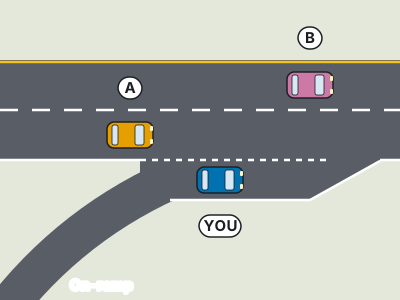
12. When entering a Nevada freeway from an on-ramp, which traffic must the entering driver yield to?
- Only trucks in the right lane
- Traffic already on the freeway
- Vehicles behind the on-ramp entrance
- No traffic, because freeway drivers must always brake
Show answer
Traffic already on the freeway. The driver using the on-ramp must yield to traffic already traveling on the freeway and enter only when a safe gap exists. The freeway vehicles have an established path, so an entering driver should adjust speed and merge without forcing them to brake. The truck-only choice overlooks cars and motorcycles in the roadway. Use the ramp to build an appropriate speed, check mirrors and blind spots, signal, and choose a gap. Yielding here means planning the merge, not stopping at the end of the ramp without looking.
Study this in the handbook: Right of Way
13. What does Nevada's Basic Rule say about driving speed?
- Never drive at a speed that endangers anyone
- Always drive exactly at the posted limit
- Drive faster when traffic is heavy
- Use the vehicle's maximum speed on straight roads
Show answer
Never drive at a speed that endangers anyone. Nevada's Basic Rule requires a driver to choose a speed that does not endanger the driver or anyone else. The posted limit is a normal-condition maximum, not a command to maintain that speed during every situation. Heavy traffic, poor visibility, or a slick surface can make a lower speed necessary. The choice about driving exactly at the posted limit is tempting because signs are important, but it ignores the conditions surrounding the vehicle. Use the roadway, traffic, weather, and visibility as active checks, then slow whenever the posted number would be unsafe.
Study this in the handbook: Speed Limits and School Zones
14. What is an SR-22 in the context of a Nevada DUI administrative action?
- A certificate allowing a driver to exceed the speed limit
- A request to cancel the administrative hearing
- Proof of financial responsibility that may be required
- A form that removes a conviction from the driving record
Show answer
Proof of financial responsibility that may be required. Nevada's DUI penalty table identifies an SR-22 as proof of financial responsibility that may be required after an administrative revocation. It is connected to insurance responsibility, not to cancelling a hearing, changing a speed limit, or erasing a conviction. The word proof is the useful cue: the filing demonstrates financial responsibility under the state's process. A driver facing this requirement should distinguish the insurance filing from the separate license revocation and any criminal penalties imposed by a court.
Study this in the handbook: Insurance and What to Do in a Crash
15. During which hours did 19 percent of Nevada's fatal crashes occur from 2015 to 2019?
- Noon to 3 PM
- 6:00 PM to 8:59 PM, with 276 fatal crashes
- 3 AM to 6 AM
- 9 AM to noon
Show answer
6:00 PM to 8:59 PM, with 276 fatal crashes. From 2015 to 2019, 276 fatal crashes occurred between 6:00 PM and 8:59 PM, totaling 19 percent of all fatal crashes, according to the Nevada handbook. The other windows named in the choices are not the period the handbook ties to that 19 percent figure. The lesson is to treat the early evening hours with extra care: turn on headlights as light fades, slow down when visibility drops, keep a safe following distance, and scan for people and vehicles that are harder to see.
Study this in the handbook: Night Driving, Bad Weather and Skids
16. What road conditions commonly cause a vehicle to skid?
- A dry road with clear pavement only
- Only a fully charged battery
- Ice, packed snow, wet pavement, or gravel
- A properly adjusted rearview mirror
Show answer
Ice, packed snow, wet pavement, or gravel. Loss of traction is not limited to winter storms. The handbook identifies ice and packed snow as usual causes, while wet pavement and gravel can also make a vehicle slide. A clear dry road is not the only setting in which a skid can occur, and the battery or mirror choices have no direct relationship to tire grip. Reduce speed when traction is uncertain, avoid abrupt inputs, and use the vehicle owner's guidance because braking and steering systems respond differently during recovery.
Study this in the handbook: Night Driving, Bad Weather and Skids
17. At an intersection without signs or signals, what should you do before proceeding?
- Accelerate because no traffic control device is present
- Slow down and stop if necessary at a point where approaching traffic is visible
- Drive through without checking the cross street
- Stop only after entering the through lane
Show answer
Slow down and stop if necessary at a point where approaching traffic is visible. An uncontrolled intersection still requires a careful approach. If signs or markings are absent, slow down and stop when necessary at the nearest point where you can see approaching traffic on the through roadway. The absence of a stop sign does not remove the need to check for vehicles or pedestrians. Entering before looking can place your vehicle in the path of cross traffic. A useful habit is to reduce speed early, identify the sight line, and proceed only after the intersection is clear.
Study this in the handbook: Stop, Yield, Regulatory, Warning and Work Zone Signs
18. How many people died in Nevada alcohol related crashes in 2019, according to the handbook?
- 129, about 42 percent of all fatalities
- About 1,000
- About 10
- About 50, or 5 percent
Show answer
129, about 42 percent of all fatalities. In 2019, 129 people were killed in alcohol related crashes in Nevada, which equates to 42 percent of all fatalities, one percent under the national figure. Alcohol slows brain function, information processing and hand eye coordination, and over the .08 limit crash risk climbs 5 to 30 times. Anyone can report a suspected drunk driver or highway emergency by dialing *NHP, which is *647, on a cell phone.
Study this in the handbook: Young Drivers, Alcohol and Open Containers
19. In which direction does traffic move around a Nevada roundabout?
- In either direction depending on the lane
- Clockwise in two opposing streams
- Straight across the center island
- Counterclockwise in one direction
Show answer
Counterclockwise in one direction. Nevada roundabouts move traffic in one direction around the circle, counterclockwise. This organized flow keeps entering vehicles from facing head-on traffic inside the circular roadway. The clockwise choice reverses the handbook direction, while driving straight across the center island ignores the design of the roundabout. Allowing either direction would create conflicting paths. As you approach, choose the proper lane, yield to traffic already circulating, follow the counterclockwise path, and signal when exiting.
Study this in the handbook: Roundabouts
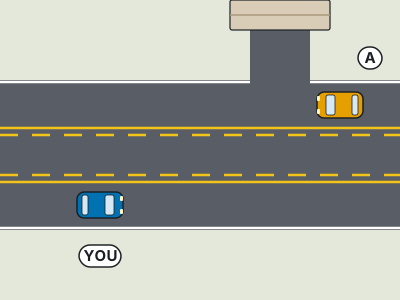
20. How far may a driver travel in a center turn lane before making a left turn?
- No more than 200 feet
- No more than 50 feet
- No more than 500 feet
- There is no stated distance limit
Show answer
No more than 200 feet. A center turn lane is for positioning for a left turn, not for traveling alongside traffic. Nevada limits travel in that lane to 200 feet before making the left turn. The 50-foot figure applies after turning left onto the highway before merging, so it describes a different part of the maneuver. Five hundred feet is not the handbook limit, and the absence-of-limit choice would turn a short preparation lane into an extra travel lane. Enter it only when the turn is approaching.
Study this in the handbook: Highway Markings
QualitySpace is expanding to Nevada
We are a California-based independent insurance brokerage working on licensing in more states. We cannot help with Nevada insurance yet. Leave your email and we will let you know when we can.
Every question is written from the official Nevada Driver Handbook. Need paper? Printable NV practice test with answer key.
Last verified 2026-10-05. How we check every question · Study all 204 as flashcards
Frequently asked questions
How many questions are on this Nevada practice test?
This fixed set has 20 questions. It is test 3 of 10 from the 204 question Nevada bank. The real NV exam asks 25 questions and you need 20 correct.
What is the passing score for the real Nevada test?
80% (20 correct answers needed out of 25) That figure comes from the official Nevada source cited on the DMV facts page.
How does this fixed test relate to the full Nevada bank?
Each numbered test is a fixed set of questions in a fixed order, so you can retake the same test later and compare. Every test mixes road signs and the other topics in about the same proportion as the full bank. Tests 1 to 10 together cover 200 of the 204 questions in the Nevada bank, each once. The full practice page mixes the whole bank at random.
Last verified 2026-10-05. See the Nevada DMV facts page for sourced state details.