
Test 8 of 10 · 20 questions · Free 2026
NV Permit Practice Test 8
Jump to the test ↓A fixed 20 question set from the Nevada bank with answers and plain English explanations. The real NV exam is 25 questions, 80 percent to pass; take the full length version on the main practice page.
Question 1 of 20 · 0 right so far
All 20 questions in test 8
Every question below comes from the Nevada question bank on this page. Open a question to see the correct answer and the explanation. Nothing here is hidden behind a signup.
1. When driving in rain, what lighting practice does the Nevada handbook recommend?
- Use only the parking lights
- Use the vehicle headlights
- Turn off all exterior lights
- Use high beams continuously in every rainstorm
Show answer
Use the vehicle headlights. The Nevada handbook says it is advisable to use your headlights when driving in rain, snow or fog. Using only the parking lights is not the advice; the handbook says drivers should not drive with just the parking lights on. Turning off all exterior lights goes against the recommendation, and the handbook does not say to run high beams continuously in every storm. Its high beam guidance is for open country at night, with a change to low beams 500 feet before oncoming vehicles. Keep the headlights clean and slow down when visibility drops.
Study this in the handbook: Night Driving, Bad Weather and Skids
2. Which situation is an exception to Nevada's school-zone U-turn prohibition?
- The signs or lights show that the school zone is not in effect
- A driver is running late for work
- The road has no painted center line
- A vehicle behind the driver is following closely
Show answer
The signs or lights show that the school zone is not in effect. Nevada prohibits U-turns in school zones, but the handbook lists specific exceptions. One is when the signs or lights designate that the school zone is currently not in effect. Being late, lacking a center line, or having a close follower does not change the legal restriction. A driver should check the active school-zone controls and the surrounding conditions before turning around. The important cue is that the exception depends on the zone's posted or illuminated status, not on a driver's personal urgency or the markings alone.
Study this in the handbook: Railroad Crossings
3. For a Nevada commercial driver license holder, which alcohol concentration range is identified for Illegal Per Se action?
- No alcohol concentration because CDL holders are exempt off duty
- Only 0.02% exactly
- 0.08% or more with no lower threshold
- 0.04% or more but less than 0.08%
Show answer
0.04% or more but less than 0.08%. The Nevada penalty table identifies a lower administrative range for a commercial driver license holder: 0.04% or more but less than 0.08%. That range is stricter than the general adult threshold shown elsewhere in the chapter. The 0.02% choice is the young-driver figure, not the commercial range, and an off-duty exemption is not stated. A CDL holder should treat any alcohol reading as a serious risk, especially because the handbook notes that additional commercial penalties can apply.
Study this in the handbook: DUI Laws and Penalties
4. Who must wear a helmet on a moped in Nevada?
- Only riders under 18
- Moped operators and passengers
- No one, since mopeds are not motorcycles
- Only passengers
Show answer
Moped operators and passengers. Nevada requires both moped operators and passengers to wear helmets. The rule is not limited to minors or to passengers, and mopeds are not exempt just because they are smaller than motorcycles. Moped owners must register their mopeds with the DMV, a one time fee meant to help prevent theft, although insurance is not required. Operators must generally stay in the far right lane.
Study this in the handbook: Trucks, Motorcycles, Mopeds and School Buses
5. What are the three purposes of highway signs in Nevada?

- They replace traffic signals at intersections
- They only set speed limits
- They identify vehicles that need repairs
- They regulate, warn, and inform
Show answer
They regulate, warn, and inform. Nevada groups highway signs into three purposes: regulating traffic, warning about conditions, and providing information. A sign may impose a rule, alert a driver to a hazard, or guide the driver toward a destination or service. The other choices reduce signs to speed limits, vehicle repair notices, or substitutes for signals, none of which describes the full classification. Identify the purpose first, then use the sign’s wording, shape, and color to understand the instruction. That habit helps distinguish a required action from advance information.
Study this in the handbook: Sign Colors and Shapes
6. Nevada prohibits parking within what distance of the nearest railroad rail?
- 20 feet
- 15 feet
- 50 feet
- 100 feet
Show answer
50 feet. Nevada lists within 50 feet of the nearest rail of a railroad among the places where you may not park. Fifteen feet appears in the handbook as the minimum stopping distance from the tracks when a train is coming, while 20 feet is used for some fire hydrant and crosswalk parking restrictions. One hundred feet is not the parking distance listed. Before leaving a vehicle near rail lines, measure from the nearest rail, not from a sign or crossing gate, and remember that trains cannot stop in time to miss cars.
Study this in the handbook: Railroad Crossings
7. What can a solid white line mark besides a lane boundary?
- The edge of a highway or the boundary beside its shoulder
- A passing lane where traffic should accelerate
- The centerline between opposing directions
- A required stopping point at every driveway
Show answer
The edge of a highway or the boundary beside its shoulder. A solid white line can mark the edge of the highway or the boundary between a travel lane and the shoulder. It should not be treated as an ordinary lane divider for passing. Crossing onto the shoulder can place the vehicle near stopped traffic, debris, or people outside the travel lane. Read the line with the surrounding roadway design, keep a safe position, and use a lawful lane when preparing for a turn or merge. A continuous white edge signals boundary, not routine passing space.
Study this in the handbook: Highway Markings
8. When passing a stopped emergency vehicle, what speed instruction applies even if you cannot change lanes?
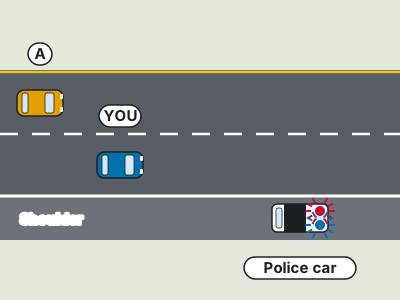
- Stop in the adjacent lane until the emergency vehicle departs
- Keep the posted limit if the emergency vehicle is on the shoulder
- Drive at least 10 mph above the limit to minimize exposure
- Slow to a speed below the posted limit and proceed with caution
Show answer
Slow to a speed below the posted limit and proceed with caution. Nevada requires a driver passing a stopped emergency, utility, or service vehicle to slow below the posted speed limit and proceed cautiously. A lane change is preferred when safe, but the speed reduction remains important when traffic or weather makes that maneuver unsafe. Keeping the limit overlooks the special hazard, and accelerating increases the risk to people outside the vehicle. Stopping in the adjacent lane can block traffic and create a collision point. Begin slowing well before the vehicle, cover the brake, and watch for a person entering the roadway.
Study this in the handbook: Emergency Vehicles and Stopped Service Vehicles
9. What does a regulatory highway sign communicate?
- A guarantee that no hazard is ahead
- A traffic law or regulation
- A repair schedule for the roadway
- A promise that traffic signals are unnecessary
Show answer
A traffic law or regulation. A regulatory sign communicates a traffic law or rule, a warning sign alerts drivers to a condition ahead, and an information sign provides guidance. Those categories explain how signs help organize roadway decisions, but they do not repair pavement, replace every signal, or guarantee that hazards are absent. Read the sign together with lane markings and traffic conditions. The key memory cue is the three-part purpose list: regulate traffic, warn about developing conditions, and inform drivers about routes or services.
Study this in the handbook: Stop, Yield, Regulatory, Warning and Work Zone Signs
10. Which roadway sign shape is reserved for a STOP instruction?
- Inverted triangle
- Octagon with eight sides
- Circle
- Pentagon with five sides
Show answer
Octagon with eight sides. Nevada lists the octagon, an eight-sided shape, as the standard shape for STOP. The handbook says sign shapes and colors have special meanings that help a driver understand the message quickly, so the outline alone tells you a full stop is required. An inverted triangle identifies yield, a circle warns of a railroad crossing ahead, and a five-sided pentagon identifies school zones or school crossings. Connect the eight-sided outline with a required full stop, then obey the sign and the pavement markings at that location.
Study this in the handbook: Sign Colors and Shapes
11. Which vehicles are included in Nevada’s stopped-vehicle protection rule?
- Law enforcement, tow, NDOT, garbage, and other vehicles covered by the rule
- Only private passenger vehicles with hazard lights
- Only fire engines inside an active intersection
- Only construction vehicles behind a barricade
Show answer
Law enforcement, tow, NDOT, garbage, and other vehicles covered by the rule. Nevada lists several examples of vehicles covered by its stopped-vehicle approach rule, including law enforcement vehicles, tow trucks, NDOT vehicles, garbage trucks, and other vehicles displaying the specified warning lights in the stated circumstances. Limiting the rule to private cars, fire engines, or barricaded construction equipment misses those examples. A driver should slow below the posted limit, proceed cautiously, and look for people working around the stopped vehicle. Identify the vehicle early and leave a safe buffer when the roadway permits.
Study this in the handbook: Emergency Vehicles and Stopped Service Vehicles
12. Why are signs, signals, and highway markings used together?
- To make passing legal in every lane
- To replace every roadway inspection
- To control traffic and make safe driving easier
- To provide fuel to every vehicle
Show answer
To control traffic and make safe driving easier. Signs, signals, and pavement markings work as a coordinated traffic-control system. They regulate movement, warn about conditions, show where to travel, and make roadway decisions easier to understand. The choices about inspections, universal passing, and fuel describe unrelated subjects rather than the purpose of traffic-control devices. Read the device in front of you, compare it with lane markings and nearby signals, and follow the combined message. A driver who notices only one element can miss a turn restriction, warning, or required stopping action.
Study this in the handbook: Sign Colors and Shapes
13. On a Nevada road with more than one lane in the same direction, how must a driver pass a person riding a bicycle?
- Honk and pass while staying in the same lane
- Move to the lane to the immediate left if it is available and reasonably safe
- Pass only after the cyclist pulls onto the shoulder
- Slow to 15 mph and pass within the same lane
Show answer
Move to the lane to the immediate left if it is available and reasonably safe. Under NRS 484B.270, when more than one lane carries traffic in the same direction, a driver overtaking a bicycle, electric bicycle, or electric scooter must exercise due care and move to the lane to the immediate left if that lane is available and moving into it is reasonably safe. On a road with only one lane in that direction, the driver passes to the left with at least 3 feet of clearance and does not move back right until safely clear. Honking while staying in the lane, waiting for the rider to leave the road, or creeping past at 15 mph in the same lane does not meet the rule, and a driver who causes a collision with a rider faces an additional penalty.
14. What extra fine does a Nevada court impose after a DUI conviction when a chemical test was conducted?
- $5
- $1,000
- No extra fine
- An additional $60 to cover the cost of the chemical analysis
Show answer
An additional $60 to cover the cost of the chemical analysis. If you plead guilty or are found guilty of DUI involving alcohol or drugs and a chemical test was conducted, the court will impose an additional $60 fine to cover the costs of the chemical analysis, on top of the regular fines, jail, DUI school and license revocation. Tough DUI laws apply equally to young drivers, and a suspected drunk driver can be reported by dialing *NHP.
Study this in the handbook: Young Drivers, Alcohol and Open Containers
15. What do broken or dashed white lines generally indicate?
- A centerline separating opposing traffic
- A boundary that always prohibits lane changes
- Same-direction lanes where a safe lane change may be made
- A stop line before every intersection
Show answer
Same-direction lanes where a safe lane change may be made. Broken or dashed white lines mark lanes on a road with more than one lane moving in the same direction. Unlike a solid white boundary, they generally permit a lane change or passing movement when the maneuver is safe. The marking does not authorize crossing into opposing traffic, and it is not a stop line. Check mirrors, signal, judge the gap, and move smoothly without straddling the line. The visual cue is a repeated white segment rather than one continuous boundary.
Study this in the handbook: Highway Markings
16. On a divided Nevada highway, when must a driver stop for a school bus displaying flashing red lights?
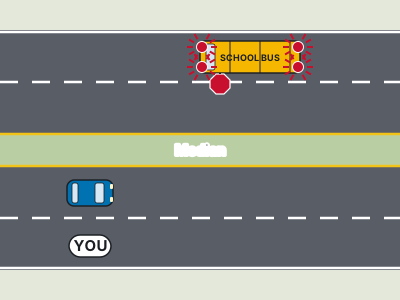
- When traveling in the same direction as the bus
- Only when traveling toward the bus
- Only if a crossing guard is present
- Never, because divided highways exempt all traffic
Show answer
When traveling in the same direction as the bus. A flashing red signal on a school bus normally requires drivers to stop. Nevada's divided-highway exception narrows the duty: a driver on the opposite side is not required to stop, while a driver traveling in the same direction as the bus must stop. The presence of a crossing guard is not the condition, and the exemption does not cover every lane on a divided road. Watch the bus's lights and roadway design, stop before reaching it, and remain stopped until the driver turns off the flashing red signals.
Study this in the handbook: Trucks, Motorcycles, Mopeds and School Buses
17. Two vehicles reach an unsigned and unsignalized Nevada intersection at about the same time. Which vehicle should usually go first?
- The vehicle with the larger engine
- The vehicle on the left
- The vehicle on the right
- The vehicle closest to the center line
Show answer
The vehicle on the right. At an intersection without signs or signals, Nevada's usual rule gives priority to the vehicle on the right. That does not authorize a driver to enter blindly, because the handbook also emphasizes caution and crash avoidance. The left-side choice would apply the rule backward. A good cue is to slow, scan all approaches, and identify which vehicle is on your right before proceeding. If another driver does not yield as expected, yielding yourself is safer than insisting on priority.
Study this in the handbook: Right of Way
18. How long does a new Nevada resident have to apply for a Nevada driver license?
- 10 days
- 90 days
- One year
- 30 days
Show answer
30 days. Drivers moving to Nevada from another state must apply for a Nevada license within 30 days after becoming a resident. Ten days is too short, and 90 days or one year are longer than the law allows. You also need a Nevada license if you live or work in Nevada, with exceptions for border state employees and military members stationed there. Vehicle registration has its own 30 day deadline. To get a Nevada license you must be at least 16 and prove your full legal name, age, and Nevada residency.
19. What happens if a Nevada applicant uses a cell phone during the drive test?
- The examiner gives a warning
- Points are deducted but the test continues
- The test is an automatic failure
- Nothing, if it is hands-free
Show answer
The test is an automatic failure. The Nevada handbook states that using a cellular phone during a drive test results in automatic failure. It is not a warning or a point deduction, and the handbook makes no hands-free exception for the test. Passengers and animals are also not allowed in the vehicle during the road test. Put the phone away before the examiner gets in. A $25 fee is charged for the initial knowledge and skills tests.
Study this in the handbook: Tests and Driver Education
20. What is the minimum age to get a Nevada instruction permit?
- 15 and a half
- 14
- 16
- 15
Show answer
15 and a half. To get a Nevada instruction permit you must be at least 15 and a half years old, complete an application, pass vision and knowledge tests, and have a parent or guardian available to authorize it. Fourteen is too young, 15 is six months short, and 16 is the minimum age for a driver license rather than the permit. Applicants under 18 must then hold the permit for at least six months before applying for a license.
Study this in the handbook: Instruction Permits and Teen Restrictions
QualitySpace is expanding to Nevada
We are a California-based independent insurance brokerage working on licensing in more states. We cannot help with Nevada insurance yet. Leave your email and we will let you know when we can.
Every question is written from the official Nevada Driver Handbook. Need paper? Printable NV practice test with answer key.
Last verified 2026-10-05. How we check every question · Study all 204 as flashcards
Frequently asked questions
How many questions are on this Nevada practice test?
This fixed set has 20 questions. It is test 8 of 10 from the 204 question Nevada bank. The real NV exam asks 25 questions and you need 20 correct.
What is the passing score for the real Nevada test?
80% (20 correct answers needed out of 25) That figure comes from the official Nevada source cited on the DMV facts page.
How does this fixed test relate to the full Nevada bank?
Each numbered test is a fixed set of questions in a fixed order, so you can retake the same test later and compare. Every test mixes road signs and the other topics in about the same proportion as the full bank. Tests 1 to 10 together cover 200 of the 204 questions in the Nevada bank, each once. The full practice page mixes the whole bank at random.
Last verified 2026-10-05. See the Nevada DMV facts page for sourced state details.